Councilmember Dan Strauss, at La Carta de Oaxaca in Ballard
1. Back in 2013, when the city opened its first “parklet” in two former parking spaces on Capitol Hill, opponents (like this guy, who called the city “vehemently, virulently anti-car”) claimed that repurposing parking spaces for non-car uses would lead to all kinds of calamities, including lost parking revenue, traffic congestion, and the collapse of business districts—after all, why would anyone go to a business if they couldn’t park out front?
Parklets eventually caught on, and none of the dire consequences opponents predicted came to pass—in fact, the outdoor seating made business districts more appealing by bringing people into areas that used to be choked by cars. During the pandemic, the city decided to expand the program (allowing larger, more permanent structures) and make it free, providing safe, semi-permanent spaces for restaurants and bars to operate and helping businesses that might otherwise have closed.
Sitting under one of these temporary outdoor structures outside the La Carta de Oaxaca restaurant in Ballard Tuesday morning, Mayor Bruce Harrell signed legislation sponsored by District 6 Councilmember Dan Strauss to extend the program until January 31, 2023, with a goal of making it permanent. Eventually, Strauss said, the city will start charging for the permits and impose design standards for street dining structures, but that it won’t be “the same amount as [revenue from] five parking spots”—the pre–pandemic cost. “We don’t want to rush and jump to conclusions about how much a permit should cost or what the design standards should do,” Strauss said.
In a sign of how much things have changed since the parklet program started, only one reporter asked how making the program permanent would impact “parking and traffic congestion,” and Strauss responded with a hand wave. Gesturing to cars parked across the street, Strauss said, “As you see, we are having both the ability to have people eating outside and to park their cars. There’s many parking stalls here. What we also see here in Ballard is with increased density, we have more people living close to [businesses]”—people who don’t need to drive.
2. Seattle’s Office of Police Accountability won’t have a new permanent director until this summer at the soonest, giving the mayor’s office and city council time to launch a national candidate search for the high-profile role. Former OPA Director Andrew Myerberg left the office in January to join Mayor Bruce Harrell’s office as the new Director of Public Safety; Dr. Gráinne Perkins, an adjunct professor of criminology at Seattle University and a former detective in the Irish Police Service, currently runs the OPA as interim director.
During a city council public safety committee meeting on Tuesday, committee chair Lisa Herbold said the council will waive the standard 90-day deadline for the mayor to appoint a replacement for a departing OPA director; ordinarily, if the mayor misses the 90-day deadline, the public safety committee is responsible for appointing a new director. Instead, Deputy Mayor Monisha Harrell said her office will hire a recruiting firm that specializes in police oversight positions, with a goal of identifying six candidates and starting to interview them by May 27.
Deputy Mayor Harrell added that the next OPA director will need to be a “special unicorn” who can navigate increased public scrutiny of police oversight agencies. During Myerberg’s four years at the OPA, police accountability advocates criticized his cautious approach to investigating police misconduct—particularly allegations of excessive force, which Myerberg argued were rarely black-and-white enough to justify firing an officer. Myerberg said he was wary of recommending discipline that officers could get overturned on appeal; his wariness may be one reason for the overall decline in the number of disciplinary appeals filed by Seattle police officers over the past five years.
Harrell added that her office will also form a committee, which will include members of Seattle’s Community Police Commission, to review the OPA director’s job description. In the past year, the CPC has increasingly challenged the OPA for what it views as inadequate disciplinary recommendations in high-profile misconduct cases.
Then-candidate Bruce Harrell at a press conference near the Woodland Park encampment in summer 2021.
By Erica C. Barnett
A large, longstanding encampment in Upper Woodland Park has now become “the highest-priority [encampment] site in the city,” City Councilmember Dan Strauss, whose district includes the park, told PubliCola yesterday. Strauss and Mayor Bruce Harrell’s office said city officials are meeting weekly with outreach providers to come up with a strategy for the encampment, which includes about 70 tents and as many as 100 people, including some who had been living in a nearby encampment the city’s Parks Department removed late last month.
The encampment is on the city’s official “priority list” for January, a designation bestowed on encampments the city is about to sweep.
Ordinarily, when an encampment is on the priority list, a group of city outreach workers called the HOPE Team goes to the site and offers the people living there whatever shelter happens to be available. Although the HOPE Team has exclusive access to some beds that are not available to other outreach providers, there are often no more than one or two beds available across the city, and those beds may not be suitable for every person living at an encampment.
Practically speaking, it would be impossible to move everyone living in even a midsize encampment into shelter in the few days the HOPE Team usually spends doing outreach before a sweep, even if the shelter that became available that week happened to be appropriate for those specific encampment residents. As a result, encampment sweeps tend to earn their name—encampment residents describe being swept from one site to another and then swept again, moving around neighborhoods in an endless round robin of sweeps.
“The mayor is … acting with a new urgency in aggressively pursuing alternative shelter options, considering a wide range of options from leasing or buying existing buildings to standing up tiny house villages.”—Jamie Housen, spokesman for Mayor Bruce Harrell
Strauss says the Woodland Park removal will be different. Like the recent successful effort to remove a smaller encampment at the Ballard Commons park, he said, the city will send service providers into the encampment to collect the names of everyone living there, assess their needs, and assign each person to appropriate housing or shelter as it becomes available. “Our ability to place people in shelter will depend on two things: One, throughput for people who are in shelter into affordable housing” so that existing shelter beds become available, “and then, secondly shelter expansion.”
Strauss acknowledges that the Ballard Commons was successful precisely because several brand-new shelter facilities became available all at once, creating temporary excess capacity in the shelter system so that people actually had places to go. With Woodland Park, the situation is different; it’s impossible to move people into shelter that doesn’t exist.
Mayoral spokesman Jamie Housen said Harrell is “acting with a new urgency in aggressively pursuing alternative shelter options, considering a wide range of options from leasing or buying existing buildings to standing up tiny house villages.” Harrell, Housen added, “is committed to ensuring progress at the site and is doing so by engaging the City with community, providers, and stakeholders in a constructive, methodical, and effective approach that drives visible change and improved outcomes for encampment residents and Woodland Park community members as quickly as possible.”
Low-Income Housing Institute director Sharon Lee said LIHI—the city’s primary tiny-house village provider—has not heard anything about a proposal for new tiny houses to shelter people living in Woodland Park. Typically, standing up a new tiny house village is a process that requires funding from the city through the budget process, which happens annually with “supplemental” budget changes every three months, followed by a request for proposals and selection process.
During a meeting of the King County Homelessness Authority’s governing board on Thursday, KCRHA director Marc Dones said the biggest challenge to standing up new shelters and tiny house villages isn’t funding but staffing. Recently, they said, “wehavehadsheltersoperateovernightshiftswithasingleperson,whichissimplynotadvisable.” The authority’s budget, which is primarily supplied by the city of Seattle, includes funding to expand Camp Second Chance in West Seattle.
In the meantime, Strauss said during a meeting of the Greenlake Community Council Wednesday night, the city will begin working on “short-term supports like trash mitigation and hygiene mitigation. So if you see a port-a-potty go up, or a handwashing station, or a Dumpster, this does not indicate a sanctioned encampment. It is a temporary placement. It will go up and it will go down.” The specific timeline for this process, Strauss said, will be “based on shelter capacity.”
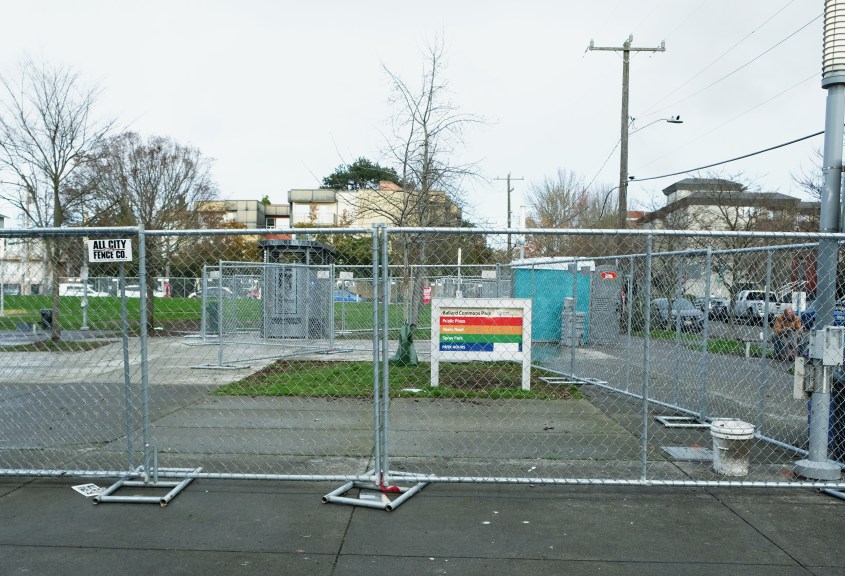
Last week, sanitation crews and Parks Department employees showed up to remove the remains of a large, persistent encampment at the Ballard Commons park. From the outside, the removal looked exactly like every other encampment sweep: Tents, furniture, and household detritus disappeared into the back of garbage trucks as workers wandered around directing anyone still on site to leave. Hours later, crews installed a tall chain-link fence, identical to the ones that have become ubiquitous at former encampment sites around the city. Huge red “PARK CLOSED” signs emphasized the point: This park, once disputed territory, has been claimed. It will remain closed for at least six months for renovations, remediation, and, as District 6 City Councilmember Dan Strauss put it last week, “to allow the space to breathe.”
But the removal of the encampment at the Commons actually was different, because—for once, and contrary to what the city’s Human Services Department has always claimed is standard practice—nearly everyone at the encampment ended up moving to a shelter or housing, thanks to months of work by outreach providers and a hands-off approach from the city. At a press conference outside the Ballard branch library last week, Strauss heralded the results of the city’s “new way of doing encampment removals.”
While a humane approach like the one the city took at the Ballard Commons should serve as the baseline for how the city responds to encampments in the future, its success won’t be easy to replicate. That’s because there simply aren’t enough shelter beds, permanent housing units, or housing subsidies to accommodate all the residents of even one additional large encampment, much less the hundreds of encampments in which thousands of unsheltered people live across the city.
Before explaining why it would be premature, and potentially harmful, to praise the city for abandoning its “old” approach to encampments, it’s important to understand how the approach to this encampment really was different, and why it’s simplistic (and unhelpful) to refer to the removal of the encampment, and the closure of the park, as just another “sweep.”
Ordinarily, when the city decides to remove an encampment, the Human Services Department sends out an advance team, known as the HOPE Team, to offer shelter beds and services to the people living there and to let them know the encampment is about to be swept. The HOPE Team has exclusive access to some shelter beds, which makes it possible for the city to credibly claim it has “offered shelter” to everyone living at an encampment prior to a sweep. However, even the HOPE team is limited to whatever beds happen to be available, which tend to be in shelters with higher turnover and fewer amenities, like the Navigation Center in the International District. Mobility challenges, behavioral health conditions, and the desire to stay with a street community are some common reasons people “refuse” offers of shelter or leave shelter after “accepting” an offer. If someone needs a wheelchair ramp or a space they can share with their partner and those amenities are not available at the shelters that have open beds, the sweep will still go on.
Processed with VSCO with n1 preset
At the Commons, in contrast, city outreach partners, including REACH and Catholic Community Services, spent months getting to know the 85 or so people living in the encampment, learning about their specific needs, and connecting them to resources that worked for them. More than 20 percent of the people living at the Commons had “significant medical issues” that many conventional shelters are not equipped to address, including Stage 4 cancer, emphysema, paralysis, and seizure disorders, REACH director Chloe Gale said last week. Eighty percent had serious behavioral health conditions, including addiction. One had been the victim of gender-based violence and did not feel safe going to shelter alone.
Eventually, outreach workers were able to find placements for nearly everyone living at the Commons, working with people on a one-on-one basis and building trust over months. The approach is time-consuming, costly, and resource-intensive—and it only works if there is sufficient shelter and housing available.
At last week’s press conference, Councilmember Strauss said that by “using a human-centered approach” the city is “giving [outreach providers] time for them to get get people inside, we’re finding and creating adequate shelter and housing. And [that approach] results in people getting inside rather than displaced.” On Monday, Strauss said during a council meeting that he had “begun working to bring a similar outcome to Lower Woodland Park,” where residents have been complaining about a large RV and tent encampment for months.
The problem—and a likely point of future friction for the city—is that the single biggest factor enabling this “human-centered approach” was the opening of dozens of new spots in tiny house villages and a Downtown Emergency Service Center-run hotel in North Seattle, which will provide permanent housing for dozens of people with severe and persistent behavioral health challenges. Those new resources, more than any outreach strategy or “new approach” by the city, enabled people to move, not from one park to another, but to places they actually wanted to go. Now that those shelter and housing slots are occupied, the city will revert to the status quo, at least until more shelter and housing becomes available.
The issue preventing the city from taking a person-by-person approach to encampments is only partly that Seattle fails to consider the individual needs of people living unsheltered; it’s also that the city has never taken seriously the need to fund and build shelter and housing that serves those needs on the level that will be necessary to make a visible dent in homelessness. This is changing, slowly—as Strauss noted last week, 2021 was the first year in which the city met its goal of spending $200 million a year on affordable housing—but the process of moving people inside will inevitably be slow and partial, especially if the city does not do significantly more to fund both shelter and housing.
Since the beginning of the pandemic, according to data provided by the Human Services Department, the city has only added about 500 new shelter beds, and even that number is misleading, because it includes nearly 200 rooms in two temporary hotel-based shelters that will close down next month, sending providers scrambling to find placements for hundreds of people in the middle of winter.
Strauss acknowledged last week that the reason the city could declare the Ballard Commons a success story was that so many tiny house village units became available at once. “The reason that we were able to remove the encampment about our comments now over the last two and a half months is because the shelter availability has come online,” Strauss said.
A few hours later, at a meeting of the Ballard District Council, King County Regional Homelessness Authority director Marc Dones tried to inject a dose of realism into a conversation with homeowners who expressed frustration that they continue to see unhoused people in the area, including “one of the biggest car camping problems in the city.”
For example, one district council member asked, would the homelessness authority provide a person or team of people, along the lines of the Seattle Police Department’s community service officers, for Ballard residents to call when they see “someone repetitively harassing a business” or sleeping in their car?
Instead of offering meaningless reassurances, Dones responded that the job of the KCRHA is not to respond to individual neighborhood concerns about specific homeless people—nor would creating a special homeless-monitoring force for a neighborhood help anyway, in the absence of resources to help the people whose behavioral health conditions manifest as public nuisances. “For a lot of folks who have intense behavioral health needs, we don’t have any place for them to go. … It’s my job to not bullshit you on that,” Dones said.
What’s more, they added, sometimes the authority will outright reject community ideas that are bad. “The broad constituency here wants to solve this problem in a healthy and really compassionate way,” Dones said. “And that’s one of those places where if we’re telling people the honest truth about what can and can’t be done with what we have, it’s gonna go a lot further.”
Telling the truth about what works and what doesn’t seems like a simple thing. But it’s so contrary to the Seattle way of doing things that it’s almost shocking to hear an authority figure tell a traditional homeowners’ group that they can’t have what they want, and, moreover, that what they want won’t solve the problem they’ve identified.
Telling people what they want to hear is an ingrained political strategy, particularly when it comes to homelessness. When she first came into office, one-term Mayor Jenny Durkan promised she would build 1,000 new “tiny house” shelters in her first year in office. By the end of her term, only about 200 had opened. Her successor, mayor-elect Bruce Harrell, has similarly promised to add 2,000 new “emergency, supportive shelter” beds, using “existing local dollars” to fund this massive expansion. If this effort, modeled directly on the failed “Compassion Seattle” charter initiative, succeeds, it will almost certainly result in the kind of relatively low-cost “enhanced” shelter many people living in encampments reject, for reasons that outreach workers (and perhaps, now, come council members) understand well.
The question for Seattle isn’t, or shouldn’t be, “How will we add as many shelter beds as cheaply as we can so we can remove homeless people from public view?” It is, and should be: “How can we shelter and house unsheltered people in a way that prevents them from returning to homelessness while creating realistic expectations for housed residents who are frustrated with encampments in parks?” As the Ballard Commons example illustrates, it takes more than “X” number of shelter beds to get people to move inside. It takes time, effort, money, and a willingness to view unsheltered people as fully human.
On Monday, the city council rejected a proposal by Councilmember Lisa Herbold that would have required churches to build more deeply affordable housing in exchange for density bonuses (upzones) that could double the value of property they own. The legislation the council adopted will provide a financial incentive for religious institutions to build apartments for people and households earning up to 80 percent of the Seattle area median income—for a one-person household, about $65,000 a year.
The legislation has its roots in anti-displacement efforts. Back in 2019, the state legislature adopted legislation requiring cities to give religious institutions density bonuses—essentially, the right to build more housing—on property they own, if they agree to use it for affordable housing. Three months ago, the city council adopted, and Mayor Jenny Durkan signed, legislation stipulating that starting in July 2022, the housing that churches build on upzoned land must be, on average, affordable to people making 60 percent or less of the Seattle median income—about $49,000 for one person, or $70,000 for a family of four.
After the legislation passed, several local churches asked Durkan and council members to change the law to increase the affordable threshold to 80 percent. At that affordability level, apartments are essentially market-rate—around $1,620 for a studio apartment, or $1,850 for a one-bedroom unit, no matter where they are located in the city. In contrast, the legislation the council and mayor approved in June required average rents of around $1,200 for a studio and $1,300 for a one-bedroom apartment.
Herbold’s amendment would have continued to allow religious institutions in neighborhoods the city has identified as having a high displacement risk, such as the Central District, Rainier Beach, North Beacon Hill, and Lake City, to build housing affordable at the higher-income threshold, while retaining the 60 percent affordability requirement in other areas.
Nearly seven in ten Black households make less than half of the Seattle median income, and only 10 percent fall between the 50 percent and 80 percent income levels. In other words, fewer than 10 percent of all Black renter households in the city will even theoretically qualify for new church-based housing at the higher income levels the council adopted.
Representatives from local churches argued that requiring deeper affordability anywhere in the city would make it difficult for them to build housing, resulting in the displacement of churches and their congregants, because housing affordable to people making lower incomes simply doesn’t “pencil out” on church property.
“The [new] legislation, as originally developed, created a win-win scenario where these institutions—almost all of whom make significant contributions to service and justice in the city—can continue to thrive where they are in our neighborhoods and contribute to the crying lack of affordable housing,” Michael Ramos, head of the Greater Seattle Church Council, wrote in an email to Herbold’s office opposing her amendment.
“The ideal is that we have affordable housing at 60 percent area median income across the city, and we have so many policy mechanisms and funding mechanisms to do so,” said Councilmember Dan Strauss, who sponsored both bills. “Churches need the flexibility to be able to have people [earning] up to 80 percent AMI in their buildings, so that they can either choose to have people move back into the community that have been displaced or to use that revenue to create the services that other residents are receiving to meet the needs of their community.” Continue reading “Council Raises Income Level for “Affordable” Housing on Church-Owned Property”→
1. Eight Seattle police officers who registered to vote using the addresses of Seattle Police Department precincts instead of their home addresses—including Seattle Police Officers’ Guild President Mike Solan—will not face criminal charges. Instead, after an investigation by the Office of Police Accountability (OPA), two of the officers (including Solan) received one-day unpaid suspensions and three received oral reprimands; the remaining three officers retired or resigned before the investigation ended.
The South Seattle Emerald first reported that eight SPD officers had registered to vote using their precinct addresses in July 2020, after a search of county voting records found at least one officer registered at each of the department’s five precincts. Because registering to vote using an incorrect residential address is a felony in Washington—one punishable by a five-year prison sentence or a $10,000 fine—the OPA initially referred the case to SPD for a criminal investigation.
The department decided not to investigate; according to the OPA’s report on the case, an SPD captain justified the decision by noting that the officers were already under investigation by the King County Department of Elections, and by claiming (incorrectly) that all of the officers lived in Seattle.
While all acknowledged that they had used their precinct addresses when registering to vote, most argued that they did so to avoid making their home addresses a public record for safety reasons. In response, OPA Director Andrew Myerberg advised the officers to lobby the state legislature to pass tighter privacy protections instead of breaking state law.
In lieu of an investigation, the OPA began its own investigation of the officers’ alleged policy violations, ultimately ruling that all eight officers violated SPD’s professionalism policies, as well as a policy prohibiting officers from using their precinct addresses for personal business. OPA Director Andrew Myerberg didn’t say whether he believed the officers knowingly violated state law, though he noted that King County Elections’ investigation will eventually resolve the question. “Ignorance of the law is not a defense,” he wrote in his report. “This is especially the case for police officers who are entrusted with the responsibility of enforcing it.”
If the elections department does rule that the officers knowingly broke state law, county election officials told the OPA they are unlikely to press charges—the law targeting incorrect voter registration addresses is frequently broken and rarely enforced.
Only five of the officers agreed to interviews with OPA investigators. While all acknowledged that they had used their precinct addresses when registering to vote, most argued that they did so to avoid making their home addresses a public record for safety reasons. In response, Myerberg advised the officers to lobby the state legislature to pass tighter privacy protections instead of breaking state law.
2. The city will replace two rented shower trailers, which have been stationed at Seattle Center and King Street Station in Pioneer Square since last fall, with trailers it bought from a Pittsburgh-based company called Restroom2Go Restroom Trailers. According to a Seattle Public Utilities spokeswoman, the trailers cost the city just over $188,000.
As the COVID pandemic abates, the city has begun closing down and relocating facilities and services for people experiencing homelessness, including “de-intensified” mass shelters and hygiene facilities like the two shower trailers. For now, the spokeswoman said, people will still be able to shower at King Street Station, but the shower trailer at Seattle Center will have to move as summer programming returns to the former World’s Fair grounds. A temporary shelter run by the Downtown Emergency Service Center at Seattle Center’s Exhibition Hall has already started shutting down, with residents moving back into the Navigation Center (a congregate shelter in the International District).
Another DESC shelter whose residents moved to Exhibition Hall during the pandemic, the Queen Anne Shelter, remains closed.
Support PubliCola
If you’re reading this, we know you’re someone who appreciates deeply sourced breaking news, features, and analysis—along with guest columns from local opinion leaders, ongoing coverage of the kind of stories that get short shrift in mainstream media, and informed, incisive opinion writing about issues that matter.
We know there are a lot of publications competing for your dollars and attention, but PubliCola truly is different. We cover Seattle and King County on a budget that is funded entirely by reader contributions—no ads, no paywalls, ever.
So if you get something out of this site, consider giving something back by kicking in a few dollars a month, or making a one-time contribution, to help us keep doing this work. If you prefer to Venmo or write a check, our Support page includes information about those options. Thank you for your ongoing readership and support.
According to SPU, the city is still looking for a place to move the Seattle Center trailer “on the campus,” and is also working out what to do with the two trailers in the long term. “City staff are considering exploring the best options for the trailers, including making them mobile, keeping them stationary or a hybrid approach, to meet the needs of our clients and maximize utilization.”
Even with the two trailers remaining in service, there are very few options for people living unsheltered to take a shower citywide. Lack of access to hygiene is a major quality of life issue, and a barrier to accessing public facilities like transit and libraries, not to mention applying for a job. According to the city’s current hygiene map, there are just 14 places in the city that offer free showers, most of them concentrated near the downtown core; neighborhoods south of I-90, including all of West and Southeast Seattle, have just one shower location each.
3. Someone—perhaps the same brave long-lens photographers who add images of unsheltered people to Google Maps results for various Seattle parks—took the time recently to rename the Ballard Commons Park “Straussville” in Google Maps.
Dan Strauss is the city council member for District 6, which includes the Commons; unsheltered people have lived and congregated in the park, which is next to the Ballard branch library, for many years, but have become more visible during the pandemic as the city decreased encampment sweeps. As of Monday morning, the fake park name had been removed.
District 6 Councilmember Dan Strauss’ legislation is an acknowledgment that Seattle’s neighborhood character is changing.
by Josh Feit
City Council member Dan Strauss passed legislation this week that extends the city’s sidewalk and curbside permitting program for Seattle businesses for another year. Standing next to one of the semi-permanent “pergolas” that now line Ballard Avenue, Strauss said, “we want them here forever.” Mike Stewart, head of the Ballard Alliance, noted the “great symbiotic relationship between restaurants, retailers, and the Ballard Sunday Farmers Market. By supporting any one of those,” Stewart said, customers help support the neighborhood’s whole urban core.
It’s a good start. In fact, I inaugurated the “Maybe Metropolis” column during the tumult of the pandemic last Fall by seizing on the street seating program as a promising sign that the COVID-19 crisis was unlocking Seattle’s larger urbanist sensibility.
But…
Strauss’ legislation doesn’t fully capitalize on this pivotal moment. Public momentum is currently pushing Seattle in an urban direction. In just one year, the city has now issued 233 outdoor restaurant permits, compared to about 384 outdoor dining permits issued over the previous 12 years combined.
Obviously, part of that increase is related to that fact that the permits were free this year; ordinarily there’s a square footage charge and a $232 up-front free. Nonetheless, this year’s permits represent an increase of more than 700 percent over the previous years’ average—a tremendous spike.
If there’s one thing we’ve learned from the pandemic, it’s that Seattle’s “neighborhood character” has a different personality type than we thought. Long a coded excuse against everything from more mother-in-law apartments, to triplexes, to nighttime lights in parks, it turns out Seattle’s “neighborhood character” is far more malleable and exciting than Seattle’s reactionary reflex suggests.
If we miss this opportunity to transform Seattle’s non-downtown neighborhoods on a grander scale than simply allowing outdoor seating while failing to make our local communities places that actually support our lives—as opposed to supporting Stepford lives—we will have squandered 2021’s urban revelation.
Certainly, some of the pent-up energy is specific to the pandemic, but given that trends like working from home were already in play prior to 2020—teleworking in Seattle increased 113 percent between 2010 and 2019—it seems the pandemic has actually revealed, rather than invented, neighborhood needs and preferences.
For example, the jump in working from home was not a function of Seattle’s simultaneous population boom, as it dramatically outpaced other modes like driving (which actually decreased) and walking. The need for more neighborhood options to do business, shop, and go out nearby isn’t going away if people continue to work in greater numbers at home.
The pandemic has actually revealed, rather than invented, neighborhood needs and preferences..
The change in mood that has coincided with the need for more activated neighborhoods has certainly nudged the city to already relax some rigid rules this past year. In addition to making it easier for businesses to set up sidewalk and street dining, the council has also eased restrictions on small home businesses and made some streets pedestrian and bike only zones.
It’s a good look. But rather than taking a piecemeal approach, council members need to think comprehensively about making all our city neighborhoods more neighbor-friendly. This means recalibrating zoning (more density and uses), restriping existing pavement (more bus and bike lanes), and retaking the public right of way (with bioswales, bike racks, P-Patches, microparks, and closing streets to cars.)
In March, I published a list of seven neighborhood Must Dos for meeting this moment, which mostly focused on increasing housing density in non-downtown neighborhoods (end single family zoning, please!) and increasing the density of indie businesses as well. Along those lines, I wrote: “With hundreds of businesses getting street (or sidewalk) seating permits … it needs to be a permanent option.” Since the council seems to be responding to the zeitgeist, I’d like to take advantage of the momentum and offer some more necessary fixes for Seattle’s neighborhoods.
Because District 6 Councilmember Strauss is showing such leadership on this issue, I’m proposing Ballard, which makes up the bulk of District 6, as the first neighborhood to implement the following recommendations for acknowledging and activating our new neighborhood character.
We can call it the Ballard Action District, or BAD.
Ballard Ave.
First, while allowing multifamily housing in Seattle’s exclusive single-family zones must be central to any plan to reinvent our neighborhoods, let’s start by upzoning the real estate that’s adjacent to our neighborhood parks and schools, creating Parks Oriented Development (POD) and Schools Oriented Development (SOD).
Eighty-nine percent of the city’s parks and open spaces are in single family zones. Similarly, the vast majority of the city’s top-performing elementary schools are in single-family areas. Let’s give more people access. In order to redistribute these assets, let’s start undoing those single-family enclaves, which make up 65 percent of the city’s developable land, by prioritizing real estate around parks and schools for multi-family and affordable housing.


 But the removal of the encampment at the Commons actually was different, because—for once, and contrary to what the city’s Human Services Department has always claimed is standard practice—nearly everyone at the encampment ended up moving to a shelter or housing, thanks to months of work by outreach providers and a hands-off approach from the city. At a press conference outside the Ballard branch library last week, Strauss heralded the results of the city’s “new way of doing encampment removals.”


 The South Seattle Emerald

 If we miss this opportunity to transform Seattle’s non-downtown neighborhoods on a grander scale than simply allowing outdoor seating while failing to make our local communities places that actually support our lives—as opposed to supporting
