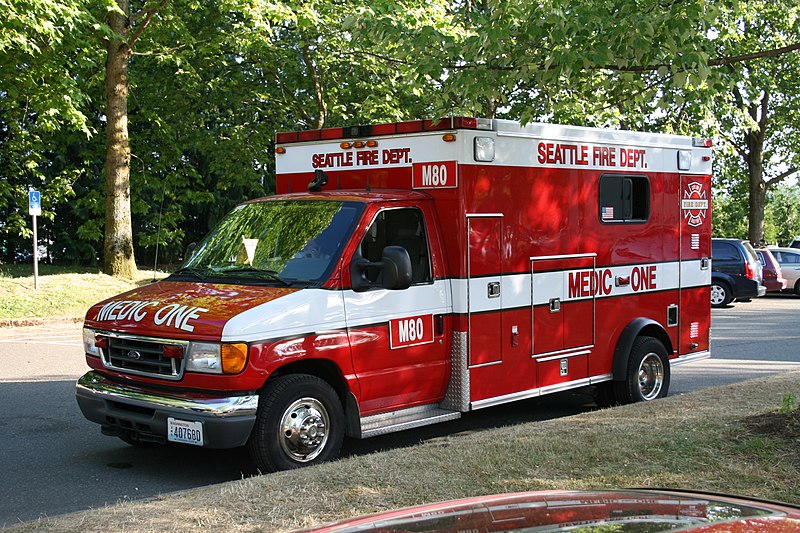
On Wednesday, the Seattle Police and Fire Departments responded to questions from the Community Police Commission about some of the circumstances that may have contributed to the death of Jaahnavi Kandula, a 23-year-old pedestrian who was killed in a marked crosswalk by SPD Officer Kevin Dave. Dave was driving to join Seattle Fire Department EMTs at a suspected overdose in South Lake Union. According to the response from Seattle Fire Chief Harold Scoggins, Seattle Fire Department policy requires police to be present when SFD responds to overdoses, because “overdose patients can become violent during treatment to reverse the overdose.”
The CPC asked the Fire Department to explain the reason it requires police officers to be present when Fire responds to overdose calls, posing four questions about the policy, how it came about, and “What percentage of drug overdose calls prior to the implementation of this policy included compromised safety, assaults, and/or injuries to SFD personnel related to reversing the effects of an overdose?”
In his response, Seattle Fire Chief Harold Scoggins said that the requirement “goes back at least 20 years and is designed to provide scene safety for firefighters and paramedics as overdose patients can become violent during treatment to reverse the overdose.” He did not answer the CPC’s question about how common it is for people coming out of overdoses to be violent, saying only that “[e]ncountering combative patients or bystanders on emergency responses has unfortunately become a reality for firefighters and paramedics.”
Narcan (or naloxone), the widely available overdose reversal drug, is used daily by non-emergency responders, including drug users themselves, and other public employees are trained to use it in the absence of paramedics or any armed response. In 2019, then-Washington state health officer Kathy Lofy signed a “standing order” that made Narcan available over the counter without a prescription to any person who wants it, calling it a “very safe,” life-saving medication.
“When weighing the decision to respond using emergency driving, officers must consider if the incident is life threatening, road conditions, vehicle and pedestrian traffic, weather, speed, lighting, and their own driving abilities.”—Police Chief Adrian Diaz
In his letter, Scoggins said SFD has developed a “new method for tracking assaults and threatening behavior experienced by firefighters in the field,” in general, and has begun reporting this information. PubliCola has asked SFD for this data and will update this post with additional information when we receive it.
Seattle Police Chief Adrian Diaz also responded to the CPC’s questions. After describing the training officers receive in “emergency driving”—driving under emergency circumstances, such as a high-priority call where someone’s life is at risk—Diaz said officers are justified in taking “risks [that] “can result in severe consequences for the public and the officer. … When weighing the decision to respond using emergency driving…. [o]fficers must consider if the incident is life threatening, road conditions, vehicle and pedestrian traffic, weather, speed, lighting, and their own driving abilities.”
Diaz said the fact that the overdose was a Priority 1 call would not, in itself, necessitate emergency driving. “The priority level is a factor to consider but is not generally controlling,” Diaz wrote. “While many Priority 1 calls would warrant emergency driving under our current policy and training, not all do and officers are expected to consider the totality of the circumstances.”
PubliCola has filed a records request the audio from the initial 911 call; SPD categorically denied a separate request for all recorded audio related to the Kandula’s death, citing their ongoing investigation into the incident.
In a conversation with PubliCola last week, SPD Chief Adrian Diaz noted that Dave is a licensed EMT who was headed to the scene of a medical emergency, implying that he was on the way to respond to the reported overdose, not to provide security for the Fire Department. On February 6, the head of the Seattle Fire Fighters Union, Kenny Stuart, expressed frustration about SPD officers getting trained as EMTs and responding to medical emergencies like overdoses directly, saying this was the responsibility of the fire department, not SPD. (It’s a longstanding, ongoing issue.)
“Our EMS delivery system under the Medic One program is arguably the best in the country, and randomly allowing additional EMTs from other city departments to self-dispatch or to perform EMS functions at an incident does not improve or support the level of care we demand from this program,” Stuart wrote. “In fact, it unnecessarily complicates our response and diminishes the service that the public depends on and expects.”
Seattle Fire Department firefighters and paramedics are “the only personnel that are dispatched as EMTs” to medical emergencies, Stuart continued, “and they should be the only personnel who deliver EMS to the people of Seattle. We need our police officers to provide scene security and protect us so we can do our jobs effectively.”
Several years ago, SFD’s medical director told PubliCola the fire department preferred to use rescue breathing—a method to restore breathing in overdose victims without Narcan—followed by intravenous naloxone to facilitate a slower return to normal breathing without putting a person into instant opiate withdrawal. We’ve asked SFD whether this is still the department’s policy, and how the emergence of fentanyl has impacted overdose response, and will update this post when we hear back.
When King County and the city of Seattle established the King County Regional Homelessness Authority in 2019, the two governments signed an agreement that required the new agency to adopt a five-year implementation plan that would include, at a minimum, “strategies to reduce homelessness in at least the following populations: youth and young adults, families, veterans, single adults, seniors, and those experiencing acute behavioral health challenges.”
The draft plan the KCRHA released late last month later goes far beyond that mandate, proposing a series of actions that would—in combination with separate investments in permanent housing—effectively eliminate unsheltered homelessness in King County within five years, mostly by investing in shelter.
Overall, the plan proposes spending between $1.7 billion and $3.4 billion a year to add 18,000 new temporary spaces for people to live, including 7,100 new shelter or “emergency housing” beds, 3,800 medical respite beds for people with acute health-care needs, 4,600 new safe parking spaces for people living in RVs or their cars, and 2,600 beds for people who need addiction recovery support. Altogether, the proposal represents a more than fourfold increase in shelter beds and safe parking spots over just five years. Separately, the plan says the region will need to invest around $8.4 billion in one-time capital costs for permanent and “temporary housing,” a term that encompasses all kinds of shelter.
The focus on shelter and other forms of “temporary housing,” like recovery housing for people struggling with addiction, represents a turnaround from the region’s previous strategy of de-emphasizing shelter in favor of programs like rapid rehousing, which aims to move people directly from the street into private apartments, where they receive short-term subsidies but are expected to pay full rent within a matter of months. Rapid rehousing programs still exist (and can be successful), but they are no longer touted as a panacea the way they were during the Ed Murray administration.
“The plan is really structured around ending unsheltered homelessness, not all forms of homelessness, and that is important,” KCRHA CEO Marc Dones told PubliCola earlier this month. “We built this draft plan in relationship to what would be necessary in order to significantly reduce or eliminate folks sleeping outside, acknowledging that that doesn’t address the other forms of homelessness, like couchsurfing [or people living] doubled up. Things that like are also a significant concern. But we decided that we needed to go towards one thing first, and it was ‘people shouldn’t sleep outside.'”
Implementing the new plan would cost an order of magnitude more than what the region currently spends on homelessness. One reason for that is that the KCRHA, using a model created by the state Department of Commerce, now estimates that there are far more unhoused people in King County than any previous study has concluded—around 56,000, or roughly one out of every 50 people. That number dwarfs the county’s own 2021 estimate; it’s also significantly larger than the US Department of Housing and Urban Development’s estimate of 25,000 people experiencing homelessness across the entire state of Washington.
“For every unit of permanent, affordable housing that comes online, we don’t need as much temporary stuff. If there was a big push to site and develop permanently low-income housing, we could retool [the plan] literally over the course of a week.”—KCRHA CEO Marc Dones
Here’s another data point: As part of its effort to identify and permanently house everyone experiencing homelessness in downtown Seattle, Partnership for Zero, the KCRHA has spent part of the last year creating a “by-name list” of everyone experiencing homelessness in the area, which extends from Belltown to the Chinatown-International District. So far, they’ve identified around 800 people. Even assuming that number is an undercount, it suggests that almost all the homeless people in King County live outside downtown Seattle—an area originally chosen, in part, because it has one of the highest concentrations of homelessness in the county.
KCRHA community impact officer Owen Kajfasz, who leads the agency’s data team, said 56,000 only represents the “floor” for homelessness in King County—in other words, it could be an undercount. However, he acknowledged that the new estimate includes everyone who identified as homeless at any point during the year—including those who were only homeless for a short period, such as a week or a day, and who found places to live on their own.
The KCRHA’s Five-Year Plan includes no new spending on tiny houses, and actually assumes a reduction in the number of tiny house villages over the next five years.
Numerous studies, spanning decades, have concluded that a large number of people “self-resolve” their homelessness within a few days or weeks, although at least one recent analysis has found that number is decreasing. If the number of people who need longer-term interventions, such as case management and temporary housing, is only a fraction of the total people who are homeless in King County every year, the cost to shelter and assist those who need more help could be lower than the KCRHA’s eye-popping estimates.
“To say we need to stand up 18,000 emergency shelter beds, in absolute terms, for 53,000 people experiencing homelessness in King County doesn’t make sense,” said Low Income Housing Institute director Sharon Lee, whose organization operates low-income apartments and “tiny house village” shelters around the county. “The costs of adding spaces just for RVs and car safe parking total $139 million! This is not the correct strategy nor is this in any way financially feasible.”
Local political leaders praised KCRHA for laying out a plan to address unsheltered homelessness, but also seemed unconvinced that the proposal is politically or financially realistic.
A spokesman for Mayor Bruce Harrell, for example, said that while Harrell “supports KCHRA’s dedicated focus on ending unsheltered homelessness and prioritizing immediate and long-term solutions to help get people indoors with access to services and a path to recovery,” the city already funds the majority of the KCRHA’s budget and increased its contribution slightly last year “despite a significant budget deficit.” Last year, the KCRHA asked the city for an additional $54 million to fund 400 new shelter beds and 130 safe-parking spaces; they didn’t get it.
“For budget estimates included in the five-year proposal, we look forward to better understanding how existing investments will be applied and how we can unite support from local, state, and federal governments—along with private and philanthropic sources—to realistically meet budget expectations and advance solutions that drive tangible positive impact,” Harrell’s spokesman, Jamie Housen, said.
Seattle City Council homelessness committee chair Andrew Lewis said he has “faith and confidence that that (cost) number does reflect probably what the investment would be to truly end homelessness and have a flexible system where homelessness is brief, people can get rapidly rehoused, and everything else. That said, the product I would like to see is a corollary tactical, substantive plan … that we can implement in one to two years with things like pallet shelters, RV safe lots, tiny houses—things that people can see and have confidence that we can get on top of this problem.”
His fear, Lewis said, is that if Seattle doesn’t make a visible dent in unsheltered homelessness, people will lose confidence in strategies that work, like low-barrier housing for people struggling with addiction. “We did, in this biennium, make a half-billion-dollar investment in housing [through the city’s capital budget], and for a city, that is a really big contribution to the regional solution. So I think it is possible for us to build on that and continue to be a partner within the reasonable constraints of our means. But,” he added, “I do think it requires us to demonstrate visible progress with a shorter-term, tactical plan” that will build “currency” for larger investments later.
Lewis has been a longtime advocate for tiny house villages, noting that people living in encampments will often “accept” a referral to a tiny house after saying no to traditional shelter. Dones, in contrast, has argued repeatedly that tiny houses cost too much and don’t get people into housing fast enough. Notably, the Five-Year Plan proposes spending no new money on tiny houses, and actually proposes decreasing the number of tiny-house units by 55—a stark contrast to the rest of the proposal, which proposes large new investments in every other type of shelter.
According to the plan, just 1 percent of people experiencing homelessness told KCRHA researchers that they preferred tiny house villages to other forms of shelter.
However, that conclusion is based on extrapolation from 180 interviews in which researchers asked people a list of open-ended questions, such as “what things or people have been helpful to you?” These interviews were also used to estimate the number of people experiencing homelessness in last year’s “point-in-time count,” and to describe the living conditions of the county’s homeless population as a whole.
Researchers never asked respondents to identify which type of shelter they preferred. Instead, they asked then to describe, in an open-ended way, “an optimal condition that would support them to move on in their housing journey,” Dones said. The things they mentioned, Kajfasz added, “were very infrequently aligned with the tiny own village model.” For example, some people said they would prefer to have their own restrooms, or running water in their unit—in other words, a hotel room.
According to the plan, just 1 percent of people experiencing homelessness told KCRHA researchers that they preferred tiny house villages to other forms of shelter. However, that conclusion is based on extrapolation from 180 interviews in which researchers asked people a list of open-ended questions, such as “what things or people have been helpful to you?”
Lee called the KCRHA’s plan, which singled out tiny houses while lumping all other forms of shelter, including hotels, into a single category, “anti-tiny house,” adding, “we question the methodology and numbers.”
For example, “How come they don’t have breakout categories for congregate shelters, noncongregate shelters, hotels, and overnight shelters?” Lee said. “We actually need all of them.” During a recent meeting of the KCRHA’s implementation board, several speakers urged the committee to support funding for tiny house villages. After listening to their comments, board member and former Bellevue mayor John Chelminiak said, “I agree with the speakers today who say, ‘Don’t take options off the table,’ and this [plan] takes options off the table.”
Dones said the authority put tiny houses in their own micro-category because “the community has sort of held [tiny houses] apart from other forms of shelter investment,” adding, “I recognize this is a departure, but what I heard [from the interviews] is that folks do prefer hoteling or emergency housing. … There is a point at which ‘because they told me’ is enough.”
Even if the KCRHA were able to secure funding for a sizeable portion of its five-year plan, some of its elements—like the proposal to secure and open hundreds of parking lots across the county for people living in RVs and cars—seem obviously unworkable based on the region’s recent history trying and failing to open even one such lot.
Consider, for example, the fact that the city of Seattle has been trying unsuccessfully for well over a decade to create a single safe lot for people living in their cars or RVs. So far, every attempt has been a failure. Just last year, plans for a small RV safe lot in SoDo were scaled back, then shelved, due to opposition from people living in the adjacent Chinatown/International District neighborhood—long before neighborhood opposition doomed an adjacent shelter expansion.
LIHI, which was the only applicant for a contract from KCRHA to open an RV safe lot last year, told KOMO recently that they’ll need a 30,000-to-40,000-square-foot parking lot to hold just 35 RVs. After six months of looking, they have not found a suitable lot.
Dones said the plan could change based on feedback the KCRHA receives about the draft, including the public. (The three-week public comment period closed on February 8). The level of need the plan anticipates, they added, could change dramatically if state and regional invests in housing quickly. “For every unit of permanent, affordable housing that comes online, we don’t need as much temporary stuff,” Dones said. “If there was a big push to site and develop permanently low-income housing, we could retool it literally over the course of a week or so to say ‘Now we need this much.” The question, for many of the officials who’ve staked their hopes on the new authority, may not be “how much” but “how?”
Back in 2018—as a Gen X traitor, evidently—I editorialized against saving the Showbox. I was opposed to making policy based on ’90s nostalgia and was for building new housing coupled with the $5 million in affordable housing funds the development would generate from the city’s Mandatory Housing Affordability program.
At the time, a City Hall legislative staffer asked me in earnest if there was any spot around town that would turn me into a NIMBY if it was slated to get torn down and replaced with fancy condos? I honestly couldn’t think of anything that fit the bill.
But now comes the latest in Seattle-is-changing news: The Grand Illusion, the independent movie house at 50th and University Way NE (the Ave), may be the next casualty of real estate development. It’s still not 100 percent clear what the fate of the Grand Illusion will be, but according to a January 23 Daily Journal of Commerce report, real estate developer Kidder Mathews is offering the building for $2.8 million on behalf of the theater’s longtime owner. For now, the theater, which has been around since 1970, has signed another two-year lease, and they say they’re set on finding a new home.
The news hits me in the gut. True story: Just 10 days before I read about the Grand Illusion’s hazy future, I went to a movie at the groovy theater (for the first time since the pandemic, and likely even well before that). Excited to find the place as lively as ever—a disheveled goth was working at the combo ticket/refreshments booth before a nearly sold-out Friday night show—I ended up making a contribution to the nonprofit the very next day. Over the years, I’ve seen countless indie, foreign, art, and cult films at the Grand Illusion while eating a bucket of popcorn heavily dusted in nutritional yeast. I even attended former Seattle city council member Nick Licata’s wedding there, sitting in the rickety yet plush red seating. I’ve also spent a healthy dose of time in the adjacent tortured-poet coffee shop. The Grand Illusion defines Ave culture.
The countercultural Seattle landmark is in a precarious spot because current Seattle zoning prohibits housing and businesses just about everywhere else in the city.
As a pro-development urbanist, I could be called a hypocrite for fretting over the fate of this charming, grunge-y spot. But actually, the potential closure of the Grand Illusion simply confirms the basic problem with Seattle’s zoning code I’ve been writing about for more than 20 years. The reason developers buy up spots in exciting locations like 50th and the Ave. is because these spots are typically located in the few slices of the city that are zoned for multi-family and mixed-use development. “Under current zoning, the listing … estimates that a six-story building could yield 31 apartments,” the DJC reported.
This fact underscores an even more germane point: Offing the Grand Illusion for density is redundant. The block where the theater now stands already works the way a smart city should, with its surrounding dense zoning and plentiful transit. Unfortunately, the area is an oasis of six- and seven-story neighborhood commercial zoning in a desert of land zoned for low-density and single-family housing (and no commercial space). We don’t need more businesses and housing on the Ave.—we need them in the surrounding low-density residential zones.
The YIMBY position remains as it has always been: Put more housing and businesses in the suburban-esque tracts of Seattle where we should have more economic diversity. Unfortunately, with density cordoned off into just 25 percent of the city’s residential land, developers have limited places to build. And so it’s the dense urban areas where beloved, longstanding institutions—Piecora’s on Capitol Hill, Mama’s Mexican Kitchen in Belltown, Tup Tim Thai on Lower Queen Anne—get replaced by apartments. Meanwhile, the strictly single-family tracts stay untouched as the people who live there see their assets grow.
I’m not going to start a petition drive or sign onto a “Save the Grand Illusion” campaign—a la the cringe-worthy, largely white and Gen X effort to save the Showbox. Instead, I’ll point out that the news comes with an explanation slow-growthers won’t like: The Grand Illusion isn’t on the chopping block because of some pro-developer bent in Seattle’s zoning rules. The countercultural Seattle landmark is in a precarious spot right now because current Seattle zoning restricts housing and businesses just about everywhere else in the city.
Mandatory parking often sits empty, especially in dense neighborhoods near transit stops. Photo credit: Enoch Leung from Canada, CC BY-SA 2.0, via Wikimedia Commons
By Ryan Packer
Democrats in Olympia are making good on their pledge to remove local regulatory barriers to housing by proposing bills that would require cities and towns to permit diverse types of new housing. Many of these bills are being passed over the objections of local elected officials, who are wary of changes in state law that take away their authority to maintain status-quo land use policies.
But while lawmakers seem willing to go against the recommendations of some cities when it comes to density limits, they seem more hesitant about getting rid of local parking requirements. Parking requirements add costs to new housing—garages aren’t cheap to build—and are often unnecessary as cities become denser and easier to navigate without a car. Cities across Washington currently require a certain number of parking spaces for each new housing unit they permit, though Seattle has removed that requirement for buildings close to transit lines.
Many of the bills proposed this session remove or reduce minimum parking requirements in order to reduce construction costs. But those provisions are now proving to be a sticking point for both parties.
Rep. Julia Reed (D-36, Seattle) is leading the charge to eliminate parking minimums, particularly in areas that are close to transit. “A lot of these parking minimum laws that are in place from cities and counties, they were created a while ago and they’re not really revisited that often,” Reed said. “It’s not tied to how people really move around that neighborhood, it’s tied to an assumption that parking is needed.” Reed cited the high cost of parking spaces in new buildings: $50,000 or more per spot.
Reed’s House Bill 1351 would prohibit cities from requiring parking in new buildings within a half-mile of frequent transit lines, and within a quarter-mile of half-hourly bus service. But by the time that bill passed the house local government committee this week, the restriction only applied to areas within a quarter-mile of any level of transit service. And even that major change wasn’t enough to get any Republicans in the committee to vote for it, in a year when Democrats are counting on some Republican votes to get their housing votes across the finish line.
The state senate is where that support might matter the most. When the bill’s senate counterpart received a hearing earlier this month, it was a Democrat, Sen Claudia Kauffman (D-47, Kent), who expressed concerns with how this would impact downtown Kent, where street parking is generally free. “If you start reducing [required parking] because of the transit center, it’s going to reduce people’s ability to have their car. … For me, this doesn’t work within the transit system that we have,” Kauffman said. “In my area this just wouldn’t work.”
Many of this year’s senate housing bills would also reduce or remove parking minimums. Senator Marko Liias’ (D-21, Edmonds) Senate Bill 5466 would require cities to allow substantially denser developments around transit stations, and would ban parking minimums within three-quarters of a mile of any major transit stop.
“It doesn’t make sense, when we’re saying [that] in a transit zone, the way we want people to move is by transit, to also require and guarantee that you can get to those destinations by car,” Liias said at the bill’s first public hearing. “Overlaying the two creates really incompatible and inefficient land uses. … When we require parking minimums, that’s when we get empty parking lots right next to light rail stations.”
Under the new version of the bills allowing more apartments near transit, a potential fourplex just outside a transit corridor would have to include four parking spaces, which might push a homeowner or developer to consider a different type of building altogether—like a single-family home.
Housing advocates are in broad agreement that it’s essential to eliminate parking minimums as part of this year’s housing bills. “If the bill doesn’t do that, local parking mandates will force developers to build more parking than communities need, and that excess parking will undermine the state’s goals to create transit-oriented communities that give residents good alternatives to cars,” Dan Bertolet of the Sightline Institute, the Seattle-based think tank, testified at a committee hearing on SB 5466 this week. A 2021 paper by a researcher at Santa Clara University showed that when Seattle reduced required parking near transit in 2012, developers built 40 percent fewer parking spaces, translating to around 18,000 fewer stalls and over half a billion dollars in reduced housing costs.
Though it’s still early, efforts to weaken parking restrictions are already becoming a trend. This week, the house and senate housing committees approved both House Bill 1110 and its counterpart Senate Bill 5190, which require cities inside the Seattle and Spokane metro areas to allow fourplexes on all residential lots, and sixplexes close to transit. But both chambers did so only after approving a new version that allows cities to require at least one parking spot for each housing unit for areas away from transit, when the previous version only allowed them to require one spot per lot. That means a potential fourplex just outside a transit corridor would have to include four parking spaces, which might push a homeowner or developer to consider a different type of building altogether—like a single-family home.
Even as that bill passed its senate committee with his vote, one of its Republican sponsors, Sen. John Braun (R-20, Centralia), said he isn’t ready to vote “yes” when it gets to the Senate floor, suggesting there’s more bartering ahead on the Senate. A majority of Republicans in both chambers oppose the bills in the name of maintaining local control—as opposed to supporting them based on developers’ private property rights, a traditional conservative position.
With the proposals to eliminate parking minimums getting the most vocal pushback from local leaders, and many lawmakers apparently listening to those concerns, these urbanist provisions might be the first casualties as deadlines approach and leaders in both chambers look to create compromises to reach a deal.
Ron Davis, a tech entrepreneur and urbanist who’s running for the District 4 (northeast Seattle) city council seat being vacated by one-term Councilmember Alex Pedersen, is a first-time candidate who decided to run before he knew Pedersen was leaving his seat—spurred on, he told PubliCola, by frustration with the incumbent’s intransigence on housing, taxation, and the city budget. “Alex was a wall-builder extraordinaire—he literally uses the power of the regulatory state to keep people out of high opportunity neighborhoods,” Davis said.
Davis, who announced his candidacy on January 31, grew up in a working-class family that rose into the middle class through what he calls “almost the fairy-tale American dream,” enabling him to go to Harvard Law School school and ultimately create and sell off a software company that aimed to reduce burnout and stress for call-center employees. Since selling that company, he’s been a sales executive and consultant for tech companies, and more recently started getting involved in local politics, joining the Roosevelt Neighborhood Association, 46th District Democrats, Sound Transit’s Citizen Oversight Panel, and the boards of Futurewise and Seattle Subway, a pro-transit group.
If that seems an awful lot like the resume of someone who’s been planning to run for office for a while, Davis doesn’t disagree. “I have a lot of passion for local land use and transit, and although there area lot of levers that can be pulled at the state state level and other places, I care about my local community and I was represented by someone that made me crazy.” After talking with local political leaders, campaign consultants, and policy experts, it “became clear that that [running for council] was the best fit,” Davis said.
“The 15-minute city concept has been really abused here to justify urban villages. It’s supposed to be that every person lives in a 15-minute city, not little 15-minute neighborhoods that are stuck on arterials everyone can drive through.”
If he’s elected, Davis said, he’ll push for a more inclusive housing strategy for the city, starting with the city’s comprehensive plan, which is up for a major revision this year. The city’s decades-old “urban village” strategy, which concentrates multifamily housing along busy arterial roads while reserving most of the city’s residential land for suburban-style single-family houses, is on the table.
“The fact that all five [comprehensive plan] options still include urban villages is preposterous,” Davis said. “The 15-minute city concept”—the idea that everyone should be able to access what they need within 15 minutes without a car—”has been really abused here to justify urban villages. … It’s supposed to be that every person lives in a 15-minute city, not little 15-minute neighborhoods that are stuck on arterials everyone can drive through.”
Davis, unsurprisingly, connects density to homelessness—you can’t solve homelessness without housing, and you can’t build housing in cities where it isn’t allowed—but he also said he supports adding a lot more shelter while the region ramps up housing investments, a view that puts him in the company of both the King County Regional Homelessness Authority and Mayor Bruce Harrell.
“You can throw a million social workers at a problem—and we do need more, and they need to be paid a living wage—but at some point, if they don’t have resources to offer, they’re going to be limited in what they can do,” Davis said. “I think one of the mistakes that we on the left have made is [not acknowledging] it takes a ton of money and time to build the houses. We have to build the housing. I’m 1,000 percent for that. But … I am for intermediate solutions while we build,” like tiny houses and safe lots for people living in their vehicles, Davis said.
The city recently convened a new progressive revenue task force to come up with recommendations to increase revenues at the local level—including, potentially, for affordable housing. At the same time, Gov. Jay Inslee has proposed a statewide ballot measure to authorize $4 billion in bonds to fund thousands of new units across the state.
Davis said he supports both those efforts, but when it comes to housing for people experiencing homelessness in King County, “I would rather see a serious King County tax, so that it would be genuinely regional, and … so that various individual governments wouldn’t have an incentive to defect and hold everyone else hostage.” Currently, only King County and Seattle fund the regional homelessness authority, although four north King County cities recently voted to contribute.
Davis is currently one of three people seeking the District 4 seat—the others are socialist UW grad student Matthew Mitnick and former Teresa Mosqueda opponent Kenneth Wilson—but the race for this open position will almost certainly get more viable candidates in the months before the May filing deadline. State Rep. Gerry Pollet, who was a rumored candidate for the seat, did not respond to PubliCola’s questions last month.
Collective action is the heart of the labor movement. As a public sector union, PROTEC17 members work together to improve conditions at our own workplaces. What is often lost in the public understanding of unions is how we also strive to improve the communities where we live.
The inadequate and shrinking supply of affordable housing in our region has become a crisis. That’s why our union, along with a number of coalition partners, is supporting Initiative I-135, which would create a public developer to build and acquire permanently affordable social housing in Seattle.
PROTEC17 represents the largest number of union workers at the City of Seattle. Through mobilization, negotiating strong contracts, and workplace wins, union members’ ability to create positive change undoubtedly fosters a better workplace and livelihood for themselves and their colleagues. However, with the rising cost of living and housing in Seattle, it is increasingly difficult to raise city employees’ compensation to fit the realities of living in Seattle. The simple fact is that too many city employees cannot afford to live in the very city they support, shape, and serve.
It is in this context that I-135, the social housing initiative, offers a proactive, transparent, and inclusive pathway to the development of truly affordable housing in the city of Seattle. I-135 does this by creating a Public Development Authority that will enable the city of Seattle to acquire properties, renovate existing housing, and build affordable homes, removing the pressure for profits and allowing more collective and collaborative management. The authority itself will be directed by a public oversight board composed of renters, union members, experts in affordable and green development, as well as City Council and Mayoral appointees. It is collective action in action and as an ongoing model.
Housing created by the authority would include units to fit a mix of household sizes, as well as units that are affordable to a cross section of tenants—from those with extremely low incomes to those making up to 120% of Seattle’s median income. If passed, the tools provided by I-135 will be a critical component to restoring and maintaining living communities that cross incomes, ages, and backgrounds.
For these reasons, and many more, a broad range of community, labor, and small business partners have come together to support I-135. Join us in this collective action and vote YES on I-135. Let’s give our city the opportunity to create affordable housing by and for the people.
Karen Estevenin is the executive director of PROTEC17, a member-powered labor union representing nearly 10,000 public employee professionals across the Pacific Northwest. PROTEC17 members work in city, county, and state government, public health, and beyond to support the programs and services that our communities rely on everyday.
Donate to The C Is for Crank's Laptop Retirement Fund
My computer is the single most important piece of equipment I own, and for much of the last five years, I’ve relied on my trusty 2015 MacBook Pro to write and edit posts, tweet up a storm from public meetings, file public records requests, edit transcripts and photos, and generally keep The C Is for Crank in operation. Now it’s time to retire my old machine and trade it in for a newer model.
I’d really appreciate any help my readers are willing to provide to help me defray the cost of this critical piece of office equipment. A new, faster machine (not to mention one without—ahem—an ever-so-slightly cracked screen) will make it easier to bring The C Is for Crank to you every day. My back will also be grateful as I rush from candidate debate to city council meeting to coffee shop back to City Hall. I accept contributions via Venmo (Erica-Barnett-7), Paypal, and by check at the address on my Support page. Thank you so much for your support!



 At the time, a City Hall legislative staffer asked me in earnest if there was any spot around town that would turn me into a NIMBY if it was slated to get torn down and replaced with fancy condos? I honestly couldn’t think of anything that fit the bill.

