
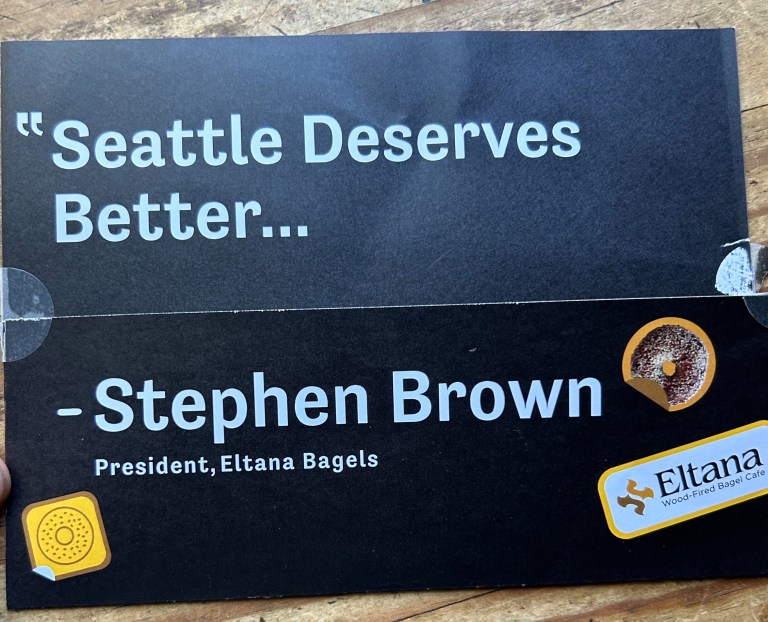
1. After PubliCola reported on a mailer and billboards from Eltana Bagels that appeared to promote the District 1 City Council campaign of Eltana founder and president Stephen Brown, his treasurer contacted us to let us know that the campaign will reimburse Eltana approximately $33,000 for the promotion, along with a billboard in West Seattle and a June 2023 Youtube video that concludes, “Stephen Brown fixed the bagel problem in Seattle—who knows what’s next?”
 The mailers, which went out shortly before ballots arrive for the August 1 primary, read, “Seattle Deserves Better… – Stephen Brown” and open to reveal the word “…Bagels!” along with an offer for free bagels valued at $25. About half the mailers went out to addresses in West Seattle, which does not have an Eltana location. (Brown says Eltana targeted people who live near grocery stores that sell the bagels).
Last week, Brown characterized the billboard and mailers—on which “Eltana” appears off to the side in much smaller font than Brown’s name—as a routine advertising expense. “The intention was to use a banal, stereotypical message as a parody—to use humor to sell bagels,” Brown told PubliCola. Similarly”This effort is not a campaign expense—it is not electoral in nature.”
Brown’s campaign decided to pay for the billboard and mailer after Seattle Ethics and Elections Commission director Wayne Barnett sent Brown a letter posing a series of questions about the promotion, including when the mailers went out and where they went, what vendors Eltana used for the ads, and how often Eltana has sent out similar mailers. Barnett also asked whether previous Eltana promotions have prominently featured Brown’s name, and requested examples of other advertising materials from Eltana over the last two years.
“As you know, all money spent to promote your candidacy must be timely reported, and is limited by your choice to participate in the Democracy Voucher Program,” Barnett wrote. “Therefore, we must resolve this issue before the Voucher Program can release any more funds to your campaign.”
The reimbursement has not showed up yet in campaign filings.

2. Transit advocates were dismayed when Mayor Bruce Harrell wrote a letter to his fellow Sound Transit board members in May suggesting the agency study alternatives that could move a future light rail station north or west of Sound Transit’s preferred alternative. The goal of considering both of these alternatives was to prevent a four-year closure of Westlake Ave. that would impact Amazon, Vulcan, and other large employers in the area. One of those alternatives, the “shifted west” option, would have eliminated the Denny station altogether.
Last week, at a meeting of the board’s system expansion committee, Harrell said he now plans to support the preferred alternative and focus on ways to mitigate the impacts of construction in the neighborhood. “I’m waiting for the ridership analysis [to see] how it affects all of this, but I [am] leaning towards support for the DT-1 preferred alternative that will preserve the two stations in South Lake Union with a strong emphasis—again, I can’t repeat this enough—on mitigating construction impacts,” Harrell said.
During public comment, a number of representatives from South Lake Union businesses testified that closing Westlake to cars for the four-year construction period would be like signing a death warrant for the (booming) neighborhood. Dan McGrady, a longtime lobbyist for the developer Vulcan who now lobbies on behalf of PEMCO Insurance, said light rail station construction on Westlake would cause “devastation” similar to the COVID pandemic, creating a “lasting scar on the community” that “I just don’t think the community can survive.”
Sound Transit is hosting two webinars about the South Lake Union station alternatives before the full board meets again on July 27, where they will have an opportunity to pick a different preferred alternative or keep the preferred alternative on Westlake just off Denny Way.


 Currently, there are no walk-in crisis centers anywhere in King County, and the wait for a residential treatment bed averaged 44 days as of July, according to the county. Since 2018, the county has lost more than 110 residential treatment beds and is down to 244 beds countywide. “A question that doesn’t get asked enough to the person who says ‘get people into treatment,'” King County Councilmember Girmay Zahilay said Monday, is “‘get people into treatment where?'”
 “Communities are afraid to use their parks, people are afraid to walk down 3rd Avenue, and parents are afraid to send their kids to wait for the bus,” Davison said, pointing to the Seven Stars Pepper restaurant at the intersection of S. Jackson Street and 12th Little Saigon as a case study in the consequences of rising petty crime. The owner, Yong Hong Wang, warned last fall that her restaurant is on the brink of failure because customers are afraid of the ad hoc street market — a group of vendors selling everything from shampoo to narcotics — at an adjacent bus stop.
 “Public Health does not have the staffing capacity to provide proactive, daily testing at each of these sites,” the spokeswoman, Kate Cole, said. “As we do for all other homeless services sites in King County, if a shelter has staff or residents who appear to have COVID-like illness, our homeless services support team will provide on-site testing and consultation to help control any potential COVID spread.”