Tag: COVID-19

Guest Editorial: Seattle’s Restaurants Can’t Wait for COVID Relief

Photo by Belinda Fewings on Unsplash

By Debra Russell and Jessica Tousignant

The lockdown was a necessary step in the fight against the coronavirus pandemic, but we couldn’t predict what it would mean for businesses. Restaurant owners didn’t know what to expect.

We were so grateful when Seattleites stepped up and supported us by ordering food for takeout. You were patient and generous as we built an entirely new business model. It was a bumpy transition, but you reminded us that we’re all in this together. Even now, your takeout orders are keeping many of us afloat.

But we can’t forget that our members who are hanging on are the lucky ones. One of the most frustrating aspects of the current economic downturn is that we don’t have enough data to understand exactly how bad things really are. It’s unclear how many neighborhood businesses have closed permanently since March.

The clearest overview of the economic impact on businesses nationwide arrived in a recent report from Yelp, which showed that of all the businesses that closed since March , about 61 percent have now closed permanently. That’s 97,966 businesses wiped out nationwide. Due to the customer-driven nature of Yelp’s reporting, this almost certainly represents an undercount—and in Washington, the numbers are likely even worse.

When ordinary people don’t have enough money to spend at local businesses, those businesses don’t make enough money to stay open.

The Yelp data confirms what we have suspected to be true: We’ve already lost half the businesses that had to temporarily close for lockdown, and the rest are imperiled. A majority of Seattle’s neighborhood restaurants will likely close by the end of the year.

Let’s be clear: this isn’t on our customers. They’ve done more than their part to keep us afloat. But the people and organizations who are supposed to use their resources and visibility to stand up for and protect small business have been entirely absent.

Local leaders claimed we should wait for the federal government to lead the way in the economic response to the pandemic. But the US Senate adjourned for vacation until September 8 without any agreement on a new stimulus plan. Since the additional $600-per-week unemployment benefits written into the last stimulus package were allowed to expire, some of our members report business has dropped by as much as 25 percent. When ordinary people don’t have enough money to spend at local businesses, those businesses don’t make enough money to stay open.

For years, powerful business interests like chambers of commerce, the Washington Hospitality Association, and others have used small businesses as a political football. Today, small businesses are shuttering around Seattle, people are losing their jobs, and these same organizations have quietly looked the other way.

The federal government told states and cities that they’re on their own, and local leaders have failed to step up to fill the void. Mayor Jenny Durkan, for instance, vetoed the expenditure of emergency funds—as though this economic collapse isn’t the biggest emergency most Seattleites have ever seen. (The city council subsequently overturned that veto, but Durkan’s budget would reallocate the money for other purposes.)

Continue reading “Guest Editorial: Seattle’s Restaurants Can’t Wait for COVID Relief” →

Maybe Metropolis: The Pandemic Has Forced Seattle To Reconsider Its Neo-Suburban Model

By Josh Feit

Judging by the sheer number of permits the city has issued in the past five months allowing businesses to turn sidewalks, parking spots, and city streets themselves into places for people to hang out, there’s an unforeseen consequence of the pandemic: A citywide Seattle neighborhood renaissance.

Under a temporary program called “Safe Starts,” SDOT has issued 135 such permits since the COVID-19 crisis hit, with 73 more local business requests for permits in the queue. (The numbers, based on data through September, are actually much higher because the West Seattle Junction Business Improvement Association got an unprecedented single permit allowing all 230 shops and restaurants in the district to set up a single table and chair outside their storefronts).

Seattle’s neighborhood businesses are using all these permit options (they’re free) to turn neighborhoods outside the downtown core into people-centric hot spots. Just grab a table in the middle of the street on 9th Avenue N. between Thomas and John Streets in South Lake Union, and you’ll quickly get a sense of the new block-party atmosphere that’s helped redefine the city in recent months.

Support PubliCola

PubliCola is supported entirely by generous contributions from readers like you. If you enjoy breaking news, commentary, and deep dives on issues that matter to you, please support this work by donating a few bucks a month to keep this reader-supported site going—and expanding!

If you don’t wish to become a monthly contributor, you can always make a one-time donation via PayPal, Venmo (Erica-Barnett-7) or by mailing your contribution to P.O. Box 14328, Seattle, WA 98104. We’re truly grateful for your support.

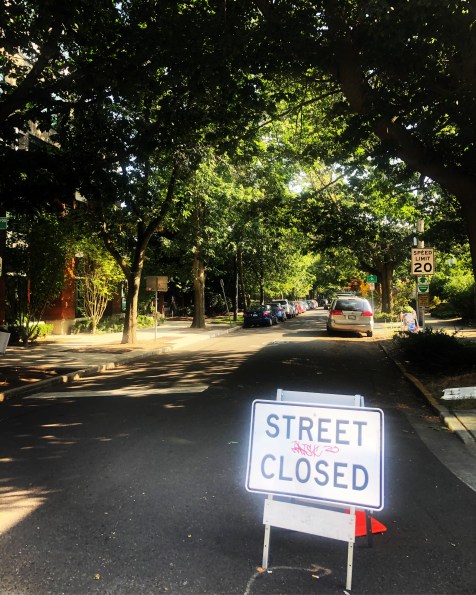
Neighborhoods aren’t merely dedicating more public space for eating and drinking. The elevated energy is also being formalized on neighborhood side streets. As part of another SDOT program called “Stay Healthy Streets,” 13 stretches of neighborhood streets, totaling more than 20 miles, have sidelined cars in favor of people. Instead of reading “Street Closed,” SDOT signs barring cars could just as logically read “Street Open.”

The takeaway for city policy makers should be clear. While inveterate single-family-zoning advocates continue to decry urbanization in any form (in order to preserve neighborhood character, they say), Seattle’s neighborhoods are not as fragile as the naysayers have claimed. On the contrary, the uptick in neighborhood action seems to have amplified, rather than destroyed, neighborhood character.

Hilariously, one business that has chosen to convert sacred parking space into café seating, Café Javasti, was an adamant parking space patriot during Wedgwood’s retrograde fight against a protected bike lane on 35th Ave. NE.

“I don’t understand why we’d ever go back.” — West Seattle Junction BIA Executive Director Lora Swift

From “outdoor cafés to outdoor retail racks,” West Seattle Junction BIA Executive Director Lora Swift said, the neighborhood has a “new cadence” and a “more European feel.”

She says she’ll be advocating to keep the permits in play through “at least 2021,” adding that she’d like the programs to stay in place longer than that. “I don’t understand why we’d ever go back,” she said, noting that her enthusiasm is “underscored by requests from the community… to continue to this new Seattle. We’ve gotten so many emails.” Continue reading “Maybe Metropolis: The Pandemic Has Forced Seattle To Reconsider Its Neo-Suburban Model” →

Sterling Harders: Proposed State Funding Cuts Would Harm Patients, Essential Health Care Workers

The 45,000 in-home and nursing home caregivers of SEIU 775 have always been on the front lines of health care. We’re the first ones to know if our clients are coughing or running a fever. We know when the person we care for seems dizzy, or when their appetite is off. We know first because we’re inside of their homes providing health care, preparing food, and cleaning surfaces, giving invaluable care to the most vulnerable people in our communities. We keep those who want to stay in their homes out of costly institutions, and care for those who require nursing home care to stay healthy.

Caregivers didn’t stop providing care during the coronavirus pandemic, despite a glaring lack of PPE in the first few months. Nelly, a caregiver in Yakima, lives with her client. When everyone in Nelly’s home, including Nelly, tested positive for COVID-19, she continued providing care and kept her vulnerable client out of the hospital.

The proposed Washington State Department of Social and Health Services (DSHS) cuts would kick 10,000 seniors and people with disabilities off home care, and put more than 10,000 caregivers out of work when we can least afford to lose more jobs.

Caregiving is essential. Yet it has been consistently devalued because of systemic racism and sexism. Like farm workers and domestic workers, caregivers were deliberately excluded from the worker protection laws created after the Great Depression. We were excluded because of who we are and what we look like—predominantly women, including black women, women of color and immigrants. Caregivers had to fight to win basic standards like minimum wage, the right to a union, and even the right to protection from harassment and discrimination long after other workers won those rights.

When the coronavirus hit, the caregivers of our union immediately started negotiating with the state for COVID protections. We were the first caregivers in the country to win hazard pay. But everything we’ve won—not just hazard pay but our health care, our wages, and our jobs themselves—are at risk due to the economic crisis brought on by the pandemic.

There are about 30 million people unemployed in this country, including half a million people in Washington State. Millions more are risking their lives going to work every day—not just caregivers but grocery workers and farmworkers and delivery drivers—and these folks are often working for near poverty wages. Yet with looming budget shortfalls facing our state, what’s on the table for caregivers? Cuts. The state is trying to find revenue by proposing massive, devastating, offensive cuts.

The proposed Washington State Department of Social and Health Services (DSHS) cuts would kick 10,000 seniors and people with disabilities off home care, and put more than 10,000 caregivers out of work when we can least afford to lose more jobs. The cuts to wages and benefits could result in a loss of $1,300 a year for a full-time caregiver. In nursing homes, perhaps the most dangerous place to be during a global pandemic, DSHS has proposed cutting funding by $240 million dollars per year. Continue reading “Sterling Harders: Proposed State Funding Cuts Would Harm Patients, Essential Health Care Workers” →

Alex Hudson: The Path to a Just Transportation Recovery

By Alex Hudson

When the pandemic began and much of the world stopped moving, public transit carried on, connecting essential workers to jobs and people to food, health care, and other critical services. Bus drivers bravely continued working to get people where they needed to go, and adapted to help deliver food to seniors and patients to care. The COVID-19 pandemic has exposed a deep truth: public transit is, and always will be, essential.

There is worry that ridership is down now and won’t return. These fears are based on a return to pre-COVID levels of congestion and skyrocketing used car sales. But the risks of veering away from transit in a post-pandemic world are huge. If drivers get back in their cars exclusively, we’ll cut people off from opportunity and will be stuck in worse congestion than before, resulting in wasted time, more greenhouse gases and toxic pollutants that make our planet less livable, and hundreds of lives lost to preventable crashes.

The vision for public transit in a post-pandemic Puget Sound hasn’t changed: It must be fast, frequent, reliable and affordable. COVID-19 has simply underscored the urgency of addressing how we plan for and fund it. As we recover, the smart and most affordable investment we can make is in building a resilient and accessible public transit system that connects people to opportunities, creates good paying jobs, and supports our climate goals.

Here are three steps we can take to get there:

Invest in transit like it’s a key part of a just economic recovery—because it is. There can be no economic recovery without well-funded public transit. In Seattle, essential workers account for 33 percent of transit riders. These folks keep Seattle’s hospitals running, our grocery stores stocked, and provide social service, caretaking and education that all of us are depending on. In addition to getting people to their jobs, transit investments create good, green, family-wage jobs that last. An analysis of the 2009 stimulus package found that stimulus dollars spent on transit projects created more jobs than dollars spent building or maintaining highways. “To create the most jobs per dollar, invest in transit and maintenance,” the analysis concluded.

Transportation is a household’s second-highest cost, and the average household in King County spends more than $12,500 per year on their vehicles. In 2019, seven million Americans were at least three months behind on their car loans. As unemployment remains high and household finances are stretched to the breaking point, public transit is a desperately-needed affordable alternative to driving that millions of people across the country are counting on.

To keep our communities strong during this challenging economic climate, public transit must be centered in recovery plans and cannot be left out of the federal stimulus packages. All new COVID relief funding on the local, state, and federal levels must include investments for transit, teleliving, biking, walking, and rolling. To make sure this happens, we have to continue building strong coalitions across business, labor, environmental, and social justice advocates. We need everyone at the table.

Pay for it now, or pay the price later. Transit is a fundamental pillar of a functional economy, yet we have seen that the funding that keeps transit moving is fragile and overlooked at every level of government. TransitCenter estimates that across the country, transit agencies will see a $26 billion-$40 billion annual shortfall due to COVID. Declines in fare revenue, as well as the underlying supporting taxes, leave our agencies facing extreme budget shortfalls and elected leaders grappling with no easy choices.

Funding for transit in Washington has never been resilient or adequate. The 18th Amendment to our state Constitution restricts how we can spend transportation dollars. Rather than using gas tax money to create a more efficient and sustainable system overall, the state is forced to funnel money into highway projects, many of which only further pollution and congestion. This outdated restriction must be reconsidered—our social, economic and environmental future depends on it.

Washington lacks progressive revenue options for transit, and the passage of I-976 left local governments with even fewer tools. We need to move away from regressive, restrictive, and volatile sources of funding like the gas tax and replace them with sustainable and resilient funding options, like an equitably designed road user charge or congestion pricing and a statewide air quality surcharge. While working toward reform, we must continue to utilize the existing tools and support local transit ballot measures, starting by passing Seattle Proposition 1 and renewing the Seattle Transportation Benefit District, which funds transit investments in Seattle, for another six years.

Prioritize racial equity in our recovery plan and undue long standing disparities. The pandemic has exacerbated inequities that exist within and are caused by our transportation system. Black, Indigenous, and People of Color (BIPOC) experience disproportionate impacts through exposure to air and noise pollution caused by racist planning decisions which built traffic arterials and highways in their communities, lowering home values, separating communities, and increasing exposure to air and noise pollution and preventable traffic violence. Health disparities caused by exposure to air pollution, such as higher rates of asthma, have left BIPOC communities more vulnerable to contracting COVID. Creating an equitable transportation system is literally a matter of life or death for BIPOC communities in Washington. Continue reading “Alex Hudson: The Path to a Just Transportation Recovery” →

Mayor’s 2020 Budget Would Reallocate JumpStart, Uber Taxes to Pay for BIPOC Investments To Be Determined by New Task Force

Screen shot from internal City of Seattle presentation obtained by PubliCola.

UPDATE: Mayor Jenny Durkan’s office has confirmed that the mayor plans to use both JumpStart (payroll) tax revenues, which are currently earmarked for housing, people experiencing homelessness, and small businesses, and money from the Transportation Network Companies (Uber/Lyft) tax to help pay for her $100 million “new investment” in BIPOC communities. The details of that spending would be hammered out by a task force whose members Durkan will announce next week. (More information in original story, below.)

The TNC tax is currently earmarked for affordable housing near transit and the Center City Streetcar. Using TNC revenues to get to the $100 million goal could mean abandoning the troubled downtown streetcar project.

Earlier this year, the city council passed the JumpStart tax—a graduated payroll tax on high-income workers’ earnings. Durkan, who opposed the tax, nonetheless only vetoed the council’s JumpStart spending plan, letting the tax itself become law without her signature. (The council overrode the veto).

It was an odd move that many observers questioned at the time. However, if Durkan was planning to use the tax revenues to pay for her July commitment, which she made at the height of clashes between protesters and Seattle police, the mayor’s decision to preserve the tax but try to undo the spending plan makes sense. 

But it will have consequences. Under the council’s plan, payroll tax revenues would be used in the short term to fund rent relief, non-congregate shelter beds, immigrant and refugee relief programs,grocery vouchers, and direct assistance to child care centers and other small businesses. In the long term, the tax is supposed to provide $214 million a year for low-income and affordable housing, equitable development, small business support, and Green New Deal projects.

Council member Teresa Mosqueda, who proposed the JumpStart plan, told PubliCola, “JumpStart funding for 2021 was supposed to lessen the austerity cuts that were expected to core government services, much of which serves BIPOC communities. We cannot take expected JumpStart revenue to make good on a promise [Durkan] couldn’t keep.”

The council, which is just coming off a bruising battle over the 2020 rebalancing package, will have to decide now whether they want to fight Durkan’s plan to allocate $100 million to a list of projects that won’t be determined until her task force comes up with spending priorities; or to give in and abandon some or all of the JumpStart spending plan they adopted in July.

If they fight, the mayor will be able to accuse the council of “not listening to community” because their spending plan didn’t involve the kind of lengthy community process Durkan has proposed. If they don’t, community groups that worked to secure the funding in that plan, including groups that advocated for months for the Green New Deal spending plan, could lose out.

Overall, according to PubliCola’s reporting, Durkan’s budget plan would require between 75 and 80 outright layoffs, representing about $7 million in city spending. The mayor will present her budget to the council next Tuesday at 1pm.

Support PubliCola

PubliCola is supported entirely by generous contributions from readers like you. If you enjoy breaking news, commentary, and deep dives on issues that matter to you, please support this work by donating a few bucks a month to keep this reader-supported site going—and expanding!

If you don’t wish to become a monthly contributor, you can always make a one-time donation via PayPal, Venmo (Erica-Barnett-7) or by mailing your contribution to P.O. Box 14328, Seattle, WA 98104. I’m truly grateful for your support.

Original story follows.

As PubliCola reported yesterday, in advance of today’s announcement, Mayor Jenny Durkan is convening a new “Equitable Investment Task Force” as part of a “Reimagining Seattle” process that will begin discussions to “realign” the city’s spending  for a post-COVID recovery. The mayor’s announcement, made in an op/ed in the South Seattle Emerald, does not provide many details about her “Equitable Communities Initiative” or the makeup of the task force, but does indicate that this will be a multi-year process, starting with the 2021 budget she’ll propose next Tuesday and continuing with an already planned supplemental budget next spring.

As we noted on Twitter yesterday, PubliCola has obtained additional details that shed more light on the mayor’s plans, which also involve numerous internal “work groups” (distinct from the external task force) and more than 30 city staff, most of them from the city budget office or the mayor’s office.

In an internal PowerPoint presentation titled “Reimagining Seattle As We Know It,” Durkan’s office laid out a plan that that includes new internal city of Seattle “work groups” and an Equitable Investment Task Force with various committees and a paid facilitator, which will “interface” with, and get technical assistance from, the city by way of the new work groups. The mayor’s office will serve as the liaison between all these different groups, and a still-to-be-hired Director of Re=covery and Equitable Investment will head up the whole effort.

The mayor has been criticized in the past for appointing task forces to discuss urgent problems in the past instead of taking quick and decisive action. Past task forces have included groups that discussed homelessness (One Table), zoning in industrial areas (the Industrial and Maritime Strategy Council), and business (the Small Business Advisory Council), among others.

This purpose of this task force is, in part, to discuss how to spend the $100 million the mayor has pledged in “new spending” on BIPOC communities in her 2021 budget, which her office will present to the city council on Tuesday.

One likely source of these revenues will be the JumpStart tax, which is intended to help individuals and businesses recover from the COVID-related economic downturn next year, to cover some of the $100 million. Earlier this year, Durkan vetoed the spending plan for the tax, but not the tax plan itself (the council overrode the veto).

Council member Teresa Mosqueda, who proposed the JumpStart plan, told PubliCola, “JumpStart funding for 2021 was supposed to lessen the austerity cuts that were expected to core government services, much of which serves BIPOC communities. We cannot take expected JumpStart revenue to make good on a promise [Durkan] couldn’t keep.”

According to the city’s internal presentation, the task force—whose members the mayor’s office has not yet identified—will have four co-chairs, and the whole effort will be headed up by the mayor’s new Director of Recovery and Equitable Investment, who has not been hired yet (the job posting went up in early September). PubliCola hears it’s been a challenge to find someone to fill the cabinet-level position, which has a pay range of $120,000 to $180,000.


Alex Brennan: Pandemic Shows that Density Isn’t the Problem, It’s the Solution

By Alex Brennan, Futurewise

During normal times, the case for moving into an efficient apartment in a dense urban neighborhood close to work, instead of a suburban house with a long commute, is compelling and logical.  For starters, the short commute means valuable extra time at home.

Meanwhile: You don’t need your own private yard because you can walk to the park. You don’t need a big apartment because the coffee shop down the block is an extension of your living room. Being out and about in the neighborhood is part of what makes urban life great. You run into people you know, and you come across all sorts of people you don’t know.

But now the coffee shop is takeout only. Crowded streets and parks require a masked, distancing dance, especially for elders or others at high risk. And for those of us who have switched to virtual work from home (it’s important to remember that many essential workers must still commute), we are now stuck in that apartment. Maybe we squeezed in a little work desk next to our bed or added it on to the kitchen table, but that roomy house an hour from the suddenly shuttered downtown office suddenly looks a lot more appealing.

Will some jobs stay virtual? Sure. But the core innovative industries that drive our economy thrive on in-person interactions.

Since the pandemic upended our lives in March, people have been asking me if (or in many cases telling me that) the pandemic portends the end of cities and density. And I get it. Living in the city right now is hard. The pandemic surfaces old associations between cities and disease. And there are some signs in New York and San Francisco that those who can afford to move are leaving for the suburbs.

I’m not here to predict the future, but I can tell you I’m not giving up on density. To explain why, I think it’s important to start by clarifying what is not happening.

First, density is not increasing your chances of getting COVID. In King County, for example, the densest zip codes have the lowest positive test rates and some of the lowest death rates. Globally, some of the densest cities in the world—Seoul, Tokyo, Hong Kong, Singapore, Taipei—are models for preventing the spread of the pandemic. (The concentration of top medical facilities certainly helps.)

Support PubliCola
PubliCola is supported entirely by generous contributions from readers like you. If you enjoy breaking news, commentary, and deep dives on issues that matter to you, please support this work by donating a few bucks a month to keep this reader-supported site going—and expanding!

If you don’t wish to become a monthly contributor, you can always make a one-time donation via PayPal, Venmo (Erica-Barnett-7) or by mailing your contribution to P.O. Box 14328, Seattle, WA 98104. I’m truly grateful for your support.

Second, we are not experiencing the end of agglomeration economies, the enigmatic force that brings businesses and jobs closer together. Will some jobs stay virtual? Sure. But the core innovative industries that drive our economy thrive on in-person interactions. Amazon just leased another two million square feet of office space and announced they will have 25,000 jobs in downtown Bellevue by 2025—right across from the soon-to-open downtown Bellevue light rail station. Facebook just snatched up the headquarters office that REI let go—adjacent to the soon-to-open Spring District light rail station. And while perhaps struggling at the moment, Boeing isn’t going to start building airplanes on Zoom.

Beyond unpacking misperceptions about disease and jobs, it is important to think about the lessons we’re learning from the pandemic, the recovery that we want, and the important role dense, mixed-use, walkable cities can play.

Protecting rural areas. It might seem counterintuitive, but urbanism starts with respect for rural lands.  Remember the first time after lockdown that you left your home and went for a hike in our beautiful mountains? Remember what a blessing it was to have the great outdoors so close? Building up in the city allows us to protect our wild places and our working farms and forests. If we all take our virtual jobs and move to the countryside, it won’t be the countryside anymore. It will just be another suburb.

Climate Change.  The pandemic has taught us that we need to be better prepared for shocks, and there is no bigger shock coming than climate change. Are you angry that our leaders let our public health infrastructure waste away in good times? Well you should be furious about our inadequate efforts to mitigate and prepare for climate change. This year’s toxic smoke is only the beginning if we don’t act now.

If we all take our virtual jobs and move to the countryside, it won’t be the countryside anymore. It will just be another suburb.

Dense communities are one of the best tools for reducing greenhouse gas emissions from transportation (Washington State’s largest source of emissions) by shortening travel distances and encouraging walking, biking and transit over driving alone. Dense cities also allow us to grow without building suburbs out on the forest’s edge, reducing human exposure to the destruction of climate-exacerbated forest fires.

Health. That increase in walking, biking, and transit, over sitting in the car, improves outcomes for cardiovascular disease and type-2 diabetes. Those two conditions also happen to be two of the biggest risk factors of dying from COVID-19. But it’s not just about COVID, cardiovascular disease is the leading cause of death in the US (diabetes is the seventh) and both ailments diminish the quality of life of millions more. Dense, walkable urban neighborhoods that incorporate physical activity into daily life are a big part of the cure.

Cost savings. When the pandemic is over, governments and households are both going to have a lot of debt. Density is part of how we can have a great quality of life and save money. Dense development cuts down on infrastructure costs, requiring fewer miles of roads and water, sewer, electrical, and internet lines. Density makes fire, ambulance, and other response-time-based services more efficient. That translates into lower taxes or better services (take your pick).

For households, less driving reduces the second biggest household cost, transportation. And while density alone cannot solve our housing affordability crisis, when land is expensive, more efficient use of land reduces building costs.

Reviving Main Streets. Density isn’t just about the big city, it’s also important for small towns. Right now, locally owned small businesses are struggling more than ever. The foot traffic that they thrive on has been decimated by COVID-19. If we let these places continue to be replaced by online shopping and big box stores out by the interchange, our small towns will lose their heart, their sense of place, and their tax base. Allowing second-story apartments above shops, and duplexes and triplexes nearby, can help bring back the foot traffic that Main Streets need to compete.

Public life. Let’s return to where we started. During normal times, dense neighborhoods are places of community and connection, places to run into friends on the sidewalk or at the coffee shop, places for festivals and marches. Right now, unfortunately, we can’t enjoy being with other people this way, and that is hard. But I believe, after the isolation of the pandemic, we will emerge more hungry for public life than ever before.

The United States of America has the lowest-density cities in the world. This isn’t because we harbor a Jeffersonian love for the suburbs. It’s because federal policies like the interstate highway act and the VA and FHA home mortgage programs have promoted sprawl for decades. Local policies also play a role: It remains true today that most low-density development in Washington State would not be financially feasible if impact fees reflected the true cost of the associated infrastructure. At the same time, single family neighborhoods in inner-ring suburbs would be transitioning to duplexes, townhomes, and lowrise apartments if the zoning allowed for it.

When the COVID-19 pandemic ends, we will need to rebuild our country. Will we continue the policies of suburban bias that has guided the last 70 years or will we learn new lessons from the pandemic and create a more urban future?

Alex Brennan is the Executive Director at Futurewise. The organization’s current campaign, Washington Can’t Wait, is fighting to build more climate-resilient, equitable and affordable communities by strengthening the Washington State Growth Management Act.