Mayor Kills Controversial Northeast Seattle Bike Lane; New Design Also Lacks Parking

Learn to trust the Crank: As I reported this morning, Mayor Jenny Durkan’s office met with advocates for and against a proposed one-way protected bike lane on 35th Ave. NE to tell them that the city does not plan to move forward with the long-planned lane.

According to a notice from the Seattle Department of Transportation, SDOT is going with an “alternative design” that includes no bike lane at all. The protected bike lane has been a part of the city’s adopted bike master plan since 2014. Recently, a group of opponents has argued that adding a protected bike lane on one side of the street would harm businesses by removing parking spaces—despite the fact that a city parking utilization study found that only 40 percent of the parking spaces near the proposed bike lane were occupied on an average weekday.

Ironically, the new design actually eliminates just as much parking as the bike lane plan, which was already designed, contracted, and shovel-ready. In a statement, SDOT said cyclists could use an existing “parallel neighborhood greenway” several blocks away which bike advocates called an inadequate substitute for a protected lane on an already existing major bike arterial.

The most recent report on the Move Seattle levy revealed that the Seattle Department of  Transportation has continued to fall behind on plans to build out the bike network laid out in the 2014 Bike Master Plan, particularly when it comes to protected bike lanes.

Here’s SDOT’s statement on the decision. I have calls out to SDOT and the mayor’s office and will update this post with any additional information.

Since the early stages of the 35th Ave NE Project, we’ve heard support from the community for changes to the street that improve safety. When the project began, the goal was to better organize the street, increasing safety for everyone. To meet this goal, we proposed a design that included bike lanes consistent with recommendations in the Bike Master Plan.

In response to the feedback we heard about the design, and based on industry best practices, data analysis, and continued conversations with the community, we’ve chosen to move forward with a new design that includes 1 travel lane in each direction, a center turn lane (north of 65th) and parking maintained on the east side of the street (between NE 47th and NE 85th streets).

Better street design can lead to safer streets. The new design helps us improve safety and operations for all travelers on 35th by providing a dedicated space for turning vehicles. We’ve seen decreased vehicle speeds and decreased collision rates on streets with 1 lane in each direction and a center turn lane. Examples include NE 75th St, NE 125th St, and Nickerson St. By slowing vehicle speeds and better defining the travel lanes, this helps increase safety for everyone on 35th, including people crossing the street. While there would be no protected bike lanes on 35th, people riding in the street would still benefit from slower vehicle speeds and clearly defined travel lanes. We will also be making enhancements to the parallel neighborhood greenway on 39th Ave NE that provides a route for people that prefer to bike on a quieter street.

To make space for the center turn lane, parking will be maintained on the east side of the street, instead of both sides. Throughout this project, we’ve worked with businesses and religious organizations along 35th to better understand parking, loading, and access needs. With the new design, we have decided to prioritize parking on the east side of the street. This decision is based on community feedback and the location of several existing load zones and ADA parking spaces on the east side of the street. We’ve heard these spaces are critical for people with limited mobility that are attending services at the religious institutions on 35th.

The new design addresses many concerns we’ve heard from the community however, we’ve also heard requests for additional enhancements along the corridor. SDOT is evaluating these requests and will share more information as we have it.

Support The C Is for Crank
If you like the work I’m doing here, and would like to support this page financially, please support me by becoming a monthly donor on Patreon or PayPal.  For just $5, $10, or $20 a month (or whatever you can give), you can help keep this site going, and help me continue to dedicate the many hours it takes to bring you stories like this one every week. This site is funded entirely by contributions from readers, which pay for the time I put into reporting and writing for this blog and on social media, as well as reporting-related and office expenses.  If you don’t wish to become a monthly contributor, you can always make a one-time donation via PayPal, Venmo (Erica-Barnett-7) or by mailing your contribution to P.O. Box 14328, Seattle, WA 98104. Thank you for reading, and I’m truly grateful for your support.

Morning Crank: HSD Changes Homeless Contract Requirements; 35th Ave Bike Lane Approaches Resolution

1. The city’s Human Services Department is revising its benchmarks for withholding funds from underperforming homeless service providers after 20 of 46 service providers who received contracts with the city last year failed to meet new standards adopted in 2017. The new benchmarks will reduce the total amount of contracted pay HSD can withhold from 12 percent to 8 percent per year, and will reward providers for improvement over the course of a year, even if providers don’t hit their targets for things like exits to permanent housing and returns to homelessness.

As I reported last month, 20 of 46 city-contracted homeless service programs failed to meet the city’s new performance standards by the end of 2018, and were docked part of their pay under a new contracting system adopted by HSD in 2017. That system, which represented a major shift in how HSD contracts with human-services providers, enables the city to withhold 12 percent of a service provider’s contract if they fail to hit specific numbers on five metrics, including the percentage of clients who exit to permanent housing and the number of clients who end up back in the county’s homelessness system (a metric known colloquially, and somewhat imprecisely, as “returns to homelessness.”) Officials with the city refer to this system as “performance pay,” and say it’s meant as a reward for good results; providers have argued that withholding contracted funds makes it harder for them to meet the city’s ambitious new goals for moving people from homelessness to permanent housing.

A look through the performance improvement plans (PIPs) for the 16 programs that initially failed to receive their full contract pay last year, which I obtained through a records request, shows that many are falling far short of their targets—so far, in some cases, that it’s difficult to see how they will ever catch up.

Lindsey Garrity, with HSD, says the city will provide performance pay in increments of 25 percent, depending on how much progress providers are making toward their goals. “We have room to move around how we structure the performance pay and how we look at rewarding programs as they move toward performance,” as opposed to the previous “all or nothing approach,” Garrity says. “As it was structured, we weren’t rewarding improved performance and that is something we’re going to change in 2019.”  HSD’s Lily Rehrmann adds. The standards, which vary by program type, will remain the same.

Whether the programs that failed to meet HSD’s stringent new standards in 2019 will be able to do so next year remains an open question. A look through the performance improvement plans (PIPs) for the 16 programs that initially failed to receive their full contract pay last year, which I obtained through a records request, shows that many are falling far short of their targets—so far, in some cases, that it’s difficult to see how they will ever catch up.

A shelter run by Compass Housing Alliance, for example, is supposed to move a minimum of 40 percent of its clients into permanent housing when they leave. Throughout 2017, and during the first three quarters of 2018, that number never rose above 19 percent. Youthcare’s Catalyst shelter for young adults, from which no more than 20 percent of clients are supposed to return to homelessness, had a homelessness return rate, in one quarter, of 67 percent (and the number never went below the 20 percent target.) Santos Place, a transitional housing program run by Solid Ground, has an average stay in 2017 of 844 days, a number that had declined to 705 by the second quarter of last year. The target length of stay is no more than 150 days.

In some cases, the performance improvement plans, which are largely boilerplate, provide a glimpse at providers’ objections to the one-size-fits-all performance metrics. Catholic Community Services, for example, argued that their nighttime-only shelter for homeless men over 50 lacked funding for the kind of intensive case management that would allow to hit the target of 40 percent exits to permanent housing. Compass Housing Alliance pointed out that their rate of exits to permanent housing at the Peter’s Place shelter was artificially low (between 8 and 19 percent last year, against a goal of 40 percent). because the shelter accepts a high volume of one-night-only referrals from Operation Night Watch—people who stay at the shelter for one night and leave without accessing the services that are provided to regular guests. The Downtown Emergency Service Center raised a similar concern about its downtown night shelter, noting that many overnight clients are one-time-only direct referrals from Harborview and the Seattle Police Department who are “often not interested in engaging with services.” And several organizations cited staffing shortages as a major challenge—a problem that presumably requires  more funding, not less.

Garrity says HSD is committed to making sure its contractors succeed. “The city cannot do the work it does without the providers. Our goal is to always keep it moving forward and keep it a relationship that works for both entities,” she says. “Sometimes performance pay is talked about as if its purpose is very punitive, but we need [providers] to succeed in order for us to be successful.”

Support The C Is for Crank
If you like the work I’m doing here, and would like to support this page financially, please support me by becoming a monthly donor on Patreon or PayPal.  For just $5, $10, or $20 a month (or whatever you can give), you can help keep this site going, and help me continue to dedicate the many hours it takes to bring you stories like this one every week. This site is funded entirely by contributions from readers, which pay for the time I put into reporting and writing for this blog and on social media, as well as reporting-related and office expenses.  If you don’t wish to become a monthly contributor, you can always make a one-time donation via PayPal, Venmo (Erica-Barnett-7) or by mailing your contribution to P.O. Box 14328, Seattle, WA 98104. Thank you for reading, and I’m truly grateful for your support.

2. Advocates and opponents of a long-planned protected bike lane on 35th Ave. NE are meeting Tuesday with new Seattle Department of Transportation director Sam Zimbabwe and staff from the mayor’s office to discuss the resolution of the debate over the lane. Bike lane proponents have told me that they anticipate Mayor Jenny Durkan to side with bike lane opponents and agree to eliminate the lane. Neither the mayor’s office nor SDOT provided any details about the meeting, which will reportedly also include the mediator hired by the city last September.

Some background: The city’s official Bike Master Plan has included a separated bike lane on 35th Ave. NE between Wedgwood and Ravenna since it was last updated in 2014. The project has already been both designed and contracted, and was supposed to be completed in 2018. Last year, however, opponents of the bike path began a concerted effort to convince Mayor Jenny Durkan to kill the proposal. Their efforts included both standard-issue arguments (eliminating on-street parking will destroy businesses; cyclists can just shift their route six blocks to the east or west) and more novel approaches, like arguing that bike lanes are only “for the privileged”—a claim that is surely news to groups like Rainier Valley Greenways, which have been begging the city for safe bike infrastructure on or near the most dangerous street in the city, which happens to run through many of Seattle’s least-privileged neighborhoods.

After death threats, vandalism, a bomb scare, and the creation of a single-issue PAC dedicated to supporting to “transportation-related causes like Save 35th and candidates for local office who are not ideologues when it comes to local transportation planning” (they’ve raised $21,125 so far), the city hired mediator John Howell, at a cost of nearly $14,000, to “explore areas of concern” between opponents and advocates of the bike lane. The result, ultimately, was the creation of a new “compromise” plan that did not include any bike lanes at all, including any kind of alternative path for bike commuters. Strangely, the city’s proposed compromise eliminated just as much parking as the city’s original designed and contracted plan.

Morning Crank: Litmus Tests and Red Meat in West Seattle

The audience at Speak Out Seattle’s council forum in West Seattle (screen shot)

1. Speak Out Seattle, a group that fought against the head tax for homelessness, opposes tiny house villages and encampments, and backed an initiative to ban safe consumption sites in Seattle, kicked off the 2019 local campaign season with a forum last night in West Seattle. All five candidates—attorney Phillip Tavel, popcorn entrepreneur Jesse Greene, police lieutenant Brendan Kolding, and Isaiah Willoughby, plus incumbent Lisa Herbold.

It was probably inevitable that I’d be frustrated with this forum, though not for the reasons you might expect. Sure, I get frustrated with misconceptions about homelessness, and I’ve heard enough people who have never held public office (and never will) call for harsh law-and-order policies for several lifetimes. But my real issues with this forum—the first of several SOS plans to hold this year—were unrelated to the group’s conservative policy prescriptions.

First, many of the questions had little to do with policies the candidates would fight for if they were elected; instead, they were simplistic, red-meat, litmus-test questions, things like “What did you think of the ‘Seattle Is Dying report on KOMO?; “What grade would you give the city council?”; and “Do you support a state income tax?” Not only was there only one “right” answer to these questions (“I agreed with it completely”; “F”; and “no,” respectively), the answers meant very little, beyond giving an audience that came with its mind made up an opportunity to cheer or boo.

Second, facts didn’t seem to matter very much. (I know, I know—but wouldn’t it be nice if they sometimes did?) Herbold, who is not just the incumbent but a 20-year city hall veteran with a deep understanding of a vast range of city issues, had no opportunity to respond to false or misleading claims—like when her opponents referred to former mayoral staffer Scott Lindsay’s alarmist spreadsheet detailing crimes by 100 hand-picked offenders as a “study” that proved the need for harsher policies, or when Greene claimed that police can’t arrest people who have fewer than 30 “hits of methamphetamine or heroin” on their person. The one time Herbold did get a chance to respond directly to a piece of misinformation, it came from the moderator, KOMO’s Mike Lewis, who asked why, when the city council “radically increased business license fees” a few years back, didn’t they spend any of that money hiring new police officers. (Answer: They did.) Herbold also pushed back on an irrelevant question about whether she would support a “safe injection site” in West Seattle, pointing out that no one had ever suggested or even brought up such a proposal, and brandishing a fake flyer advertising an injection site in Pigeon Point—a sleepy area north of Delridge—as an example of how false rumors create panic.

Support The C Is for Crank
If you like the work I’m doing here, and would like to support this page financially, please support me by becoming a monthly donor on Patreon or PayPal.  For just $5, $10, or $20 a month (or whatever you can give), you can help keep this site going, and help me continue to dedicate the many hours it takes to bring you stories like this one every week. This site is funded entirely by contributions from readers, which pay for the time I put into reporting and writing for this blog and on social media, as well as reporting-related and office expenses.  If you don’t wish to become a monthly contributor, you can always make a one-time donation via PayPal, Venmo (Erica-Barnett-7) or by mailing your contribution to P.O. Box 14328, Seattle, WA 98104. Thank you for reading, and I’m truly grateful for your support.

The result wasn’t a shitshow, exactly (the crowd only shouted Herbold down once, when she gave the city council a B-minus grade), but neither was it an opportunity for undecided voters to find out what the candidates would actually do if they were elected. Knowing what challengers think of a head tax that was defeated last year might provide some information about their views on taxes (though not much, since all of Herbold’s challengers said they hated it), and questions like “Why does Seattle have such a high property crime rate?” might give candidates a chance to pontificate for 60 seconds on that very broad issue, but to what end? Speak Out Seattle is a relatively new group, still struggling to escape its association with Safe Seattle, the volatile online group that recently claimed—falsely—that the Seattle Police Department was trying to cover up a grisly “beheading” at a homeless encampment in South Seattle. One way to accomplish that would be to ask, “Is the premise of this question true?” before posing it to candidates. Another would be to treat candidate forums not as an opportunity to quiz candidates on their top-five general issues (What causes homelessness? Is property crime getting worse?) but to find out what specific policies they would fight for on the council, and how they would work with other council members to make them happen. Elections aren’t about ideas; they’re about people. Candidate forums should be too.

2. With Rob Johnson leaving the city council on April 5 (sooner than I predicted here, since Johnson has apparently decided he does not need to stick around until Sound Transit’s Elected Leadership Group makes its Ballard-to-West-Seattle route recommendations), the council will need to pick a new member—and King County Executive Dow Constantine will need to pick a new Sound Transit board member.

The council’s process, outlined by council president Bruce Harrell here, will likely result in the appointment of a “caretaker”—someone who will serve out the rest of Johnson’s single term through the budget in November, and agree not to run for the position. Constantine’s process is more of a wild card. Under state law, the county executive must appoint a representative from North King County to Johnson’s position; historically, this has been a member of the Seattle City Council, and it would be unusual for Constantine to break from this tradition for a short-term appointment.

Currently, the two most likely candidates appear to be council member Lorena Gonzalez and council member Debora Juarez—Gonzalez because she’s a council veteran who represents the whole city (and, not for nothing, a West Seattleite like Constantine), Juarez because of her enthusiasm for getting into the weeds of the project in her North Seattle district, which includes two future light rail stations. Two other factors: Gonzalez, who heads up the council’s public safety committee, may have too much on her plate to take over a big new transportation job; Juarez, meanwhile, is up for reelection, and will be spending much of her time over the next few months on the campaign trail. Mike O’Brien, who was displaced from the board by Johnson in 2016, could be a dark-horse candidate, but given his previous conflict with Constantine over the proposed new King County juvenile jail, his appointment looks like the longest of long shots.

3. Leaders of the Seattle Department of Transportation, Sound Transit, and King County Metro watched as workers carefully lowered a new gunmetal-colored bus shelter into place on Fifth Avenue on Thursday, one of the final touches on a new northbound transit priority lane that will open this coming Saturday, when all bus routes come out of the downtown transit tunnel and 15 routes are redirected onto different streets. Northbound and souhtbound transit lanes on Fifth Avenue will pair with southbound lane a northbound transit priority lane on Sixth Ave. (Info on Metro services changes here, and Sound Transit service changes here.)

Also Thursday, the Move All Seattle Sustainably (MASS) Coalition called for the immediate implementation of a temporary bus priority lane on Third Avenue between Stewart and Denny Streets to meet transit demand in Belltown and South Lake Union when the buses come out of the tunnel. MASS formed last year to push for more city investments in safe nonmotorized transportation infrastructure (including the completion of the downtown bike network.) In a statement, the coalition noted that 100,000 riders use that section of Third Avenue every day, yet “this section of 3rd Avenue still prioritizes single-occupant vehicles and parking — even though it carries only 7300 cars a day.

Asked about the proposal, Zimbabwe said it was the first he’d heard of it. “We’re looking at all sort of things as we continue to monitor the situation, he said. “It’s not something that’s going to happen right away.” Heather Marx, the director of downtown mobility for the city, said after the press conference that the city’s transportation operations center, which opened last year in anticipation of a Viadoom that never came, has remained open on a 24-7 basis ever since it opened, and would continue to stay open on a constant basis indefinitely, or at least through 2019, when the current budget cycle ends. Marx said the city still has some tricks up its sleeve if the buses get stuck in traffic, including adding more bus lanes, signal timing to give buses priority, and rerouting buses again.

Morning Crank: “We Have Zoned Our City Backwards”

“I’m not calling anyone a racist. I am calling out the reality that we are living in a city that has a history of …  housing laws designed to keep certain people out of certain areas of the city, and as a policy maker, it is my duty to undo this history.”

After nearly five years of public hearings, open houses, legal challenges, amendments, and debate, the city council adopted the “citywide” Mandatory Housing Affordability plan on Monday by a 9-0 vote. The legislation (which does not actually apply citywide) will allow developers to build more housing in parts of the city where density is already allowed, and will allow additional housing, ranging from a second house to small apartment buildings, on about 6 percent of the land that is currently zoned exclusively for detached single-family houses.

In exchange for greater density, developers are required to build or pay a fee to build housing affordable to people making 60 percent or less of the Seattle median income. The amount developers will pay to build will be higher in areas where the city has determined the risk of displacement is high and access to opportunities is low, and lower in areas with low displacement risk and high access to opportunity. The city hopes that MHA will result in 6,000 units of new low-income housing over the next 10 years. The plan has already been partially implemented—six neighborhoods, including downtown, South Lake Union, and the University District—were upzoned two years ago

The rest of the city’s single-family areas, which occupy about 75 percent of the city’s developable residential land, will be untouched by the changes.

Public comment on Monday was dominated, as usual, by homeowners who argued that the proposed changes will “destroy” neighborhoods, rob property owners of their views, and—a perennial favorite—”ghettoize” places like Rainier Beach by forcing low-income people of color to live there.

The specter of “ghettos” was both explicit—two white speakers mentioned “ghettos” or “ghettoization” in their comments—and implicit, in comments from several white homeowners who expressed concern that their (unnamed, absent) friends and family of color would be displaced from their current neighborhoods. “I want to provide affordable housing to my children and grandchildren, who are of all colors, but I want to protect her [Seattle’s] natural beauty,” one speaker said, after inveighing against the potential loss of views from North Capitol Hill. Another speaker (also white) invoked her “many… friends and family of color [who] have been displaced from the Central District and particularly from Columbia City… to the Rainier Beach area, and now it s up for upzoning.” Where, she wondered, would these anonymous friends and family be forced to move next?

Support The C Is for Crank
If you like the work I’m doing here, and would like to support this page financially, please support me by becoming a monthly donor on Patreon or PayPal.  For just $5, $10, or $20 a month (or whatever you can give), you can help keep this site going, and help me continue to dedicate the many hours it takes to bring you stories like this one every week. This site is funded entirely by contributions from readers, which pay for the time I put into reporting and writing for this blog and on social media, as well as reporting-related and office expenses.  If you don’t wish to become a monthly contributor, you can always make a one-time donation via PayPal, Venmo (Erica-Barnett-7) or by mailing your contribution to P.O. Box 14328, Seattle, WA 98104. Thank you for reading, and I’m truly grateful for your support.

After listening to more than an hour of such comments—including one white speaker who claimed that “upzoning is the new redlining”—the council’s women of color were eager to correct the record. Lorena González, whose own Mexican-American family would have been excluded from much of the city under both the formal racial covenants that ended in the 1940s and the unofficial redlining that replaced them, noted first that “this legislation is not even close to citywide—there are approximately 127 neighborhoods in the city, and this legislation only relates to 27 of them.” The remaining 100 neighborhoods, she said, are still “currently and strictly zoned exclusively single-family.”

She continued: “I’m not calling anyone a racist. I am, however, calling out the reality that we are living in a city that has a history of implementing and preserving housing laws designed to keep certain people out of certain areas of the city, and as a policy maker, it is my duty to undo this history and to support legislation to begin the process of dismantling… laws that are intended to exclude people who look like me from owning or living in a single-family home.”

Teresa Mosqueda added more historical context. “What we have done over the last few decades is we have zoned our city backwards,” she said, referring to the fact that as recently as the middle of the last century, multifamily housing was allowed on much of the land Seattle now preserves for exclusive single-family use. “I’m sad that we’re not actually having a conversation about citywide changes. That is the next conversation we need to have.”

“The only way to create universal access to housing is by building a housing-rich city.” – Council member Rob Johnson

Today’s vote served as a bit of a swan song for council member Rob Johnson, who is widely expected to step down after the end of April to start his new job as a transportation advisor to Seattle NHL. Johnson, who spent much of his single term shepherding the legislation, sounded a bit wistful as he closed out debate and called for a vote. After thanking city staffers, other council members, and his wife Katie, Johnson  noted the signs all over Seattle that oppose “build the wall” rhetoric. “Well, zoning is building a metaphorical wall around our city.” By adopting MHA, he said, “We’re starting the process of dismantling walls around our neighborhoods that have given exclusive groups sole access to the resource-rich communities around our city. … The only way to create universal access to housing is by building a housing-rich city.”

The battle over MHA is not over, of course. SCALE, the group that spent much of the last year and a half appealing the plan in front of the city’s hearing examiner, said in a statement Monday that they were “considering appealing the inadequately considered impacts of the MHA legislation to the [state] Growth Management Hearings Board.”

2. González and Mosqueda weren’t the only ones feeling salty before Monday’s big vote. Sally Bagshaw, who is also leaving the council after this year, took the opportunity to correct an op/ed by Queen Anne homeowner and anti-density activist Marty Kaplan that ran in this Sunday’s Seattle Times. Kaplan has spent much of the last several years appealing a city proposal that would allow homeowners to add up to two accessory dwelling units (one attached, one in the backyard) to their properties. The Times ran Kaplan’s factually challenged rant alongside a pro-MHA piece by Johnson, suggesting that an elected city council member and a neighborhood activist who spends his time fighting people’s right to build garage apartments are on roughly the same level.

“Here’s what makes me grumpy,” Bagshaw began. “There have been so many things that have been said on the con side of this that I just think have gotten in our way, and repeating untruths over and over against simply doesn’t make  something so.” Kaplan’s piece, Bagshaw continued, said that the city was “railroading” neighborhoods and would “eliminate all single-family zoning,” and “nothing could be further from the truth. We are going to be retaining 94 percent of the single-family zones,” Bagshaw said.

“Here’s what makes me grumpy. There have been so many things that have been said on the con side of this that I just think have gotten in our way, and repeating untruths over and over against simply doesn’t make  something so.” – Council member Sally Bagshaw

Bagshaw didn’t get around to demolishing all of the false and absurd claims in Kaplan’s editorial one by one, so I’ll add a couple more. Kaplan claims in his piece that allowing homeowners to build backyard or mother-in-law apartments on their own property will “eliminate single-family housing regulations citywide, erasing 150 years of our history.” Single-family zoning didn’t even exist 100 years ago, much less in 1869, 15 years after the Denny Party landed at Alki. Moreover, allowing people to retrofit their basements to produce rental income or add an apartment for an aging relative does not constitute a “threat to single-family neighborhoods”; rather, it’s a way for homeowners to stay in the neighborhoods where they live, and provide new people with access to those neighborhoods—a rare commodity in a city where the typical single-family house costs more than three-quarters of a million dollars. Kaplan even  suggested that “lame-duck politicians, who know they can’t get reelected” (four of the nine council members who voted for MHA are not running again) should not be “allowed” to vote on zoning policy, as if only universally popular politicians who plan to keep their seats forever should be allowed to vote in a democracy.

Kaplan isn’t done with his own fight against density. In an email to supporters last week, he vowed to continue appealing the environmental impact statement on the accessory dwelling unit proposal. Unlike some of Monday’s public commenters, Kaplan didn’t couch his opposition to density in concern for low-income homeowners or renters at risk for displacement. Instead, he was straightforward (not for the first time) about whose interests he cared about (emphasis mine): “Our ultimate goal: to negotiate a fair compromise that better meets the needs of all of Seattle’s homeowners,” Kaplan wrote. “Representing every Seattle neighborhood, our team of volunteers, professional consultants, and attorneys continue to advance our appeal to prove that the Environmental Impact Statement (EIS) is deficient and inadequate in studying and transparently revealing the true impacts to every Seattle property owner.

3. Right at the beginning of yesterday’s meeting, council members voted to move the nomination of interim Human Services Department director Jason Johnson as permanent director out of Kshama Sawant’s human services committee and into the select committee on homelessness and housing, which is chaired by Bagshaw and includes the entire city council. Sawant has opposed Johnson’s nomination, arguing that Mayor Jenny Durkan did not institute a “transparent and inclusive process” for choosing an HSD director, and has held multiple hearings to give Johnson’s opponents opportunities to denounce him publicly. On Monday, she cited the results of a survey of HSD employees that revealed widespread dissatisfaction with management, particularly among workers in the Homeless Strategy and Investments division. Sawant said the council was “stabbing [communities] in the back” with the “shameful” decision to move the appointment out of her committee. Bagshaw’s proposal passed 7-2, with Mike O’Brien joining Sawant in opposition to the move.

Council Campaign Fundraising: Who’s Raking It In and Who’s Lagging Behind

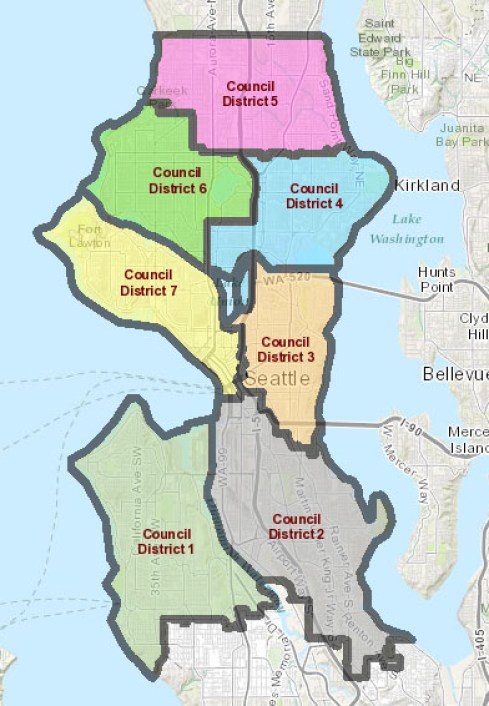
We’re about two months away from the May 15 filing deadline for city council elections, the point when no more candidates can add their names to the 52 (as of this posting) who have put their names in contention. Will the number grow to 70, for an average of 10 candidates per council race on the ballot? Will any of these candidates raise any money, or are the top two in most races already a foregone conclusion? How much money will be spent in this election, the first election under the new district system in which none of the candidates are holdovers from the pre-district system?

Those questions are obviously speculative, but a look at the money—who’s raising it, who’s spending it, and who’s benefiting—can provide some clues. Here are a few observations from the first month in which candidates have ramped up (or, in some cases, slacked off) on raising and spending on their campaigns.

A quick note about campaign fundraising figures: Cash on hand numbers are approximate, because campaigns only disclose expenditures at the end of the month. I haven’t provided cash on hand numbers for every candidate, because those numbers are less relevant now than they will be further along in the campaign, when candidates need money to drum up votes and every dollar really counts. Because many candidates choose to report contributions as they come in—a practice that becomes mandatory in the final days of the campaign—contributions are often more up to date than expenditures. When a candidate has not reported any contributions after their most recent monthly filing, I will note “as of February 28” to make that clear.

Democracy vouchers are a form of public campaign financing the city of Seattle first started using in 2017. To qualify, candidates must get at least 150 signatures and 150 donations of $10 or more from Seattle residents. Every Seattle resident received four vouchers worth $25 each, which they can contribute to any qualifying candidate. Candidates who accept democracy vouchers are subject to campaign contribution and spending limits, including an individual contribution cap of $250. Candidates who don’t participate aren’t subject to those limits, and can take contributions up to $500.

Support The C Is for Crank
If you like the work I’m doing here, and would like to support this page financially, please support me by becoming a monthly donor on Patreon or PayPal.  For just $5, $10, or $20 a month (or whatever you can give), you can help keep this site going, and help me continue to dedicate the many hours it takes to bring you stories like this one every week. This site is funded entirely by contributions from readers, which pay for the time I put into reporting and writing for this blog and on social media, as well as reporting-related and office expenses.  If you don’t wish to become a monthly contributor, you can always make a one-time donation via PayPal, Venmo (Erica-Barnett-7) or by mailing your contribution to P.O. Box 14328, Seattle, WA 98104. Thank you for reading, and I’m truly grateful for your support.

In District 1 (West Seattle), incumbent Lisa Herbold has raised the most from actual contributors, with $13,014 in contributions and about $11,996 on hand. Phillip Tavel, an attorney who got 18 percent of the vote in his run for the same seat in 2015, reported more contributions as of February 28—$17,571—but $10,590 of that was Tavel’s own money. Meanwhile, Tavel has spent $16,565. Once other debts are factored in, Tavel has a negative balance of $9,599.

Some of Tavel’s expenses, interestingly, came in the form of refunds to supporters who gave $500—the maximum contribution for candidates who aren’t accepting democracy vouchers. Tavel’s largest contribution is now $250, indicating that he now hopes to take advantage of the public financing program. As of February 28, he had 61 contributors from Seattle—89 shy of the 150 Seattle voters whose signatures and contributions he will need to qualify.

The other District 1 candidates haven’t made much of a play so far; one, SPD lieutenant and two-time state house candidate Brendan Kolding, has seemingly done nothing except loan himself money and pay it back. He has contributions from 33 Seattle residents, plus four out-of-towners with the last name Kolding.

In District 2, Ari Hoffman—the Safe Seattle-backed candidate who was in the news, most recently, for promoting an unfounded conspiracy theory about a beheading-by-saw in a homeless encampment near the Mount Baker light rail station—leads the pack in fundraising with $20,280, in part because he is not seeking democracy vouchers and can accept $500 contributions. (His latest contribution list includes two dozen such donations). Hoffman shares a campaign manager named Veronica Garcia with Ann Sattler, who is running against incumbent Debora Juarez in District 5. He has spent about $350 on Facebook ads so far.

Tammy Morales—who made it through the primary for the same seat in 2015 and narrowly lost to council incumbent Bruce Harrell—has brought in $17,699 in contributions so far, a number that will likely grow quickly (in 2015, running against an incumbent, she raised nearly $75,000). As of the end of February, Morales had a negative balance of $2,609; $3,075 in new contributions reported on March 13 should just push her into the black.

Christopher Peguero, a Seattle City Light employee and community advocate, has raised just $6,435 so far—$3,544 of that from Peguero himself—but is making decent progress toward qualifying for vouchers, with 118 contributors. South Seattle bike advocate Phyllis Porter has raised $2,618, but had already spent $12,212 as of February 28—most of that on consultants CD Strategic ($7,857) and Blue Wave Political Partners ($4,366), putting her $10,285 in the hole. Mark Solomon, SPD’s crime prevention coordinator for south and southwest Seattle, has raised $4,307. The majority of that money (53%) comes from outside city limits, but it also includes a large number of small, democracy voucher-level contributions of $10 or $20; so far, Solomon has 45 contributions toward the 150 required to qualify.

The race for District 3 presents an interesting financial picture because the incumbent, Kshama Sawant, is not taking democracy vouchers (she says she needs to be able to raise as much as possible in anticipation of “big-business” groups spending up to a million dollars to defeat her.) Partly as a result, Sawant is blowing her opponents away in fundraising, with $50,948 in contributions so far, including a Bernie-approved $27 donation to herself. So far, the overwhelming majority (84 percent) of Sawant’s contributions come from outside her district, with half her contributions coming from outside the city of Seattle itself. More than half of Sawant’s donations are maxed-out $500 contributions.

So far, the onslaught of corporate-backed candidates Sawant predicted has not materialized. King County public defender Ami Nguyen has raised about $11,398, mostly (72%) from out of town. Sawant’s closest competitor, Hashtag Cannabis owner Logan Bowers, has raised $30,572 so far, including $5,800 in democracy vouchers. A quarter of that money comes from inside District 3 (for incumbent Sawant, that number is 16%.) Bowers has spent a fair amount—about $1,300—to access the Washington State Democrats’ donor database.

Nine candidates are running in District 4, which incumbent Rob Johnson is abdicating after a single term, so I’ll limit my fundraising-related comments to the handful with significant contributions. (Obviously, it’s early days, so any of the candidates I don’t mention here, like Abel Pacheco and Cathy Tuttle, could have a fundraising surge later on.) First on that list is Alex Pedersen, a former aide to ex-council member Tim Burgess who expressed some potentially incendiary views about transit and homelessness on his since-deleted neighborhood newsletter. Pedersen has raised $44,954 so far, including $12,050 from democracy vouchers—a number that goes down to $26,518 once $18,436 of Pedersen’s own money is excluded. Pedersen’s contributors include 2015 District 4 candidate Tony Provine (creator of the infamous “bulldozers are coming” campaign mailer), Fremont property magnate and anti-bike-lane activist Suzie Burke; and well-known anti-density activists Toby Thaler, Bill Bradburd, and Susanna Lin (Lin and Thaler are on the board of Seattle Fair Growth, a group that helped sue to stop the Mandatory Housing Affordability plan the city council is finally adopting on Monday).

Emily Myers, a Ph. D candidate at the University of Washington, has raised $8,028 so far, including several hundred in $27 contributions (and 86% of it from outside her district). Shaun Scott, who is running as a member of the Democratic Socialists, has raised $14,884, including about 60 $27 contributions. No District 4 candidate other than Pedersen has qualified for democracy vouchers so far, although Scott appears to have enough qualifying contributions (the city’s democracy website does not indicate how many signatures a candidate is gathered until he or she turns them in). Nineteen-year-old college student Ethan Hunter, the subject of several fluffy media profiles when he announced he was running earlier this year, has reported no campaign activity since December 12.

District 5 incumbent Debora Juarez rarely lets a turn at the mic go by without mentioning her North Seattle district, and her relentless advocacy for her district has paid off in the form of a fairly frictionless campaign so far. Her opponents include two perennial candidates, plus Thornton Creek Alliance activist John Lombard, and attorney and former Seattle Supersonics employee Ann Sattler, who appears to be running on a law-and-order platform and is not seeking democracy vouchers. Sattler has raised $9,237,  a number that includes $4,137 of her own money. (Most of the remaining $5,000 is from $500 contributions). Juarez, meanwhile, has raised $10,500 and has registered, but not yet qualified for, democracy  vouchers.

District 6, the seat being vacated by 10-year incumbent Mike O’Brien, is the most crowded council race so far, with a dozen candidates competing to represent Northwest Seattle. It’s safe to say, though, that most of those candidates aren’t viable, and that one, former council member Heidi Wills, is already a likely frontrunner based on name recognition alone, even though she hasn’t raised much money (just $1,370, for a negative balance of $2,285 after the cost of building her website is factored in) since declaring her candidacy earlier this month. Jay Fathi, a Fremont doctor who hired local campaign veteran Christian Sinderman as his campaign consultant, is seeking to qualify for vouchers (he has 102 qualifying contributions so far), and is in the red, or just above it, despite $15,695 in contributions because he owes $12,769 to Sinderman’s firm.

Two other candidates raising money in District 6 are Jon Lisbin, who received 13% in his 2015 candidate for the same position (he’s raised $13,036, including $6,010 in contributions from himself), Dan Strauss, a legislative aide to District 7 incumbent Sally Bagshaw ($11,133), and Kate Martin, who previously ran for school board and mayor and was behind an unsuccessful campaign to preserve a section of the Alaskan Way Viaduct as part of an elevated waterfront park ($6,175).

District 7 incumbent Sally Bagshaw is the fourth council incumbent to announce her retirement this year, and eight candidates have lined up so far to seek her old job. So far, the clear frontrunner appears to be former interim police chief Jim Pugel, who has started racking up progressive endorsements and has raised nearly twice as much as his two leading competitors, with $35,796 in contributions (about a third of them, interestingly, from people who list “not employed” as their employment status, which usually indicates someone is retired). Pugel also appears to be using Sinderman’s firm, Northwest Passage, as his primary consultant. Andrew Lewis, the onetime campaign manager for former council member Nick Licata, has raised $19,155, which includes contributions from several former local, county, and state elected officials (Peter Steinbrueck, Martha Choe, Larry Phillips). Kidder Matthews development consultant Michael George has raised $18,325, largely from people in the development and building industry (and 51% from outside city limits). Naveed Jamali and Jason Williams also have relatively active campaigns; I’ll report more on their fundraising if it picks up significantly. So far, only Lewis has qualified for democracy vouchers (and has received $2,950 in voucher form); George and Williams are both seeking to qualify, and Jamali is not participating.

For up-to-date election information, check out the Seattle Ethics and Elections Commission’s campaign website. For current information on democracy vouchers, go to the city’s Democracy Voucher page.

Out of Office Notice

I’ll be out of town for the next week, returning on Monday, March 18. Have a great week, follow me on Twitter, and consider contributing to the care and feeding of this site (and me) on Patreon, Paypal, or through the other options detailed here.

See you next week!

—Erica