1. Homeowners from Magnolia squared off against renters and advocates for BIPOC Seattle residents Saturday in a forum about city council redistricting that included a preview of an amended district map that would divide the peninsula at the crest of a hill that divides the area both geographically and demographically.
Redistricting has been particularly contentious in District 6 (northwest Seattle) and District 7 (Magnolia, Lower Queen Anne, and downtown). The latest map from the five-member Seattle Redistricting Commission moves all of Magnolia into northwest Seattle’s District 6, consolidating two areas with large, west-facing houses into a single district that excludes less-wealthy areas like Crown Hill and Fremont, which would be divided into three districts.
A group called Redistricting Justice for Seattle, which represents people of color, renters, and other historically marginalized Seattle residents, came up with a map that would preserve the current dividing line in Fremont and return southeast Magnolia to District 7, while keeping other areas, like the Central District and the Rainier Valley, whole. At Saturday’s forum, dozens of supporters of the RJS plan spoke up in favor of a similar proposal from redistricting commissioner Patience Malaba that would split the Magnolia peninsula along 28th Ave. West, consistent with the RJS proposal.
However, representatives from Magnolia businesses, along with several Magnolia residents, pushed back on the plan; one called RJS a “special interest group” that was interfering in the process, while another said she was concerned about the “prejudice” she heard from RJS advocates, many of whom were Black or brown, against Magnolia.
The woman who called RJS a special-interest group also accused them of just “looking at a map” and deciding to divide up a cohesive neighborhood. Actually, the eastern half of the peninsula has far more in common with the less wealthy, renter-heavy parts of District 7 than it does with the view homes on the west side of the 500-foot hill that actually divides the area.
According to data from the US Census Bureau, the three Census tracts that make up this area are overwhelmingly renters (58, 70, and 77 percent, respectively), racially diverse (between 28 and 39 percent people of color), and young (with a median age between 33 and 36.) In contrast, the west-facing, view-home half of the neighborhood is 90 percent homeowners, 81 percent white, and has a median age of 47—a population whose own special interests are powerfully served by splitting up renters and voters of color into multiple voting districts.
The redistricting commission will meet again at noon on Wednesday, October 12, at City Hall.
2. With less than a month to go before election day (November 8), the campaign to change Seattle’s election system to one where voters can select as many candidates as they like (approval voting) continues to far outpace the competing campaign for ranked-choice voting (a system in which voters rank candidates by preference) and for retaining the current top-two primary system. Seattle Approves, the campaign for approval voting, had raised nearly $500,000 by the end of September, while Ranked Choice Voting for Seattle had juts $52,000 and Seattle for Election Simplicity, the local business-backed group that wants to keep elections the same, had raised just under $45,000.
More than $200,000 of the funding for Seattle Approves came from the Center for Election Science, a tech billionaire-backed California think tank that’s pushing approval voting. Another $135,000 from Sam Bankman-Fried, the founder of the cryptocurrency exchange FTX. Eighty-seven percent of the funding for Seattle Approves has come from outside the state of Washington (including Nassau, Bahamas resident Bankman-Fried), and just 2 percent of the campaign’s contributions come from donors who gave $700 or less.
In contrast, 79 percent of the funding for Ranked Choice Voting for Seattle so far has come from inside city limits, most of it from district 7, which includes downtown, Magnolia, and Queen Anne. Eight percent of contributions to the ranked-choice voting campaign were under $700.
Seattle for Election Simplicity’s funding consists entirely of larger donations, but those top out at $5,000—compared to Seattle Approves’ $211,000 and Ranked Choice Voting for Seattle’s $25,000. Most of the donors advocating for the status quo are, perhaps unsurprisingly, local, with 36 percent of the the group’s contributions coming from outside city limits.
The King County Jail in downtown Seattle has lacked potable water since Thursday, September 29, and people incarcerated at the jail have been relying on bottled water for the past week, PubliCola has confirmed.
According to a spokesman for the county’s Department of Adult and Juvenile Detention (DAJD), the county “has had the tap water in the jail tested multiple times in multiple locations, and all tests have indicated that the water meets EPA standards for drinking water. However, since the water is still cloudy, we are providing bottled water for drinking and cooking purposes.” The jail has “ample supplies of bottled water,” the spokesman said.
According to the president of the King County Corrections Guild, Dennis Folk, inmates are allowed one bottle of water at a time and can trade in empties for new bottles. This restriction, Folk said, makes it less likely that people will melt the plastic bottles to turn them into weapons or fill them with urine or feces to fling at guards or other inmates.
However, it’s unclear how frequently people inside the jail are actually getting access to water.
“What we are hearing is that there is rationing of water and people are having to choose between hydration or hygiene, and there just isn’t enough water available,” the president of the public defense union (SEIU 925), Molly Gilbert, said.
A spokesman for the jail said there is no rationing and that DADJ offers water “at every meal, periodically throughout the day, during medication delivery, and per request of jail residents.”
PubliCola reported the news exclusively on Twitter Thursday morning.
According to an email from King County Department of Adult and Juvenile Detention (DAJD) director Allen Nance to the King County Department of Public Defense, the department became aware of “complaints related to water quality” last week (according to Folk, the water coming out of the taps was brown). “We immediately implemented bottled water for all persons in custody and staff out of an abundance of caution,” Nance wrote.
“We have women in the jail who are having their period and they’re unable to get a change of underwear for the week,” Gilbert said. “It’s inhumane, it’s unconstitutional, and it’s a clear liability for the county.”—Molly Gilbert, SEIU 925, King County Public Defense Chapter
Water testing found high “turbidity,” or cloudiness—basically, foreign particles in water that can indicate the presence of disease-causing microbes—and the water has remained off since then while the county has tried to figure out the source of the problem. In his email, Nance said the brown water may have resulted from faulty screens on the water heaters at the jail. According to the DAJD spokesman, the county has sent samples of the water for testing and expects to get the results back tomorrow.
The ongoing water shutoff is just the most recent example of ongoing problems at the jail that have severely limited residents’ access to medical care, attorneys, and time outside their cells. In a survey conducted by the ACLU of Washington in late September, public defenders reported that their clients often lacked access to basic medical care, such as treatment for injuries and dental care, and medication, including everything from insulin to psychiatric meds. When there aren’t enough guards on duty, Gilbert said, escorts for the jail nurses who hand out medication are often the first thing to go. Responding to Gilbert’s statements, the jail spokesman said there are “few if any instances when medication passes would be affected by corrections officer staffing” and that the jail delivers medication even during staffing shortages.
Most of the ongoing issues at the jail stem directly from a worsening staffing shortage, combined with a growing population as the county books more people on misdemeanor charges and transfers inmates from the Regional Justice Center in Kent, whose setup requires more guards per incarcerated person. In recent months, staffing shortages at the jail have led to frequent lockdowns, in which people are locked in their cells 23 hours a day, and defense attorneys report waiting hours to meet with clients, who have to be escorted to meeting areas by guards who are in short supply.
In January, the unions for the public defenders and jail guards joined forces to ask county officials to reduce the population at the downtown jail. Although that request was in response to COVID outbreaks, the staffing shortages that were at issue back then have only worsened in the intervening months.
“We have women in the jail who are having their period and they’re unable to get a change of underwear for the week,” Gilbert said. “It’s inhumane, it’s unconstitutional, and it’s a clear liability for the county.” The jail spokesman disputes this and says jail inmates regularly receive fresh clothes regularly, and can get clean underwear whenever they want.
King County offers hiring bonuses for guards at both the adult and youth detention centers, but hiring hasn’t kept up with attrition as guards burn out and leave. Booking fewer people into the jail would be one solution—about half the people in the downtown jail are booked for three days or less—but that idea is politically unpopular at a time when perceptions of crime have increased. One candidate for King County Prosecutor, Federal Way mayor Jim Ferrell, recently signed on to an “open letter” from eight South King County mayors calling for more felony bookings and “incarceration to ensure… public safety.”
1. The Seattle Police Department has fired controversial officer Andrei Constantin, who created a fake Twitter account to harass and mock protesters and make fun of victims of police violence, including George Floyd and Breonna Taylor.
According to the SPD disciplinary action report explaining why Constantin was fired, the officer posted dozens of “extremely unprofessional, offensive, derogatory, and entirely unacceptable” tweets that “celebrated violence against protesters, ridiculed human beings who were injured or killed, taunted the family members of deceased individuals, and publicly accused SPD of hating its employees, blamed victims of assault, appeared to celebrate a homicide, and stated George Floyd ‘got justice.'”
Constantin’s tweets, originally uncovered by Twitter user @WhiteRoseAFA in October 2021, included posts calling people who participated in the 2020 protests against police violence “antifa terrorists” who should be “napalmed”; mocking the death of the young activist Summer Taylor, who was struck by a driver in a section of I-5 that had been closed down for a march; and telling the mother of an activist who was murdered in Portland, “Rest in piss bitch.” Constantin posted as @1SteelerFanatic under the name “Bruce Wayne”; he deactivated the account last year.
4. Meet Officer Andrei Constantin of the Seattle Police.
Constantin was previously the subject of at least nine other Office of Police Accountability complaints. Those complaints, detailed on the SPD.watch website, included: Pulling over a driver without justification, pointing a gun at him, and handcuffing him; threatening to use his Taser on a man who was not being threatening; and detaining a homeless Black bike rider and for nearly an hour. Last year, as PubliCola reported, Constantin received an eight-day unpaid suspension after shattering the driver-side window of someone’s car while they were sitting at a gas station.
In his written decision to fire Constantin, SPD police chief Adrian Diaz acknowledged Constantin had received “counseling” for the mental anguish he claimed to have endured as the result of the 2020 protests, but said that in light of his long disciplinary history and the “inexcusable” nature of his posts, Constantin could no longer work at SPD. Constantin last day at SPD was September 22.
2. The union representing Seattle Public Utilities’ 85 call center employees has reached an agreement with the city that exempts these workers from the mandate that all city employees come in to the office a minimum of two days a week, PubliCola has learned. As we reported in July, many call center workers preferred working from home because it was a huge improvement on commutes that could add up to hours of unpaid time in the car or on the bus each day.
“The City shall exempt the employees in the SPU Contact Center from any in-office minimum requirement, in acknowledgement of the substantial expense compliance would cause that department to incur,” the agreement says.
As we reported in July, call center workers have been more efficient and effective, by the city’s own metrics, since representatives started working at home instead of a crowded room in downtown Seattle.
The agreement allows SPU to require workers to come back to the office if management decides it will “improve operations.” It also requires call center employees to live within a three-hour drive of the Seattle Municipal Tower so they can get there if needed—a change that narrows the possibilities for true telecommuting.
In addition, other city employees who are subject to the mandate—part of Mayor Bruce Harrell’s “One Seattle” effort to bring workers back into a still-struggling downtown—will be allowed to spread their in-office days across a two-week pay period, instead of coming in two days every week. The agreement also clarifies what counts as “in the office” (field work, including inspections, public meetings, and trainings will count as in-office time) and give individual departments the opportunity to ask for exemptions from the rules.
In July 2020, King County Executive Dow Constantine committed publicly to closing down the Patricia H. Clark Children and Family Justice Center (CFJC), saying it was time to shift “public dollars away from systems that are rooted in oppression and into those that maintain public health and safety.”
“Today I commit King County to converting the remaining youth detention units at the CFJC to other uses as quickly as possible, and no later than 2025,” Constantine announced in a Twitter thread that noted the connection between police murders of Black people and mass incarceration. About half the kids King County incarcerates are Black, a group that makes up about 6 percent of the county population, and about 18 percent are white, compared to 69 percent of the county.
Constantine’s announcement came at a time of heightened public scrutiny of the criminal legal system in the immediate aftermath of George Floyd’s murder by police in Minneapolis. The youth detention center had opened just five months earlier, replacing a decrepit, 212-bed facility next door, and stood largely empty because of COVID and a general reduction in youth arrests. The population would hover at about 20 young people throughout the next year, peaking at 26 and dipping to just 17 in August 2021.
One year later, however, the trend has reversed. In August, the average daily population at the youth jail was 41; on October 3, it was 42, including four kids charged as adults. While the population at the jail has grown, the number of guards at the jail has declined; as of September, 22 of 91 juvenile detention officer positions were unfilled, down from about six vacancies in the fall of 2020—a shortfall of 24 percent.
The timeline for closing down the youth detention center could also get a reality check. Closing the jail requires alternatives to incarceration that don’t exist yet, and the process to come up with those alternatives, which will likely include restrictive housing for youth who present a danger to the community, is proceeding slowly.
The increase in the number of young people incarcerated at the CFJC is exacerbated by a similarly steep decline in the number of people working at the jail. A representative of the Juvenile Detention Guild told PubliCola that juvenile corrections officers are leaving their jobs more than twice as fast as the county can hire replacements. Understaffing has also impacted other positions at the facility, which has at times been short on nurses and other medical staff. The high attrition rate has created a shortage not just of workers but experience—a gap that shows no sign of closing even as the county ramps up financial incentives to get new hires in the door.
Understaffing has contributed to the frequent use of solitary confinement, a practice that persists even though it was officially banned in 2017. Jail officials acknowledge that they use “room confinement” when there aren’t enough staff to let kids into common areas safely, but there is no legal distinction between “room confinement” and other euphemisms for isolating kids in their cells for up to 20 hours a day.
Solitary confinement leads to stress, boredom, and fights, and has contributed to a reported uptick in assaults on guards and other staff. According to the juvenile guards’ union representative, “We hire staff who want to work with youth, but they are leaving [because] it is an unsafe work environment, we have to lock youth in their dorms for extended periods of time, [and we] do not have sufficient staffing to provide services to the youth.”
King County officials are aware that keeping kids in their cells is a problem, but the use of the practice has been escalating. In July, there were 13 days when kids were locked in their cells between 18 and 20 hours a day because of short staffing at the jail. Additionally, an independent monitor’s report released in May found a “significant increase” in the number of times youth were put in “restrictive housing” (solitary confinement) because of a risk of “imminent and significant physical harm to the youth or others,” along with a spike in the length of this form of confinement; in the first quarter of this year, 41 kids were put in restrictive housing for an average of 6 hours per session.
Nick Straley, an attorney with Columbia Legal Services, says the Department of Adult and Juvenile Detention (DAJD) is skirting laws that were passed specifically to prevent the department from doing exactly what it’s doing now. “The King County Council should get involved and pass strict requirements that force DAJD to do the right thing because we know they aren’t” on their own, Straley said.
King County Councilmember Girmay Zahilay—who, like most of the nine county council members, visited the CFJC recently to get a better sense of conditions at the jail—said he was “shocked” to learn recently that the county still effectively allows solitary confinement for youth.
“If we literally don’t have the staffing to monitor people, I understand why that creates a different kind of situation, but it still is alarming, because from an experiential perspective rather than a technical perspective, the youth experience that the same way,” Zahilay said. “All the reasons we don’t want solitary confinement for youth are still true in that scenario, and we have to do everything we can to change those circumstances.”
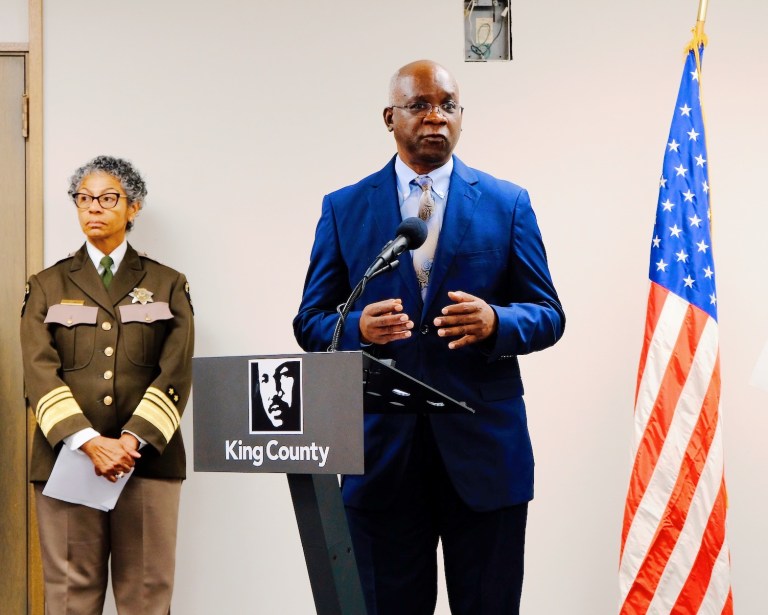
Department of Adult and Juvenile Detention Director Allen Nance (background: King County Sheriff Patti Cole-Tindall)
For adolescents, confinement is a particularly harsh punishment, depriving them of not only of chances to interact with other kids and adults but making it harder to schedule visits with attorneys and family members. During visits, kids are separated from their family members by Plexiglas, depriving them of the chance to hug their parents or hold their own children.
“There have been issues with parents not being able to have contact with their kids and only being able to see each other through Plexiglas,” a COVID-era innovation that prevents direct contact between family members and incarcerated youth, CLS’ Straley says. “The reality is that you’ve got the bare minimum level of humane treatment, and simply not having enough staff isn’t the only reason. They need to have more staff, and/or they need to have fewer kids in jail.”
There’s little consensus about why the county is locking up more kids at a time when youth detention is supposedly on a path to extinction. Jimmy Hung, who leads the juvenile division of the King County Prosecutor’s Office, attributes the reversal to an uptick in violent crime among both young people and adults. “And it’s not isolated to King County; it’s throughout the country,” Hung said. “We are dealing with aftermath of a once-in-a-century global pandemic, and that has also collided with the continuing escalation and increase in just the sheer number of firearms we have in our community.”
Straley believes the “perception out there that crime is running out of hand” is also contributing to harsher sentences from judges. “I think that perception is not accurate, but that’s the perception, and judges are aware of that and they adjust the sentence accordingly,” he said.
A DADJ spokesman, Noah Haglund, said another reason more kids are being detained is that incarcerated youth are being incarcerated longer, particularly the small percentage of kids charged as adults, whose average stay at the CFJC is 284 days; for kids detained on juvenile charges, it’s 17. Both averages have increased over the last five years.
Whatever the reasons, the number of kids at the youth jail is growing, and the number of staff at the jail is not keeping up.
DAJD director Allen Nance, appointed to the position last month after three years as head of the juvenile division, told PubliCola recently that the department “recognize[s]that not only do we need to do a better job recruiting quality folks to work with our young people in custody, but we also have to work diligently to implement strategies to keep the employees that we have today.”
Currently, the department offers hiring bonuses of $7,500 for new hires and $15,000 for lateral hires, as well as $5,000 to any county staffer who recruits a new detention officer for the adult or youth detention center. (Jobs at the adult jail pay slightly better).
However, the county lacks any significant programs to retain jail staffers once they’re hired—a major problem, given how many leave after they experience the challenges of the job; according to the union representative, “many staff will forfeit the money versus staying due to conditions” at the jail, including low morale, lack of support from DAJD leadership, poor schedules, and a lack of transparency about what will happen to CFJC staff if and when the facility closes.
Rod Dembowski, a King County council member who has been skeptical of the 2025 closure date, said during a recent council meeting that one reason the CFJC may be having trouble hiring guards is that the jobs offer no long-term security. “Why would someone come on to this job or stay in this job if it’s going to be gone in two or three years?” Dembowski said. “It’s not a real great career incentive and that may be hampering us.”
Hiring bonuses remain the primary tool the county uses to recruit new guards at both the juvenile and adult jail, which is also facing a crippling staff shortage. But county rules require newly hired jail staff to pay part of their bonuses back if they stay less than three years, which means that a guard hired today would have to stay at the CFJC until 2025, when the facility is supposed to close, with no guarantee of a new position.
“Our office’s position has always been that zero youth detention is a goal that we should strive for, and it’s aspirational. I don’t believe that we can truly reach zero youth detention before I’m gone, but maybe for my daughter and my grandkids we can see that [happen].”—King County Prosecutor’s Office Juvenile Division Director Jimmy Hung
At the same time, the juvenile detention department currently relies heavily on mandatory overtime, which falls primarily on new hires. Nance, the DAJD director, said “we definitely intend to reduce over-reliance on mandatory overtime, and in fact, incentivize individuals to voluntarily work overtime,” but did not offer specifics when we asked him about the issue in September.
Nance also said the department is “in the process of finalizing” retention incentives for existing staff, “recognizing that those individuals who have already made the commitment to stay at the detention facility through 2025 deserve an opportunity to work in an environment where they are valued, where they where they are well compensated, and where we go above and beyond wherever we possibly can to support their continued employment in the department.”
Nance did not offer more details about the department’s strategy to keep the staff it has.
Nor is it clear whether the youth detention center will actually close in 2025—or ever. Earlier this year, planning for the closure shifted from the DAJD to the Department of Community and Human Services (DCHS) in recognition of the fact that closing the youth detention center will require standing up community-based alternatives to incarceration, including housing that is more humane than a jail. Continue reading “Fewer Staff, More Incarcerated Kids, and Frequent Solitary Confinement as Youth Jail Closure Deadline Approaches”→
The Seattle Police Department presented its initial “risk managed demand” analysis of 911 calls to the city council’s public safety committee earlier this week, a long-awaited presentation that was cut short because council members needed to get to Mayor Bruce Harrell’s budget speech. The eventual goal of the analysis, which looked at 356 call types and categorized them by the risk of harm they posed to callers, is to come up with a system for routing some calls to non-police responders or co-response teams, in which police serve as backup to service providers; this initial report is just a first step toward that eventual goal.
As we’ve reported, Mayor Bruce Harrell has adopted a go-slow approach to implementing alternatives to police, frustrating some council members who have been pushing for years to implement a pilot for responding to low-risk calls, along the lines of programs already in place in cities across the country, and see how it works. Earlier this month, Harrell’s office indicated they were open to a small pilot along the lines of Eugene’s CAHOOTS program or the Star program in Denver; his proposed budget for 2023 includes about $2 million for this purpose.
First, SPD gave each call type a risk number based on how the city currently responds to calls—an “all-hazards” response that always includes police. Then they applied a “mitigation” factor, essentially asking: What would this call look like if non-police responders were available?
SPD’s analysis looked at 356 different types of calls and categorized them by risk, taking two passes at the question. First, they gave each call type a risk number based on how the city currently responds to calls—an “all-hazards” response that always includes police. Then they applied a “mitigation” factor, essentially asking: What would this call look like if non-police responders were available to go out either alone or in tandem with police?
Between the two rounds, SPD data crunchers manually “recoded” more than half of all calls; 31 percent were “upgraded” to a higher risk level (meaning SPD believes police need to be present) and 23 percent were downgraded to a lower risk, based on the assumption that non-police responders would de-escalate a situation. SPD Chief Operating Officer Brian Maxey told the council that, for example, a welfare check might be categorized as Tier 1 (the highest-risk situation, requiring police), but further analysis would downgrade it to a Tier 3, which a social service provider could respond to with police backup.
In response to questions from committee chair Lisa Herbold and Councilmember Teresa Mosqueda, Maxey said SPD looked at the risk to people on the civilian end of 911 calls, rather than police, because the estimate of risk to police would have to be based on the current all-hazards response, which created the risk of “bootstrapping” the assumption that the risk to officers is generally higher than it is. “It seems like a completely different exercise to me,” Herbold said. “If you include use of force, then we are skewing the data in favor of a police response,” Maxey responded.
Herbold told PubliCola she was also concerned about the fact that SPD’s modeling required so much intervention by a human being who reversed the initial finding more than half the time. Since SPD’s model “only gets it right about half the time,” she said, “is this one performing the way SPD wants it to perform? Should we think about revising the formula?” It may be, ultimately, that there is no truly objective formula for pinpointing how much risk every 911 call poses to anyone, which means the best course of action could be moving forward with alternative responders based on the imperfect information we do have, rather than perfect information that will never be possible.
During the next phase of the analysis, SPD will begin setting up a “call triage system” in which bots that can process and categorize natural language to help 911 operators categorize calls based on their level of risk, using the “objective” measure of word frequency to augment call-takers’ human instincts. Accenture, a multinational management consulting and data analysis firm that has had a blanket contract with SPD since 2015, is developing that system now.
The public safety committee won’t meet again until December, after adopting the 2023 city budget.
In a preview of the next several weeks of budget deliberations, the city council’s budget committee (which includes all nine council members) discussed their initial questions and concerns about Mayor Bruce Harrell’s proposed budget this week.
The budget would require the city council to overturn a 2019 law Harrell himself supported when he was on the council. That law requires the city to increase human service provider contracts by the rate of inflation, with the intent of providing raises to service providers that at least keep up with inflation; during the meeting when the council unanimously approved the law, Harrell said it was important to provide raises to human service providers “in both periods of economic growth and in periods of economic hardship,” and sponsored an amendment codifying this intent.
The contracts that would be impacted include all the homeless contracts the city funds but that are now administered by the King County Homelessness Authority. Harrell’s proposal would amend this law to cap mandatory pay increases at 4 percent a year, or about half the current rate of inflation, meaning that as long as inflation is higher than 4 percent, human services workers would see declines in real wages year after year. Harrell’s budget cites economic hardship as the reason he is proposing the cut.
Three years ago, Harrell took the exact opposite position. In 2019, as council chair, he proposed and passed an amendment emphasizing not only that the money needed to go directly to “underpaid” workers but that the city intended to provide full inflationary increases “in both periods of economic growth and in periods of economic hardship.”
Harrell’s proposed $10 million budget increase for the KCRHA would be earmarked mostly for shelters and tiny house villages, rather than the items the homelessness agency proposed funding in its request for $90 million in additional city and county funding; that unfilled request would have funded a 13 percent wage increase for homeless service providers.
“In the entire spectrum of building this budget, this decision was particularly difficult,” city budget director Julie Dingley told the committee. “We know that human service provider workers do some of the most difficult and meaningful work in the city and that employers do not necessarily enjoy the funding needed, but unfortunately, during forty-year high inflation, the ongoing liability that the current law would require, does not match our ongoing general fund resources.”
Three years ago, Harrell took the exact opposite position. In 2019, as council chair, he proposed and passed an amendment emphasizing not only that the money needed to go directly to “underpaid” workers but that the city intended to provide full inflationary increases “in both periods of economic growth and in periods of economic hardship.”
Introducing his amendment at a full council meeting that year, Harrell said, “Some of us have been around where we’ve had real tough times, [during] a recession. While we’ve had to make tough cuts, the work [human services providers] do is so critically important that we recognize we have to preserve if not even enhance the funding” during economic downturns.
On Wednesday, Councilmember Lisa Herbold, echoing comments by budget chair Teresa Mosqueda, said she was “disappointed” that the mayor’s budget would permanently cap increases for human service providers regardless of the actual inflation rate. ”
“We heard from folks this morning, nonprofit leaders, who have already passed budgets that provide a modest but essential wage increase for staff on the strength of their trust that the city was going to to follow the law and fully fund the required increase,” Herbold said. “Our intent is to advance nonprofit worker wages, not force them further behind, which I feel that this proposal does.”
As of earlier this year, the KCRHA reported that the five largest homeless service providers had more than 300 vacancies for jobs that average between $20 and $25 an hour, or between $41,000 and $52,000 a year. Increasing all human services contracts (which include more than just homeless providers) by 7.6 percent, as existing law requires, would cost about $6.5 million. As a point of contrast, Harrell’s budget includes more than $4 million for police recruitment and retention strategies, an effort to increase the number of Seattle Police Department officers that includes hiring bonuses of up to $30,000, on top of an $83,000 starting salary that rapidly increases to six figures, plus overtime, according to SPD’s recruitment page.
Image via King County Regional Homelessness Authority
Harrell’s budget proposes a second change to law that takes the opposite approach to high inflation as his proposal to cap human service contract increases below inflationary levels. This change would allow the city to use the JumpStart payroll tax fund, which is earmarked for housing, Green New Deal programs, equitable development, and small businesses, to provide about $86 million toward filling the $140 million budget gap.
Last year, the council passed a law setting a clear limit on the use of JumpStart funds to backfill general fund shortfalls: If the general fund falls below $1.5 billion, the city can use JumpStart money for other purposes. Harrell’s budget would change that law to pin the general fund baseline to inflation, setting the floor for JumpStart transfers at a variable rate based on the current rate of inflation and allowing the city to use more of the earmarked money for non-JumpStart purposes whenever high inflation leads to economic hardship.
That money includes a presumption of $44 million in unspent JumpStart funds from this year, most of which would go toward a new revenue stabilization (“rainy day”) fund equal to 10 percent of JumpStart revenues every year; another $9 million would pay for administering the JumpStart tax itself through the general fund.
Mosqueda, the architect of the JumpStart tax, said she had questions about how the mayor is proposing to spend the repurposed tax and whether his plan aligns with the four priorities in the original JumpStart legislation.
“We have to continue, as a council, to make sure any of the higher-than-anticipated revenue that is being suggested to be used for investments into the general fund does still align with our city’s core progressive values” as well as “with the priorities this council has articulated in the past,” Mosqueda said.
“Part of the demand we all heard was, you have to tell us where you’re going to spend this [JumpStart] money. I totally agree that we need more revenue in the general fund so we can do the basic things that we need to do as a city, [but] these are commitments we have made to the people of Seattle.”—City Councilmember Tammy Morales
For example, Mosqueda questioned the mayor’s proposal to use $3 million a year in JumpStart funds to pay for 14 new positions at the city to support Sound Transit’s construction of light rail from West Seattle to Ballard, which Dingley said fits into the “Green New Deal” spending category because it involves shifting people from single-occupancy vehicles to trains.
When the council first considered the JumpStart tax, Councilmember Tammy Morales notes, “Part of the demand we all heard was, you have to tell us where you’re going to spend this money. … I totally agree that we need more revenue in the general fund so we can do the basic things that we need to do as a city … [but] these are commitments we have made to the people of Seattle” in the JumpStart spending plan itself and subsequent legislation codifying the spending categories the tax can be used for.
Harrell’s budget proposal would also broaden the use of the JumpStart tax to allow it to fund housing for people making up to 60 percent of the area median income; currently, the tax primarily funds housing for very low-income people making up to 30 percent of AMI, a group that is not served at all by the market-rate housing market. The JumpStart tax can already pay for mixed-income housing that includes people making up to 60 percent of median, but the change would likely change the balance in favor of people making more money.
Harrell’s budget uses $20 million in unspent funds from 2022 and assumes an ongoing $10 million annual “underspend” in both 2023 and 2024; City Budget Office director Julie Dingley told council members Wednesday that she “would prefer not to have to use this kind of strategy,” but that “we feel comfortable at this point that there will be about this amount left at the end of the year” to balance the next year’s budget.
The budget also proposes using general fund dollars to continue and expand the Clean City Initiative and the new Unified Care Team, which together clean up trash, displace and relocate encampments and RVs, provide information about services and shelter beds to people being displaced by sweeps, and take residents’ complaints about encampments. The proposed budget would allocate more than $13 million to these programs, not counting the many individual line items related to graffiti cleanup, a particular pet peeve for Harrell. The budget would spend more than $800,000 on graffiti abatement, plus another $250,000 on Harrell’s One Seattle Day of Service, which includes graffiti abatement by volunteers.
Donate to The C Is for Crank's Laptop Retirement Fund
My computer is the single most important piece of equipment I own, and for much of the last five years, I’ve relied on my trusty 2015 MacBook Pro to write and edit posts, tweet up a storm from public meetings, file public records requests, edit transcripts and photos, and generally keep The C Is for Crank in operation. Now it’s time to retire my old machine and trade it in for a newer model.
I’d really appreciate any help my readers are willing to provide to help me defray the cost of this critical piece of office equipment. A new, faster machine (not to mention one without—ahem—an ever-so-slightly cracked screen) will make it easier to bring The C Is for Crank to you every day. My back will also be grateful as I rush from candidate debate to city council meeting to coffee shop back to City Hall. I accept contributions via Venmo (Erica-Barnett-7), Paypal, and by check at the address on my Support page. Thank you so much for your support!


 Redistricting has been particularly contentious in District 6 (northwest Seattle) and District 7 (Magnolia, Lower Queen Anne, and downtown). The latest map from the five-member Seattle Redistricting Commission moves all of Magnolia into northwest Seattle’s District 6, consolidating two areas with large, west-facing houses into a single district that excludes less-wealthy areas like Crown Hill and Fremont, which would be divided into three districts.
 According to the SPD
 By Erica C. Barnett
 By Erica C. Barnett
