Category: Politics

“We Are Intentionally Tying Our Hands”: Council Passes Soda Tax Spending Plan with 7-Vote Majority


The simmering tension between the mayor’s office and the city council boiled over this afternoon, as the council passed (and Mayor Jenny Durkan immediately vowed to veto) legislation sponsored by council member Mike O’Brien that creates  a dedicated fund for excess revenues from the sweetened beverage tax, and stipulating that this money can only be used for new or expanded programs benefiting the low-income communities most heavily impacted by the tax. The vote was a veto-proof 7-1, with Debora Juarez (D5) absent and interim District 4 council member Abel Pacheco voting no.

“We are intentionally tying our hands,” O’Brien said Monday afternoon, by “making a clear policy statement that this money should be off limits except for the stated purposes” laid out in the legislation.

This debate has a long history. In 2017,  the council passed the controversial tax with the stipulation that the revenues from the tax would be poured back into programs promoting equitable food access in the communities most impacted by the tax—low-income communities and communities of color that lack access to affordable, healthy food. One year later, with soda tax revenues coming in higher than anticipated, Mayor Jenny Durkan proposed (and the council approved) a budget that used those “extra” dollars to fund food-access and education programs that had previously been funded through the city’s general fund. The budget swap came with a caveat: By 2019, the council said, Durkan needed to come up with a plan to ensure that soda tax revenues were used to fund healthy-food initiatives, not used to free up funding for other mayoral priorities.

Durkan expressed her “disappointment in the City Council’s vote to pass legislation that creates a significant hole in the City’s budget and cuts funding for critical low-income programs”

That didn’t happen, which brings us to the latest impasse. Last week, Durkan’s departments of Human Services and Education and Early Learning sent letters to providers warning them that the council planned to “cut” their funding. As I reported, dozens of service providers responded with letters rejecting this framing, condemning the mayor for (as they saw it) holding their funding hostage to a political battle over revenues that shouldn’t have been used to supplant general-fund dollars in the first place. On Monday, representatives from these groups showed up at city hall to support O’Brien’s legislation. For Durkan “to end funding for basic needs and services is the unthinkable and simply cruel,” El Centro de la Raza human services director Denise Perez Lally told the council—an especially blunt, but by no means isolated, assessment of Durkan’s position.

At the same time—and completely unbeknownst to the council—the Senior Action Coalition, a group that represents Chinese American seniors with limited English proficiency, showed up in force to oppose O’Brien’s legislation. It was unclear how many of the dozens of seniors who filled the council chambers were familiar with the details of the proposal. Several spoke generally, in English, in favor of preserving funding for food banks, but there were no translators for the non-English speakers in the crowd. “We weren’t told they were coming,” a surprised-looking council staffer said. Tanika Thompson, a food access organizer with Got Green, addressed the group directly during public comment. “I want you to know that the mayor has the power to fund your programs and is working on her budget right now,” Thompson said. “This is a scare tactic to pit our united organizations against each other.”

Pacheco, who was appointed to serve the remainder of former council member Rob Johnson’s position back in April, tried to introduce an amendment that would push back the effective date of the legislation until 2021, arguing that because the council “endorsed” a tentative 2020 budget last year as part of the normal budget process, any changes now would amount to “cuts.” (This is exactly the argument Durkan has made, arguing that O’Brien’s legislation “directly cuts” programs funded through 2020 in the endorsed version of the budget.) In fact, the mayor proposes a new budget every year; the “endorsed” second-year budget always changes—sometimes dramatically—based on a mayor’s priorities, available funding, and spending obligations created during the intervening year, making this an unusual and arguably tenuous argument that ignores the ordinary push-and-pull of the annual budget process.

“I don’t think that those of us who are sitting here now imagined a world in which we would be put in this unfortunate situation of manufactured division among communities of color and disadvantaged communities.” — Council member Lorena Gonzalez

After his amendments failed, Pacheco apologized to human services providers on behalf of the council for failing (before he was appointed) to secure long-term funding for the programs Durkan moved out of the general fund last year. This prompted a stinging rebuke from council member Lorena Gonzalez, who said, “The only apology that I’m going to give to the community is that we didn’t catch this when we passed it back in 2017, because it has always been our intent to have this be a dedicated revenue source.” Back then, Gonzalez continued, “I don’t think that those of us who are sitting here now imagined a world in which we would be put in this unfortunate situation of manufactured division among communities of color and disadvantaged communities and the pumping out of terribly inaccurate information that has resulted  in creating a tremendous amount of fear in community-based organizations.”

Who Said It? A Quiz from Last Night’s GOP-Sponsored Homelessness Forum

In a bit of kismet (or misfortune?) so perfect it almost seemed planned, the 43rd District Democrats held their primary-election endorsement meeting last night at Kane Hall on the UW campus—right next to a forum sponsored by the 36th District Republicans titled “HOMELESS & ADDICTED IN SEATTLE.” (Two Democrats I talked to in the foyer outside both events referred to the panel as “the hate group meeting” and “the Klan rally,” respectively).

The 43rd’s endorsements were uneventful (no candidate reached the 60% threshold for endorsement in Districts 3, 4, 6, or 7—the four districts that partially overlap with the 43rd), so I spent my night popping back and forth between the Democrats and the Republicans, whose security guards eventually stopped checking my backpack every time I returned.

The panel brought together two AM radio hosts, a police union leader and SWAT team offcer, the founder of Safe Seattle, a former Republican state legislator who now leads the Family Policy Institute of Washington, the program manager for Christian shelter provider Union Gospel Mission, and several others, to spend three hours agreeing at length about what causes homelessness and how to fix it. (In the panel’s apparently unanimous view, addiction, specifically heroin addiction, is the main root cause of homelessness, and the fix consists of tough-love “solutions” like forced treatment and making it “more uncomfortable to stay addicted,” as one panelist put it.)

It would have been a perfect echo chamber, if not for the presence of a few hecklers  (quickly ejected), plus a handful of folks who stuck around to ask questions that challenged the unanimous tough-love narrative of the panel (quickly shouted down). I find echo chambers exhausting (witness, on the other end of the spectrum, my extreme reluctance to cover council member Kshama Sawant’s endless “PACK CITY HALL” rallies), so instead, I’ve gathered a few quotes from last night’s panel into a little quiz.

See if you can guess which speaker from this list made each of the following statements (answers below the jump).

1. “You can’t have a relationship [with a homeless client] when you’re a social worker. My ex-wife is a social worker…. There’s no relationship.”

2. “Take the ties off of the hands of our brave men and women who are officers and allow them to do their jobs.”

3. “[There are t]hose who are advocating for giving more and more and more money and more and more services to people that aren’t taking any responsibility, and that is called enabling.”

4. “I don’t like doing my job anymore.”

5. “That question is a setup! I’m not going to tell him!”

6. “If you want to have a conversation with a bunch of experts, you can organize your own panel.”

7. “There is no homelessness in South Korea, in Japan, because they have a culture of family, of focusing on virtue. … If you have a culture that’s broken… you have evil, you have drugs, you have no accountability.”

8. “I’ve worked with hundreds of homeless people over 15 years. I have dozens of friends who have been homeless. The majority of those dozens of friends are not addicts.”

9. “Third and Pike, the downtown market, is the largest criminal organization for shoplifting in this country.”

10. “I think we have to stop calling it homelessness. I think we have to start addressing it as addiction.”

Support The C Is for Crank
Hey there! Just a quick reminder that this entire site, including the post you’re reading, is supported by generous contributions from readers like you, without which this site would quite literally cease to exist. If you enjoy reading The C Is for Crank and would like to keep it going, please consider becoming a sustaining supporter. For just $5, $10, or $20 a month (or whatever you can give), you can help keep this site going, and help me continue to dedicate the many hours it takes to bring you stories like this one every week. This site is my full-time job. Help keep that work sustainable by becoming a supporter now! If you don’t wish to become a monthly contributor, you can always make a one-time donation via PayPal, Venmo (Erica-Barnett-7) or by mailing your contribution to P.O. Box 14328, Seattle, WA 98104. Thank you for reading, and I’m truly grateful for your support.

Continue reading “Who Said It? A Quiz from Last Night’s GOP-Sponsored Homelessness Forum”

Chamber of Commerce PAC Endorses Just One Incumbent in Council Races

The Civic Alliance for a Sound Economy—the political branch of the Seattle Metropolitan Chamber of Commerce—announced its endorsements this morning, in a preview of which candidates will  benefit from  the $800,000 Chamber president Marilyn Strickland says the PAC has amassed so far.

Here are CASE’s endorsements:

Seattle City Council Position 1: Phil Tavel
Seattle City Council Position 2: Mark Solomon
Seattle City Council Position 3: Egan Orion
Seattle City Council Position 4: Alex Pedersen
Seattle City Council Position 5: Debora Juarez
Seattle City Council Position 6: Jay Fathi and Heidi Wills
Seattle City Council Position 7: Michael George and Jim Pugel

Chamber president and CEO Marilyn Strickland and chief of staff Markham McIntyre announced the PAC’s endorsements at the Chamber’s downtown Seattle headquarters this morning. (Update: You can read the questions CASE asked the 19 candidates they interviewed here.) Both emphasized repeatedly that the group’s endorsements weren’t about “ideological purity,” (or, as Strickland also put it, “echo chamber politics”) but rather, about which candidates are “willing to sit down and listen to the concerns of business” and “who understand the basic functions of local government and are willing to sit down and have a constructive dialogue because that’s how things get done,” Strickland said.

Both Strickland and McIntyre repeatedly came back to the scuttled “head tax,” which would have fallen hardest on its big-business members, including major CASE contributors like Amazon and Vulcan.  “On homelessness and housing, we’ve been talking to the council about ways that we want to engage with [them] at the table, and instead we got a progressive revenue task force that had a predetermined conclusion,” McIntyre said. “We were invited to sit at that table, [while] knowing full well that they had already decided what exactly they were going to do and just wanted us to rubber stamp it, and in our minds that’s not really a partnership.”

Strickland added that the Chamber believes the council ignored the recommendations of Barb Poppe, the Ohio consultant whose 2016 report on homelessness in Seattle became the basis of a set of recommendations called Pathways Home. Candidates got points with the Chamber for supporting the idea of a new joint city-county agency to oversee the region’s response to homelessness, and for taking seriously businesses’ “legitimate concerns” about public safety arising from “street disorder.”

“There is what I call the street population, and then there are people who are homeless and they’re not necessarily one and the same,” Strickland said. “There are people that are a part of the street population who do things that are antisocial, and there are people who are homeless. And sometimes I think we just say they are one and the same.” CASE was impressed, Strickland said, by candidates who understood the “difference between the two” groups.

While it’s true that people who commit street-level crimes such as shoplifting and low-level drug dealing aren’t always homeless, there is a strong correlation between drug- and alcohol-related crimes and homelessness, which is one reason the successful LEAD diversion program does outreach to people experiencing chronic homelessness and addiction.

CASE hasn’t distributed any money to candidates yet, and likely won’t do so until closer to the primary. Their main expenditures so far have been on polling.


Morning Crank: “As a Seattle Native”

If we allow backyard cottages, it could open the door to neighborhood character-destroying duplexes like this

1. The city’s hearing examiner heard final arguments late last month in the latest effort by Queen Anne activist Marty Kaplan to prevent homeowners from building mother-in-law units and backyard cottages (accessory dwelling units, or ADUs) on their property. (Kaplan has been filing legal challenges “as a Seattle native” since 2016, arguing that allowing two ADUs—e.g., a backyard cottage plus a basement apartment—will destroy the character of Seattle’s exclusive single-family neighborhoods and lead to rampant speculation by developers). The preferred alternative (there’s no actual legislation yet, since the proposal has been locked up in litigation) would also remove the existing parking mandate; establish restrictions on the size of new single-family houses in an effort to thwart McMansion-style developments; and lift the current owner-occupancy requirement in favor of a new rule requiring that a homeowner who has one ADU and wants to build a second must own the property for at least a year before beginning to build.

If the hearing examiner rules that the environmental review of the ADU proposal, sponsored by council member Mike O’Brien, was adequate, the council can move forward with actual legislation as early as next month. Their goal is to finalize and vote on the legislation no later than August.

But hold up. Mayor Jenny Durkan reportedly hopes to negotiate with the council to get some amendments to the legislation, starting with the owner-occupancy requirement. ADU opponents, including Kaplan, have argued that allowing up to two secondary units on a lot will open single-family neighborhoods up to “speculative development,” unless the city mandates that any homeowner who wants to build an ADU has to live on that property in perpetuity. The specter of developers descending greedily upon single-family property for the privilege of building a secondary unit (and then, after owning the property for a full year after that, building a third) might strike anyone familiar with Seattle’s existing real-estate market as absurd, but to spell it out: There’s no evidence of a speculative boom in backyard apartments in other cities, like Portland and Vancouver, where they’re easier to build; the scenario in which developers build backyard apartments, then sit on those properties for the year before building another unit, makes little financial sense; and fans of missing-middle housing for middle-class people who can no longer afford to buy anything in Seattle might consider a little development a good thing. Nonetheless, Durkan reportedly wants to put owner-occupancy requirements back on the table, and to reopen the discussion about parking requirements. Council sources say the parking idea in particular is probably a nonstarter.

The hearing examiner is expected to make his ruling by mid-May.

Support The C Is for Crank
If you like the work I’m doing here, and would like to support this page financially, please support me by becoming a monthly donor on Patreon or PayPal.  For just $5, $10, or $20 a month (or whatever you can give), you can help keep this site going, and help me continue to dedicate the many hours it takes to bring you stories like this one every week. This site is funded entirely by contributions from readers, which pay for the time I put into reporting and writing for this blog and on social media, as well as reporting-related and office expenses.  If you don’t wish to become a monthly contributor, you can always make a one-time donation via PayPal, Venmo (Erica-Barnett-7) or by mailing your contribution to P.O. Box 14328, Seattle, WA 98104. Thank you for reading, and I’m truly grateful for your support.

2. The city’s Human Services Department found itself on the defensive in late February, after Mayor Durkan claimed in her state of the city speech that the city had “helped more than 7,400 households move out of homelessness and into permanent housing.” As I first reported, that number was misleading at best—the city actually counted 7,400 exits from programs, a number that almost certainly overstates the number of actual people who have gotten out of homelessness because it counts every program as an exit (so that, for example, a household of two who stopped using five homelessness programs would count as five “exits.”)

At the time, HSD officials and the mayor’s office expressed frustration to reporters who asked questions about the discrepancy, insisting that they should have “known all along” that when the city said “households,” they really meant “exits from programs,” and that reporters should focus not on what the numbers specifically represent, but on the fact that they’re going up.  “No matter how you look at it, it’s getting better,” HSD deputy director Tiffany Washington said. Nonetheless, several other reporters considered it newsworthy that the city did not know how many people it was actually helping, despite the city’s insistence that it was not a revelation.

Even as the city was telling reporters that they shouldn’t have been surprised that “households” does not mean “households,” internal communications between mayoral and HSD staffers, which I obtained through a records request, show that prior to the mayor’s press conference to discuss the numbers the Monday after my story ran, the city decided to remove all references to “households” in a talking-points memo bound for the mayor’s desk.

The shift was fairly abrupt. On Thursday, February 21, for example, HSD spokeswoman Meg Olberding wrote in an internal email that one of the department’s top speaking points was “30% More Households Exit (Maintain) to Permanent Housing.” One day later, and several hours after my initial story on the “households” vs. “exits” discrepancy, the mayor’s homelessness advisor, Tess Colby, emailed the mayor’s office and HSD staff to say that she had “revised the memo to Mayor to replace ‘HHs’ with ‘exits’ solely in the interest of precision.”

In all, 12 references to “households” were removed from the memo. For example, the top bullet point, which referred to “the 7,400-goal … for exiting households from the system and maintaining permanent supportive housing clients” was changed to “exits from the system and maintaining permanent supportive housing clients.” A sentence that originally read, “In 2018 431 Native American/Alaska Native households exited  homeless services programs …and 2,979 Black/African Americans households exited homeless services programs” was changed to read, “In 2018 there were 431 exits among Native Americans/Alaska Natives from homeless services programs …  and exits of Black/African Americans increased to 2,979.” And a reference to enhanced shelters “exiting nearly twice as many households” in 2018 than the previous year was changed to say, “Exits to permanent housing increased nearly two-fold.”

These changes may seem minor, but they (and their timing) are significant. The mayor’s office got called out for overstating its success in responding to homelessness. Publicly, they went on the defensive, telling reporters they were making a big deal out of nothing. Privately, though, the mayor’s office appeared to realize the confusion was warranted.

3. Speak Out Seattle, a group that fought against the head tax for homelessness, opposes tiny house villages and encampments, and backed an initiative to ban safe consumption sites,  held a forum for District 2 council candidates Thursday night, although only four of the seven declared candidates decided to attend. (Two, Tammy Morales and Christopher Peguero, had previously stated their intent to boycott the forum). The remaining candidates were bounce-house rental company owner Ari Hoffman, Socialist Workers Party Henry Dennison, Seattle Police Department crime prevention coordinator Mark Solomon, and Rainier Valley community organizer Phyllis Porter.

I live-tweeted the event, which was attended by an incongruously white audience given that D2 is the least-white district in the city. I’ve included a few key moments below, and collected all my tweets in a Twitter moment here.

Council Campaign Fundraising: Who’s Raking It In and Who’s Lagging Behind

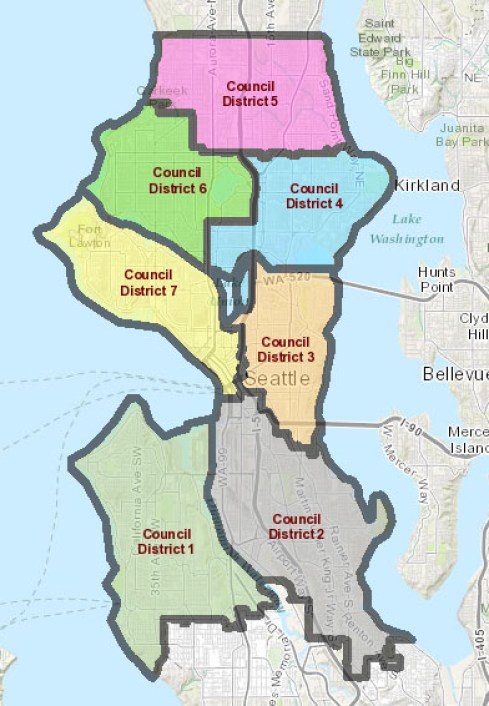
We’re about two months away from the May 15 filing deadline for city council elections, the point when no more candidates can add their names to the 52 (as of this posting) who have put their names in contention. Will the number grow to 70, for an average of 10 candidates per council race on the ballot? Will any of these candidates raise any money, or are the top two in most races already a foregone conclusion? How much money will be spent in this election, the first election under the new district system in which none of the candidates are holdovers from the pre-district system?

Those questions are obviously speculative, but a look at the money—who’s raising it, who’s spending it, and who’s benefiting—can provide some clues. Here are a few observations from the first month in which candidates have ramped up (or, in some cases, slacked off) on raising and spending on their campaigns.

A quick note about campaign fundraising figures: Cash on hand numbers are approximate, because campaigns only disclose expenditures at the end of the month. I haven’t provided cash on hand numbers for every candidate, because those numbers are less relevant now than they will be further along in the campaign, when candidates need money to drum up votes and every dollar really counts. Because many candidates choose to report contributions as they come in—a practice that becomes mandatory in the final days of the campaign—contributions are often more up to date than expenditures. When a candidate has not reported any contributions after their most recent monthly filing, I will note “as of February 28” to make that clear.

Democracy vouchers are a form of public campaign financing the city of Seattle first started using in 2017. To qualify, candidates must get at least 150 signatures and 150 donations of $10 or more from Seattle residents. Every Seattle resident received four vouchers worth $25 each, which they can contribute to any qualifying candidate. Candidates who accept democracy vouchers are subject to campaign contribution and spending limits, including an individual contribution cap of $250. Candidates who don’t participate aren’t subject to those limits, and can take contributions up to $500.

Support The C Is for Crank
If you like the work I’m doing here, and would like to support this page financially, please support me by becoming a monthly donor on Patreon or PayPal.  For just $5, $10, or $20 a month (or whatever you can give), you can help keep this site going, and help me continue to dedicate the many hours it takes to bring you stories like this one every week. This site is funded entirely by contributions from readers, which pay for the time I put into reporting and writing for this blog and on social media, as well as reporting-related and office expenses.  If you don’t wish to become a monthly contributor, you can always make a one-time donation via PayPal, Venmo (Erica-Barnett-7) or by mailing your contribution to P.O. Box 14328, Seattle, WA 98104. Thank you for reading, and I’m truly grateful for your support.

In District 1 (West Seattle), incumbent Lisa Herbold has raised the most from actual contributors, with $13,014 in contributions and about $11,996 on hand. Phillip Tavel, an attorney who got 18 percent of the vote in his run for the same seat in 2015, reported more contributions as of February 28—$17,571—but $10,590 of that was Tavel’s own money. Meanwhile, Tavel has spent $16,565. Once other debts are factored in, Tavel has a negative balance of $9,599.

Some of Tavel’s expenses, interestingly, came in the form of refunds to supporters who gave $500—the maximum contribution for candidates who aren’t accepting democracy vouchers. Tavel’s largest contribution is now $250, indicating that he now hopes to take advantage of the public financing program. As of February 28, he had 61 contributors from Seattle—89 shy of the 150 Seattle voters whose signatures and contributions he will need to qualify.

The other District 1 candidates haven’t made much of a play so far; one, SPD lieutenant and two-time state house candidate Brendan Kolding, has seemingly done nothing except loan himself money and pay it back. He has contributions from 33 Seattle residents, plus four out-of-towners with the last name Kolding.

In District 2, Ari Hoffman—the Safe Seattle-backed candidate who was in the news, most recently, for promoting an unfounded conspiracy theory about a beheading-by-saw in a homeless encampment near the Mount Baker light rail station—leads the pack in fundraising with $20,280, in part because he is not seeking democracy vouchers and can accept $500 contributions. (His latest contribution list includes two dozen such donations). Hoffman shares a campaign manager named Veronica Garcia with Ann Sattler, who is running against incumbent Debora Juarez in District 5. He has spent about $350 on Facebook ads so far.

Tammy Morales—who made it through the primary for the same seat in 2015 and narrowly lost to council incumbent Bruce Harrell—has brought in $17,699 in contributions so far, a number that will likely grow quickly (in 2015, running against an incumbent, she raised nearly $75,000). As of the end of February, Morales had a negative balance of $2,609; $3,075 in new contributions reported on March 13 should just push her into the black.

Christopher Peguero, a Seattle City Light employee and community advocate, has raised just $6,435 so far—$3,544 of that from Peguero himself—but is making decent progress toward qualifying for vouchers, with 118 contributors. South Seattle bike advocate Phyllis Porter has raised $2,618, but had already spent $12,212 as of February 28—most of that on consultants CD Strategic ($7,857) and Blue Wave Political Partners ($4,366), putting her $10,285 in the hole. Mark Solomon, SPD’s crime prevention coordinator for south and southwest Seattle, has raised $4,307. The majority of that money (53%) comes from outside city limits, but it also includes a large number of small, democracy voucher-level contributions of $10 or $20; so far, Solomon has 45 contributions toward the 150 required to qualify.

The race for District 3 presents an interesting financial picture because the incumbent, Kshama Sawant, is not taking democracy vouchers (she says she needs to be able to raise as much as possible in anticipation of “big-business” groups spending up to a million dollars to defeat her.) Partly as a result, Sawant is blowing her opponents away in fundraising, with $50,948 in contributions so far, including a Bernie-approved $27 donation to herself. So far, the overwhelming majority (84 percent) of Sawant’s contributions come from outside her district, with half her contributions coming from outside the city of Seattle itself. More than half of Sawant’s donations are maxed-out $500 contributions.

So far, the onslaught of corporate-backed candidates Sawant predicted has not materialized. King County public defender Ami Nguyen has raised about $11,398, mostly (72%) from out of town. Sawant’s closest competitor, Hashtag Cannabis owner Logan Bowers, has raised $30,572 so far, including $5,800 in democracy vouchers. A quarter of that money comes from inside District 3 (for incumbent Sawant, that number is 16%.) Bowers has spent a fair amount—about $1,300—to access the Washington State Democrats’ donor database.

Nine candidates are running in District 4, which incumbent Rob Johnson is abdicating after a single term, so I’ll limit my fundraising-related comments to the handful with significant contributions. (Obviously, it’s early days, so any of the candidates I don’t mention here, like Abel Pacheco and Cathy Tuttle, could have a fundraising surge later on.) First on that list is Alex Pedersen, a former aide to ex-council member Tim Burgess who expressed some potentially incendiary views about transit and homelessness on his since-deleted neighborhood newsletter. Pedersen has raised $44,954 so far, including $12,050 from democracy vouchers—a number that goes down to $26,518 once $18,436 of Pedersen’s own money is excluded. Pedersen’s contributors include 2015 District 4 candidate Tony Provine (creator of the infamous “bulldozers are coming” campaign mailer), Fremont property magnate and anti-bike-lane activist Suzie Burke; and well-known anti-density activists Toby Thaler, Bill Bradburd, and Susanna Lin (Lin and Thaler are on the board of Seattle Fair Growth, a group that helped sue to stop the Mandatory Housing Affordability plan the city council is finally adopting on Monday).

Emily Myers, a Ph. D candidate at the University of Washington, has raised $8,028 so far, including several hundred in $27 contributions (and 86% of it from outside her district). Shaun Scott, who is running as a member of the Democratic Socialists, has raised $14,884, including about 60 $27 contributions. No District 4 candidate other than Pedersen has qualified for democracy vouchers so far, although Scott appears to have enough qualifying contributions (the city’s democracy website does not indicate how many signatures a candidate is gathered until he or she turns them in). Nineteen-year-old college student Ethan Hunter, the subject of several fluffy media profiles when he announced he was running earlier this year, has reported no campaign activity since December 12.

District 5 incumbent Debora Juarez rarely lets a turn at the mic go by without mentioning her North Seattle district, and her relentless advocacy for her district has paid off in the form of a fairly frictionless campaign so far. Her opponents include two perennial candidates, plus Thornton Creek Alliance activist John Lombard, and attorney and former Seattle Supersonics employee Ann Sattler, who appears to be running on a law-and-order platform and is not seeking democracy vouchers. Sattler has raised $9,237,  a number that includes $4,137 of her own money. (Most of the remaining $5,000 is from $500 contributions). Juarez, meanwhile, has raised $10,500 and has registered, but not yet qualified for, democracy  vouchers.

District 6, the seat being vacated by 10-year incumbent Mike O’Brien, is the most crowded council race so far, with a dozen candidates competing to represent Northwest Seattle. It’s safe to say, though, that most of those candidates aren’t viable, and that one, former council member Heidi Wills, is already a likely frontrunner based on name recognition alone, even though she hasn’t raised much money (just $1,370, for a negative balance of $2,285 after the cost of building her website is factored in) since declaring her candidacy earlier this month. Jay Fathi, a Fremont doctor who hired local campaign veteran Christian Sinderman as his campaign consultant, is seeking to qualify for vouchers (he has 102 qualifying contributions so far), and is in the red, or just above it, despite $15,695 in contributions because he owes $12,769 to Sinderman’s firm.

Two other candidates raising money in District 6 are Jon Lisbin, who received 13% in his 2015 candidate for the same position (he’s raised $13,036, including $6,010 in contributions from himself), Dan Strauss, a legislative aide to District 7 incumbent Sally Bagshaw ($11,133), and Kate Martin, who previously ran for school board and mayor and was behind an unsuccessful campaign to preserve a section of the Alaskan Way Viaduct as part of an elevated waterfront park ($6,175).

District 7 incumbent Sally Bagshaw is the fourth council incumbent to announce her retirement this year, and eight candidates have lined up so far to seek her old job. So far, the clear frontrunner appears to be former interim police chief Jim Pugel, who has started racking up progressive endorsements and has raised nearly twice as much as his two leading competitors, with $35,796 in contributions (about a third of them, interestingly, from people who list “not employed” as their employment status, which usually indicates someone is retired). Pugel also appears to be using Sinderman’s firm, Northwest Passage, as his primary consultant. Andrew Lewis, the onetime campaign manager for former council member Nick Licata, has raised $19,155, which includes contributions from several former local, county, and state elected officials (Peter Steinbrueck, Martha Choe, Larry Phillips). Kidder Matthews development consultant Michael George has raised $18,325, largely from people in the development and building industry (and 51% from outside city limits). Naveed Jamali and Jason Williams also have relatively active campaigns; I’ll report more on their fundraising if it picks up significantly. So far, only Lewis has qualified for democracy vouchers (and has received $2,950 in voucher form); George and Williams are both seeking to qualify, and Jamali is not participating.

For up-to-date election information, check out the Seattle Ethics and Elections Commission’s campaign website. For current information on democracy vouchers, go to the city’s Democracy Voucher page.

Morning Crank: “Madame Chair, I Agree With You Completely.”

1. After a two-and-a-half hour meeting Wednesday night, city council member Kshama Sawant cast the lone vote for her own resolution to send interim Human Services Department Jason Johnson’s nomination as HSD director back to the mayor’s office. However, since no one on the human services committee, which Sawant chairs, voted “no,” the resolution will move forward to the full council.

Sawant’s resolution calls for a formal search process by a search committee that includes nonprofit human service providers, people experiencing homelessness, and HSD employees. The resolution does not explicitly express opposition to Johnson or make the case that he is unqualified for the job. However, Sawant—who is up for reelection this year—has made little effort to hide the fact that she is not a fan of the interim director, who took over after former director Catherine Lester resigned almost a year ago, and many of the people who showed up to testify last night expressed their explicit opposition to his appointment.

Prior to last night’s meeting, as she did prior to a last-minute public hearing on Johnson’s appointment in January, Sawant sent out a “Pack City Hall!” rally notice, urging her supporters to show up and “Hold Mayor Durkan accountable to the community and Human Services workers!” Perhaps as a result, the overwhelming majority of the testimony was in favor of Sawant’s resolution.

(In a somewhat novel twist, a few of the speakers opposing Johnson did so because they felt he was too supportive of groups like the Low-Income Housing Institute and SHARE, whose members also showed up to oppose Johnson’s appointment, but for completely different reasons; one of these speakers called Johnson “incompetent,” and another blamed the city for “an extremely drunk woman” he said had been “terrorizing Magnolia.”)

In addition to inviting her supporters to show up and testify, Sawant took the highly unusual step of inviting eight people who supported her resolution  to sit with the council at the committee table as they deliberated and took a vote. This setup gave the advocates an opportunity to echo Sawant’s statements and respond whenever council members Bruce Harrell or Lisa Herbold said anything contrary to Sawant’s position. (A quote from one advocate that paraphrases many others made around the table over the course of the meeting: “Madame Chair, I agree with you completely.”)  The result was an atmosphere in council chambers even more circus-like than most Sawant rally/hearings, with Harrell, in particular, barely able to disguise his frustration when advocates at the table talked over him (“I feel like I have to raise my hand here,” he said) or accused him of being “afraid” of doing a national search.

The advocates, including representatives from the homeless advocacy group SHARE, the Human Services Department,  the Seattle Indian Center, and the Seattle Human Services Coalition, argued that the council should open up the nomination process and, in the words of Tia Jones with the Seattle Silence Breakers, “just make [Johnson] apply—post it on the site and make him apply like everybody else.”

Herbold and Harrell responded that if the process for appointing Johnson was inadequate, the appropriate thing to do would be to revisit the process after Johnson’s nomination moves forward, given that the nomination took place legitimately under rules the council established in 2007. “Those are the rules that we all agreed to,” Herbold said. “I’m appreciative of the idea that the status quo isn’t acceptable.” But, she added, “I’m inclined to consider the individual when we have an individual before us,” and to make that process transparent and accountable, rather than rejecting Johnson’s nomination out of hand. “I feel like sending [the nomination] back is making it about the person,” Herbold said.

Sawant countered that the rules delineating the council’s role in considering mayoral appointments have to be a “living body, meaning, when we hear from hundreds of people, we can’t tell them, ‘These are the rules, so we can’t do what you’re asking us to do.’ … Clearly, we’re hearing loud and clear from people that they want to do something different. How can we ignore that?”

In a final bit of political theater, Sawant opened up the question of whether she should call for a vote on her own resolution to the audience, most of whom had already spoken in favor of the resolution. “All here who are not on council or staff, do you think we should vote for this resolution?” Sawant said. Herbold pointed out that she had received many letters from people who support Johnson and want to move the process forward. “Where are they?” shouted someone in the crowd—suggesting, it seemed, that either Herbold was making up the emails or that the people who showed up in person should count more than the people who wrote emails or called their council members on the phone.

Sawant addressed her supporters again: “Should I call this for a vote? I’m asking members of the public because that’s who I’m accountable to.” After a chorus of “Ayes” from the audience, Sawant called the vote. It passed by a vote of 1, with both Harrell and Herbold abstaining.

The resolution now moves on to the full council, where it faces long odds.

2. Steve Daschle, with the Human Services Coalition, said that the thing he found most “irksome” about Durkan’s human services approach was that she still has not met with the coalition after more than a year in office. “In the 30 years I’ve been involved in the Human Services Coalition, this is the first mayor who has not met with the coalition in a full year and two months of her term, and we think it’s imperative that the chief executive of the city take the time to come and talk to one of the key constituencies that would help shape that decision, and it wasn’t done,” Daschle said.

3. In City Council news, two more candidates entered the race for District 4, the seat currently held by Rob Johnson: Abel Pacheco, a STEM education advocate who sought the same seat in 2015 and received 8.4 percent of the vote, and Cathy Tuttle, the founder of Seattle Neighborhood Greenways. Pacheco sent out an announcement that he was running Tuesday; Tuttle confirmed that she was running to The C Is for Crank yesterday afternoon.

Also, as I noted on Twitter Monday, nonprofit director Beto Yarce, who was one of the first candidates to challenge Sawant in District 3 (Capitol Hill, the Central District, Montlake), has dropped out of the race. Yarce drew criticism early on for the fact that he and his partner live in Mill Creek, not Seattle. Yarce said he and his partner, who owns a house in the Snohomish County suburb, were planning to move to Capitol Hill; during his campaign, Yarce was renting a space in the neighborhood from a friend on a short-term basis, his campaign consultant confirmed.

4. The city has finally hired a consultant to conduct outreach on a proposal to make the building that houses the Showbox nightclub a permanent part of the Pike Place Market Historical District. (The city council adopted “emergency” legislation making the Showbox a temporary part of the market last year, in order to prevent the property, which was recently upzoned to allow very dense housing, from being developed as apartments. In response, the owner of the building sued the city). The consultant, Stepherson and Associates, has also done outreach work for the city on the First Hill Streetcar, the downtown seawall replacement project, and the Move Seattle levy. Because the contract is for less than $305,000 and Stepherson and Associates is on the city’s consultant roster, the contract did not have to be bid through an open process.

The city’s schedule calls for all of the outreach work on the Showbox proposal, as well as a full environmental review under the State Environmental Policy Act, to be done by March, with a council vote this June. As I noted when I reported on the search for a contractor in January, that’s a remarkably quick timeline for an expansion of the Market, at least by historical standards:

To put this timeline in historical context, the Market Historical District has been expanded twice before: Once, in 1986, to include Victor Steinbrueck Park, and again in 1989, to add a parking garage and senior housing. Seattle Times archives show that the debate over the latter addition lasted more than three years, and archival records at the city clerk’s office show that the council was receiving letters on the draft legislation fully nine months before they adopted the expansion.

AEG Live, which owns the Showbox, is free to close or relocate the venue when its current lease runs out in 2021; the question at hand is whether the building itself is historic, and whether the city can require that it remain a live-music venue in perpetuity.

If you like the work I’m doing here, and would like to support this page financially, please support me by becoming a monthly donor on Patreon or PayPal! For just $5, $10, or $20 a month (or whatever you can give), you can help keep this site going, and help me continue to dedicate the many hours it takes to bring you stories like this one every week. This site is funded entirely by contributions from readers, which pay for the time I put into reporting and writing for this blog and on social media, as well as reporting-related and office expenses. 

If you don’t wish to become a monthly contributor, you can always make a one-time donation via PayPal, Venmo me at Erica-Barnett-7, or mail me an old-fashioned check (or fan letter) at P.O. Box 14328, Seattle, WA 98104.

Thank you for reading, and supporting, The C Is for Crank!