1. Plans to build a 14-story hotel across the street from the north First Avenue entrance to Pike Place Market are now in limbo after the city’s Landmarks Preservation Board voted 6-1 to designate the three-story Hahn Building a historic landmark last week. The board previously rejected applications to landmark the building twice, in 1999 and 2014, and commission staff recommended against a landmark designation this time, “as it does not appear to have the integrity or the ability to convey its significance as required.”
The Hahn Building, which served as a single-room occupancy hotel for low-income workers, was completed in its current, three-story form in 1907, making it one of the older buildings in the area and one of dozens of SROs that used to operate downtown. (The original one-story building was finished in 1897.) One At last week’s landmarks board meeting, landmarking proponents argued that its history and proximity to Pike Place Market qualified it for historic status.
Photographer and writer Jean Sherrard called the building a “vital hinge in the market’s front door” and “a transitional step down from the tall buildings that fill the downtown core behind it.” Landmarks commissioner Jordan Kiel, who cast the lone vote against landmark status, countered that “being landmark-adjacent does not make you a landmark,” calling the heavily altered Hahn a “background” without “a significant impact to the city as an SRO.”
Residents of the Newmark condo tower, which sits directly to the east of the Hahn, have heavily supported the landmark effort, creating an online petition and GoFundMe to support their efforts. If the hotel is built, many of these condo owners would lose their views of Puget Sound to the west. Newmark residents also supported efforts to “save the Showbox,” which sits on the same block and was going to be developed as an even taller condo building.
Landmark status does not prevent a building from being demolished, but it’s one factor that a city hearing examiner will consider when deciding whether to approve a master use permit for the proposed new hotel. The developer can also appeal the landmark’s board decision to the hearing examiner.
Support PubliCola
If you’re reading this, we know you’re someone who appreciates deeply sourced breaking news, features, and analysis—along with guest columns from local opinion leaders, ongoing coverage of the kind of stories that get short shrift in mainstream media, and informed, incisive opinion writing about issues that matter.
We know there are a lot of publications competing for your dollars and attention, but PubliCola truly is different. We cover Seattle and King County on a budget that is funded entirely by reader contributions—no ads, no paywalls, ever.
Being fully independent means that we cover the stories we consider most interesting and newsworthy, based on our own news judgment and feedback from readers about what matters to them, not what advertisers or corporate funders want us to write about. It also means that we need your support. So if you get something out of this site, consider giving something back by kicking in a few dollars a month, or making a one-time contribution, to help us keep doing this work. If you prefer to Venmo or write a check, our Support page includes information about those options. Thank you for your ongoing readership and support.
2. Over the next year, the Seattle Department of Transportation plans to replace all its license-plate readers—cameras that track cars and buses through traffic, producing data that SDOT uses to determine real-time travel times and improve things like signal timing—with cell-phone-tracking censors made by a company called Acyclica. The sensors, which will be embedded in utility cabinets along a handful of major arterial streets, track people’s location by identifying a specific code, or address, associated with their cell phones.
Although the city has been using Acyclica’s technology on a smaller scale since 2014, the 2017 surveillance ordinance requires the city to periodically review surveillance technologies for compliance with the ordinance. Last week, the city council’s transportation and utilities committee discussed Acyclica in the context of a city audit on license-plate readers. Several council members brought up concerns about the new technology, including the possibility that it can be used to track individual Seattle residents or by law enforcement. Continue reading “Former SRO Gets Landmark Status, Council Considers Cell-Phone Tracking Tech”→
Plus election speculation and news from City Hall.
1. As the COVID-19 pandemic approaches the one-year mark, the city of Seattle has decided to keep some restrooms in parks and other public spaces open over the winter so that people who might ordinarily use restrooms in fast-food restaurants or libraries can have more places to go.
As PubliCola reported last month, the city’s Parks Department says it has no choice but to close certain parks restrooms down during the winter months because their plumbing can’t withstand freezing temperatures. The department provided PubliCola with a list of all the restrooms that are currently closed, either for winterization or for other reasons, such as fires, vandalism, or structural damage.
The upshot: Of more than 130 restrooms operated directly by the city, and not counting restrooms in library buildings or shelters operated by nonprofit providers, more than 60 are currently closed. Of those, fewer than half have been replaced by what the city euphemistically calls “sanicans,” better known as portable toilets, and only a relative handful of which include a place for people to wash their hands after doing their business.
In Judkins Park, near PubliCola HQ, a lonely pair of portable toilets that replaced two multi-stall restrooms looked the worse for wear this weekend, as did toilets placed in nearby Sam Smith Park. The official restroom map maintained by the city’s Human Services Department lists two open restroom buildings and a 24-hour “sanican.” Other restrooms that only have portable toilets, according the Parks Department’s list, show up on HSD’s list of open restrooms, as do many non-city restrooms that are open limited hours, such as Immanuel Community Services (open from 8 to 2 on weekdays) or are only accessible to certain groups, such as the women-only day center at Mary’s Place.
The result is that—like last year—the city’s list of “open” restrooms overstates the actual number of restrooms that are open, accessible, and safe, not to mention clean.
2. Limited-access day centers, the five library branches (of 27) that allow walk-in restroom use, and portable toilets with handwashing stations are certainly better than nothing. But during a pandemic, when people experiencing homelessness have less access than usual to basic hygiene, portable toilets without toilet paper or a sink invite the spread of disease. Last month, King County Public Health issued a warning about an outbreak of Shigella, a highly contagious bacterial infection that causes diarrhea, fever, and vomiting. According to the county, “the [Shigella] germs can spread when someone with Shigella does not wash their hands well after using the toilet then contaminates objects, food or water.”
Support PubliCola
If you’re reading this, we know you’re someone who appreciates deeply sourced breaking news, features, and analysis—along with guest columns from local opinion leaders, ongoing coverage of the kind of stories that get short shrift in mainstream media, and informed, incisive opinion writing about issues that matter.
We know there are a lot of publications competing for your dollars and attention, but PubliCola truly is different. We cover Seattle and King County on a budget that is funded entirely by reader contributions—no ads, no paywalls, ever.
Being fully independent means that we cover the stories we consider most interesting and newsworthy, based on our own news judgment and feedback from readers about what matters to them, not what advertisers or corporate funders want us to write about. It also means that we need your support. So if you get something out of this site, consider giving something back by kicking in a few dollars a month, or making a one-time contribution, to help us keep doing this work. If you prefer to Venmo or write a check, our Support page includes information about those options. Thank you for your ongoing readership and support.
Since the end of October, Public Health has received 61 reports of Shigella, 46 of those after December 14. Of that total, the vast majority—47—occurred among “people who reported experiencing homelessness or unstable housing or who accessed homeless services,” a spokeswoman for Public Health told PubliCola. Because these numbers only reflect reported cases, the true number is undoubtedly higher.
According to King County’s info page, simple “handwashing with soap and water is the best way to protect yourself and others against Shigella infections.” Many homeless people lack this option, and we’re seeing the results.
3. Lorelei Williams, the deputy director overseeing capital projects for the Seattle Department of Transportation, is leaving the city after more than 16 years to take a job with WSP, a mega-engineering firm that has many current contracts with the city, including a contract to monitor the structural integrity of the West Seattle Bridge. Williams will be WSP’s Pacific Northwest Transportation Business Line Leader.
According to an SDOT spokesman, Williams “has not had any role in selecting WSP or overseeing their contracts” for SDOT. She’ll be the second high-ranking SDOT staffer to make the jump to the engineering firm in recent years, after Mike Terrell left his position as deputy director in charge of capital projects and roadway structures to take a job at WSP in 2018. Although city rules bar certain high-ranking employees from lobbying elected officials for three years after leaving the city, there are no rules prohibiting city employees from taking jobs at firms that compete for city contracts.
4. Although conventional wisdom has it that King County Executive Dow Constantine, who is running for reelection this year, has a lock on the position, one name keeps coming up as a potential challenger: Washington State Sen. Joe Nguyen (D-34). Nguyen won his senate seat in 2018, defeating Constantine’s deputy executive, Shannon Braddock. He did not return a call seeking comment about whether he’s running.
Apparently, the popularity of these closures is causing some angst. People who oppose closing Lake Washington Boulevard to cars took their case to the joint Board of Parks Commissioners and Park District Oversight Committee meeting last Thursday night. At the online meeting, SDOT floated the concept of making some of 2020’s COVID-19-era pedestrian-and-bike-only streets permanent. Lake Washington Boulevard isn’t currently under consideration for permanent closure, but SDOT’s anxious critics, intent on nipping the idea in the bud, pointed out that the vaunted Olmsted Brothers originally designed Lake Washington Boulevard for cars. Specifically, they said, for “recreational…pleasure drives.”
I love it when city officials are able to turn original intent arguments back against NIMBYs, and Parks Commissioner Tom Byers did just that. Byers, former deputy mayor under Mayor Paul Schell, pointed out that the typical car speed when the Olmsteds designed the boulevard was 12 mph. Today, it’s 25 mph. (Seems more like 30 or 40 if you’ve ever been biking there and had a car up in your business, but still.) For the past decade, the city has traditionally closed Lake Washington Boulevard to cars on Sundays during summer months.
This past summer, responding to people’s need for daily recreational opportunities in their neighborhoods during the pandemic, SDOT restricted car access on 26 miles of neighborhood streets, creating bike-and pedestrian-friendly zones known as “Stay Healthy Streets” to create more room for people to walk, bike, and roll while maintaining at least six feet of distance from others. SDOT also teamed up with the Seattle Parks and Recreation Department for four additional miles of closed streets (I consider all these open streets), near Alki Point, near Green Lake, in Goldens Gardens Park, and along Lake Washington Boulevard, to expand park footprints. SDOT called these park-adjacent no-car zones “Keep Moving Streets.”
SDOT is now surveying the public to decide where to make 20 miles of these car-free streets permanent. It’s all part of the department’s pedestrian-centric response to the pandemic, which also now includes 150 sidewalk, converted parking spot, and street permits that neighborhood coffee shops and restaurants have used to set up outdoor seating. That popular program, known as “Safe Starts,” has been extended through October 2021.
In the first installment of this column a couple of months ago, I wrote about all these programs combined, arguing that the ad hoc emergency response was energizing Seattle’s neighborhoods and providing a surprise opportunity to rethink how our city should be planned and zoned.
The notion of re-upping the Lake Washington Boulevard car-free pilot as a pedestrian and bike thoroughfare (thanks for bringing it up, guys!) is a prequel to the overdue debate over reallocating public right-of-way. It’s time to retrofit our growing city to human scale.
Support PubliCola
If you’re reading this, we know you’re someone who appreciates deeply sourced breaking news, features, and analysis—along with guest columns from local opinion leaders, ongoing coverage of the kind of stories that get short shrift in mainstream media, and informed, incisive opinion writing about issues that matter. Earlier this month, we took a look back at just some of the work we’ve been able to do thanks to generous contributions from our readers, but those pieces represent just a handful of the hundreds of stories we’ve published this year.
We know there are a lot of publications competing for your dollars and attention, but PubliCola truly is different. We cover Seattle and King County on a budget that is funded entirely and exclusively by reader contributions—no ads, no paywalls, ever.
Being fully independent means that we cover the stories we consider most interesting and newsworthy, based on our own news judgment and feedback from readers about what matters to them, not what advertisers or corporate funders want us to write about. It also means that we need your support. So if you get something out of this site, consider giving something back by kicking in a few dollars a month, or making a one-time contribution, to help us keep doing this work. If you prefer to Venmo or write a check, our Support page includes information about those options. Thank you for your ongoing readership and support.
SDOT’s idea isn’t about tradition. It’s about change. And ultimately, that’s what Byers’ “12 mph” quip was getting at.
“I’m really excited about the future potential of these streets,” Seattle Parks District Oversight Committee member Deepa Sivarajan seconded.
Sivarajan, a policy manager at Climate Solutions by day, went even further. “Let’s not prioritize historical intent and historical preservation when thinking about these streets,” she said. “A lot of historical preservation in Seattle tends to preserve an era that was de facto segregationist. Thinking about the historical intent of a ‘driving street’ is not the biggest factor we should be considering.” Sivarajan argued that the city should consider equity above original intent, and her own priorities seemed to also include health and safety; she cited collisions and pollution as something the Olmsteds didn’t consider when designing boulevards for “pleasure drives.”
Sivarajan’s social justice angle served notice on the opponents of SDOT’s potential plan. In addition to the goofy original intent talking points, the preservationists had also been arguing that closing Lake Washington Boulevard to cars would be unfair to communities of color who, they claimed without presenting data, rely on the boulevard to access the city and parks from the Rainier Valley and beyond.
Opponents of a car-free Lake Washington Boulevard also got an earful from Parks Commissioner Dennis Cook, who’s African American. “I’ve walked the lake [for] many, many, many years,” he said. “During the pandemic, I’ve seen more people of color walking Seward Park than I have in the last five to ten years. It’s amazing. It’s wonderful to see because people are out there greeting people and their neighbors, and it’s building community.” Cook noted that the area in question is in the 98118 ZIP code, where the population is 25 percent African American. Seattle is 7 percent Black overall.
Seattle is a city of hills and water; thus we are also a city of bridges. Our bridges are critical for mobility and both the local and regional economy. Bridges are also critical transit infrastructure. That’s why I, along with Councilmembers Alex Pedersen and Andrew Lewis, have introduced legislation, along with a companion budget action for 2021, that would create a new $20 vehicle license fee (VLF) to pay for critical bridge maintenance throughout the city. The fee, if it’s approved by the Council this week, will be added to the existing $20 fee that funds additional Metro bus hours through the Seattle Transportation Benefit District.
The closure of the West Seattle Bridge on March 23 placed Seattle’s dependence on its bridges in stark relief. Every person and business in West Seattle, or anyone going to West Seattle, has felt the impact of this closure. Before it was closed, the West Seattle Bridge carried 17,000 daily transit riders on 13 routes making 900 daily trips. Two of these routes—the RapidRide C Line and Route 120—were among the top 10 routes for ridership in all of King County.
But the West Seattle Bridge is hardly the only vulnerable bridge in Seattle; for decades, funding for critical maintenance has fallen short, allowing the city’s bridges to fall into further and further disrepair. In September, the City Auditor released an audit, requested by Councilmember Pedersen, that focused on 77 bridges owned and operated by the Seattle Department of Transportation. That audit reported that bridge funding is well below the minimum annual $34 million level needed for the long-term health of this critical infrastructure.
Support PubliCola
PUBLICOLA NEEDS YOUR HELP.
This ad-free website is supported ENTIRELY by generous contributions from readers. At a time when real local news is more threatened than ever by declining revenues and the growing spread of misinformation, PublICola is a trusted source of breaking news, commentary, and deep dives on issues that matter.
If you enjoy the work we do here at PubliCola, please help us KEEP IT GOING by donating a few bucks a month or making a one-time donation via PayPal, Venmo (Erica-Barnett-7) or by check at P.O. Box 14328, Seattle, WA 98104. We’re truly grateful for your support.
The audit notes the overall condition of SDOT’s bridges has declined during the last decade and that Seattle is “not spending enough on the upkeep and preservation of its bridges, and risks becoming out of compliance with federal regulations.” This is, unfortunately, consistent with previous findings on the state of Seattle’s bridges, including an SDOT report from 2013 that found that 43 of the city’s bridges were “functionally obsolete,” and suggested that the city had a bridge maintenance backlog of nearly $2 billion.
Judging by the sheer number of permits the city has issued in the past five months allowing businesses to turn sidewalks, parking spots, and city streets themselves into places for people to hang out, there’s an unforeseen consequence of the pandemic: A citywide Seattle neighborhood renaissance.
Under a temporary program called “Safe Starts,” SDOT has issued 135 such permits since the COVID-19 crisis hit, with 73 more local business requests for permits in the queue. (The numbers, based on data through September, are actually much higher because the West Seattle Junction Business Improvement Association got an unprecedented single permit allowing all 230 shops and restaurants in the district to set up a single table and chair outside their storefronts).
Seattle’s neighborhood businesses are using all these permit options (they’re free) to turn neighborhoods outside the downtown core into people-centric hot spots. Just grab a table in the middle of the street on 9th Avenue N. between Thomas and John Streets in South Lake Union, and you’ll quickly get a sense of the new block-party atmosphere that’s helped redefine the city in recent months.
Support PubliCola
PubliCola is supported entirely by generous contributions from readers like you. If you enjoy breaking news, commentary, and deep dives on issues that matter to you, please support this work by donating a few bucks a month to keep this reader-supported site going—and expanding!
If you don’t wish to become a monthly contributor, you can always make a one-time donation via PayPal, Venmo (Erica-Barnett-7) or by mailing your contribution to P.O. Box 14328, Seattle, WA 98104. We’re truly grateful for your support.
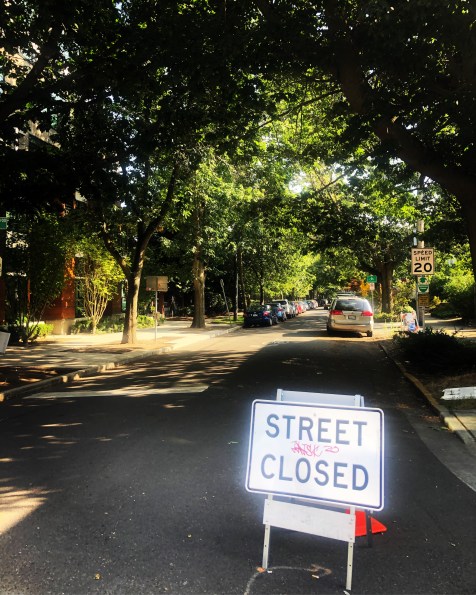
Neighborhoods aren’t merely dedicating more public space for eating and drinking. The elevated energy is also being formalized on neighborhood side streets. As part of another SDOT program called “Stay Healthy Streets,” 13 stretches of neighborhood streets, totaling more than 20 miles, have sidelined cars in favor of people. Instead of reading “Street Closed,” SDOT signs barring cars could just as logically read “Street Open.”
The takeaway for city policy makers should be clear. While inveterate single-family-zoning advocates continue to decry urbanization in any form (in order to preserve neighborhood character, they say), Seattle’s neighborhoods are not as fragile as the naysayers have claimed. On the contrary, the uptick in neighborhood action seems to have amplified, rather than destroyed, neighborhood character.
“I don’t understand why we’d ever go back.” — West Seattle Junction BIA Executive Director Lora Swift
From “outdoor cafés to outdoor retail racks,” West Seattle Junction BIA Executive Director Lora Swift said, the neighborhood has a “new cadence” and a “more European feel.”
She says she’ll be advocating to keep the permits in play through “at least 2021,” adding that she’d like the programs to stay in place longer than that. “I don’t understand why we’d ever go back,” she said, noting that her enthusiasm is “underscored by requests from the community… to continue to this new Seattle. We’ve gotten so many emails.” Continue reading “Maybe Metropolis: The Pandemic Has Forced Seattle To Reconsider Its Neo-Suburban Model”→
On Wednesday, almost two and a half years after the city of Seattle banned “micro-mobility” companies like Lime and Spin from operating electric scooter-sharing programs in the city, a city council committee took a tentative step toward allowing a small “pilot” program to test out the concept, authorizing scooters to operate everywhere bikes are allowed (streets, bike lanes, and sidewalks that make up parts of bike lanes) and to adopt a fee schedule for scooter companies interested in participating in the new “pilot” program.
The pilot will allow three companies—Lime, a “seated scooter” company such as Tesla-backed Wheels, and a third company providing some combination of seated and standing scooters—to each put 500 scooters each on Seattle streets. (The two-wheeled “seated scooters” look extremely similar to a better-known two-wheeled micromobility technology, minus the pedals). A fourth company, and 500 more scooters, could be added if another new technology emerges and the city wants to try it out.
If the initial pilot is successful, that number could be increased to as many as 6,000. For comparison, Seattle’s original free-floating bike share program started with 1,500 bikes, but within four months had expanded to a maximum of 12,000.
Shared electric scooters could, according to Seattle Department of Transportation analysis, replace up to 175,000 car trips a month; provide a non-motorized alternative for people trying to get out of West Seattle while the West Seattle Bridge is closed; make it easier for people to access transit; and cut monthly CO2 emissions by up to 85 metric tons. They’re also popular with a more diverse group of users than bikes, according to SDOT mobility solutions manager Alex Pazuchanics.
“It took bikeshare a decade to get to the point that scooter share got to in 12 months [in other cities], and I think that’s because it’s accessible to more people who wouldn’t necessarily ride a bike,” Pazuchanics said in an interview after Tuesday’s meeting.
Scooters have been ubiquitous across the US for years, with programs in more than 100 cities at every latitude and with every type of topography, from Miami to Boston to Tacoma. With Seattle finally, belatedly, on the brink of giving them a try, here are some of the factors that could still sink our nascent scooter program.
• Poor planning for parking.
The biggest concern about bikesharing in Seattle, which is now provided by just one company, Lime, is that users sometimes parked them carelessly, blocking sidewalks or leaving bicycles “strewn around” in ways that some people found unsightly. Leaving aside the latter complaint (has anyone told them what people do with cars?) the issue of sidewalk and curb ramp blockages is significant for people with disabilities, who need the ability to navigate sidewalks without obstacles in their way.
SDOT’s response to these concerns has been to focus mostly on user behavior—for example, by requiring companies to fine users $20 if they park their scooters outside designated areas, such as the “furniture zone” of sidewalks and in planting strips, or having users take “quizzes” at the beginning of each ride to confirm that they understand the parking restrictions. “I think it’s important that we fine users that are not using the devices properly,” council member Dan Strauss, who sponsored the two bills adopted in committee Wednesday, said.
Council president Lorena González wondered Wednesday why the city wasn’t instead providing more places for scooters to park legally, much as the city does for cars. “When we talk about the parking and enforcement issues and obstruction— all of those things will continue to be problems continue to be problems so long as we are not being thoughtful and deliberate in providing dedicated space and making sure that users of these devices have somewhere appropriate to put them,” González said.
Support The C Is for Crank
The C Is for Crank is supported entirely by generous contributions from readers like you.
If you enjoy breaking news, commentary, and deep dives on issues that matter to you, please support this work by donating a few bucks a month to keep this reader-supported site going.
If you don’t wish to become a monthly contributor, you can always make a one-time donation via PayPal, Venmo (Erica-Barnett-7) or by mailing your contribution to P.O. Box 14328, Seattle, WA 98104. I’m truly grateful for your support.
• “But things are different in Seattle…”
Seattle likes to subject every “new” transportation alternative—from biking as an alternative to driving alone to bikeshare to scooters—to endless scrutiny on the grounds that Seattle is somehow different than all other cities. Usually, this is attributed to some combination of our culture (“people will never give up their cars!”) or weather (“no one rides bikes in January!”) or topography (have you heard? We have hills).
All these issues have come up repeatedly in recent discussions about scooters, including on Wednesday, when several speakers noted the existence in Seattle of both hills and rain. For example, Strauss noted that “if, at the end of the pilot program or during the pilot program, we see that the city of Seattle is not suitable for this sort of program because of hills or rain or other factors, then we can end the pilot.”
• The unfinished Bike Master Plan
The success of any scooter program relies heavily on a connected network of bike lanes, which will be the only legal alternative to riding in the street. (Unlike bicycles, scooters will not be allowed on sidewalks). Thanks to COVID and, before that, a general lack of enthusiasm for biking infrastructure from Mayor Jenny Durkan, key elements of the bike master plan have been canceled or delayed indefinitely, including a long-planned bike lane on Fourth Avenue between Pioneer Square and Belltown, a protected bike lane on Martin Luther King Jr. Way South, and a bike connection between Georgetown and downtown.
“Micromobility is going to change the way we get around our city, and unless we connect the bike network, we’re not going to have a safe place for people to use these micromobility tools,” Strauss told me. For now, though, the city seems to be hoping that scooter riders, much like bicyclists, will figure out a way to get where they’re going using a combination of bike lanes and routes that parallel arterial roads, such as greenways, to minimize the danger of collisions.
“One of the challenges [with the scooter pilot] is that it brings a whole new user,” says Joel Miller, SDOT’s micromobility program lead. “There is a responsibility to just educate people [that] you might not want to take the same route in a scooter than you would in a car.”
SDOT also believes that as the speed limit on more city streets is lowered to 25 miles an hour, the roads themselves will become safer for scooters. Council member Tammy Morales, who represents southeast Seattle (an area that still lacks any direct protected bike routes into downtown) pointed out that whatever the actual speed limit, “I can assure you that very few people drive 25 miles an hour on Rainier, MLK, or Beacon Avenue South.” Without safe, convenient ways for scooter users to get where they want to go, the whole project could be doomed to failure—or, worse, fatalities.
• Too few scooters…
As mentioned above, the “pilot” program will distribute just 1,500 scooters across 84 square miles of Seattle, which could prevent critical masses from forming that make them a truly reliable and convenient short-distance transportation mode. If you look for a scooter for a few times and there are none around, you could be inclined to delete the app from your phone.
And because the scooters will include various types of devices (seated, standing, and perhaps a third option), people won’t necessarily get the type of vehicle that they want—someone who prefers to stand on a four-wheeled scooter, for example, may not want to sit on what is essentially a two-wheeled, pedal-less bike.
SDOT’s Pazuchanics says with fewer people going anywhere because of the pandemic, “there’s not as much demand and it doesn’t warrant the kind of scale that we thought was necessarily in a full-scale pilot program.” He says SDOT will continue to “monitor what is the right amount so that you as an individual will have enough confidence that there is a device available to you, but you’re not at a saturation point” where the scooters are just everywhere.
• … in the wrong places
The “equity” requirement for the scooter pilot says that at least 10 percent of the initial fleet, or 150 scooters total, must be located in “environmental justice community areas”—generally lower-income areas with high concentrations of people of color. But because those areas are spread so broadly across the city (and encompass such huge swaths of land), there is a good likelihood that some of these areas will end up with no scooters at all. For people living and working in such areas, it will be like the scooter program doesn’t exist.
Miller, who answered similar questions at the committee meeting, says “equity” doesn’t necessarily mean just equitable distribution, and that the city still needs to “talk to community, and with COVID, that’s something we haven’t been able to do yet.” He said SDOT hopes to set up community conversations, with compensation for people who wouldn’t otherwise be able to attend, in the spring.
• Overzealous enforcement
In addition to fines for parking in the wrong place, council members expressed concern that people would flout the rules by not wearing helmets, which are required under a county law that is rarely enforced. Although no one from SDOT suggested changing city policy to empower police to crack down on helmet avoiders, Miller did tell the council that some scooter companies provide helmets along with the devices (a disposable, biodegradable sleeve inside the helmet keeps the grossness factor down), and noted that some provide discounts for riders who provide a selfie showing them wearing a helmet at the beginning of a ride.
Seattle will be the first city to mandate that each scooter provider limit a user’s first ride to 8 miles an hour, a speed that can feel frustratingly slow, in order to give riders time to learn to to maneuver and accelerate. “It might not be as convenient, it might not be as fun, but it’s going to be a lot safer,” Miller told council members Wednesday.
But will an artificially slow ride (or two or three) make people scroll over to their Uber app, or hop in their cars? Strauss doesn’t think so. After the meeting, he told me he considered slowing down people’s trips a reasonable tradeoff if it leads to fewer crashes. “I think that if people know that that slower option is only going to last for one to three trips, I don’t think that that would drive them away from riding the scooter,” he says.


 Photographer and writer Jean Sherrard called the building a “vital hinge in the market’s front door” and “a transitional step down from the tall buildings that fill the downtown core behind it.” Landmarks commissioner Jordan Kiel, who cast the lone vote against landmark status, countered that “being landmark-adjacent does not make you a landmark,” calling the heavily altered Hahn a “background” without “a significant impact to the city as an SRO.”


 By Lisa Herbold
 By Josh Feit


