Tag: Dan Strauss

Strauss Burke-Gilman Trail Proposal Revamps Rejected “Leary Alternative”

The “Leary Alternative,” with Councilmember Dan Strauss’ proposed change to an older version of the proposal marked inBu blue.

By Erica C. Barnett

When Seattle City Councilmember Dan Strauss announced, earlier this month, that he had come up with a plan to break a 29-year deadlock and complete the long-delayed Burke-Gilman Trail through Ballard, the response from local outlets who have covered the battle over the years ranged from mild praise to rapturous enthusiasm.

Seattle Bike Blog said Strauss’ proposed “Leary Alternative,” which would avoid conflicts with the industrial businesses that have stalled the trail’s completion with legal tactics for decades, marked “the biggest development in the Missing Link saga in years,” but noted that it could “spell doom” for a straightforward trail extension along Shilshole, the “missing link” of the trail. On the ecstatic end of the spectrum, the Stranger raved, “By God, Dan Strauss May Have Done It” in a piece touting Strauss’ plan to “satisfy everyone who’s had soooo much to say for the past two [sic] decades.”

Longtime bike advocates, however, noticed something about the plan: It wasn’t new. In fact, the city already painstakingly studied a very similar proposal, also known as the Leary Alternative, in a 2016 draft environmental impact statement (DEIS). The DEIS evaluated several plans to complete the Missing Link, including the Shilshole route, and concluded that Leary could be less safe for cyclists than the Shilshole option, in part because it included 13 intersections where cars and trucks would have to drive directly across the path.

“A connection on Leary that is built is safer than a connection on Shilshole that is never built.”—City Councilmember Dan Strauss

That’s “the most [intersections] of any of the alternative routes and substantially more than any existing portion of the [Burke-Gilman Trail], potentially making it a less desirable route for bicyclists and other trail users,” according to the DEIS—and potentially delaying trail users an average of 15-25 seconds when vehicles periodically block the trail. The Leary Alternative would also require sacrificing sidewalk space along parts of Market St., and could slow down buses on six different King County Metro routes, the report concluded.

Strauss says his plan, which shortens the distance bikes would spend alongside busy Leary Way by several blocks compared to the original Leary option, could be the breakthrough that resolves an apparently intractable conflict. “A connection on Leary that is built is safer than a connection on Shilshole that is never built,” Strauss said. Since the debate over the missing link began, the city completed work on a three-block stretch of path between 24th Ave. NW and the Ballard Locks; if that stretch had been completed in 2004, Strauss said, he wouldn’t have been riding his bike on the street several blocks north and gotten hit by a car.

Strauss also argues that Ballard has changed dramatically since advocates first started pushing for a trail along Shilshole three decades ago. “Ballard has gotten more dense,” he said. “We used to have industrial businesses on Market, Leary, Ballard [Ave. NW] and Shilshole, and in today’s Ballard, Market, Leary, and Ballard are almost exclusively commercial while Shilshole remains almost completely industrial.” The DEIS remarked on this transformation seven years ago, noting that a trail along Market and Leary “would run through [a] busy commercial district, which would provide a different recreational experience”—with more people going in and out of businesses on foot, for example—than the rest of the Burke-Gilman Trail.

“There’s a lot going on, and a lot of opportunities for conflict. Any [Leary Way NW] design would have to be really aggressive in prioritizing the safe movement of people on bikes, people walking, as well as all the other people using the space for other purposes.”—Cascade Bicycle Club policy director Vicky Clarke

“There’s a lot going on, and a lot of opportunities for conflict” along Market and Leary, said Vicky Clarke, the policy director for Cascade Bicycle Club. “Any design would have to be really aggressive in prioritizing the safe movement of people on bikes, people walking, as well as all the other people using the space for other purposes,” like crossing from parking spaces to stores ad waiting for the bus.

The proposed route also includes a large number of utility poles that the trail will have to “wiggle around,” Clarke said. “When you’re designing around a bus stop or utility poles or businesses, it has the potential to erode the user experience, safety, and comfort, so there’s a lot of challenges to designing this route.”

Strauss has asked Mayor Bruce Harrell and Seattle Department of Transportation director Greg Spotts to study his alternative using money set aside to complete the trail. But even if the city decides to end the “missing link” impasse by building a revamped Leary alternative, Clarke notes that “there’s still going to be people biking on Shilshole because it’s the most simple and direct route to connect with the existing Burke-Gilman, so there still need to safety improvements along Shilshole.” Strauss says he agrees, and would start by fixing the variable pavement—which at different points consists of concrete, asphalt, and gravel—and provide better signage for driveways and parking spaces instead of the plastic drums and poorly marked gravel lots that serve those purposes now.

Clarke said the changes to Shilshole will need to go beyond flatter pavement and better signage. For example? Well, she said, “there’s a really good design for a trail.”

Downtown Sweep Highlights Urgency of Resolving Seattle’s Other “Top-Priority Encampment,” Woodland Park

By Erica C. Barnett

Last Wednesday, police and parks department workers removed a highly visible encampment in downtown Seattle after a weekslong standoff between protesters and the city. Mayor Bruce Harrell justified the no-notice sweep by saying the encampment was an “obstruction to pedestrian access” along Fourth Avenue between James and Columbia Streets—a stretch of sidewalk that happens to be visible from the mayor’s office on the seventh floor of City Hall.

Across town, the sweep left advocates and outreach workers wondering whether the city would take similarly swift action to clear a controversial encampment at Woodland Park—the largest remaining park-based encampment in the city, and one Harrell has repeatedly identified as a top priority for his administration. During his campaign, for example, Harrell said the encampment would be gone by “January or February” of this year, “because I work with a sense of urgency.” In January, Harrell officially identified Woodland Park as a “top-priority” site. Then, last month, he re-emphasized the point in his state of the city speech, saying, “we will continue our efforts on top priorities like Woodland Park. … Woodland Park is a gem in our city—and trash, fires, continued inhumane conditions are not acceptable, period.”

Last month, a fire at a campsite in Woodland Park destroyed a tent and damaged a park shelter, prompting renewed neighborhood calls for the city to clear the encampment.

To address trash, the city installed five Dumpsters in the park at a cost of $2,000 each, according to a spokeswoman for the Parks Department.

City Councilmember Dan Strauss, who represents the neighborhood surrounding the park, has said the city will take a methodical approach to clearing the encampment—creating a list of every person living there, then moving each of them individually to appropriate shelter or housing before securing the area against future encampments and reclaiming it for general public use. The city took a similar approach at the Ballard Commons, with one major difference—when the city closed the Commons, dozens of new shelter and housing spots had just become available, making it much easier than usual to relocate people into places they actually wanted to be.

“I have heard about people coming to Woodland Park. We’re trying to make sure folks know, you’re not going to move here and get bumped up a list or anything like that.”—City Councilmember Dan Strauss

At Woodland Park, in contrast, the city must rely on its existing, inadequate pool of shelter and housing options—a tiny house here, a single bed in a gender-segregated shelter there—and hope that people both “accept” referrals to shelter and actually go shelter and stay there instead of coming back.

To that end, the city is reserving “approximately half” of whatever shelter beds open up for people living in Woodland Park, Harrell spokesman Jamie Housen said. “Otherwise, the timeline for making offers of shelter to those residing in Woodland Park would only be further extended given the number of people residing onsite”—between 60 and 80, according to outreach workers in the area.

Another difference between Woodland Park and the Ballard Commons is that Woodland Park is much larger and can’t easily be contained, like the Commons, by a fence. This makes it easy for new people to move in—which, Strauss acknowledges, they are doing now.

“I have heard about people coming to Woodland Park,” Strauss said, including some who have arrived specifically because they’ve heard that the city is making shelter and housing available to people living there. “We’re trying to make sure folks know, you’re not going to move here and get bumped up a list or anything like that.” Outreach workers say that when the city announces an encampment will be swept soon, people usually show up from other places, hoping to get access to shelter and services that are unavailable to people living elsewhere.

To ensure the list of people on the list for shelter and services at Woodland Park doesn’t get longer, outreach workers are creating a “by-name list” of people eligible for expedited access because they lived in the park before a certain date; those who arrive later will get “the same priority as everyone else in the city,” Strauss said. The city prioritizes people for shelter based on their “vulnerability,” a grim calculus that includes factors like a person’s age, disabilities, and the length of time they’ve been homeless. Currently, there are only a handful of shelter beds available on any night for the tens of thousands of people the King County Regional Homelessness Authority now estimates are homeless across the region.

Katie Jendrey, a volunteer with a mutual-aid group that has been working in Woodland Park for months, said the existence of a fixed “by-name list” suggests an officially sanctioned division of Woodland Park’s homeless population into haves and have-nots—those who might get shelter because they got there first, and those who will, by official city policy, be left behind.

“I do think the city is doing something right in doing intensive outreach over an extended time,” Jendrey said. But, she added, “we’ve been nervous about this by-name list thing, because the population always fluctuates. To say ‘We’ve got a list’ [is to say], ‘This is who we’re going to give services to, not those people.'” Continue reading “Downtown Sweep Highlights Urgency of Resolving Seattle’s Other “Top-Priority Encampment,” Woodland Park”

Outdoor Seating Is Here to Stay, City Extends Hiring Deadline for Police Accountability Director, “Seattle Nice” Debates “Operation New Day”

Councilmember Dan Strauss, at La Carta de Oaxaca in Ballard

1. Back in 2013, when the city opened its first “parklet” in two former parking spaces on Capitol Hill, opponents (like this guy, who called the city “vehemently, virulently anti-car”) claimed that repurposing parking spaces for non-car uses would lead to all kinds of calamities, including lost parking revenue, traffic congestion, and the collapse of business districts—after all, why would anyone go to a business if they couldn’t park out front?

Parklets eventually caught on, and none of the dire consequences opponents predicted came to pass—in fact, the outdoor seating made business districts more appealing by bringing people into areas that used to be choked by cars. During the pandemic, the city decided to expand the program (allowing larger, more permanent structures) and make it free, providing safe, semi-permanent spaces for restaurants and bars to operate and helping businesses that might otherwise have closed.

Sitting under one of these temporary outdoor structures outside the La Carta de Oaxaca restaurant in Ballard Tuesday morning, Mayor Bruce Harrell signed legislation sponsored by District 6 Councilmember Dan Strauss to extend the program until January 31, 2023, with a goal of making it permanent. Eventually, Strauss said, the city will start charging for the permits and impose design standards for street dining structures, but that it won’t be “the same amount as [revenue from] five parking spots”—the pre–pandemic cost. “We don’t want to rush and jump to conclusions about how much a permit should cost or what the design standards should do,” Strauss said.

In a sign of how much things have changed since the parklet program started, only one reporter asked how making the program permanent would impact “parking and traffic congestion,” and Strauss responded with a hand wave. Gesturing to cars parked across the street, Strauss said, “As you see, we are having both the ability to have people eating outside and to park their cars. There’s many parking stalls here. What we also see here in Ballard is with increased density, we have more people living close to [businesses]”—people who don’t need to drive.

2. Seattle’s Office of Police Accountability won’t have a new permanent director until this summer at the soonest, giving the mayor’s office and city council time to launch a national candidate search for the high-profile role. Former OPA Director Andrew Myerberg left the office in January to join Mayor Bruce Harrell’s office as the new Director of Public Safety; Dr. Gráinne Perkins, an adjunct professor of criminology at Seattle University and a former detective in the Irish Police Service, currently runs the OPA as interim director.

During a city council public safety committee meeting on Tuesday, committee chair Lisa Herbold said the council will waive the standard 90-day deadline for the mayor to appoint a replacement for a departing OPA director; ordinarily, if the mayor misses the 90-day deadline, the public safety committee is responsible for appointing a new director. Instead, Deputy Mayor Monisha Harrell said her office will hire a recruiting firm that specializes in police oversight positions, with a goal of identifying six candidates and starting to interview them by May 27.

Deputy Mayor Harrell added that the next OPA director will need to be a “special unicorn” who can navigate increased public scrutiny of police oversight agencies. During Myerberg’s four years at the OPA, police accountability advocates criticized his  cautious approach to investigating police misconduct—particularly allegations of excessive force, which Myerberg argued were rarely black-and-white enough to justify firing an officer. Myerberg said he was wary of recommending discipline that officers could get overturned on appeal; his wariness may be one reason for the overall decline in the number of disciplinary appeals filed by Seattle police officers over the past five years.

Harrell added that her office will also form a committee, which will include members of Seattle’s Community Police Commission, to review the OPA director’s job description. In the past year, the CPC has increasingly challenged the OPA for what it views as inadequate disciplinary recommendations in high-profile misconduct cases.

3. This week on the Seattle Nice podcast, Erica and political consultant Sandeep Kaushik debate the merits of Mayor Harrell’s “Operation New Day” effort to crack down on crime in downtown Seattle. Continue reading “Outdoor Seating Is Here to Stay, City Extends Hiring Deadline for Police Accountability Director, “Seattle Nice” Debates “Operation New Day””

Woodland Park, Site of Seattle’s Largest Encampment, Now “Highest-Priority Site In the City”

Then-candidate Bruce Harrell at a press conference near the Woodland Park encampment in summer 2021.

By Erica C. Barnett

A large, longstanding encampment in Upper Woodland Park has now become “the highest-priority [encampment] site in the city,” City Councilmember Dan Strauss, whose district includes the park, told PubliCola yesterday. Strauss and Mayor Bruce Harrell’s office said city officials are meeting weekly with outreach providers to come up with a strategy for the encampment, which includes about 70 tents and as many as 100 people, including some who had been living in a nearby encampment the city’s Parks Department removed late last month.

The encampment is on the city’s official “priority list” for January, a designation bestowed on encampments the city is about to sweep.

Ordinarily, when an encampment is on the priority list, a group of city outreach workers called the HOPE Team goes to the site and offers the people living there whatever shelter happens to be available. Although the HOPE Team has exclusive access to some beds that are not available to other outreach providers, there are often no more than one or two beds available across the city, and those beds may not be suitable for every person living at an encampment.

Practically speaking, it would be impossible to move everyone living in even a midsize encampment into shelter in the few days the HOPE Team usually spends doing outreach before a sweep, even if the shelter that became available that week happened to be appropriate for those specific encampment residents. As a result, encampment sweeps tend to earn their name—encampment residents describe being swept from one site to another and then swept again, moving around neighborhoods in an endless round robin of sweeps.

“The mayor is … acting with a new urgency in aggressively pursuing alternative shelter options, considering a wide range of options from leasing or buying existing buildings to standing up tiny house villages.”—Jamie Housen, spokesman for Mayor Bruce Harrell

Strauss says the Woodland Park removal will be different. Like the recent successful effort to remove a smaller encampment at the Ballard Commons park, he said, the city will send service providers into the encampment to collect the names of everyone living there, assess their needs, and assign each person to appropriate housing or shelter as it becomes available. “Our ability to place people in shelter will depend on two things: One, throughput for people who are in shelter into affordable housing” so that existing shelter beds become available, “and then, secondly shelter expansion.”

Strauss acknowledges that the Ballard Commons was successful precisely because several brand-new shelter facilities became available all at once, creating temporary excess capacity in the shelter system so that people actually had places to go. With Woodland Park, the situation is different; it’s impossible to move people into shelter that doesn’t exist.

Mayoral spokesman Jamie Housen said Harrell is “acting with a new urgency in aggressively pursuing alternative shelter options, considering a wide range of options from leasing or buying existing buildings to standing up tiny house villages.” Harrell, Housen added, “is committed to ensuring progress at the site and is doing so by engaging the City with community, providers, and stakeholders in a constructive, methodical, and effective approach that drives visible change and improved outcomes for encampment residents and Woodland Park community members as quickly as possible.”

Low-Income Housing Institute director Sharon Lee said LIHI—the city’s primary tiny-house village provider—has not heard anything about a proposal for new tiny houses to shelter people living in Woodland Park. Typically, standing up a new tiny house village is a process that requires funding from the city through the budget process, which happens annually with “supplemental” budget changes every three months, followed by a request for proposals and selection process.

During a meeting of the King County Homelessness Authority’s governing board on Thursday, KCRHA director Marc Dones said the biggest challenge to standing up new shelters and tiny house villages isn’t funding but staffing. Recently, they said, “we have had shelters operate overnight shifts with a single person, which is simply not advisable.” The authority’s budget, which is primarily supplied by the city of Seattle, includes funding to expand Camp Second Chance in West Seattle.

In the meantime, Strauss said during a meeting of the Greenlake Community Council Wednesday night, the city will begin working on “short-term supports like trash mitigation and hygiene mitigation. So if you see a port-a-potty go up, or a handwashing station, or a Dumpster, this does not indicate a sanctioned encampment. It is a temporary placement. It will go up and it will go down.” The specific timeline for this process, Strauss said, will be “based on shelter capacity.”

A “New Approach to Encampment Removals” Is Limited by a Lack of Places for People to Go

By Erica C. Barnett

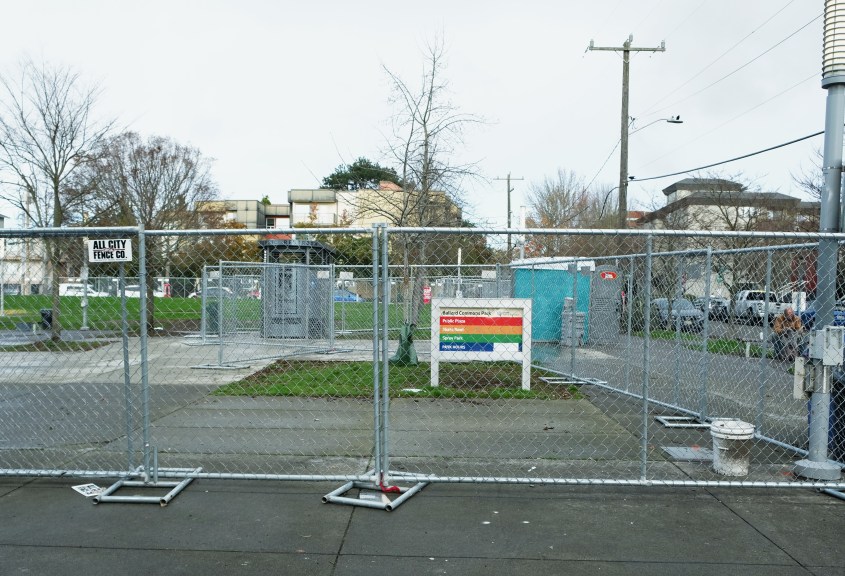
Last week, sanitation crews and Parks Department employees showed up to remove the remains of a large, persistent encampment at the Ballard Commons park. From the outside, the removal looked exactly like every other encampment sweep: Tents, furniture, and household detritus disappeared into the back of garbage trucks as workers wandered around directing anyone still on site to leave. Hours later, crews installed a tall chain-link fence, identical to the ones that have become ubiquitous at former encampment sites around the city. Huge red “PARK CLOSED” signs emphasized the point: This park, once disputed territory, has been claimed. It will remain closed for at least six months for renovations, remediation, and, as District 6 City Councilmember Dan Strauss put it last week, “to allow the space to breathe.”

But the removal of the encampment at the Commons actually was different, because—for once, and contrary to what the city’s Human Services Department has always claimed is standard practice—nearly everyone at the encampment ended up moving to a shelter or housing, thanks to months of work by outreach providers and a hands-off approach from the city. At a press conference outside the Ballard branch library last week, Strauss heralded the results of the city’s “new way of doing encampment removals.” 
While a humane approach like the one the city took at the Ballard Commons should serve as the baseline for how the city responds to encampments in the future, its success won’t be easy to replicate. That’s because there simply aren’t enough shelter beds, permanent housing units, or housing subsidies to accommodate all the residents of even one additional large encampment, much less the hundreds of encampments in which thousands of unsheltered people live across the city.

Before explaining why it would be premature, and potentially harmful, to praise the city for abandoning its “old” approach to encampments, it’s important to understand how the approach to this encampment really was different, and why it’s simplistic (and unhelpful) to refer to the removal of the encampment, and the closure of the park, as just another “sweep.”

Ordinarily, when the city decides to remove an encampment, the Human Services Department sends out an advance team, known as the HOPE Team, to offer shelter beds and services to the people living there and to let them know the encampment is about to be swept. The HOPE Team has exclusive access to some shelter beds, which makes it possible for the city to credibly claim it has “offered shelter” to everyone living at an encampment prior to a sweep. However, even the HOPE team is limited to whatever beds happen to be available, which tend to be in shelters with higher turnover and fewer amenities, like the Navigation Center in the International District. Mobility challenges, behavioral health conditions, and the desire to stay with a street community are some common reasons people “refuse” offers of shelter or leave shelter after “accepting” an offer. If someone needs a wheelchair ramp or a space they can share with their partner and those amenities are not available at the shelters that have open beds, the sweep will still go on.

Processed with VSCO with n1 preset

At the Commons, in contrast, city outreach partners, including REACH and Catholic Community Services, spent months getting to know the 85 or so people living in the encampment, learning about their specific needs, and connecting them to resources that worked for them. More than 20 percent of the people living at the Commons had “significant medical issues” that many conventional shelters are not equipped to address, including Stage 4 cancer, emphysema, paralysis, and seizure disorders, REACH director Chloe Gale said last week. Eighty percent had serious behavioral health conditions, including addiction. One had been the victim of gender-based violence and did not feel safe going to shelter alone.

Eventually, outreach workers were able to find placements for nearly everyone living at the Commons, working with people on a one-on-one basis and building trust over months. The approach is time-consuming, costly, and resource-intensive—and it only works if there is sufficient shelter and housing available.

At last week’s press conference, Councilmember Strauss said that by “using a human-centered approach” the city is “giving [outreach providers] time for them to get get people inside, we’re finding and creating adequate shelter and housing. And [that approach] results in people getting inside rather than displaced.” On Monday, Strauss said during a council meeting that he had “begun working to bring a similar outcome to Lower Woodland Park,” where residents have been complaining about a large RV and tent encampment for months.

The problem—and a likely point of future friction for the city—is that the single biggest factor enabling this “human-centered approach” was the opening of dozens of new spots in tiny house villages and a Downtown Emergency Service Center-run hotel in North Seattle, which will provide permanent housing for dozens of people with severe and persistent behavioral health challenges. Those new resources, more than any outreach strategy or “new approach” by the city, enabled people to move, not from one park to another, but to places they actually wanted to go. Now that those shelter and housing slots are occupied, the city will revert to the status quo, at least until more shelter and housing becomes available.

The issue preventing the city from taking a person-by-person approach to encampments is only partly that Seattle fails to consider the individual needs of people living unsheltered; it’s also that the city has never taken seriously the need to fund and build shelter and housing that serves those needs on the level that will be necessary to make a visible dent in homelessness. This is changing, slowly—as Strauss noted last week, 2021 was the first year in which the city met its goal of spending $200 million a year on affordable housing—but the process of moving people inside will inevitably be slow and partial, especially if the city does not do significantly more to fund both shelter and housing.

Since the beginning of the pandemic, according to data provided by the Human Services Department, the city has only added about 500 new shelter beds, and even that number is misleading, because it includes nearly 200 rooms in two temporary hotel-based shelters that will close down next month, sending providers scrambling to find placements for hundreds of people in the middle of winter. 

Strauss acknowledged last week that the reason the city could declare the Ballard Commons a success story was that so many tiny house village units became available at once. “The reason that we were able to remove the encampment about our comments now over the last two and a half months is because the shelter availability has come online,” Strauss said.

A few hours later, at a meeting of the Ballard District Council, King County Regional Homelessness Authority director Marc Dones tried to inject a dose of realism into a conversation with homeowners who expressed frustration that they continue to see unhoused people in the area, including “one of the biggest car camping problems in the city.”

For example, one district council member asked, would the homelessness authority provide a person or team of people, along the lines of the Seattle Police Department’s community service officers, for Ballard residents to call when they see “someone repetitively harassing a business” or sleeping in their car?


Instead of offering meaningless reassurances, Dones responded that the job of the KCRHA is not to respond to individual neighborhood concerns about specific homeless people—nor would creating a special homeless-monitoring force for a neighborhood help anyway, in the absence of resources to help the people whose behavioral health conditions manifest as public nuisances. “For a lot of folks who have intense behavioral health needs, we don’t have any place for them to go. … It’s my job to not bullshit you on that,” Dones said.

What’s more, they added, sometimes the authority will outright reject community ideas that are bad. “The broad constituency here wants to solve this problem in a healthy and really compassionate way,” Dones said. “And that’s one of those places where if we’re telling people the honest truth about what can and can’t be done with what we have, it’s gonna go a lot further.”

Telling the truth about what works and what doesn’t seems like a simple thing. But it’s so contrary to the Seattle way of doing things that it’s almost shocking to hear an authority figure tell a traditional homeowners’ group that they can’t have what they want, and, moreover, that what they want won’t solve the problem they’ve identified.

Telling people what they want to hear is an ingrained political strategy, particularly when it comes to homelessness. When she first came into office, one-term Mayor Jenny Durkan promised she would build 1,000 new “tiny house” shelters in her first year in office. By the end of her term, only about 200 had opened. Her successor, mayor-elect Bruce Harrell, has similarly promised to add 2,000 new “emergency, supportive shelter” beds, using “existing local dollars” to fund this massive expansion. If this effort, modeled directly on the failed “Compassion Seattle” charter initiative, succeeds, it will almost certainly result in the kind of relatively low-cost “enhanced” shelter many people living in encampments reject, for reasons that outreach workers (and perhaps, now, come council members) understand well.

The question for Seattle isn’t, or shouldn’t be, “How will we add as many shelter beds as cheaply as we can so we can remove homeless people from public view?” It is, and should be: “How can we shelter and house unsheltered people in a way that prevents them from returning to homelessness while creating realistic expectations for housed residents who are frustrated with encampments in parks?” As the Ballard Commons example illustrates, it takes more than “X” number of shelter beds to get people to move inside. It takes time, effort, money, and a willingness to view unsheltered people as fully human.

Council Raises Income Level for “Affordable” Housing on Church-Owned Property

Photo by Daniel Tseng on Unsplash

By Erica C. Barnett

On Monday, the city council rejected a proposal by Councilmember Lisa Herbold that would have required churches to build more deeply affordable housing in exchange for density bonuses (upzones) that could double the value of property they own. The legislation the council adopted will provide a financial incentive for religious institutions to build apartments for people and households earning up to 80 percent of the Seattle area median income—for a one-person household, about $65,000 a year.

The legislation has its roots in anti-displacement efforts. Back in 2019, the state legislature adopted legislation requiring cities to give religious institutions density bonuses—essentially, the right to build more housing—on property they own, if they agree to use it for affordable housing. Three months ago, the city council adopted, and Mayor Jenny Durkan signed, legislation stipulating that starting in July 2022, the housing that churches build on upzoned land must be, on average, affordable to people making 60 percent or less of the Seattle median income—about $49,000 for one person, or $70,000 for a family of four. 

After the legislation passed, several local churches asked Durkan and council members to change the law to increase the affordable threshold to 80 percent. At that affordability level, apartments are essentially market-rate—around $1,620 for a studio apartment, or $1,850 for a one-bedroom unit, no matter where they are located in the city. In contrast, the legislation the council and mayor approved in June required average rents of around $1,200 for a studio and $1,300 for a one-bedroom apartment.

Herbold’s amendment would have continued to allow religious institutions in neighborhoods the city has identified as having a high displacement risk, such as the Central District, Rainier Beach, North Beacon Hill, and Lake City, to build housing affordable at the higher-income threshold, while retaining the 60 percent affordability requirement in other areas.

Nearly seven in ten Black households make less than half of the Seattle median income, and only 10 percent fall between the 50 percent and 80 percent income levels. In other words, fewer than 10 percent of all Black renter households in the city will even theoretically qualify for new church-based housing at the higher income levels the council adopted.

Representatives from local churches argued that requiring deeper affordability anywhere in the city would make it difficult for them to build housing, resulting in the displacement of churches and their congregants, because housing affordable to people making lower incomes simply doesn’t “pencil out” on church property. 

“The [new] legislation, as originally developed, created a win-win scenario where these institutions—almost all of whom make significant contributions to service and justice in the city—can continue to thrive where they are in our neighborhoods and contribute to the crying lack of affordable housing,” Michael Ramos, head of the Greater Seattle Church Council, wrote in an email to Herbold’s office opposing her amendment.

“The ideal is that we have affordable housing at 60 percent area median income across the city, and we have so many policy mechanisms and funding mechanisms to do so,” said Councilmember Dan Strauss, who sponsored both bills.  “Churches need the flexibility to be able to have people [earning] up to 80 percent AMI in their buildings, so that they can either choose to have people move back into the community that have been displaced or to use that revenue to create the services that other residents are receiving to meet the needs of their community.” Continue reading “Council Raises Income Level for “Affordable” Housing on Church-Owned Property”