Category: neighborhoods

The CBGB Theory: Weirdos Not Bros Will Revive Downtown

By Josh Feit

After insisting for months that getting big employers to summon their workforces back to the office was the key to a revitalized downtown, Mayor Bruce Harrell rolled out his updated “Downtown Activation Plan” this week without mentioning that increasingly remote strategy. When Amazon announced earlier this year that, starting in May, employees must come in three days a week, the company’s own employees immediately rebelled.

Today, employees are spending about a quarter of their time working from home, according to a recent Stanford University/Census Bureau study. And just last week, noting that “offices are still at half their pre-pandemic capacity,” the New York Times ran with this enervating headline (for those holding out hope for a corporate office rebound): “Return to Office Enters the Desperation Phase.”

In Seattle, telecommuting was already rising sharply prior to COVID, tripling to more than 16,000 downtown workers between 2010 and 2019, according to Commute Seattle. And let’s be honest, a 3-days-in-2-days-out model already represents the startling acknowledgment that the future of downtowns looks different than the traditional model. More important, a mandate that grates against a major social shift hardly seems like the makings of a long-term or sustainable solution.

And so, credit where credit is due to Harrell’s office for finally chilling out on the Amazon panacea and rolling out some longstanding urbanist wish-list items, including a few legislative proposals. Erica posted an in-depth report on Wednesday, and along with Harrell’s (and soon-to-be deputy mayor Tim Burgess’) predictable, go-to policing solutions, the plan does mine some of the real Janette Sadik-Khan stuff that Seattle urbanists have been talking about for more than a decade.

The grab bag  includes supporting a broader range of building and street uses—waiving fees to bring more food trucks downtown, for example, and allowing both ground-floor housing and retail on the upper floors of buildings downtown. Likewise, it includes recommendation for a pedestrian-only pilot by prohibiting cars on Pike between 1st and 2nd—a tiny bit of car-free real estate, but I’ll take it. And Harrell’s plan even gives a nod to lidding I-5, a near-decade-old, $2.3-to-$2.5 billion planning nerd agenda item. Most prominently, there’s also legislation in the mix that supports increasing downtown housing stock through targeted up-zones on Union and Pike Streets (with incentives for affordable housing) and also code changes that help turn office space into residential space.

As a neighborhood’s stock drops, it becomes more open to free-rein experimentation, not to mention more open to a diverse economic base of commercial renters.

It’s a nice roundup of ideas, but it misses the mark by emphasizing new, downtown residential housing stock; downtown is already dense and tall. We need to get serious about putting density elsewhere in Seattle, rather focusing on downtown . The first step to reviving downtown isn’t new housing, it starts with embracing the grim commercial real estate market, where vacancies recently increased from 22 percent to 24 percent.

How does embracing vacancies help revitalize downtown? Like this: As commercial vacancies rise—new demand for Seattle office space fell 30% from January 2022 —rents drop. And as rents drop, the weirdos, rather than the big employers, move in. And by weirdos, I mean: creative-class, art-centric, small-scale retail. In short: The rebirth of downtown will be sparked not by Amazon, but by high vacancy rates, leading to low rents, leading to an influx of vibrant, small businesses, leading to new housing demand.

Call it the CBGB theory of city planning. During the sluggish mid-to-late 1970s, New York City’s famously abandoned and spent Lower East Side neighborhood, where CBGB set up shop on Bowery, attracted waves of bohemians who turned the neighborhood into the epicenter of an urban shock wave that would change cities into magnetic destinations for brains, youth, talent, and commerce.

Making analogies to New York City—in the 1970s, for that matter!—certainly seems like a stretch for Seattle. Seattle’s hot tech economy and hot real estate market don’t conjure the “Ford to City: Drop Dead” days of NYC bankruptcy. Nor does Seattle, population 779,000, parallel the creative serendipity that flows through a city of more than 8 million people like New York. But this basic truism makes sense at any level: As a neighborhood’s stock drops, it becomes more open to free-rein experimentation (and yes, graffiti!), not to mention more open to a diverse economic base of commercial renters.

I’m going to put my hope in the new, small businesses that have recently and eagerly started popping up downtown. 

The limited data available from real estate analysts such as CoStar suggests that demand for leases on smaller spaces (0-5,000 square feet) has decreased more than 50 percent year over year—suggesting lower rents could come, drawing small businesses  downtown.

Consider the arc of this anecdotal observation about the downtown retail renters’ market from the folks at Seattle Restored, a City of Seattle program that pairs downtown landlords with small pop-up style businesses for three-to-six month rental stints, providing grants to help with rent.

A lot of property management companies began reaching back out, perhaps realizing renters weren’t willing to pay the high prices, they were now looking for smaller renters.

When I first contacted them in April for any insights about downtown’s small space retail market, they believed landlords were willing to hold out for high rental prices. They didn’t have any hard data, but said they noticed larger real estate/property management companies were rescinding  initial offers to work with the program, likely holding out hope to rent at full market value.

However, recently they noticed a change. This week they gave me an update, saying it looked more like a renters’ market these days: About a month after we first spoke, they told me, a lot of property management companies began reaching back out. Perhaps realizing commercial tenants weren’t willing to pay the high prices, they were now looking for smaller renters. The program’s success so far backs up this theory: With 30 spaces now filled, the program is well on its way to hit its goal of 45 small businesses set up by the end of the year.

With that in mind, I’m going to put my hope in the new, small businesses that have recently and eagerly started popping up in PubliCola’s neighborhood (Pioneer Square), such as The Monkey Bridge IIOHSUN Banchan Deli & Café, and Café Lune—none of these are  a subsidized Seattle Restored business, by the way. In short, I’d rather bank on them than on Harrell’s plan for new high-rises on 3rd (conveniently ousting McDonald’s, I imagine)—or phantom Amazon employees, for that matter.

The city should focus less on policies of willful denial—landowners imagining high rents and Amazon execs mandating against reality—and focus more on attracting eager small businesses. The city can do this by passing zoning regulations that favor or even mandate smaller square footage spaces. Let the weirdos, not the bros, take the lead in reviving downtown.

Josh@Publicola.com

Light Rail Board Members Seek Middle Ground as Plan to Skip Chinatown, Midtown Stations Moves Forward

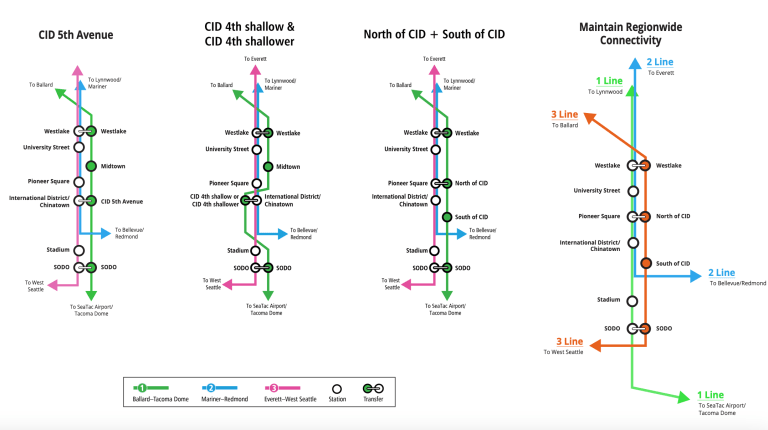
Dow Constantine and Bruce Harrell have proposed a “North-South” light rail plan that would eliminate planned Chinatown-International District and Midtown stations. A compromise proposal, sponsored by Claudia Balducci and Roger Millar, would restore the “spine” of the system and keep some connections to the CID.

By Erica C. Barnett

On Wednesday, in advance of a Sound Transit board meeting that could reshape a long-planned light rail expansion linking downtown Seattle to Ballard and West Seattle, King County Councilmember and Sound Transit board member Claudia Balducci proposed an alternative route that preserves the existing “spine” of the system while eliminating a planned station in the Chinatown International District (CID). Voters approved the expansion, called “ST3,” in 2016.

The last-minute proposal is a direct response to, and amendment of, another last-minute proposal backed by King County Executive Dow Constantine and Mayor Bruce Harrell, who is sponsoring the motion. That “north-south” plan, which has no cost estimates, engineering, or design, would take a new light rail station on Fourth Avenue in Chinatown off the table, eliminate a planned “Midtown” station that would have served First Hill, and add a new “south of CID” station a few blocks north of the existing Stadium station south of downtown.

The big advantage to his plan, according to Constantine, is that in addition to eliminating the disruptive and harmful impacts of construction in Chinatown, it would set the stage for a whole new “neighborhood” centered around the site of the current King County Administration Building.

Compared to the “north-south” proposal, Sound Transit board member Claudia Balducc said, “this option would mean less out of direction travel and better connections for South and East riders [and] retain a one seat ride from South Seattle, South King and Pierce to the CID.”

Balducci’s proposal, co-sponsored by Washington State Department of Transportation director Roger Millar, would re-connect the “spine” of the system—which, under all previous plans, would be split into segments when expansion lines to Ballard and West Seattle open in the 2030s—keeping a one-seat ride from Lynnwood to Tacoma and, importantly, preserving the existing connection between South Seattle and the CID, which Constantine’s plan would eliminate. Essentially, it would create a true Ballard-to-West Seattle line (which no previous plans would do) while preserving connections to Chinatown from the east and south.

Compared to the “north-south” proposal, Balducci said, “this option would mean less out of direction travel and better connections for South and East riders [and] retain a one seat ride from South Seattle, South King and Pierce to the CID.”

Either of the two north-south options would eliminate the “Midtown” station, which would come the closest of any station to the dense First Hill neighborhood—echoing a similar decision in 2005, when the Sound Transit board voted to scrap a long-planned station in the neighborhood, a decision that eventually produced the First Hill streetcar.

“If Midtown Station goes away, then they need to understand that what they’ve done is eliminate the highest ridership station in all of ST3 and that is going to require that they mitigate the hell out of it,” said Transportation Choices Coalition Alex Hudson, who noted that many of the people who work in First Hill hospitals live south of Seattle and could have used the new light rail line to commute to their jobs. “That’s 15,500 people who were counting on excellent [rail] service and have been paying for it and won’t get it—that’s not small change. That’s a real harm.”

Mitigating for the loss of the Midtown station, which could come in the form of expanded bus or other transit service in the area, will add costs to the project—eating into any savings from eliminating the station, Hudson said.

TCC wants the Sound Transit board to keep an existing option, the Fourth Avenue “shallower” option, on the table; as long as they’re considering an unstudied plan, she said, the board should keep a more thoroughly vetted option on the table. Balducci has introduced a second amendment that would keep that option on the table, and said that since the new Constantine-Harrell plan will require a supplemental environmental impact statement, “we should use that time to also study and improve the 4th option as much as possible. Then we’ll have the ability to make the most informed choice,” Balducci said.

“Before we walk away from the option to have a great transit hub on 4th that could both serve the CID and connect our light rail lines most effectively to each other, Sounder, Amtrak and other modes, I’m asking that the agency look harder at ways to address community concerns,” Balducci added.

It’s unclear whether Balducci and Millar’s proposals will gain traction, or if the Constantine-Harrell plan has so much momentum that it will steamroll efforts to keep other options on the table. The board meets tomorrow at 1:30 pm.

Maybe Metropolis: The NIMBY Illusion

Image via Grand Illusion Cinema (Facebook)

By Josh Feit

Back in 2018—as a Gen X traitor, evidently—I editorialized against saving the Showbox. I was opposed to making policy based on ’90s nostalgia and was for building new housing coupled with the $5 million in affordable housing funds the development would generate from the city’s Mandatory Housing Affordability program.

At the time, a City Hall legislative staffer asked me in earnest if there was any spot around town that would turn me into a NIMBY if it was slated to get torn down and replaced with fancy condos? I honestly couldn’t think of anything that fit the bill.

But now comes the latest in Seattle-is-changing news: The Grand Illusion, the independent movie house at 50th and University Way NE (the Ave), may be the next casualty of real estate development. It’s still not 100 percent clear what the fate of the Grand Illusion will be, but according to a January 23 Daily Journal of Commerce report, real estate developer Kidder Mathews is offering the building for $2.8 million on behalf of the theater’s longtime owner. For now, the theater, which has been around since 1970, has signed another two-year lease, and they say they’re set on finding a new home.

The news hits me in the gut. True story: Just 10 days before I read about the Grand Illusion’s hazy future, I went to a movie at the groovy theater (for the first time since the pandemic, and likely even well before that). Excited to find the place as lively as ever—a disheveled goth was working at the combo ticket/refreshments booth before a nearly sold-out Friday night show—I ended up making a contribution to the nonprofit the very next day. Over the years, I’ve seen countless indie, foreign, art, and cult films at the Grand Illusion while eating a bucket of popcorn heavily dusted in nutritional yeast. I even attended former Seattle city council member Nick Licata’s wedding there, sitting in the rickety yet plush red seating. I’ve also spent a healthy dose of time in the adjacent tortured-poet coffee shop. The Grand Illusion defines Ave culture.

The countercultural Seattle landmark is in a precarious spot because current Seattle zoning prohibits housing and businesses just about everywhere else in the city.

As a pro-development urbanist, I could be called a hypocrite for fretting over the fate of this charming, grunge-y spot. But actually, the potential closure of the Grand Illusion simply confirms the basic problem with Seattle’s zoning code I’ve been writing about for more than 20 years. The reason developers buy up spots in exciting locations like 50th and the Ave. is because these spots are typically located in the few slices of the city that are zoned for multi-family and mixed-use development. “Under current zoning, the listing … estimates that a six-story building could yield 31 apartments,” the DJC reported.

This fact underscores an even more germane point: Offing the Grand Illusion for density is redundant. The block where the theater now stands already works the way a smart city should, with its surrounding dense zoning and plentiful transit. Unfortunately, the area is an oasis of six- and seven-story neighborhood commercial zoning in a desert of land zoned for low-density and single-family housing (and no commercial space). We don’t need more businesses and housing on the Ave.—we need them in the surrounding low-density residential zones.

The YIMBY position remains as it has always been: Put more housing and businesses in the suburban-esque tracts of Seattle where we should have more economic diversity. Unfortunately, with density cordoned off into just 25 percent of the city’s residential land, developers have limited places to build. And so it’s the dense urban areas where beloved, longstanding institutions—Piecora’s on Capitol Hill, Mama’s Mexican Kitchen in Belltown, Tup Tim Thai on Lower Queen Anne—get replaced by apartments. Meanwhile, the strictly single-family tracts stay untouched as the people who live there see their assets grow.

I’m not going to start a petition drive or sign onto a “Save the Grand Illusion” campaign—a la the cringe-worthy, largely white and Gen X effort to save the Showbox. Instead, I’ll point out that the news comes with an explanation slow-growthers won’t like: The Grand Illusion isn’t on the chopping block because of some pro-developer bent in Seattle’s zoning rules. The countercultural Seattle landmark is in a precarious spot right now because current Seattle zoning restricts housing and businesses just about everywhere else in the city.

Josh@PubliCola.com

Sponsors of Pro-Housing Bills in Olympia Emphasize Statewide Affordability Crisis

Image of a four-unit apartment building
One Salient Oversight at English Wikipedia, Public domain, via Wikimedia Commons

By Ryan Packer

In response to rising housing costs and increased homelessness statewide, the state legislature is considering an unprecedented number of bills that would influence the ability of cities across the state to set local policy around housing, density, and land use. 

Among the proposals introduced so far: A bill that would eliminate most minimum parking requirements near transit stations; one cutting local design review boards out of the approval process for residential construction; one streamlining permitting; one allowing residential lots to be split into multiple lots so additional units can be built on those lots; and one reforming condominium laws. Many of these bills have already had a public hearing and are headed toward committee votes—extremely fast work compared to past years.

House Bill 1110, introduced by Rep. Jessica Bateman (D-22, Olympia) and Rep. Andy Barkis (R-2, Olympia), is taking center stage as a retooled version of similar legislation, HB 1782, that never made it to the House floor last year. This year’s bill would require cities to legalize sixplexes within one-half mile of frequent transit. It would also allow fourplexes as a base level of density in areas in and around Seattle and Spokane, and in towns and cities with more than 6,000 residents elsewhere in the state.

This so-called “missing middle” bill would attempt to add a level of density between single family homes and large apartment buildings currently absent from many Washington cities.

Last year, opposition from the Association of Washington Cities (AWC), a lobbying group for cities, helped prevent HB 1782 and other housing bills from advancing; the group argued that zoning changes that preempted city rules would take away local control and impose “one-size-fits-all” regulations on cities across the state. In 2023, legislators hope to bypass that criticism by focusing on the impacts of high housing costs.

“I feel more confident this year because we’ve been doing a lot of coalition building and a lot of work to talk about the real causes of our housing shortage and crisis,” Bateman said. During its first hearing last week, elected officials from Olympia, Bothell, Everett, and Burien turned out to support the bill, with much less direct opposition than last year.

Supporters also say they’ve done work to broaden the coalition that supports the bill. The AWC, unlike last year, is not currently opposing HB 1110, but is pushing to water down changes to single-family zones to only include triplexes, and to not impact every lot within a city.

Another bill, introduced by Senator Marko Liias (D-21, Edmonds), focuses on loosening restrictions on density directly around transit stations, preserving traditional single-family zoning in wide swaths of cities across the state. That bill may prove an easier political sell compared to opening up single-family areas to increased density, particularly in the state senate, where there are fewer Republicans ready to partner on housing bills.

“As I talk to my constituents, I’ve got folks in Edmonds, Lynnwood, Mukilteo, that are really wary about missing middle [housing]” housing, Liias said, referring to moderately dense housing that’s affordable to middle-income earners. In contrast, Liias said, “when I talked about transit-oriented development, virtually everybody’s in agreement that we should be siting more housing next to transit. That’s a much more consensus perspective.”

The local control issue may still be a hurdle, though. Rep. Spencer Hutchins (R-26, Gig Harbor), who sits on the housing committee, suggested during a meeting with the Gig Harbor city council earlier this month that even if he agrees with a policy change on housing, he might still oppose it on principle. “I will be looking at things through the lens of, making sure that we are protecting the ability of our local governments to represent their local citizens well, and not have Olympia run roughshod over cities and counties,” Hutchins said.

Rep. Bateman doesn’t give a lot of credence to the local control argument. “Currently what cities are doing is, they’re limiting what private property owners can do with their property,” she said. “You don’t have the freedom to make your own decision about adapting to the market, responding to what the market need is. People want more diverse housing options.” 

This year, Democrats are trying to zoom out on the issue of housing and focusing on multiple aspects of the state’s housing crisis. The Democratic caucuses in both chambers have begun referring to three “pillars” that lawmakers will attempt to tackle around housing this session: Increasing public subsidies for affordable housing, passing tenant protections for renters, and loosening restrictions on housing supply that are limiting growth. 

The first housing “pillar” is clearly a priority for Governor Jay Inslee, who is pushing to raise the state’s debt limit to fund $4 billion in investments in housing over the next six years. That proposal, even if lawmakers approve it, would need to go to voters statewide in November, adding an extra level of uncertainty. 

The sheer number of housing bills this session  is itself a strategy to avoid a repeat of last year, when almost no housing bills made it past legislative deadlines. “It’s one thing to say that one bill can’t solve all the problems, but it’s another thing to actually have a whole bunch of other bills that are working to solve these challenging areas that make it more difficult to build housing,” Rep. Bateman said. 

ryan@publicola.com

New Sound Transit Options Would Move Future Light Rail Station Out of Chinatown-International District

One of the options for moving the planned new Chinatown-International District light rail station, near city and county buildings, would allow transfers between all the light rail lines, through an underground connection to the existing Pioneer Square station, but it would not provide a direct connection to Sounder and Amtrak trains.

By Lizz Giordano

After facing heavy criticism from many within the Chinatown-International District over a new light rail station, Sound Transit is considering new options that would move the station out of the neighborhood.

The agency is now studying a location north of the CID, a block from the existing Pioneer Square Station near the King County Courthouse. This proposal would place the new station just to the east of 4th Ave, between Jefferson and Terrace Streets. Another potential location would put the future station along 6th Avenue S, just north of the current Stadium Station and Greyhound Bus Station.

The new station is part of the West Seattle-Ballard light rail extension that will add two new lines through downtown Seattle. The first new line will start at the Alaska Junction in West Seattle and head east to SoDo—eventually connecting to Everett via an extension that’s now set to open in 2032. The second will run from Ballard to SeaTac Airport and Tacoma via downtown, the CID, and SoDo, with service estimated to start in 2039.

Participants in Sound Transit’s public workshops, who included residents, business owners, and representatives from community groups and social service agencies, suggested the new locations to the agency after the Sound Transit board instructed staff to conduct further outreach after many in the neighborhood objected to the alternatives Sound Transit laid out in its Draft Environmental Impact Statement (DEIS), released earlier this year.

Locating the station in the Chinatown-International District, rather than near the stadiums or in Pioneer Square, would enable direct transfers between light rail lines, Sounder commuter rail, and Amtrak long-distance rail.

Those alternatives included building along 5th Avenue in the middle of the CID, consuming several blocks of the historic district, or on 4th Ave, a disruptive and costly option that would include rebuilding the viaduct under the heavily used road. Both alternatives included deep (180-foot) and shallow (80-foot) tunnel options.

Cathal Ridge, Sound Transit’s executive corridor director, said there are trade-offs for each of the new alternatives that would push the station out of the neighborhood. The new CID station is supposed to connect the communities around it and serve as a regional transit hub for light rail and other transit modes. Locating the station in the CID, rather than near the stadiums or in Pioneer Square, would enable direct transfers between light rail lines, Sounder commuter rail, and Amtrak long-distance rail.

The northern location, near city and county buildings, would allow transfers between all the light rail lines, through an underground connection to the existing Pioneer Square station, but it would not provide a direct connection to Sounder and Amtrak trains. Plans also show a deep station at 103 feet below ground, another drawback to this location.

The southern site, sandwiched between 4th Avenue and Airport Way, wouldn’t offer direct transfers between any of the other rail lines and would leave riders in a very inhospitable walking environment. Current plans show a station 115 feet underground. For comparison, the U District Station near the University of Washington is 80 feet below ground.

During the most recent outreach meeting, in December, Sound Transit did not discuss the heavily criticized 5th Ave options, nor the deep station alternative along 4th Avenue. Transit advocates said a 180-foot-deep tunnel on Fourth Ave. would create a poor rider experience, because it would take several additional minutes to access the underground station.

In a push to keep the station off 5th Avenue, the Washington Trust for Historic Preservation recently added the entire CID to its Most Endangered Places list.

“A station along 5th Ave exacerbates displacement of local, long-standing businesses and their employees while placing yet another major construction project within a community that has endured an inequitable burden from such projects in the past,” Huy Pham, the Trust’s director of preservation programs, wrote in an email to Sound Transit in December.

“At this time, our call to action is to have Sound Transit take the 5th Avenue option off the table, while they conduct a thorough analysis of 4th Avenue impacts,” Pham told PubliCola.

Along with the new options, Sound Transit is also considering an even shallower tunnel on 4th Ave—40 feet deep instead of 80.

Ben Broesamle, the operations director for the transit advocacy group Seattle Subway, doesn’t want to see the station moved away from the CID, and supports a shallower, less disruptive 4th Ave. Tunnel. “If Sound Transit is still interested in building a new tunnel that serves transit riders, they should take a hard look at a very shallow 4th Ave station for the CID,” Broesamle said.

“If you’re not too concerned about the cost, the disruption, all of that, you might say, well, 100 years from now [the CID] might be the best place .But people do care about what’s going to happen in the next 10 years. That means a lot to people.” Peter Nitze, president and CEO of Nitze-Stagen

Peter Nitze, president and CEO of the real estate investment firm Nitze-Stagen, sees a lot of benefits of a new station closer to the King County Courthouse: Moving construction out of the heart of the CID and helping redevelop the area. While also saving Sound Transit money by eliminating the need for a midtown station, part of the downtown segment in the Ballard extension located near 5th Avenue and Columbia Street, a few blocks north of the proposed north of CID site.

Nitze-Stagen is redeveloping land on the corner of 7th Avenue and Jackson and has a minority ownership in a parking garage near Union Station. If Sound Transit locates the new station along 4th Avenue, the garage would stand to lose about 200 parking stalls, or about 20 percent of its capacity.

“If you’re not too concerned about the cost, the disruption, all of that, you might say, well, 100 years from now [the CID] might be the best place,” said Nitze. “But people do care about what’s going to happen in the next 10 years. That means a lot to people.”

Sound Transit discarded other ideas brought up during community workshops, including building the new station in the Lumen Field parking lot or just south of Royal Brougham Way. The agency said that these alternatives either presented technical challenges or the location didn’t meet the goals—connecting neighborhoods and serving as a regional transit hub—of the new station.

Maybe Metropolis: Pro-Housing Democrats Poised for Action in 2023 After Ousting Obstructionist Seattle Rep. Pollet

Finetooth, CC BY-SA 3.0, via Wikimedia Commons via Wikimedia Commons

By Josh Feit

Before I get to last week’s quiet yet encouraging news out of Olympia—House Democrats removed single family zoning preservationist Rep. Gerry Pollet (D-46, N. Seattle) from his position overseeing housing policy—I’d like to review a couple of other recent, below-the-radar news items that provide context for why such a seemingly picayune parliamentary move in the state legislature matters for Seattle.

First, in October, the Washington State Advisory Council on Historic Preservation decided to okay a request from Wallingford homeowners to put hundreds of houses in Wallingford on the National Register of Historic Places; this week, the National Parks Service made it official.

Expect to see more and more attempts by “In this House” Seattleites to weaponize “historic” districts as a tool against reforming local land use policy that could otherwise increase affordable housing and density in Seattle.

Meanwhile, another quiet zoning decision reflected the opposite path: Last month, the Seattle Landmarks Preservation Board voted against landmarking the “unremarkable” (as Erica hilariously put it) two-story wood-framed Jai Thai building on Capitol Hill. The decision cleared the way for a new seven-story affordable housing development.

You can attribute Pollet’s NIMBY politics to an old-fashioned brand of lefty populism that elevates provincialism (knee-jerk suspicion of development mixed with tired exhortations about neighborhood “character”) into a fight to preserve single-family zoning.

Unfortunately, these two decisions taken together ultimately reaffirm the prevalence of Seattle’s off-kilter city planning philosophy: Seattle confines multi-story density to the same neighborhoods over and over, while foregoing opportunities for new housing in the hefty majority of the city—75 percent— that’s currently zoned exclusively for detached single-family houses. Sadly, Capitol Hill’s density is a Catch-22 for urbanists: Enthusiastically adding units to one of Seattle’s densest neighborhoods provides fodder for the city’s redundant single-family zones to ward off reforms that could create new housing. This preserves the status quo: Skyrocketing housing prices. The Seattle area has some of the most expensive housing prices in the country, with median rents above $1,700 (over $2,200 in the Seattle region) and a median sale price of $810,000.

It’s no wonder King County says we need to build around 240,000 new affordable units in the next 20 years, or 12,000 new units a year. Currently, we’re nowhere close to that pace; over the last two years, according to the Seattle Office of Housing, the city averaged about 1,300 affordable units a year.

Thankfully, pro-housing folks are fighting to reverse this trend. Witness the long overdue progressive coup in Olympia. Earlier this month, under youthful, new leadership, the state house Democrats finally removed Rep. Gerry Pollet (D-46, N Seattle) as chair of the pivotal House local government committee. As we have been reporting for years, Rep. Pollet has repeatedly used his position to kill pro-housing bills. (No surprise, The Urbanist has also called out Pollet for undermining housing legislation.) You can attribute Pollet’s NIMBY politics to an old-fashioned brand of lefty populism that elevates provincialism (knee-jerk suspicion of development mixed with tired exhortations about neighborhood “character”) into a fight to preserve single-family zoning.

Initially, frustrated with Pollet’s history of watering down pro-housing legislation, the House Democratic Caucus voted in late November to shrink the scope of Pollet’s committee by moving all housing issues into the housing committee, whose chair, Rep. Strom Peterson (D-21, Everett) supports urbanist legislation. Last year, for example, Peterson co-sponsored Rep. Jessica Bateman’s (D-22, Olympia) bill, HB 1782, that would have authorized duplexes, triplexes, and fourplexes in residential areas within a half-mile of a major transit stops. It was one of several pro-density bills Pollet helped kill last year. 

The move to take housing policy out of Pollet’s committee was orchestrated by a new generation of Democrats who want to send a message that affordable housing (tied to density) will be a top priority in 2023.

Two weeks later—evidently not done sending their message—the caucus voted to remove Pollet as chair of the local government committee altogether, handing the reins to Rep. Devina Duerr (D-1, Bothell), another co-sponsor of last year’s failed density bill.

With much better odds of passing their bills intact out of Peterson’s committee than under Pollet’s provincialism, pro-housing legislators could bring some necessary state governance to Seattle’s failed local policies.

The Seattle Times, whose editorial board shares Pollet’s preservationist POV, ran an editorial last week lamenting the leadership sea change by parroting Pollet’s go-to  “local control” mantra, claiming that pro-housing bills would prohibit local governments from enacting affordable housing requirements. That’s untrue. The bills that urbanists like Rep. Bateman support simply give local jurisdictions the option to allow multifamily housing in single-family neighborhoods, leaving affordable housing requirements in the hands of local jurisdictions.

“If we’re really concerned with affordable housing,” Rep. Bateman told PubliCola, “let’s first acknowledge some basic facts: Single-family zoning is 100 percent displacing people and causing gentrification.”

This status quo—not the bogeyman of future development—constitutes a current threat to housing affordability. For example, existing policy not only squeezes supply by making most of the available land in Seattle off-limits to multifamily housing, it also encourages teardowns and McMansions. Rep. Bateman’s pending, more ambitious 2023 proposal will challenge that status quo by authorizing fourplexes in residential areas of cities across the state—anywhere detached single-family homes are allowed.

Data show that even this modest increase in density improves affordability. Portland made fourplexes legal citywide two years ago and the first set of numbers indicates that they are more affordable to rent or purchase than duplexes, triplexes, or single-family homes. Additionally, Bateman said her legislation will create an affordability incentive with a “density bonus” that allows scaling up to sixplexes if two of the units are affordable to people making between 30 and 80 percent of the area median income.

On the state senate side, Sen. Marko Liias (D-21, Everett) is cueing up legislation that would target upzones (more dramatic ones) specifically near transit hubs.

This is all to say, for more news that could end up having big implications in the coming year: Pay attention to the state legislature’s prefiled bills page and watch for new pro-housing legislation. With much better odds of passing their bills intact out of Peterson’s committee than under Pollet’s provincialism, pro-housing legislators could bring some necessary state governance to Seattle’s failed local policies.