Tag: Sound Transit

“Security Levels Are Going to Increase” on Sound Transit Trains, as Agency Struggles to Win Back Riders

By Erica C. Barnett

Hours after Sound Transit’s Technical Advisory Group read the light rail agency the riot act for, among other things, fostering a culture that “appears to discourage decision-making” (read Mike Lindblom’s comprehensive story on the TAG’s critique and recommendations), Sound Transit’s Rider Experience and Operations Committee got an update last week on the agency’s renewed efforts to crack down on people who violate transit rules, including riders who fail to pay their fares.

As longtime PubliCola readers know, Sound Transit has long struggled to balance its fare enforcement policy (which was recently amended to give riders additional warnings and more opportunities to resolve fare violations before receiving a $124 ticket) with its farebox recovery policy, which stipulates that fare revenues should pay for 40 percent of the cost to operate Link Light Rail. (Sound Transit’s other services, such as Sounder express rail and Sound Transit Express buses, have lower farebox recovery targets). The agency has only achieved that 40 percent goal—which is significantly higher than King County Metro’s 25 percent farebox recovery target—in one year, 2017; between 2019 and 2020, the rate plunged from 26 percent to 8 percent, and hit 16 percent—a post-lockdown high—last year.

Security officers “have already started conducting targeted enforcement activities of removing people from trains and stations throughout the system,” Sound Transit CEO Julie Timm said, adding that the agency has also begun moving ORCA fare card readers away from station platforms, “especially in our tunnels.”

According to a presentation by Sound Transit staff, the agency’s “fare ambassadors”—neon-vested Sound Transit staff who replaced uniformed fare enforcement officers in 2020—found that 15 percent of the riders they interacted with had not paid their fare. This number is far less than casual estimates by former agency CEO Peter Rogoff, who once lamented that he witnessed “almost no one” paying their fares after a Mariners game, but still twice as high as pre-pandemic nonpayment levels. Sound Transit’s Deputy Director of Passenger Success Sean Dennerlein said at Thursday’s meeting that the agency is still struggling to hire fare ambassadors—currently, there are 17, up from a low of four but still a third less than the number funded—and “we do lose them fairly quickly,” Dennerlein said.

New Sound Transit CEO Julie Timm said the agency has initiated a new crackdown on violations of the state law governing transit conduct, which prohibits a wide range of behaviors on transit and at transit stops, from smoking to playing music and “loud behavior.” In January, the board approved four new contracts for private security services totaling up to $250 million over six years; these new contracts, Timm said, would help address “the ongoing challenge of too few available officers on our system.”

Starting this month, Timm continued, “security levels are going to increase.” Security officers “have already started conducting targeted enforcement activities of removing people from trains and stations throughout the system,” Timm said, adding that Sound Transit has also begun moving ORCA fare card readers away from station platforms, “especially in our tunnels,” so that fare ambassadors can check fares before people board trains and so security can “discourage or report unlawful conduct to discourage incidents on trains.”

The new emphasis on security guards represents an apparent reversal of efforts both pre- and mid-pandemic to address concerns about racially biased fare and rule enforcement by reducing the presence of security guards on trains.

Sound Transit’s current fare policy “triggers consideration of a fare increase” if farebox recovery falls below the minimum levels adopted by the board. Currently, Sound Transit’s zone-based adult fares are all over the map, ranging from $2.00 for the isolated Tacoma light rail “T” line to as much as $5.75 for Sounder commuter rail. If nothing changes, according to Thursday’s staff presentation, fares would range from $2.25 up to $4.25 once all the projects from the 2008 Sound Transit 2 ballot measure, which will extend light rail to Redmond and Federal Way, are open.

One option is a flat fare that would apply across the system; this option would eliminate the requirement to “tap off” after getting off a train and would make it feasible, according to Sound Transit staff, to cap fares after a rider has spent a certain amount—something many transit systems across the country, from Portland to New York City, already allow.

New Sound Transit Options Would Move Future Light Rail Station Out of Chinatown-International District

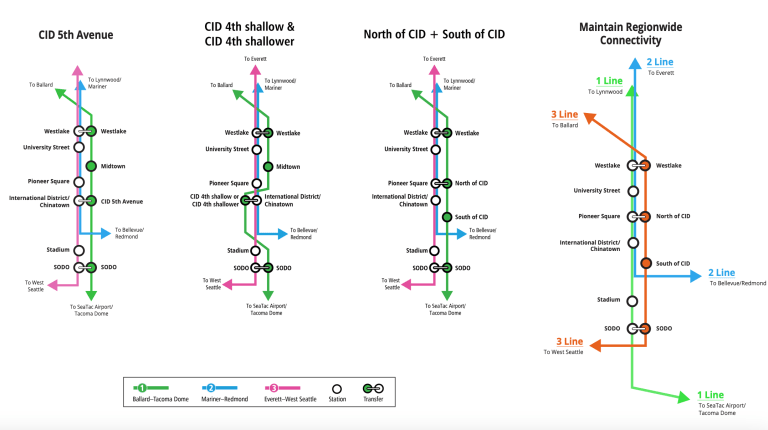
One of the options for moving the planned new Chinatown-International District light rail station, near city and county buildings, would allow transfers between all the light rail lines, through an underground connection to the existing Pioneer Square station, but it would not provide a direct connection to Sounder and Amtrak trains.

By Lizz Giordano

After facing heavy criticism from many within the Chinatown-International District over a new light rail station, Sound Transit is considering new options that would move the station out of the neighborhood.

The agency is now studying a location north of the CID, a block from the existing Pioneer Square Station near the King County Courthouse. This proposal would place the new station just to the east of 4th Ave, between Jefferson and Terrace Streets. Another potential location would put the future station along 6th Avenue S, just north of the current Stadium Station and Greyhound Bus Station.

The new station is part of the West Seattle-Ballard light rail extension that will add two new lines through downtown Seattle. The first new line will start at the Alaska Junction in West Seattle and head east to SoDo—eventually connecting to Everett via an extension that’s now set to open in 2032. The second will run from Ballard to SeaTac Airport and Tacoma via downtown, the CID, and SoDo, with service estimated to start in 2039.

Participants in Sound Transit’s public workshops, who included residents, business owners, and representatives from community groups and social service agencies, suggested the new locations to the agency after the Sound Transit board instructed staff to conduct further outreach after many in the neighborhood objected to the alternatives Sound Transit laid out in its Draft Environmental Impact Statement (DEIS), released earlier this year.

Locating the station in the Chinatown-International District, rather than near the stadiums or in Pioneer Square, would enable direct transfers between light rail lines, Sounder commuter rail, and Amtrak long-distance rail.

Those alternatives included building along 5th Avenue in the middle of the CID, consuming several blocks of the historic district, or on 4th Ave, a disruptive and costly option that would include rebuilding the viaduct under the heavily used road. Both alternatives included deep (180-foot) and shallow (80-foot) tunnel options.

Cathal Ridge, Sound Transit’s executive corridor director, said there are trade-offs for each of the new alternatives that would push the station out of the neighborhood. The new CID station is supposed to connect the communities around it and serve as a regional transit hub for light rail and other transit modes. Locating the station in the CID, rather than near the stadiums or in Pioneer Square, would enable direct transfers between light rail lines, Sounder commuter rail, and Amtrak long-distance rail.

The northern location, near city and county buildings, would allow transfers between all the light rail lines, through an underground connection to the existing Pioneer Square station, but it would not provide a direct connection to Sounder and Amtrak trains. Plans also show a deep station at 103 feet below ground, another drawback to this location.

The southern site, sandwiched between 4th Avenue and Airport Way, wouldn’t offer direct transfers between any of the other rail lines and would leave riders in a very inhospitable walking environment. Current plans show a station 115 feet underground. For comparison, the U District Station near the University of Washington is 80 feet below ground.

During the most recent outreach meeting, in December, Sound Transit did not discuss the heavily criticized 5th Ave options, nor the deep station alternative along 4th Avenue. Transit advocates said a 180-foot-deep tunnel on Fourth Ave. would create a poor rider experience, because it would take several additional minutes to access the underground station.

In a push to keep the station off 5th Avenue, the Washington Trust for Historic Preservation recently added the entire CID to its Most Endangered Places list.

“A station along 5th Ave exacerbates displacement of local, long-standing businesses and their employees while placing yet another major construction project within a community that has endured an inequitable burden from such projects in the past,” Huy Pham, the Trust’s director of preservation programs, wrote in an email to Sound Transit in December.

“At this time, our call to action is to have Sound Transit take the 5th Avenue option off the table, while they conduct a thorough analysis of 4th Avenue impacts,” Pham told PubliCola.

Along with the new options, Sound Transit is also considering an even shallower tunnel on 4th Ave—40 feet deep instead of 80.

Ben Broesamle, the operations director for the transit advocacy group Seattle Subway, doesn’t want to see the station moved away from the CID, and supports a shallower, less disruptive 4th Ave. Tunnel. “If Sound Transit is still interested in building a new tunnel that serves transit riders, they should take a hard look at a very shallow 4th Ave station for the CID,” Broesamle said.

“If you’re not too concerned about the cost, the disruption, all of that, you might say, well, 100 years from now [the CID] might be the best place .But people do care about what’s going to happen in the next 10 years. That means a lot to people.” Peter Nitze, president and CEO of Nitze-Stagen

Peter Nitze, president and CEO of the real estate investment firm Nitze-Stagen, sees a lot of benefits of a new station closer to the King County Courthouse: Moving construction out of the heart of the CID and helping redevelop the area. While also saving Sound Transit money by eliminating the need for a midtown station, part of the downtown segment in the Ballard extension located near 5th Avenue and Columbia Street, a few blocks north of the proposed north of CID site.

Nitze-Stagen is redeveloping land on the corner of 7th Avenue and Jackson and has a minority ownership in a parking garage near Union Station. If Sound Transit locates the new station along 4th Avenue, the garage would stand to lose about 200 parking stalls, or about 20 percent of its capacity.

“If you’re not too concerned about the cost, the disruption, all of that, you might say, well, 100 years from now [the CID] might be the best place,” said Nitze. “But people do care about what’s going to happen in the next 10 years. That means a lot to people.”

Sound Transit discarded other ideas brought up during community workshops, including building the new station in the Lumen Field parking lot or just south of Royal Brougham Way. The agency said that these alternatives either presented technical challenges or the location didn’t meet the goals—connecting neighborhoods and serving as a regional transit hub—of the new station.

No Historic Protections for Drive-Through Walgreen’s, More Delays for Sound Transit, Food Trucks Will Face Extra Scrutiny

Joe Mabel, CC BY-SA 3.0, via Wikimedia Commons

1. A city council committee declined to impose restrictions on a one-story former bank in South Lake Union Friday, arguing that the building, which now houses a drive-through Walgreen’s, is not historic enough to merit long-term preservation. The proposed restrictions, which were approved by the city’s Landmarks Preservation Board, would have given the landmarks board veto power over any changes to the interior or exterior of the building. The city has repeatedly increased allowed building heights in the area around the building, which is now surrounded by towers as tall as 160 feet.

The landmark designation for the 1950 building says the structure epitomizes mid-century banking architecture, which focused on convenience for middle-class consumers with cars, and says it also constitutes the outstanding work of a single designer. In fact (as the landmarks board also noted) the bank was just one of many similar structures in Seattle based on a prototype for a drive-through bank. Walgreen’s, which owns the building, had hoped to sell off the development rights for the property, keeping the building as-is but enabling another developer to build densely in a “receiving site” elsewhere in the city.

Neighborhoods committee chair Tammy Morales, who set the Walgreen’s building aside for further discussion back in April, said she saw no reason to prevent future development of the Walgreen’s site, given that there are four other similar buildings in Seattle. “Preserving this particular one-story building doesn’t make sense, given the housing crisis that we’re in and that the neighborhood has changed dramatically since 2006,” when the building got its landmark status.

The committee’s unanimous (four-member) vote against preserving the building also marks a dramatic change, as elected officials (and even the landmarks board) increasingly acknowledge that the need for housing often outweighs preservationists’ desire to see every old (and not-so-old) building protected.

2. In another sign of the times, another council committee agreed to extend the city’s “cafe streets” program, which allowed restaurants to create outdoor dining spaces during COVID, and impose new fees on businesses that take advantage of the program. (Originally, the permits were free).

Advocates for the proposal were concerned about an amendment by Northeast Seattle Councilmember Alex Pedersen to reinstate a rule that banned food trucks within 50 feet of any brick-and-mortar restaurant. Before COVID, this rule effectively prohibited food trucks in business districts all around the city—basically all the areas where people might actually be around to patronize a food truck.

Although the legislation that passed gets rid of this protectionist provision, it still subjects food trucks to extra scrutiny, requiring the Seattle Department of Transportation to report back on any “potential impacts from food trucks or other vending activity occurring in close proximity to brick-and-mortar businesses.”

Pedersen, who sponsored the amendment imposing this extra scrutiny on food truck operators, said the intent of the original 50-foot rule was “to mitigate the potential effects to small existing businesses that take on the risk of additional expenses, of capital improvements, inventory, and wages for workers to keep their brick-and-mortar operations afloat.”

Morales responded that by applying special scrutiny to food trucks, the council would be saying that food trucks—which are often run by immigrants and people of color—have a negative impact on other businesses. “The presumption with this amendment seems to be that we should protect existing businesses from competition,” Morales said, yet “we don’t ask anything of the corporations in this city that regularly squeeze out independent businesses through mergers and acquisitions.” The amendment passed, with Morales voting no, Dan Strauss abstaining, and Pedersen and Kshama Sawant voting yes.

3. Sound Transit, the regional transit agency, announced on Thursday that the extension of its existing Tacoma light rail line, which runs between downtown Tacoma and the Tacomadome, will be delayed for an unknown period due to “quality and safety issues” with the project. In a blog post, agency CEO Julie Timm said Sound Transit has already addressed multiple previous “quality issues” with the project, adding that the latest problem, which involves “track geometry,” will push the opening date until later in 2023.

“We have some folks flying in to look at some of the issues that were identified,” Timm said, but did not specify what the issues are, saying ST will have more to announce next week.

This isn’t the first time Sound Transit has identified shoddy work by its contractors since the pandemic began. Earlier this year, the agency announced it would have to delay the opening of the East Link line connecting Seattle to Bellevue because of multiple quality issues with the light rail extension across I-90. Those problems included problems with “nearly all” the concrete plinths and fasteners that affix the rails to the bridge, cracking concrete supports, missing rebar, and other structural and safety issues.

Because of those significant delays, Sound Transit has proposed changing the order in which it will open new light rail extensions. Under the new proposed schedule, the extension of the existing 1 line to Lynnwood would open in 2024, and the new line to Bellevue and downtown Redmond would open in 2025. Sound Transit doesn’t have a new opening date for a southern extension to Federal Way, which was delayed after a 200-foot section of embankment along the route slid nine feet earlier this year.

Prompted by a request from King County Councilmember and Sound Transit board member Claudia Balducci, Sound Transit staff drafted a plan to open an eight-station, Eastside-only “starter line” connecting downtown Bellevue and Redmond that will provide Eastside residents with some rail transit starting next year while Sound Transit works out the problems with the I-90 crossing.

Cascading Construction Errors Add New Delays to Light Rail Expansion

Inspectors found gaps between rails and pre-cast concrete plinths on both sides of the I-90 water crossing. They addressed the problem by installing mortar, which subsequently failed. Image: Sound Transit presentation

By Erica C. Barnett

Shoddy workmanship, the concrete workers’ strike, and the collapse of an embankment in Kent will delay the opening of the regional light rail expansion by a year or more, Sound Transit staff told agency board members on Thursday. The board already knew that a light rail extension linking Seattle to the Eastside across Lake Washington was behind schedule because of issues with concrete plinths, or track supports, installed by contractor Kiewit-Hoffman, but learned more details last week about both that construction snafu and other issues that will contribute to delays throughout the project.

The biggest potential delay involves the light-rail extension across I-90, where Sound Transit inspectors discovered problems with the concrete plinths that directly support the rails leading up to the water crossing, pre-cast concrete blocks on the bridge deck, and the nylon inserts that hold bolts in place where the rail is attached to the floating bridge itself.

“I want to be clear that as we talk about challenges and risks, we’re speaking to the ability to meet current schedules and not the ability to deliver light rail across the I-90 floating bridge,” Sound Transit’s interim CEO, Brooke Belman, said during last week’s meeting. “We are 100 percent confident in the design and operability of the segment across the floating bridge and [that we will] complete the entire alignment.”

“It was a very strange working situation for absolutely everybody, including folks who would have been on the ground looking at the work and now were required to work from home. So there were a variety of issues that led to this place where we find ourselves.”—Sound Transit deputy director Kimberly Farley

Sound Transit started unearthing problems with its I-90 crossing in 2019, when inspectors discovered that the top surface of some plinths did not connect with the rails they were supposed to be supporting. To close these gaps, Sound Transit’s Kiewit-Hoffman installed mortar between the blocks and the rails, a solution Sound Transit deputy director Kimberly Farley said the agency believed would fix the problem. Subsequently, though, that mortar failed, and Sound Transit discovered another set of problems, “including concrete placements that were too low, too high, constructed to the wrong geometry, or resulting in voids under rail fasteners,” according to a staff report.

During work to fix those construction problems, the team discovered additional issues, “such that the overall scope of the challenges has increased rather than decreased”; for example, many of the blocks had improperly installed or missing rebar, which strengthens concrete and prevents it from cracking. During this time, Sound Transit also discovered that the nylon bolt holders were stripped and decided to replace all of them. They also noticed that some of the pre-cast concrete blocks that support the rails across the bridge were cracking.

Asked why Sound Transit’s inspectors didn’t discover these problems sooner, Farley noted that much of the construction took place at the height of the pandemic, when “it was just a struggle to get everybody on site, keep the work going, and keep the protocols in place.”

“It was a very strange working situation for absolutely everybody, including folks who would have been on the ground looking at the work and now were required to work from home,” Farley continued. “So there were a variety of issues that led to this place where we find ourselves.” Earlier this year, Sound Transit hired a forensic engineer to evaluate Kiewit-Hoffman’s repairs and keep tabs on construction.

Board member Claudia Balducci told PubliCola  she was glad Sound Transit staff revealed the latest issues to the board at this stage, rather than waiting until they had come up with fixes, noting that the agency has historically had issues with transparency. Former director Peter Rogoff could reportedly be tight-fisted with information, preferring to address issues internally rather than bringing them to the board or discussing them in public. “I want that kind of transparency,” Balducci said. “I don’t want staff to be like, ‘We won’t report to the board or to the public until months later, when we have identified a problem and fully engineered a solution.'”

It could be months before the agency identifies a solution to unstable soil conditions along the alignment between Kent and Federal Way, where a 200-foot section of embankment slid nine feet earlier this year, forcing a partial closure of I-5. Originally, Farley said at last week’s meeting, Sound Transit had hoped to use timber pilings to shore up the slope, but after the slide, they went back to the drawing board. “The reason that you didn’t hear the solution [at the meeting] is because, frankly, we don’t have one yet,” Farley told PubliCola. Continue reading “Cascading Construction Errors Add New Delays to Light Rail Expansion”

JumpStart Comes to the Rescue (Again), Sound Transit Updates on Escalator Outages

The forecast office went with the baseline scenario, but noted that the pessimistic scenario has become more likely than it was three months ago.

1. Next week, Seattle’s budget office will release its budget forecast for next year, which will tell city budget writers exactly how much of a shortfall the city faces in 2023. On Monday, the city’s Economic and Revenue Forecast Council, which includes city council members and representatives from the mayor’s office, got a look at the revenue side of that equation, which, like the cost of doing city business, is strongly influenced by the economy, inflation, and interest rates set by the Federal Reserve.

The big picture: In 2022, the city would face a shortfall of nearly $18 million if not for late payments from the JumpStart payroll tax, assessed on very large local companies with highly paid workers. Those payments should have come in last year but didn’t for a variety of reasons, including the fact that some firms apparently didn’t know they had to pay the tax but “fessed up,” in the words of Office of Economic and Revenue Forecasts director Ben Noble, and paid this year.

Because JumpStart revenues were still going to the general fund in 2021 to address the impacts of the pandemic, the money went into the general fund this year. Next year, though, that won’t be the case—and the office expects other city funding sources, such as taxes, grants, and court fines, to be lower than they predicted back in April.

Overall, the forecast office predicts the city will bring in about $1.5 billion in general-fund revenues next year—down $217 million from the current forecast for 2022.

The decline in revenues can’t all be chalked up to parking ticket refunds. Other factors include lower than anticipated revenues from business and occupation taxes, FEMA reimbursement for COVID expenditures, and a decline in use for some utilities, including telephone service (on the decline for years) and water (Seattle had a rainy spring). The city also expects payroll taxes to decline in the future, as tech companies’ stock value decreases and jobs shift away from Seattle to the Eastside

2. In a presentation to the Seattle Pedestrian Advisory Board about Sound Transit’s frequent escalator and elevator outages on Wednesday Sound Transit’s vertical conveyance deputy director, John Carini, argued that user error, rather than anything Sound Transit could control, is to blame for the majority of escalator failure. Carini also talked at length about what the light-rail agency is doing to keep riders informed about why outages are happening, and noted that the agency relies mostly on the public, rather than internal systems, to let it know when its equipment is down.

After showing a slide depicting a new sign that read, “This unit is out of service due to vandalism,” Carini said, “what a lot of people don’t understand is, mechanical failures account for about 38 percent of our total outages”; the rest fall into categories like “misuse” (32 percent) and “environmental” (15 percent), which includes debris people drop that gets caught in the equipment.

Overall, Carini said, Sound Transit is actually exceeding its targets for elevators and escalators in service—if you exclude the downtown light rail tunnel, which Sound Transit took over in January 2021. That’s a huge “if”—as anyone who has taken light rail to or from downtown is well aware, the escalators in every downtown tunnel station are often out of service; currently, according to Sound Transit’s performance tracker, one in three tunnel escalators is down.

The presentation did come with some good news for frustrated light rail riders: Sound Transit is currently setting up a schedule for replacing the downtown elevators and escalators, although with the exception of the International District station, where construction is supposed to start in 2024 the schedules are “TBD.”

In the meantime, Sound Transit will keep working to repair the broken-down equipment, and finally upgrading its elevators and escalators with equipment to ping the agency when they break down, rather than relying on security guards and the general public to let them know things aren’t working. That upgrade, too, is in a “pilot” stage; it will be 2024 or later before Sound Transit stops relying on what Carini called “the human factor” to keep them up to date on equipment failures.


Citing Community Concerns, Seattle Makes No Recommendation On Chinatown-ID Light Rail Route

Fourth Avenue Viaduct
A 4th Avenue route for the West Seattle/Ballard Link Extension is the clear favorite in the Chinatown-International District neighborhood, but requires a costly rebuild of the viaduct over existing train lines in the area.

By Lizz Giordano

UPDATE: Citing missing data in the DEIS, which fails to identify the loss of Alki Beach Academy and the childcare spots, Councilmenber Alex Pedersen is proposing the city not make a recommendation in the segment that runs through the Delridge/ Youngstown area.

The amendment also makes its recommendation for a 17th Ave. W. route in Interbay contingent on the preservation of a proposed Seattle Storm practice facility in the area; former Mayor Jenny Durkan fast-tracked the new building, which contradicts the city’s recently adopted industrial land-use policies, before she left office last year.

The committee is set to vote on this amendment and a few others on Tuesday, July 5.

Original story:

As Sound Transit moves toward a decision about path of its new light rail line to Ballard and West Seattle, the city is preparing to adopt legislation urging the transit agency to bury the track underground, in order to minimize residential and maritime displacements. But the city held off on making a recommendation about the line’s routing and station placement in the Chinatown/International District, citing community concerns about displacement.

The new light rail line, known as the West Seattle/Ballard Link Extension (WSLBE), will connect downtown with West Seattle and Ballard, running through the North Delridge Neighborhood and into the Alaska Junction to the south and through South Lake Union, Seattle Center and Interbay to the north. Regardless of the final route the Sound Transit board chooses next year, businesses and residents will get displaced, and construction will close streets for months or years. 

Residents and businesses in the Chinatown-International District have raised significant concerns about the new line which could take several blocks of the historic area—displacing residents and businesses—while also bringing noise and dust during construction and when trains begin operating. The resolution, drafted by mayor Bruce Harrell’s office and sponsored by council transportation committee chair Alex Pedersen, says Sound Transit’s draft environmental impact statement for the project lacks details about these displacements and potential strategies to mitigate noise, dust, and road closures during construction. The resolution also calls for more community engagement in the Chinatown-International District neighborhoods.

Sound Transit is considering several different options for each segment of the route as the project moves through the lengthy planning stage. The next big step in the planning phase will come later this summer, when the Sound Transit board will select alternatives to continue studying while also re-identifying a preferred alternative for each segment, which the agency describes as a statement of preference, not a final decision about what to build.

“All of the alternatives are analyzed equally, but design emphasis and refinements, and mitigation strategy refinement, will be focused on the preferred alternatives,” said Sound Transit spokesperson Rachelle Cunningham. 

Chinatown/International District options

Both potential routes in the Chinatown-International District, along Fourth or Fifth Avenue, have significant potential drawbacks. Running light rail under Fifth Ave. would swallow several blocks of the historic community near the Chinatown Gate and expose the heart of the neighborhood to the brunt of the noise and dust that comes with a large construction project. It has drawn fierce opposition from the neighborhood. 

Fourth Avenue would require a rebuild of the bridge, or viaduct, that runs between S Jackson Street and Airport Way S., and would cost about one-third more than any of the Fifth Avenue alternatives Sound Transit is studying. It would also severely impact King County Metro Transit’s bus base in the area. 

Both CID alternatives would take many years to build—in the case of the shallow Fourth Avenue alternative, more than a decade— and temporarily or permanently shut down the Seattle Streetcar system, which runs from Pioneer Square to Capitol Hill. Each alternative also has deep and shallow station options; the city’s recommendations mostly avoid the alternatives with deep-tunnel stations that can only be accessed by elevators.

The city doesn’t plan to pick a preferred alternative in the CID, and is asking Sound Transit to refrain from doing so as well. Instead, the city will recommend that Sound Transit extend the study period for another six to nine months to further engage with the community. Seattle leaders also want to see more details about potential displacement in the area, along with mitigation strategies to help the neighborhood deal with construction as well as long-term changes.

There are a lot of unanswered questions, said Betty Lau, a leader in the CID  and member of the Chong Wa Benevolent Association who is pushing for a Fourth Avenue station.

She’s optimistic about this pause.

“I think with the extra time and talking with more community members, they’ll get a better idea of how these things really impact the people who live there, who do business, who depend on the tourism and on the regional draw of the three neighborhoods—Chinatown, Japantown and Little Saigon,” Lau said. “They also have more time to work on environmental studies.

“It’s also good for community members,” Lau added, “because we’re still getting the word out, we’re still looking for our allies and people to help. We’re still informing the non-English-speaking members of the community. And that does take time.”

Delridge 

In West Seattle, city staff recommend supporting a tunnel route that would cut into the ground after passing the Nucor Steel facility, then go underground near the northwest edge of the West Seattle Golf Course. This medium tunnel alternative is a less costly option than digging a hole all the way from the middle of West Seattle Golf Course and into the Alaska Junction, another proposed route.  Continue reading “Citing Community Concerns, Seattle Makes No Recommendation On Chinatown-ID Light Rail Route”