Tag: Sound Transit

Expert Panel “Disappointed” In Sound Transit’s Lack of Progress on Recommendations to Avoid Overruns, Delay

With Sound Transit poised to enter the most intense period of capital spending in its history, an advisory group expressed alarm at the agency’s apparent lack of urgency on key recommendations.

By Erica C. Barnett

A panel of outside experts established last year to help Sound Transit reduce delays to its burgeoning portfolio of megaprojects expressed disappointment last week with the agency’s progress on six recommendations it made in February, noting that many are just now getting underway after many months of delay. With the agency entering the most intense period of capital expansion in its history, members of the Technical Advisory Group (TAG) told Sound Transit’s executive committee on Wednesday, the agency needs to act aggressively to avoid major overruns and delays.

“We’re trying to up your game in order to get the dollar to go a lot further. I want to make sure you understand the value of that,” TAG member Grace Crunican told the board committee. “That’s why we’re nervous about the fact that you’re not up and running. We came to you saying, ‘Hey, let’s go,’ and it’s a year later, and, ‘hey, we haven’t gone.’”

The TAG’s recommendations included restoring lost trust between the Sound Transit board and top agency staff, including CEO Julie Timm; empowering staff to take action, such as signing off on contract changes, without running every decision up the management chain; and hiring an “experienced megaproject capital program executive team” to oversee the expansion of light rail to Tacoma, Lynnwood, Ballard, and West Seattle. The agency’s deputy CEO in charge of system expansion, longtime Sound Transit staffer Brooke Belman, quietly announced she was leaving earlier this year.

“I think we talked about it being a wave, and the wave was coming. The wave is not coming. It is on us right now. And that means the sense of urgency of moving forward with our recommendations is very, very real.”—Sound Transit Technical Advisory Group member Ken Johnsen

Since the recommendations came out, TAG members said, the agency has shown little urgency about putting them into practice. “It’s important to me that the top leadership embrace these changes and work on them diligently, and we’re a long way off from ‘diligently’ at this point,” Sound Transit board member Claudia Balducci told PubliCola.

“There’s been some work—we voted recently to change our contract approval thresholds so that more contracts can be completed and moved by the CEO… but when you get a recommendation that says you need to rebuild trust… that feels to me like something where there needed to be some intentional time invested by the board and the CEO and management to work on that.”

Meanwhile, Sound Transit continues to approach a point in its schedule where it will need to spend between about $5 billion and $8 billion a year to stay on track—a level of annual spending that will dwarf everything Sound Transit has built to date. “We have to change the way we do business,” Balducci said. Every day of delay, Technical Advisory Group (TAG) member Ken Johnsen told the committee, could have cascading effects on Sound Transit’s ability to deliver the projects it has promised, some of which are already running years behind schedule.

Pointing to a chart that shows the amount of money Sound Transit needs to spend on its projects each year in order to avoid major overruns and delays, Johnsen said, “if we sometimes sound overly aggressive on our sense of urgency and why these things need to be moving, it’s because of that chart. I think we talked about it being a wave, and the wave was coming. The wave is not coming. It is on us right now. And that means the sense of urgency of moving forward with our recommendations is very, very real.”

A key issue the TAG noted in its initial report was that “Sound Transit’s current culture appears to discourage decision-making”—staff either don’t feel like they can make decisions on their own, or don’t do so “for fear of making the wrong one and getting reprimanded.” These issues can produce delays that cause contractors to bid on projects where they know they’ll get paid on time and consistently; already, according to the February TAG report, top-tier contractors prefer to seek contracts with other agencies because of long delays getting invoices approved and paid.

“I feel that our recommendations were pretty clear and concise, but that’s not what we saw in these first meetings,” TAG member Connie Crawford, added. “And just the fact that it’s eight months later, nine months later, when we’re having the kickoff meetings [with staff]—that’s been a disappointment to us.”

After the discussion last week, the board went into executive session to discuss a performance review for Sound Transit CEO Julie Timm, who has been at the agency since last September. When they returned to the dais, after extending the session multiple times, the committee no longer had a quorum and had to end the meeting. However, questions about Timm’s future at the agency may be answered on Friday, when her performance evaluation is on the agenda for the board’s public meeting.

Ceis Gets Another $30,000 from City, Poll Tests Anti-Andrew Lewis Messages, Burien Site May be Too Loud for Shelter

1. Tim Ceis, the consultant who received a no-bid, $280,000 city contract to work on issues related to Sound Transit’s Ballard-to-West Seattle light rail alignment earlier this year, received a $30,000 contract extension this month, bringing his total city contract to $310,000.

Ceis’ contract involves meeting with neighborhood advocacy groups and other stakeholders to build “community consensus” around the mayor’s priorities for the light rail extension, strategizing, and advancing Harrell’s views to the Sound Transit board.
PubliCola broke the story about Ceis’ initial contract in March.

At the time, Harrell was pushing a proposal to eliminate a station in the Chinatown International District (CID) neighborhood and replace it with a second Pioneer Square Station across from City Hall, roughly where the King County Administration Building currently stands. King County Executive Dow Constantine has proposed creating a towering new residential neighborhood and new civic center in the area. Sound Transit board adopted this proposal as its preferred alternative in March, but left one potential CID option on the table in response to protests from residents and businesses.

The plan to skip over the CID would add a new light rail station near Lumen Field and an existing Salvation Army shelter, amid a broad swath of land owned by developer Greg Smith. As far back as 2022, Smith’s company Urban Visions had mocked up a proposal to move the planned CID station south into SoDo, suggesting the area could turn into a new destination like Chelsea Market in New York or the food and event center in the revamped Seattle Center Armory.

Documents obtained through records requests show that Ceis, along with the city’s designated liaison to Sound Transit, has met with Smith “to discuss potential partnerships related to the proposed CID south station” on Smith’s property. He has also met with attorney Jack McCullough, who represents the developer that owns the development rights around the proposed second Pioneer Street station.

The newly amended contract says that “due to delayed Sound Transit board action,” Ceis’ work will continue through November. The board spent several weeks this summer debating whether to eliminate a promised station on Denny Way or build it on Westlake as planned; Harrell, who initially seemed to support eliminating the long-planned station on Denny, ultimately got behind a station north of the original proposed site on Westlake that will cause less disruption to Amazon and the South Lake Union developer Vulcan.

Public records show that Ceis communicates regularly with Vulcan, and facilitated a meeting between Harrell and Vulcan VP Ada Healey, who told Ceis that the original plan for a station on Westlake would “put [the city’s] economic engines at risk and “sacrific[e] our downtown neighborhoods.” A spokesman for the mayor’s office said the scope for Ceis’ $250-an-hour contract remains unchanged.

2. There’s a new poll in the field testing positive and negative messages about District 7 City Councilmember Andrew Lewis, along with positive messages about his opponent Bob Kettle—a former Navy officer who received 31.5 percent of the vote to Lewis’ 43.5 percent.

The poll, which only tests positive messages about Kettle, appears to be from the Kettle campaign. For one thing, it mischaracterizes several of Lewis’ key positions in odd ways—saying, for example, that Lewis is “working…to bring rent control to Seattle” (in fact, he voted against a rent control “trigger” law earlier this month). For another, it describes Lewis’ views in a way that no human working on his campaign would be likely to phrase them—like a question that says Lewis “believes we can make progress… if we center the work and meet the moment with the urgency it requires,” or another that talks about “electrify[ing] houses.”

The real meat of the poll—the messages voters should prepare to hear from Kettle as he runs against Lewis from the right—is more or less what you’d expect from a guy with campaign signs all over the top of Magnolia and Queen Anne: Kettle will represent District 7 neighborhoods outside downtown Seattle, crack down on “open drug use and dealing from Downtown to our neighborhoods,” and “clean up our public spaces” by removing encampments now that “we’ve finally built-up enough shelter space to offer housing to everyone.”

Quick fact check on that last point: There are currently around 6,000 shelter and transitional housing beds in all of King County—a fraction of what’s needed to serve a homeless population that could be as high as 48,000. Even under the most conservative estimates, we have not “built up enough shelter space,” much less housing, “for everyone.”

3. A potential site for a Pallet shelter in Burien could be disqualified because of extreme noise levels from nearby SeaTac Airport. The property—an empty lot next to the Boulevard Park branch of the King County Library—sits inside a “35 decibel reduction zone,” in which all “living and working areas” must be soundproofed to reduce inside noise by 35 decibels.

Pallet shelters, which are thin-walled temporary structures ventilated to the outdoors, can’t be soundproofed—a fact the Port of Seattle brought up in rejecting a proposal from the city to site the shelter inside the Port’s Northeast Redevelopment Area (NERA). In both locations, the average noise level is between 60 and 70 decibels, a level SeaTac Airport’s director of environment and sustainability said was “not conducive to residential purposes, especially when it is highly unlikely that any temporary housing structures (let alone permanent structures) could be modified to attain the City of Burien’s stringent noise mitigation code.”

A spokesperson for the city of Burien did not immediately respond to questions about noise levels at the potential shelter location and how the site, which has been vacant for many years, first came to the attention of the city.

Campaign Will Pay for Bagel Giveaway After All; Harrell Backs Light Rail Station that Will Inconvenience Amazon

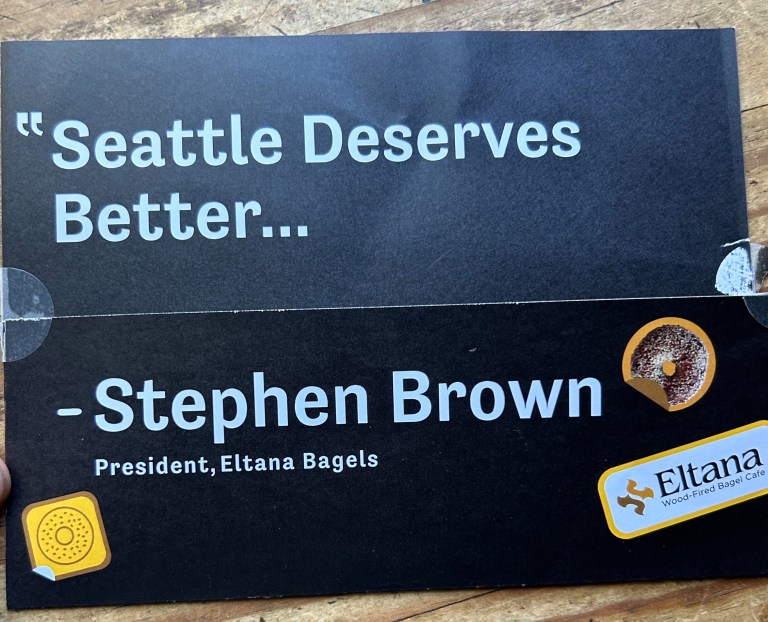
1. After PubliCola reported on a mailer and billboards from Eltana Bagels that appeared to promote the District 1 City Council campaign of Eltana founder and president Stephen Brown, his treasurer contacted us to let us know that the campaign will reimburse Eltana approximately $33,000 for the promotion, along with a billboard in West Seattle and a June 2023 Youtube video that concludes, “Stephen Brown fixed the bagel problem in Seattle—who knows what’s next?”

The mailers, which went out shortly before ballots arrive for the August 1 primary, read, “Seattle Deserves Better… – Stephen Brown” and open to reveal the word “…Bagels!” along with an offer for free bagels valued at $25. About half the mailers went out to addresses in West Seattle, which does not have an Eltana location. (Brown says Eltana targeted people who live near grocery stores that sell the bagels).

Last week, Brown characterized the billboard and mailers—on which “Eltana” appears off to the side in much smaller font than Brown’s name—as a routine advertising expense. “The intention was to use a banal, stereotypical message as a parody—to use humor to sell bagels,” Brown told PubliCola. Similarly”This effort is not a campaign expense—it is not electoral in nature.”

Brown’s campaign decided to pay for the billboard and mailer after Seattle Ethics and Elections Commission director Wayne Barnett sent Brown a letter posing a series of questions about the promotion, including when the mailers went out and where they went, what vendors Eltana used for the ads, and how often Eltana has sent out similar mailers. Barnett also asked whether previous Eltana promotions have prominently featured Brown’s name, and requested examples of other advertising materials from Eltana over the last two years.

“As you know, all money spent to promote your candidacy must be timely reported, and is limited by your choice to participate in the Democracy Voucher Program,” Barnett wrote. “Therefore, we must resolve this issue before the Voucher Program can release any more funds to your campaign.”

The reimbursement has not showed up yet in campaign filings.

2. Transit advocates were dismayed when Mayor Bruce Harrell wrote a letter to his fellow Sound Transit board members in May suggesting the agency study alternatives that could move a future light rail station north or west of Sound Transit’s preferred alternative. The goal of considering both of these alternatives was to prevent a four-year closure of Westlake Ave. that would impact Amazon, Vulcan, and other large employers in the area. One of those alternatives, the “shifted west” option, would have eliminated the Denny station altogether.

Last week, at a meeting of the board’s system expansion committee, Harrell said he now plans to support the preferred alternative and focus on ways to mitigate the impacts of construction in the neighborhood. “I’m waiting for the ridership analysis [to see] how it affects all of this, but I [am]  leaning towards support for the DT-1 preferred alternative that will preserve the two stations in South Lake Union with a strong emphasis—again, I can’t repeat this enough—on mitigating construction impacts,” Harrell said.

During public comment, a number of representatives from South Lake Union businesses testified that closing Westlake to cars for the four-year construction period would be like signing a death warrant for the (booming) neighborhood. Dan McGrady, a longtime lobbyist for the developer Vulcan who now lobbies on behalf of PEMCO Insurance, said light rail station construction on Westlake would cause “devastation” similar to the COVID pandemic, creating a “lasting scar on the community” that “I just don’t think the community can survive.”

Sound Transit is hosting two webinars about the South Lake Union station alternatives before the full board meets again on July 27, where they will have an opportunity to pick a different preferred alternative or keep the preferred alternative on Westlake just off Denny Way.

Sound Transit Board Adopts Major Last-Minute Changes to 2016 Light Rail Plan, Skipping Chinatown and First Hill

By Erica C. Barnett

After five hours of public testimony and a lengthy, often contentious debate, the Sound Transit board voted Thursday to adopt as its “preferred option” for the light rail extension through downtown Seattle a last-minute, back-of-the-napkin alternative that eliminates two long-planned stations serving the Chinatown-International District (CID) and First Hill neighborhoods in favor of new stations at Pioneer Square and just north of the current Stadium Station. The plan represents a stark departure from the Sound Transit 3 package voters approved in 2016, which included both the CID and “Midtown” stations.

The board also voted to keep a Fourth Avenue “shallower” station option on the table for further study.

King County Executive Dow Constantine, who promoted the new “north-south” option in his recent State of the County speech, said keeping Fourth on the table would give people “false hope” about the possibility of a future station in Chinatown, while arguing, along with Harrell, that skipping the CID entirely was what “the community” wanted.

But the meeting, which I covered in real time on Twitter, starkly illustrated what should have been obvious to Sound Transit board members all along: Far from being a monolith united in opposition to a station in Chinatown, the CID community is starkly divided, with a large contingent favoring a station that actually serves the neighborhood, even if it means ten years or more of construction on Fourth Avenue.

Advocates for both alternatives sorted themselves, over the course of the meeting, into two sign-waving groups on either side of the meeting room—black T-shirts and white signs against the CID station on the left, and a larger group of red T-shirts and signs supporting the station on the right. Each group clapped and hollered when someone testified in favor of their position—a clear sign, if the board needed one, that the prevailing narrative about a single “community” opposed to the CID station had always been reductive and condescending.

This wasn’t what County Executive Dow Constantine and Mayor Bruce Harrell had in mind when they introduced the new  “north-south” alternative just two months ago. Both men have argued that skipping over the CID is the best way to avoid harming a vulnerable community. Constantine has also portrayed a second Pioneer Square station as an opportunity to develop a whole “new neighborhood” where the King County Administration Building and downtown jail currently stand, part of what he’s calling his “Civic Campus Initiative.”

“Quite candidly, [the new option] came organically from the community. There are no backroom deals being made. We’ve been trying to be transparent. We’re trying to work openly and thinking out loud as things evolve.” —Seattle Mayor Bruce Harrell

Harrell, who attended the meeting virtually from out of town, has argued that moving the station out of Chinatown is the only option that prevents Sound Transit from repeating the region’s legacy of disinvestment, redlining, and harmful development in the neighborhood, which was divided by I-5 in the 1960s.

“A construction period for 10 to 12 years could cause irreparable harm,” Harrell said. “And this is a treasure; this is a gem.” Suggesting repeatedly that Fourth Avenue supporters were looking at the issue from a  “pure transit plane,” Harrell said equity was more important than what makes sense for transit riders who may just be passing through the neighborhood.

“Quite candidly, [the new option] came organically from the community,” Harrell said. As someone on the pro-CID station side of the room yelled, “Not true!” Harrell continued, “There are no backroom deals being made. We’ve been trying to be transparent. We’re trying to work openly and thinking out loud as things evolve.”

Many community members who testified—including the leaders of the Seattle CID Preservation and Development Authority (SCIPDA) and Uwajimaya—argued that the majority of people in the CID actually support keeping the station in the neighborhood, as long as Sound Transit provides mitigation for construction impacts. “Simply put, this is the best choice for the future of our community,” said Jared Johnson, the co-executive director of SCIPDA. “To have a world-class transit hub at the doorstep of the CID means a future full of opportunity and connectivity for our residents and businesses.”

King County Councilmember Dave Upthegrove, who cast the lone “no” vote on the new north-south option, said, “Construction impacts are temporary. The benefits of transit in a community are permanent.”

Not only will eliminating the CID station kill all future hope of a single Seattle transit hub where people can transfer between Sounder, Amtrak, light rail, and buses, it will cut off access to the neighborhood from Southeast Seattle, another community that has been neglected and poorly served by major infrastructure projects, like Sound Transit’s current at-grade light rail line. Under the preferred alternative, future riders between the south end and the CID will have to transfer between two stations at SoDo or go to Pioneer Square, transfer, and head back in the direction they came from.

Additionally, riders from the CID who want to access the new lines will have to either walk north to a new station near City Hall, at Fifth and James, or travel north several blocks from a station at the current site of a Salvation Army shelter in a forbidding, industrial part of south downtown crisscrossed by multi-lane arterial roads and bordered on the south by the elevated I-90 on-ramps, as the Urbanist has documented.

“It’s powerful to look out over the hearing room and see seniors, people of color, calling on us to support the Fourth Avenue option. Construction impacts are temporary. The benefits of transit in a community are permanent.”—King County Councilmember Dave Upthegrove

As public commenters with limited mobility noted Thursday, walking long distances, especially up steep hills like the one on James St., isn’t an option for everybody; in practice, the new “north” and “south” stations will be inaccessible to them and many other people, particularly elders, living in the area.

Although Constantine said continuing to study the Fourth Avenue option would create “false hope” for those who support it, both he and Harrell joined a strong board majority in voting for an amendment by King County Councilmember Claudia Balducci and Washington State Department of Transportation director Roger Millar to continue studying that alternative.

Balducci was less successful, however, with another amendment (also co-sponsored by Millar) that would re-connect the “spine” of the system—which will be split into segments when expansion lines to Ballard and West Seattle open —preserving the existing connection between South Seattle and the CID and keeping a one-seat ride from Lynnwood to Tacoma.

Constantine, in a back-and-forth with Sound Transit planning director Don Billen, argued that the board rejected a similar plan in 2015 for reasons that still apply today. “We have to stop going back and reconsidering everything we’ve ever decided,” he concluded.

Balducci, exasperated, responded that the only reason she proposed her alternative in the first place was because Constantine just put two brand-new, never-before-considered stations on the table. “The reason I bring this up now is not just because I want to re-litigate things we thought about eight years ago, but because there’s a significant new proposal on the table that changes the way the system works,” Balducci said.

The cost and feasibility of the new stations and the tunnel that would connect them is unknown, as is the cost of mitigation the agency may have to provide for eliminating the Midtown Station, which would have served First Hill. If the north-south option goes forward, it will be the second time Sound Transit has cut First Hill out of its plans; when the agency eliminated the original First Hill station in 2005, it ended up having to pay for a new First Hill streetcar.

Although Seattle City Councilmember Debora Juarez said eliminating a station in First Hill would not raise the same equity concerns as building a light rail station in the CID, the Transportation Choices Coalition has noted that thousands of the 15,500 riders who would commute to that station are hospital workers who commute from outside the city, including Pierce and South King County.

Several Sound Transit board members raised concerns not merely about the details of the new station proposal, but about the implications of moving forward so decisively on station options that have barely been studied, have no engineering behind them, and whose true costs are still unknown. Although current cost estimates put the Fourth Avenue “shallower” option as much as $800 million more expensive than the “baseline” alternative, that baseline—a hub at Fifth Avenue that would have provided the most direct access to existing transit lines—was rejected long ago because of equity concerns, and should probably be retired as a point of comparison. In addition, much of the additional cost would come from replacing a City of Seattle-owned viaduct near Union Station—a disruptive project that will need to be completed eventually, whether the light rail station happens or not.

A small contingent of advocates showed up yesterday to make the case for station options at the other end of the downtown segment in South Lake Union, where the board is considering two alternative sites along Denny Way—a preferred alternative at Westlake Avenue, and a second option at Terry Ave. N. Harrell proposed keeping the Terry option on the table because of construction impacts at Westlake.

Light Rail Board Members Seek Middle Ground as Plan to Skip Chinatown, Midtown Stations Moves Forward

Dow Constantine and Bruce Harrell have proposed a “North-South” light rail plan that would eliminate planned Chinatown-International District and Midtown stations. A compromise proposal, sponsored by Claudia Balducci and Roger Millar, would restore the “spine” of the system and keep some connections to the CID.

By Erica C. Barnett

On Wednesday, in advance of a Sound Transit board meeting that could reshape a long-planned light rail expansion linking downtown Seattle to Ballard and West Seattle, King County Councilmember and Sound Transit board member Claudia Balducci proposed an alternative route that preserves the existing “spine” of the system while eliminating a planned station in the Chinatown International District (CID). Voters approved the expansion, called “ST3,” in 2016.

The last-minute proposal is a direct response to, and amendment of, another last-minute proposal backed by King County Executive Dow Constantine and Mayor Bruce Harrell, who is sponsoring the motion. That “north-south” plan, which has no cost estimates, engineering, or design, would take a new light rail station on Fourth Avenue in Chinatown off the table, eliminate a planned “Midtown” station that would have served First Hill, and add a new “south of CID” station a few blocks north of the existing Stadium station south of downtown.

The big advantage to his plan, according to Constantine, is that in addition to eliminating the disruptive and harmful impacts of construction in Chinatown, it would set the stage for a whole new “neighborhood” centered around the site of the current King County Administration Building.

Compared to the “north-south” proposal, Sound Transit board member Claudia Balducc said, “this option would mean less out of direction travel and better connections for South and East riders [and] retain a one seat ride from South Seattle, South King and Pierce to the CID.”

Balducci’s proposal, co-sponsored by Washington State Department of Transportation director Roger Millar, would re-connect the “spine” of the system—which, under all previous plans, would be split into segments when expansion lines to Ballard and West Seattle open in the 2030s—keeping a one-seat ride from Lynnwood to Tacoma and, importantly, preserving the existing connection between South Seattle and the CID, which Constantine’s plan would eliminate. Essentially, it would create a true Ballard-to-West Seattle line (which no previous plans would do) while preserving connections to Chinatown from the east and south.

Compared to the “north-south” proposal, Balducci said, “this option would mean less out of direction travel and better connections for South and East riders [and] retain a one seat ride from South Seattle, South King and Pierce to the CID.”

Either of the two north-south options would eliminate the “Midtown” station, which would come the closest of any station to the dense First Hill neighborhood—echoing a similar decision in 2005, when the Sound Transit board voted to scrap a long-planned station in the neighborhood, a decision that eventually produced the First Hill streetcar.

“If Midtown Station goes away, then they need to understand that what they’ve done is eliminate the highest ridership station in all of ST3 and that is going to require that they mitigate the hell out of it,” said Transportation Choices Coalition Alex Hudson, who noted that many of the people who work in First Hill hospitals live south of Seattle and could have used the new light rail line to commute to their jobs. “That’s 15,500 people who were counting on excellent [rail] service and have been paying for it and won’t get it—that’s not small change. That’s a real harm.”

Mitigating for the loss of the Midtown station, which could come in the form of expanded bus or other transit service in the area, will add costs to the project—eating into any savings from eliminating the station, Hudson said.

TCC wants the Sound Transit board to keep an existing option, the Fourth Avenue “shallower” option, on the table; as long as they’re considering an unstudied plan, she said, the board should keep a more thoroughly vetted option on the table. Balducci has introduced a second amendment that would keep that option on the table, and said that since the new Constantine-Harrell plan will require a supplemental environmental impact statement, “we should use that time to also study and improve the 4th option as much as possible. Then we’ll have the ability to make the most informed choice,” Balducci said.

“Before we walk away from the option to have a great transit hub on 4th that could both serve the CID and connect our light rail lines most effectively to each other, Sounder, Amtrak and other modes, I’m asking that the agency look harder at ways to address community concerns,” Balducci added.

It’s unclear whether Balducci and Millar’s proposals will gain traction, or if the Constantine-Harrell plan has so much momentum that it will steamroll efforts to keep other options on the table. The board meets tomorrow at 1:30 pm.

From the Other Side of I-5: Little Saigon Weighs In On Sound Transit’s Light Rail Expansion In the CID

Sound Transit's shallow Fourth Avenue Station option, one of several alternatives the agency is considering for light-rail expansionBy Friends of Little Sài Gòn

Sound Transit has the power to shape equitable development in neighborhoods south of Seattle’s downtown for generations. The political discourse over where to site a station essential for light rail expansion and potentially other non-car modes of transportation has become another existential battleground, falsely pitting our community’s fears of displacement, gentrification, and desire for transit equity in a city of hyper wealth inequality against the simultaneous and very urgent need for connected, reliable, efficient transportation options as a means to climate resilience. 

Based on the limited information we have about the newly proposed North and/or South of Chinatown/International District options introduced less than three months ago, we urge Sound Transit to select the 4th Avenue Station option with upfront mitigation commitments informed by small businesses, residents, and community members throughout the construction phase. In our review, the North/South options have similar risks of displacement and disruption as the 4th Ave. alternative, with few of the potential improvements, such as expanded accessibility, ease of use, and residential and commercial reinvestment.  

We believe the 4th Ave alternative(s) will deliver the greatest long-term benefit to our communities, including our families and neighbors who come from the south end or west side via transit. And it will shift our transit system toward more accessibility and one that takes our climate crisis seriously. 

To hold public officials accountable, we must commit to ongoing multi-year organizing, together, in order to advocate for legislation that will codify mitigation commitments to increase cultural place-keeping and affordable housing in the CID. This includes securing necessary budget allocations that resource efforts like the Little Saigon Landmark Project, which will include affordable housing, including family-sized units, and micro retail spaces. 

We believe the 4th Ave alternative(s) will deliver the greatest long-term benefit to our communities, including our families and neighbors who come from the south end or west side via transit. And it will shift our transit system toward more accessibility and one that takes our climate crisis seriously. 

The ongoing attention to racial justice in climate justice is coincidentally a reminder about the legacy of the decision to  build I-5 freeway. The consequences of this are still felt today, in a cordoned-off Little Saigon bisected from the rest of the CID.

Regardless of the alignment Sound Transit chooses, without proactive mitigation commitments for the CID, we foresee further destabilization and displacement, isolation, and loss of culture and identity that has already occurred in this historic neighborhood for multiple generations. We must organize together to ensure this does not happen. Before Little Saigon was home to the Vietnamese community, it was considered “Indian country” and it was also home to Black Seattleites. We reject the idea that we must choose between a connected neighborhood that will bring new developments at the risk of displacing those who currently call the CID home—or a splintered neighborhood resistant to change. It is not either-or. Nor are our communities a monolith. 

When Friends of Little Sài Gòn (FLS) was established in 2011, our mission was centered in preserving  and enhancing Little Saigon’s cultural, economic, and historic vitality. We envision Seattle’s Little Saigon as the hub of our Vietnamese American community, where families and businesses are thriving. Twelve years later, that mission has not changed. When the pandemic struck and Little Saigon was hit especially hard by public health measures and anti-Asian bias, many businesses shut their doors, not knowing if or when they would re-open. We worked with small businesses to connect them to resources or translate information essential to staying safe while staying open. 

Taking away an option that Sound Transit arrived at that is endorsed by thousands of community members and many anchoring nonprofit and business groups in the eleventh hour will erode trust and goodwill, and be a tremendous waste of taxpayer resources.

Friends of Little Sài Gòn is comprised of small business owners, artists and culture workers, educators, and advocates, most of us first-generation Americans with the shared commonality that we all love this neighborhood and what it means to us and our city. Many of us have worked here day-in and day-out, some of us for decades, and watched the neighborhood change—while others sought work in Seattle specifically because of its concentration of Asian Americans and their ethnic enclaves. 

And in service to this community, we remember the half-measures taken by the local government. The First Hill Streetcar—a project that was supposed to connect the CID to downtown and SLU—was scrapped after years of construction and disruption to the neighborhood, leaving a disconnected line with limited range. Just as connection and infrastructure have failed to materialize, so, too, have the benefits that it was supposed to bring. As our neighborhood is still recovering from three years of pandemic impacts, and decades of uncoordinated transportation planning without us, we are seeing higher residential rental and commercial vacancy rates when culturally relevant small businesses are essential in keeping our neighborhood vibrant, accessible, and safe.

We stand by the recent productive discourse between Sound Transit, elected officials, and the community members toward finding the most beneficial ways to implement a 4th Avenue option that will meaningfully connect the CID to other neighborhoods, to connect our elders, aunties, uncles, and cousins who live elsewhere but still consider the neighborhood ‘home’ and rely on transit to get here.

Taking away an option that Sound Transit arrived at that is endorsed by thousands of community members and many anchoring nonprofit and business groups in the eleventh hour will erode trust and goodwill, and be a tremendous waste of taxpayer resources. We urge Sound Transit, King County, and the City of Seattle to make the right decision in this once-in-a-century opportunity. 

Tam Dinh—Board President; Josh Brevoort; Hong Chhuor; Vy Nguyen; Mytoan Nguyen-Akbar; Huy Pham; Steve Scheele; Leeching Tran

Friends of Little Sài Gòn, Board of Directors