Tag: Claudia Balducci

Three Key Questions to Save Our Light Rail Future

Photo by Sound Transit Special Selection via Wikimedia Commons; CC-by-2.0 license.

By Claudia Balducci

It’s no secret that our region needed high-capacity transit yesterday or better yet, four decades ago. As a lifelong transit rider and a regional transportation leader, I’ve spent much of my career fighting for East Link, passing ST3, improving transit service, and delivering the kind of system our communities deserve. This work is essential: transit connects people to opportunity, makes our region greener, and—more personally—helps my teenager find their independence.

The West Seattle and Ballard light rail extensions alone are historic in scale—the largest public works undertakings in Seattle’s history. These extensions will connect two culturally and economically prominent Seattle neighborhoods that can be hard to access. That’s why traffic-free rail to these destinations has been part of our civic vision for decades.

But Sound Transit’s recently reported rising costs threaten our ability to deliver on ST3—the bold plan voters approved in 2016 to expand rail and bus rapid transit throughout King, Pierce, and Snohomish counties. The reasons for these rising costs include increasing construction costs, high interest rates, and an uncertain federal transit funding picture. So, here’s the fundamental question: How do we meet the promise of light rail without breaking the bank?

I’m asking Sound Transit to consider three key questions this fall:

  1. Can we reimagine the second downtown tunnel?

ST3 originally proposed a second tunnel between the Chinatown–International District and Westlake Center to support a growing regional transit network. But before building new infrastructure, let’s explore whether technology and reliability upgrades could allow us to interline—running all three lines through the existing Downtown Seattle Transit Tunnel.

Consider this: London plans to run more than 30 trains per hour in a tunnel that first opened during Abraham Lincoln’s presidency, simply by upgrading to modern signaling systems. Surely, with similar technology, we can optimize Seattle’s existing tunnel—built during Ronald Reagan’s presidency—to meet our service needs. If feasible (and this will require detailed analysis from outside experts), using a single downtown tunnel could save billions—funds we could reinvest to bring light rail to Ballard and West Seattle. A central question is whether this can be achieved while maintaining reliable service. It’s a critical issue that deserves resolution.

  1. What strategies can we find to deliver projects faster and cheaper?

We must build on the work of the Technical Advisory Group (TAG), which I proposed during the last Sound Transit realignment process during COVID to identify cost-saving strategies. Can we break up transit megaprojects—an approach used by other mass transit systems across the globe—into smaller contracts to attract more bidders to a heated construction market, lowering costs and improving accountability? Can we streamline permitting at the local and state levels? And can we proactively acquire key parcels of land early to lock in real estate prices before they rise?

  1. Can we adopt service-led planning that puts riders first?

Service-led planning is the standard globally for delivering the best rider experience. Investments are prioritized based on how they support speed, reliability, and service integration. Voters endorsed ST3 for the freedom its services entailed, not the scale of what would be built. Therefore, the service enabled by any piece of infrastructure must be the highest priority.

Using these principles, if the existing Downtown Seattle Transit Tunnel can support the operations of three light rail lines by using modern signaling technology and design standards, the second tunnel becomes a nice-to-have, not a must-have. Even better, interlining will improve the rider experience by supporting easier transfers across platforms, rather than forcing long walks to adjacent stations, or cumbersome transfers across whole neighborhoods. It could also solve the longstanding challenge of how to serve the Chinatown-International District without digging up that neighborhood yet again.

It’s easy to list reasons why something won’t work. The real test is imagining how it can. For every “that’s impossible,” we must ask “how can we?” In this moment of scarcity, our creativity is our greatest resource. At Sound Transit, we’ve shown we can innovate before. Now it’s time to do it again.

We owe it to our region to solve the real problem—connecting people region-wide—and leave no good idea unexplored.

Claudia Balducci is a King County Councilmember and Sound Transit Board Vice Chair

PubliCola Questions: King County Executive Candidate Claudia Balducci

By Erica C. Barnett

The coming year will mark a major change in King County government: For the first time in 16 years, King County Executive Dow Constantine will not be on the ballot. The two leading contenders to take his place—Democrats Claudia Balducci and Girmay Zahilay—are both lawyers; both members of the King County Council and Sound Transit board; and both Democrats with similar political views. But Zahilay, 37, and Balducci, 57, bring very different life and professional experiences to the table. King County Assessor John Arthur Wilson has also filed for the position.

Balducci, a former Bellevue mayor and longtime transit advocate (going back at least to her time on the Bellevue City Council), has represented the Eastside on the county council since 2016; previously, she was director of the county’s Department of Adult and Juvenile Detention, which runs the adult and youth jails.

Zahilay, the son of Sudanese refugees who grew up living in public housing in Seattle, worked for the Seattle-based global law firm Perkins Coie before defeating county council veteran Larry Gossett in 2019. He’s viewed as a rising star in the Democratic Party, with early endorsements from Governor-Elect Bob Ferguson and several statewide unions.

PubliCola recently spoke to both candidates about why they’re running, their priorities if they win, and how they differ from each other and Constantine. Today, we’re posting our conversation with Balducci, edited for length and clarity; tomorrow, we’ll run our interview with Zahilay.

PubliCola (ECB): I know that you’ve been thinking about running for this position for a long time. What are some of your top priorities going to be if you win?

Claudia Balducci (CB): Housing is huge. I believe our success as a region depends on us begin able to provide ample housing for people to be able to afford to live here. Transportation is a big priority for me. And of course, I’ve also worked in public safety, which is very top of mind for people today.

Those are the things I have worked on and what I believe are the most important elements of success for the county executive. It’s not to say that everything else the county does doesn’t matter. There are so many things that people don’t think of as playing into safe, healthy communities. For example, we just passed the implementation plan for the Doors Open program.

ECB: What should the county be doing to improve access to housing?

CB: The spectrum of housing goes from supply [to] stability and subsidy. First of all, we have metered the supply of housing through zoning codes and other restrictions for so long that we just created scarcity. We’re working on changing that, with regulatory encouragement from our friends at the state. Some of that comes from HB 1220. Instead of just planning for jobs and housing without regard for how much the jobs pay and how much housing costs, you have to plan for housing at every level, from emergency shelter all the way up to market-rate housing.

I see cities really trying. They are being asked to plan for something they’ve never done  before—to [address] a shortfall in the number of homes that was created over decades—and they’re being asked to do it over one planning cycle.

That’s supply. Stability is: We know the most humane and cost-effective thing, if someone has housing, is to keep them from falling into homelessness, or housing instability, with tenant rental support programs that keep people in their homes. This whole area is being challenged right now. Some of our nonprofit affordable housing providers in east King County, [like] Imagine Housing, are struggling. These are big multifamily building owners who provide apartments at lower levels of affordability, and they’re just having a tough time paying enough staff and meeting their upkeep obligations. It’s is a countywide problem, not just a city problem.

Subsidy is the place where we have some opportunities for people at the end of the housing demand that the market can’t supply. It’s just not profitable to provide housing who make 30 percent of [area median income]. We have surplus land that we’ve been putting to use through Sound Transit [as housing], for example. There’s land use policies we can look at. The city of Bellevue is allowing faith communities to use their land to create affordable housing opportunities.

I’m looking forward to getting a report back on Councilmember Zahilay’s bonding proposal. My gut is that relying on rent paid by people who make 120 percent of AMI will not pay back a billion in bonds. I don’t know how that math will work. The current economic circumstances are not likely to make that pencil. And the downside is pretty far down if we’re wrong.

ECB: The county relies heavily on levies for basic services—Best Starts for Kids, the Doors Open levy you mentioned, the Crisis Care Centers levy, and many more. Do you anticipate the need for additional levies to pay for county priorities, or are we approaching a limit on sales tax increases?

CB: Of course, the levies are first and foremost a response to the 1 percent property tax cap. The county used to pay for much of its services just with the general property tax levy. But as that cap has constrained our ability to have property taxes keep up with costs, we’ve had to find other ways to fund things. That’s how you end up with the human service levy. Those programs would have gone away. That’s how you end up with parks essentially becoming an entrepreneurial exercise, because without that, the parks levy couldn’t have fully funded them.

It’s a really good question as to when this strategy will play itself out. I hear from constituents who are concerned about property taxes. I have constituents in my district who are house-rich but don’t have a lot of income. I hear quite a lot about tax levels. Yet when we ask things like, will you vote for crisis care centers because it’s a desperate need, they are very, very popular. The Harborview renovations and expansions levy was one the of highest victories ever. The voters keep saying yes.

ECB: The King County Regional Homelessness Authority has obviously struggled over the past couple of years. The city of Seattle has taken back control over some local homeless services, while Executive Constantine has basically just kept the agency’s funding the same, so that they can’t realistically expand the region’s homelessness response. Do you think there’s a path to turning KCRHA around, and what do you envision as the future for the agency?

CB: I want to be the optimist here because I’ve seen rational approaches take hold and move the needle. The challenge is to show the benefit to the regional approach. What does it mean to a city like Bellevue, or a city like Auburn, to be able to have a regional approach, so that they see that when you have a problem with homelessness, this is the agency you turn to and we have the resources to address it? The regional cities need to buy in. We’re on our second incarnation, our third executive director.

I want us to find a way to fund some additional progress on encampment resolutions. And encampment resolutions are not sweeps. I was a little skeptical at first, but I have become convinced they are not sweeps. They are not, post a date, show up with a team, and move everybody who’s there. It’s an application of services. You work with the residents of an encampment over a period of time, some weeks, and eventually people are offered housing. They have a high level of uptake of housing and, so far, a pretty high retention of housing.

ECB: What will you do as county executive to address what seem to be spiraling problems at Metro? [Editor’s note: This interview was conducted before the killing of a Metro driver earlier this month]. What do you think is the biggest problem that needs to be fixed there?

CB: The biggest problem Metro has been experiencing is staffing. In 2019, we were having discussions about our transportation benefit district and trying to figure out when and what package to go to the voters with for an infusion of bus funding. Then 2020 came, COVID hit, and we decided to shelve those discussions. And since then, the question comes up, When are you going to use your transportation benefit district? The reality is that since 2020, you could pour money into Metro and they could never use it because of the shortage of drivers and mechanics. That is beginning to turn around—the staffing shortage is shrinking. My anecdotal evidence is that my personal experience of ghost buses has gone way down. It is unusual for a bus to not show up, and for a while there, it was not unusual.

We need to staff up and build back to where our current level of service should be, but ultimately, I want us to reopen our long-term plan. I want to make sure we have a solid plan for the future so that we can make sure we’re providing abundant bus service to the region and figure out what that costs. And then we look at our transportation benefit district and ask the voters to fund that for the future.

ECB: Sound Transit is facing massive cost overruns on the planned Ballard to West Seattle line. ow do you think the agency should address this problem, and what are you currently advocating for as a Sound Transit board member? Should light rail still go to West Seattle?

CB: It is a real problem that we have to grapple with.  When we went into a revenue spiral because of COVID, we went into a realignment. And I was a realignment skeptic because I thought the revenue might bounce back up, so I pushed really hard for a reform effort, which became the Technical Advisory Committee and change in leadership and a bunch of other things. And now when you look at that cost overrun, we know what’s causing it in more detail than we have in the past. We are now able, in more detail, to take a closer look at where are we causing those problems as an agency, how can we control costs, and how can we get better bids. If you can shave a third off some of those cost increases by being smarter and more efficient and more effective, then it’s a different problem.

I have been pushing for early acquisitions, instead of waiting 10 years between saying we’re going to buy up a bunch of property and buying it. Those kinds of savings multiply. But when we have a sense of what the real magnitude is, then we can have the difficult conservations about timing, scope, station locations, and all the things we’re going to have to talk about.

ECB: Do you think it’s time to start talking about potential cutbacks, like not going to West Seattle?

CB: We absolutely need to be open, once we have done all the work on cost and revenues, to talk about scope. I start with the commitment to build what we committed to the voters to build, and so to me it’s the last resort to say we’re not going to build it. I have been a very loud and consistent advocate for trying to create a hub in the [Chinatown-International District] where all our lines come together. If that’s not possible, it’s not possible, but I want to turn over every single rock before I admit it’s not possible. I am still in the rock-turning-over phase. We’re not tossing whole alignments, but we might have to phase things.

ECB: The county executive expressed support for closing the youth and downtown jails, then reversed his position on both. First, how will you approach the youth jail issue—should the Clark Regional Justice Center stay open, and if not, what would an alternative approach to secure detention look like?

CB: One of the things that’s different about me, having worked in the system, is that I was the jail director when the plan to rebuild the juvenile court facility was created. My position was, if you want to rebuild the court, you need to rebuild the detention center. That, of course, was passed by the voters and controversy ensued. But we built it smaller than the old detention facility because we didn’t want to have a bunch of excess capacity, and we made it to be modular so that if any facility that was not needed in the future could be modified to open to the outside and used for another purpose.

Continue reading “PubliCola Questions: King County Executive Candidate Claudia Balducci”

Local Control Can Work to Solve Our Housing Crisis: Here’s How

By King County Councilmember Claudia Balducci

If we’ve learned nothing else from the last couple decades of explosive growth in King County, it’s that that past attempts to provide housing that’s affordable to everyone in our county have come up short. Really short. So short, in fact, that we need to create an additional 200,000 affordable homes by 2044 to ensure that low-income individuals, people on fixed incomes, and families throughout King County can afford a place to call home.

The results of our failure to provide adequate housing are visible everywhere: An ever-increasing number of people across King County are homeless. Young people leave the region because they don’t see a future they can afford. Racial disparities in our communities persist and grow, with Black, Indigenous and other people of color continuing to be disproportionately harmed by high housing prices.

If we don’t act now to build more housing of all types, including much-needed affordable housing, these gaps will just grow bigger. And while building the housing we need has for years felt like an intractable problem, there is hope on the horizon.

That hope comes in the form of a new and unique collaboration between King County and all 39 of our cities. As all of our cities and the county are making once-in-a-decade major updates to their comprehensive plans – which form the DNA of how a local government plans for growth – we can begin to turn the tide in a way that fits our communities while making them more inclusive and affordable.

In planning for future growth, city leaders have long pointed out the benefits of “local control” over land use planning and zoning, based on the principle that local government is closest to the people we serve, and thus is the right level of government to enact residents’ vision for the place they live. However, the concept of local control has some historical downsides – it has been used as an argument to block new housing, and thus has been a way to disenfranchise people and families of lower means, people of color and other marginalized groups.

So, what has changed? Taking the cue from House Bill 1220, a 2021 state law directing all jurisdictions to “plan for and accommodate” affordable housing at every level, representatives from cities and the county started collaborating on the issue. Together, they crafted and all jurisdictions unanimously agreed with recommendations from King County’s Affordable Housing Committee to amend county Comprehensive Planning Policies and set individualized housing affordability targets for each jurisdiction and hold each other accountable to meeting these local goals.

These targets are ambitious and bold. For example, my home city of Bellevue will need to plan for 35,000 net new housing units, 30,349 of which must be affordable to people making less than the area median income. Every city and the county have agreed to similar ambitious commitments.

PubliCola is supported entirely by readers like you.
CLICK BELOW to become a one-time or monthly contributor.

Support PubliCola

This means that cities will plan for new forms of housing that will incorporate the so-called “missing middle” of townhouses and other affordable housing types. It means cities will plan to take steps to intentionally address and undo the harms of racially restrictive housing policies of the past that continue to show up in segregated patterns of housing in the present. It means cities will plan to address displacement of existing communities and provide more places to live throughout their communities, not just in industrial areas or along highways. But the solutions in each city will be tailored to the conditions and vision of that city and its local representatives.

Recognizing we are all in this together, we also agreed to hold each other accountable. The Affordable Housing Committee will review the proposed housing-related parts of every comprehensive plan and provide feedback and recommendations for how each jurisdiction can better meet our ambitious and specific housing goals. Following adoption, the Affordable Housing Committee will monitor and track how well cities are implementing the plans on a regular basis.

Getting to this point was difficult work, and took a strong partnership of local government, private and nonprofit partners, and a dedicated group of representatives from key communities impacted by high housing costs. But we all came together because the data was so compelling, and we all know that behind the data are human beings who all need and deserve a safe, healthy place to live. They are nurses, teachers, and firefighters, our family, friends, and coworkers. They are seniors hoping to age in place and young families with dreams to raise their kids in safe communities where they have access to opportunity. They are why we are here, and our work is ultimately for them.

With this countywide housing agreement, we are empowering each city to do that in the way that works best for their residents while recognizing that every jurisdiction needs to step up to address our shared regional housing crisis. And I’m hopeful that with this effort, we can close the gap and make King County – and our whole region – a place where people can find housing and build a life filled with opportunity.

Claudia Balducci represents District 6 on the Metropolitan King County Council, which includes parts or all of Bellevue, Kirkland, Mercer Island, the Points Communities, and Redmond. She serves as chair of the King County Affordable Housing Committee and previously co-chaired the Regional Affordable Housing Taskforce (2017-18).

King County’s Baffling Website Redesign, (Sorta) Explained

From King County’s “Services” web page.

By Erica C. Barnett

After the disastrous launch of a new website that crashed due to traffic from people seeking election results last November, the King County Council passed a budget proviso, or restriction, late last year—holding back $200,000 from the project until the county’s IT department produced a status update “addressing concerns about the King County website upgrade.”

That upgrade, which started in 2017, has cost King County taxpayers $15 million so far (not counting the salaries of county employees), and will be out of date as soon as 2027, when Sitecore—the county’s content management system—changes its technology for web platforms and will no longer support King County’s website. When that happens, the county will have to find a new content management system. (A content management system, or CMS, is the “back end” of a website; PubliCola, a much simpler site than the county’s, uses WordPress).

As we reported last year, the new website design is bare-bones—more than one county employee told us they thought it was an “interim” or “intermediate” step before the “real” website launched—and confusing to navigate.

Many basic government services are hidden somewhere in an alphabetical site index that’s often redundant or counterintuitive—the county assessor’s heavily used property mapping services is buried under the label “GIS services,” in addition to its official name, “Parcel Viewer,” for instance—and the main site features a list of seemingly random county services arranged in no discernible order.

Currently, for example, visitors to kingcounty.gov are greeted with a full screen about dog adoptions, followed by a banner about the March Presidential primary election, followed by highlighted links to King County Metro, rural traffic camera feeds, the pet adoption page (again), and the county’s “careers” site (which requires additional clicks to get to a list of jobs).

PubliCola is supported entirely by readers like you.
CLICK BELOW to become a one-time or monthly contributor.

Support PubliCola

“It’s not an improvement from what we had before,” County Councilmember Claudia Balducci, who represents Bellevue, told PubliCola. “There have been improvements since [the new site] first went up—we’ve put in some requests for changes—but they’re modest. It’s things like borders and white space, and can we have pictures of the council members on their council member pages.” (Originally, the site included text-only links to text-only councilmember pages.)

Beyond those “aesthetic issues,” Balducci continued, “the biggest problem is that people need to be able to find what they need, and it’s just not easy. I stopped using the website to search for things that I wanted to find. I would just use Google, because that was far more reliable.”

A spokesperson for King County said the new website templates “were designed to be user-friendly based on modern best practices. The goal was to simplify content for improved navigation, ADA access, and translations.” The county uses Google Translate for all languages other than English.

At Tuesday’s meeting, county Chief Information Officer Megan Clarke, who became head of the IT department in November 2022, said the issues with the website stem partly from a lack of communication between the IT staffers who were creating the new website and the people who would ultimately have to use it. One example of this was when the IT division determined that 90 percent of web traffic went through 10 percent of the pages on the site, and assumed it would be fine to “eliminate 90 percent of the pages and keep the 10 [percent] that were meaningful. … Unfortunately, those assumptions weren’t vetted.”

Balducci, who noted during the meeting that many of the problems predated Clarke’s appointment, expressed a type of frustration that’s probably familiar to anyone who’s hired a technical expert to build their website: “You know how to build a website. But we know what we do, and you don’t know what we do,” she said.  “The only way this stuff works is if this is a partnership.”

In King County IT’s official, written response to the proviso, the department emphasized how many times it met with people from county departments to discuss the website and noting that some departments haven’t reorganized their site content yet in the latest version of the content management system—suggesting, in effect, that the reason “some users experience challenges with finding what they are looking for on Kingcounty.gov” is because county departments aren’t doing their part or signed off on things and later changed their minds.

Balducci, who noted during the meeting that many of the problems predated Clarke’s appointment, expressed a type of frustration that’s probably familiar to anyone who’s hired a technical expert to build their website: “You know how to build a website. But we know what we do, and you don’t know what we do,” she said.  “The only way this stuff works… is if this is a partnership.”

Clarke—taking a more conciliatory tone than the department’s official report—told the council that many of the county staffers who worked on the website didn’t have experience working with the platform they were using and didn’t get the training they needed. “There was not someone in charge who had done this before,” Clarke said. “KCIT was trying to manage something that really required a lot of depth and breadth of voices involved, and that just did not happen.  We treated the website as a project rather than a product.”

Clarke told the council she’s hiring an outside consultant to try to identifying some of the underlying issues with the site, including why it couldn’t handle traffic on a low-turnout odd-year election night, in order to fix some of the most glaring problems. (The King County spokesperson told PubliCola that the IT department did anticipate the spike in traffic on election night, and that “although [the site] initially failed to function properly, KCIT was able to resolve the issue on Election Night”—albeit long after everyone had turned to KING 5’s website, which had the results on time.)

was designed to handle traffic, and only failed when people were seeking results at 8:00, when they’re ordinarily available.

However, she noted, the county is facing a budget deficit; even if Sitecore can support the website for a couple of years after 2027, it doesn’t make much sense to sink more money into the current site.

“I look at it as, how much more do we want to sink in this area [if] we are going to move to something else?” Clarke said. “I’ve seen website projects with twice the number of pages finish on time and on budget. I absolutely know it’s possible.”

PubliCola has reached out to the King County Executive’s Office and the IT department and will update this post when we hear back.

Light Rail Board Members Seek Middle Ground as Plan to Skip Chinatown, Midtown Stations Moves Forward

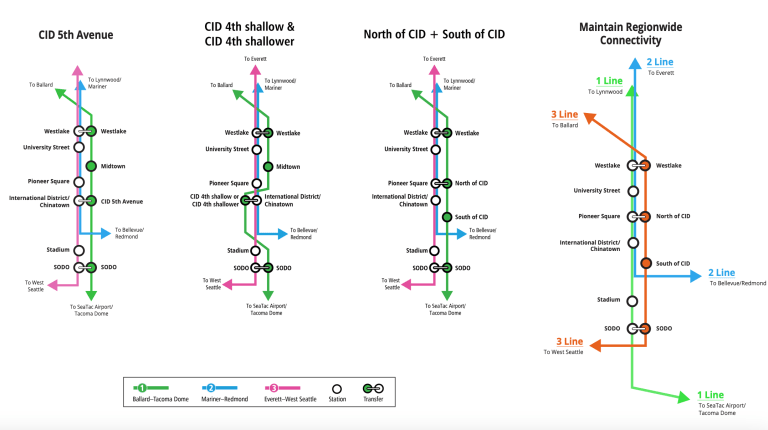
Dow Constantine and Bruce Harrell have proposed a “North-South” light rail plan that would eliminate planned Chinatown-International District and Midtown stations. A compromise proposal, sponsored by Claudia Balducci and Roger Millar, would restore the “spine” of the system and keep some connections to the CID.

By Erica C. Barnett

On Wednesday, in advance of a Sound Transit board meeting that could reshape a long-planned light rail expansion linking downtown Seattle to Ballard and West Seattle, King County Councilmember and Sound Transit board member Claudia Balducci proposed an alternative route that preserves the existing “spine” of the system while eliminating a planned station in the Chinatown International District (CID). Voters approved the expansion, called “ST3,” in 2016.

The last-minute proposal is a direct response to, and amendment of, another last-minute proposal backed by King County Executive Dow Constantine and Mayor Bruce Harrell, who is sponsoring the motion. That “north-south” plan, which has no cost estimates, engineering, or design, would take a new light rail station on Fourth Avenue in Chinatown off the table, eliminate a planned “Midtown” station that would have served First Hill, and add a new “south of CID” station a few blocks north of the existing Stadium station south of downtown.

The big advantage to his plan, according to Constantine, is that in addition to eliminating the disruptive and harmful impacts of construction in Chinatown, it would set the stage for a whole new “neighborhood” centered around the site of the current King County Administration Building.

Compared to the “north-south” proposal, Sound Transit board member Claudia Balducc said, “this option would mean less out of direction travel and better connections for South and East riders [and] retain a one seat ride from South Seattle, South King and Pierce to the CID.”

Balducci’s proposal, co-sponsored by Washington State Department of Transportation director Roger Millar, would re-connect the “spine” of the system—which, under all previous plans, would be split into segments when expansion lines to Ballard and West Seattle open in the 2030s—keeping a one-seat ride from Lynnwood to Tacoma and, importantly, preserving the existing connection between South Seattle and the CID, which Constantine’s plan would eliminate. Essentially, it would create a true Ballard-to-West Seattle line (which no previous plans would do) while preserving connections to Chinatown from the east and south.

Compared to the “north-south” proposal, Balducci said, “this option would mean less out of direction travel and better connections for South and East riders [and] retain a one seat ride from South Seattle, South King and Pierce to the CID.”

Either of the two north-south options would eliminate the “Midtown” station, which would come the closest of any station to the dense First Hill neighborhood—echoing a similar decision in 2005, when the Sound Transit board voted to scrap a long-planned station in the neighborhood, a decision that eventually produced the First Hill streetcar.

“If Midtown Station goes away, then they need to understand that what they’ve done is eliminate the highest ridership station in all of ST3 and that is going to require that they mitigate the hell out of it,” said Transportation Choices Coalition Alex Hudson, who noted that many of the people who work in First Hill hospitals live south of Seattle and could have used the new light rail line to commute to their jobs. “That’s 15,500 people who were counting on excellent [rail] service and have been paying for it and won’t get it—that’s not small change. That’s a real harm.”

Mitigating for the loss of the Midtown station, which could come in the form of expanded bus or other transit service in the area, will add costs to the project—eating into any savings from eliminating the station, Hudson said.

TCC wants the Sound Transit board to keep an existing option, the Fourth Avenue “shallower” option, on the table; as long as they’re considering an unstudied plan, she said, the board should keep a more thoroughly vetted option on the table. Balducci has introduced a second amendment that would keep that option on the table, and said that since the new Constantine-Harrell plan will require a supplemental environmental impact statement, “we should use that time to also study and improve the 4th option as much as possible. Then we’ll have the ability to make the most informed choice,” Balducci said.

“Before we walk away from the option to have a great transit hub on 4th that could both serve the CID and connect our light rail lines most effectively to each other, Sounder, Amtrak and other modes, I’m asking that the agency look harder at ways to address community concerns,” Balducci added.

It’s unclear whether Balducci and Millar’s proposals will gain traction, or if the Constantine-Harrell plan has so much momentum that it will steamroll efforts to keep other options on the table. The board meets tomorrow at 1:30 pm.

Sound Transit CEO Rogoff Out Next Year, Labor Council Wades Into Sawant Fray, 43rd Democrats Divided on Dow

1. Learn to trust the Fizz: Sound Transit CEO Peter Rogoff will leave the agency next spring. On Thursday, Sound Transit board members voted to approve the terms of Rogoff’s departure and queuing up a national search for his replacement.

The announcement came two weeks after the board removed what had seemed to be a standard one-year renewal of Rogoff’s contract from their regular agenda, after a nearly two-hour executive session in which board members discussed his performance as director of the agency. Board members also retreated to a lengthy executive session during Thursday’s meeting before emerging with the news that Rogoff “did not foresee continuing in his role,” in the words of board chair Kent Keel.

As PubliCola reported in early September, board members have spent the last month discussing whether to renew Rogoff’s contract, raising questions about Rogoff’s leadership style as well as large cost increases—largely for property acquisition—that forced the board to adopt a “realignment” plan for the voter-approved Sound Transit 3 package earlier this year. Mayor Jenny Durkan King County Council member Claudia Balducci, and King County Executive Dow Constantine are among the board members who brought up concerns publicly and internally.

According to a report by an independent consultant, Triunity, the cost increases were worsened by the fact that various divisions of the agency didn’t communicate with each other, thanks to a “siloed” organizational structure and a culture of keeping bad news under wraps. Another issue: Sound Transit, under Rogoff’s leadership, has been slow to make decisions that could reduce costs, such as choosing a single preferred alignment for light rail expansion instead of continuing to study many different options.

Durkan, one of two board members to vote against retaining Rogoff after allegations that he acted inappropriately around female staff, did not join in the round of praise for Rogoff that followed the board vote Thursday. After a round of effusive praise for Rogoff (Auburn Mayor Nancy Backus: “We should be very grateful as a board and a region for his expertise and skills”), Balducci’s comments focused mostly on Rogoff’s early years at the agency, calling him a steady hand when the agency was struggling to get its bearings

“We were trying… to build this incredibly ambitious and future-looking transit plan, to finally meet the promise of what we have needed and wanted in this region for over 50 years,” Balducci said. “Peter stepped in in the middle of that and quickly got his bearings and helped to bring us home.”

Rogoff will receive severance worth one year’s salary, plus unused vacation time and other benefits outlined in his contract. Speaking after the vote, Rogoff said he has found the job “simultaneously exhilarating and exhausting,” sometimes leaning more toward the latter. “I will continue to be the loudest cheerleader for Sound Transit’s staff and all of their accomplishments even after I step to the sidelines next year,” he said.

2. The King County Labor Council, which represents around 150 unions in King County, tweeted on Thursday urging Seattle City Councilmember Kshama Sawant to stop “meddling” and “interfering” in the internal business of the Pacific Northwest Carpenters Union, which is currently on strike over a contract that a majority of members rejected over issues including pay, contract length, and parking reimbursements. “Ask how you can support instead of being a nuisance,” the Labor Council said.

Sawant began inserting herself into the debate earlier this month, when she issued statements and held a rally urging union members to vote “no” on the contract. Union leaders, including the head of the anti-Sawant Building Trades Union as well as the Carpenters’ Union itself, have repeatedly asked Sawant to stay out of their negotiations. “[N]o politician should be meddling in a private sector union contract negotiation,” Washington State Building Trades vice president Chris McClaine said. “It only helps those who want to destroy worker unions and take money out of workers’ paychecks.”

This week, Sawant issued a flurry of statements supporting the strike, touting her own promise to contribute $10,000 (up from an initial pledge of $2,000) to the carpenters’ strike fund, and showcasing a letter of support from several dozen carpenters’ union members for “stepp[ing] forward in solidarity” with the strike. The $10,000 pledge will come from the Sawant Solidarity Fund, which supports various political efforts and campaigns.

Sawant also said this week that she will introduce legislation to “require construction contractors to fully pay for workers’ parking costs, strengthen enforcement and penalties for wage theft, and restore [the] right to strike” at sites with a project labor agreement (PLA)—a bargained agreement between the union and contractors that prohibits workers from walking off the job. PLA sites in Seattle include the NHL hockey arena, the downtown convention center, and Sound Transit’s ongoing light rail construction.

It’s unclear when Sawant plans to introduce the legislation or what mechanism it would contain for requiring specific parking reimbursements, which are currently included in union contracts, not dictated by legislation.

3. The 43rd Legislative District Democrats failed to reach an endorsement for King County Executive at their endorsement meeting Tuesday night, a victory of sorts for incumbent Dow Constantine after a series of landslide votes for lefty candidates in other races. Constantine received a little over 43 percent of the vote to his challenger, state Sen. Joe Nguyen’s, 54 percent.

That may not seem like a blowout, but compared to the district’s sweeping support for other progressive candidates—city attorney candidate Nicole Thomas Kennedy, City Council candidate Nikkita Oliver, and mayoral candidate Lorena González all received first-round votes of at least 75 percent—Nguyen’s 54 percent showing looked limp.

“We cannot wait for the status quo to solve the problems that have been impacting us for decades and they especially won’t be solved by those who helped create them,” Nguyen said before the vote. Constantine responded to this by highlighting the county’s work responding to the COVID pandemic, including the imposition of a countywide vaccine mandate for indoor and large outdoor events. “This is the kind of difficult work that real leaders do. I’ve never been much for bluster,” Constantine said.