Category: Police

King County Enlists Uncanny AI Videos for Ethics Training; Drop in Mayor’s Approval Rating Follows Anti-Wilson Media Frenzy

1. King County is using what it calls an “innovative tool” to train 4,000 executive branch employees on how to prevent waste, fraud, and misuse of public dollars: A series of short videos in which an uncanny AI avatar, wearing a tech CEO-style quarter-zip fleece, recites scripts about various training topics in front of shelves filled with leather-bound books.

According to a King County spokesperson, the videos are part of a new training protocol the county instituted “as part of Executive Girmay Zahilay’s Better Government actions,” after an audit found potential fraud, waste, and abuse of funds in youth contracts overseen by the Department of Community and Human Services.

A quick reverse image search found dozens of identical-looking videos produced for a wide range of small companies, from a “dental AI” company to a rare-earth metal dealer to a flower shop.

Usually, the AI speaks with a plummy British accent, but occasionally it speaks in other languages, like German, or in the American accent King County’s IT department chose for the training videos.

The King County spokesperson said the AI videos are based on an anti-fraud training DCHS launched in April, and said the content was generated by humans at DCHS, “in consultation with King County’s Finance and Business Operations Division.”

King County IT put together the videos using a company called Synthesia, which costs the county about $900 a year. According to the spokesperson, the IT department approved the use of the company under the county’s AI policy.

“King County embraces the use of innovative tools, including AI,” the spokesperson said. “The training went through multiple reviews internally to ensure accuracy, the AI-generated presenter has been disclosed to staff, and no prohibited County data was provided to the AI service.”

We think they dost protest a bit too much. Our question was, “Does DCHS believe this kind of AI talking head video is an effective training tool, and if so, why?”

PubliCola is supported entirely by readers like you.
CLICK BELOW to become a one-time or monthly contributor.

Support PubliCola

2. The Seattle Metro Chamber of Commerce released another batch of poll results on Thursday. (The first poll, done in collaboration with Challenge Seattle and released earlier this week, purported to show overwhelming support for police camera surveillance in Seattle neighborhoods). One poll question found that Mayor Katie Wilson’s approval rating has slipped 20 percentage points, to 37 percent; the other showed broad public support for a long list of potential public safety strategies and interventions.

Local media outlets interpreted the results as bad news for Wilson, which is certainly the case with her approval rating. But it’s worth noting, as my friend and colleague Marcus Harrison Green did on Bluesky, that approval ratings don’t exist in a vacuum: The same media that’s dutifully reporting on the mayor’s drop in support has also spent the last several weeks falling over themselves to blame Wilson for a delayed press conference after a shooting at the Bite of Seattle last month and suggest that she fired former police chief Shon Barnes on a baseless whim. (Marcus, citing his podcast co-host Nora Kenworthy, also pointed out that the backlash is transparently gendered, and I’ll add that it’s also ageist—no one would say Bruce Harrell had no right to fire his department heads or tell them what to do.)

As we’ve noted, Wilson had many pre-existing reasons for letting the police chief go—beyond his embarrassing explosion at a reporter who asked him a question, arguably a fireable offense in itself. And many in the mainstream press have done a disservice to their profession by failing to ask basic questions Barnes’ role in delaying his own department’s press conference while he waited to be briefed from his hotel room in Dallas. The press, as much as any official action or press release, create public opinion, and they’ve been working overtime to make Wilson look feckless, incompetent, and out of bounds.

The responses to the public safety questions, which the Chamber characterized as a sign of  “growing concern among voters about public safety,” are not so much… that, as they are a sign that people continue to support a combination of punishment (arrests and jail) and services (treatment and housing). Although the Seattle Times (which ran the news under the headline “Seattle voters are done waiting on public safety, new poll finds”) was “staggered” by the fact that people like ideas like foot patrols and drug treatment, these concepts generally poll well, as do ideas like banning encampments near schools and in public parks.

None of the coverage I’ve seen added much context to the poll results. Context like: SPD has said it lacks the resources to do regular foot patrols , or the fact that the city already prohibits sleeping in parks. The wording of questions like these is both misleading (suggesting that the mayor could do these things but is refusing) and designed to elicit a positive response. They are, in other words, predictable. But to a mainstream press invested in promoting a narrative of “socialist failure” (Wilson, who’s overseen steady improvement in public safety and increased police hiring, is hardly Leon Trotsky), the results of a business poll are just more evidence the mayor is refusing to give voters what they want.


As Business-Backed Poll Says Most Support Police Surveillance Cameras, Privacy Advocates Raise Security Concerns

Community Not Cameras coalition member A.J. Randall speaks at City Hall on Monday while Noah Willams films.

By Erica C. Barnett

As a new poll appeared to show strong support for police surveillance in Seattle neighborhoods, a group of police camera opponents said a visit to SPD’s surveillance headquarters raised more concerns about the security of Seattle’s surveillance footage and the potential for outside actors, such as ICE, to access and use the footage.

Mayor Katie Wilson paused expansion of the cameras, and turned off some cameras the city activated during the World Cup, until an outside consultant, NYU’s Policing Project, can complete a privacy and safety audit of the system. That review is supposed to be finalized next month.

The poll, released by Challenge Seattle—an alllance of 23 businesses started by former Gov. Chris Gregoire—and the Seattle Metro Chamber of Commerce, indicates overwhelming support for police camera surveillance across virtually every demographic group. But there are a couple of reasons to suspect that organic support for SPD cameras may be lower than the 75 percent topline Challenge Seattle and the Chamber are touting.

First, each of the three questions pollsters Fulcrum Strategy Group asked includes several positive claims about cameras, followed by a very brief description of opponents’ position.

For example, the question that yielded a 75 percent support rate was worded this way:

The Seattle Police Department sometimes uses cameras in designated public spaces after a 911 call to assist in an active investigation. These cameras do not use facial recognition technology or AI and are monitored by civilian employees, not police officers. Supporters of this policy say that it has helped catch suspects who have committed violent crimes and helps reduce crime rates. Opponents say that this kind of surveillance infringes on civil liberties and invades privacy. Knowing this, do you support or oppose allowing the use of cameras after a 911 call to assist in an active investigation?

Even with such a biased description of the cameras and SPD’s Real Time Crime Center (RTCC)—supporters who claim the cameras reduce crime are observing that crime went down over the past year and crediting cameras as the cause—just 45 percent of respondents said they strongly support the cameras, while another 30 percent said they “somewhat” supported them after “knowing” the information included in the question. The poll says 55 percent of people who self-identify as progressives also support the cameras, though the data they released doesn’t break down how much of that support is in the tentative “somewhat” category.

More telling, perhaps, is that another recent poll conducted by the same consultant, this one sponsored by the Chamber alone, found that support for cameras—as well as policies that restrict where people accused of misdemeanor drug crimes can go—was about the same in May as it was one year earlier.

In both 2025 and 2026, 51 percent of respondents agreed with the statement, “Recent laws like adding street cameras to help track crime and restricting people from returning to places where they’ve committed crimes are making Seattle safer and reducing crime.” Just 16 percent of those “strongly” agreed with this more neutrally worded statement. Meanwhile, 48 percent disagreed, up from 46 percent last year. With a 3.9 percent margin of error, that’s an even split.

Opponents of surveillance cameras have argued that if people knew more about how their information could be used—and SPD’s lack of direct authority over camera footage owned by its vendor, Axon—they would be less likely to support  expanding the cameras into more and more parts of the city. On Monday, a group of advocates from the Community Not Cameras coalition toured the RTCC and, according to Transit Riders Union member Noah Williams, reached some “very scary” conclusions about who can access the footage and how well it’s protected from outside interference.

“When the SPD and the mayor’s office and city staff tell you that the footage lives on our servers until it is called up, that is true,” Williams said at a press conference immediately after the coalition RTCC visit. The problem, he continued, is that access to the system is managed by a cloud vendor controlled by Axon, a private company, which can access footage directly, stream it on their own cloud-based platform, and push software and configuration changes without telling SPD.

“And if they can do it, so can anyone who hacks them, and so can the federal government,” Williams said. “And the city will have no idea.” The system operates on a public-facing website that does not require a virtual private network (VPN) to access, Williams said, making it easier for hackers to “start trying to find vulnerabilities” in the system.

Phil Mocek, a privacy advocate with the coalition, said the visit made him more convinced that SPD has a “Swiss cheese” system with many open pathways for Axon—or Flock, should the two companies ever merge—to access footage and information from the RTCC’s surveillance cameras as well as automated license plate reader software. SPD halted its use of Axon’s ALPR system earlier this year, when legislators passed new restrictions on ALPR use, but coalition members who went on yesterday’s tour said they learned that the software can only be disabled by Axon.

After the RTCC visit, several of the anti-surveillance activists said Lee Hunt, one of the executive staffers to former police chief Shon Barnes who plans to leave the department next month, “blew up” at the group and “stormed out of the room” twice in response to their questions.

A spokesman for SPD confirmed that Axon is able to push updates to its software, but said “all new functions are supposed to remain ‘off’ by default.”

The spokesman said camera footage is “stored locally” and cited a policy that says Axon “shall notify SPD if the Contractor receives a warrant or subpoena seeking SPD data for any purpose, including purposes related to immigration status, reproductive healthcare, or gender affirming medical services, unless prohibited by operation of law in which case, the Contractor will notify SPD about the warrant or subpoena and action taken when that prohibition is lifted; and, the Contractor shall retain or use in-house legal counsel to object to any warrant or subpoena on the grounds that Contractor does not have possession, custody or control over SPD evidence.”

This Week On PubliCola: SPD Exodus, Proposed RV Restrictions, Wilson Derangement Syndrome, and More

By Erica C. Barnett

Monday, August 10

Greater Seattle: Primary Election Edition

In the second edition of his new column, Josh Feit argues that Mayor Wilson is doing better than the mainstream press—who’ve had it in for her ever since she defeated business bro Bruce Harrell—would have you believe. Plus, some more good news for Wilson’s fellow progressives on both ends of the city.

Tuesday, August 11

Strauss Legislation Would Require RV Residents to Get Permits, Accept “Appropriate” Shelter

City Councilmember Dan Strauss says a new set of proposals will give people living in RVs and trailers new opportunities to move into shelter and housing—and, by the way, rid the city of unsightly vehicles. Homeless advocates say the punitive elements of Strauss’ plan, which would create RV permits that could be revoked for a long list of reasons, could leave many desperate people worse off than before.

Wednesday, August 12

Interim Police Chief Andre Sayles Says He Won’t Be Barnes 2.0: “I’m All About Collaboration”

In an interview with PubliCola, new interim police chief Andre Sayles talked about how he’ll be different than his predecessor, Shon Barnes, who hired Sayles as his second deputy chief in 2025. I asked Sayles how he’ll repair broken trust with Seattle’s LGBTQ community, how he’ll work with the CARE Team of first responders, and whether he plans to move to Seattle permanently—like Barnes, Sayles has a home out of state and travels to visit his family there.

PubliCola is supported entirely by readers like you.
CLICK BELOW to become a one-time or monthly contributor.

Support PubliCola


Thursday, August 13

Councilmembers Blame Mayor For Delayed SPD Press Conference, Criticize Removal of Former Chief Barnes

A council meeting billed as a 15-minute “quick look” at SPD’s response to the Bite of Seattle shooting devolved into grandstanding and political theater, as council members fell over themselves to blame Mayor Katie Wilson for a delayed press conference the night of the shooting, conveniently absolving SPD of responsibility for information flow on a night when then-chief Barnes was out of town.

Friday, August 14

Former Chief Barnes’ Top Staffers Leave SPD

The exodus of Barnes’ top staffers—Sayles excepted—has begun, with the departure of chief communications officer Barbara DeLollis and crime prevention specialist Lee Hunt from the department. Barnes brought an entourage of new, highly paid executive staff with him when he started; his reluctance to cut any of these extra positions during a budget crisis was reportedly a source of tension with Wilson.

KOMO Reporters Leave Union

A group of 22 reporters and anchors at KOMO TV will no longer be represented by SAG-AFTRA, after a 9-7 vote to decertify their union last week.

Also this week: I was a guest on Brian Callanan’s podcast News, Views, and Brews, where we discussed Barnes’ resignation, the recent primary elections, and the passage of Mayor Katie Wilson’s legislation banning rental “junk fees.” Brian is the longtime host of City Inside/Out on the Seattle Channel.

And: I covered many of the same topics as a guest (alongside musician and podcaster John Roderick and Washington Policy Center’s Paul Guppy) on KUOW’s Week In Review, where our conversation about Barnes’ departure and the search for Seattle’s next police chief took some surprising twists—turns out John and I share a loathing for management theories and leadership-conference jargon.

Former Chief Barnes’ Top Staffers Leave SPD, KOMO Reporters Leave Union, and More

1. Two top staffers hired by former police chief Shon Barnes are leaving SPD. Chief communications officer Barbara DeLollis, who’s been on leave caring for a family member on the East Coast, will not return to Seattle, and Lee Hunt, Barnes’ Executive Director of Crime and Community Harm Reduction, Lee Hunt, is retiring, according to SPD. Both will be gone by early September.

Shortly after his confirmation last year, Barnes brought on a number of new executive-level staffers, including a second deputy chief, now-interim Police Chief Andre Sayles; a chief of staff, Alex Ricketts, DeLollis; Hunt; and an additional assistant chief, Nicole Powell. New positions had to be created for Sayles, Hunt, and Powell, and DeLollis’ title was new.

The chief of staff position, which had not existed since 2001, was revived by former chief Adrian Diaz for Jamie Tompkins, who was fired, along with Diaz, after an investigation found they lied to cover up an improper relationship. Ricketts, who also worked alongside Barnes in Madison and North Carolina, remains at SPD for now.

SPD Chief Operating Officer Sarah Smith (another Barnes hire) said Hunt “has given notice to the department of his upcoming retirement in September. … We are deeply appreciative of his insight and work on stratified policing within SPD.” Stratified policing consisted of focusing on crime “hot spots” and focusing higher-ranked officers on “high-priority” crimes and geographic areas. Of DeLollis, Smith said, “We will miss her passion for transparent communication and really hope her family is well.”

DeLollis made $230,000 a year. Hunt, who—like Ricketts—previously worked with Barnes in North Carolina and Madison, made $320,000 a year. Not counting Ricketts and DeLollis, and setting aside the $50,000 bonuses Barnes, Sayles, and Powell all received under an incentive program created to recruit rank-and-file officers, the newly created positions cost the city almost a million dollars a year. The city is facing a minimum $175 million budget deficit, and Barnes reportedly resisted reducing the size of his unusually large executive staff to help close that gap.

In addition, Barnes received a total settlement worth at least $741,000 (including that $50,000 bonus, which the city let him keep) in exchange for not suing the city.

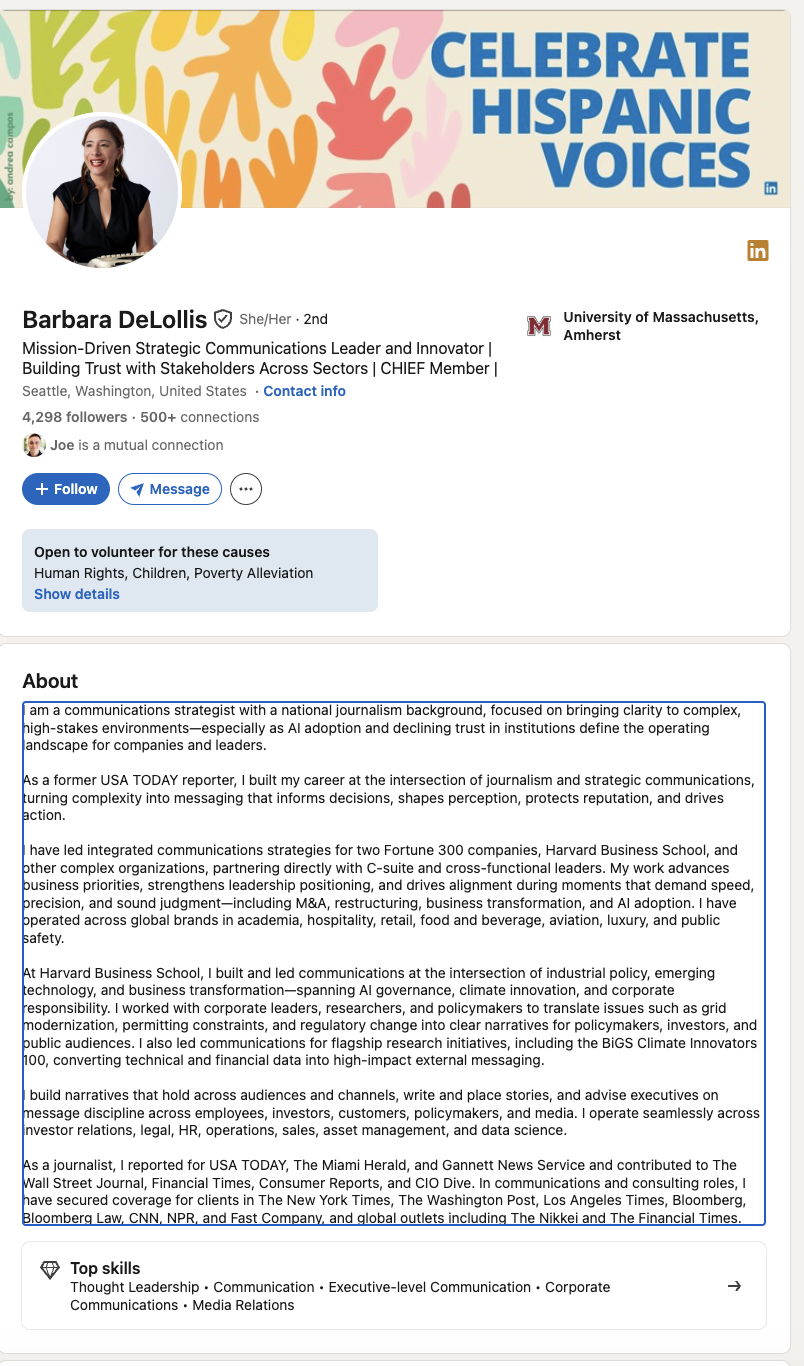
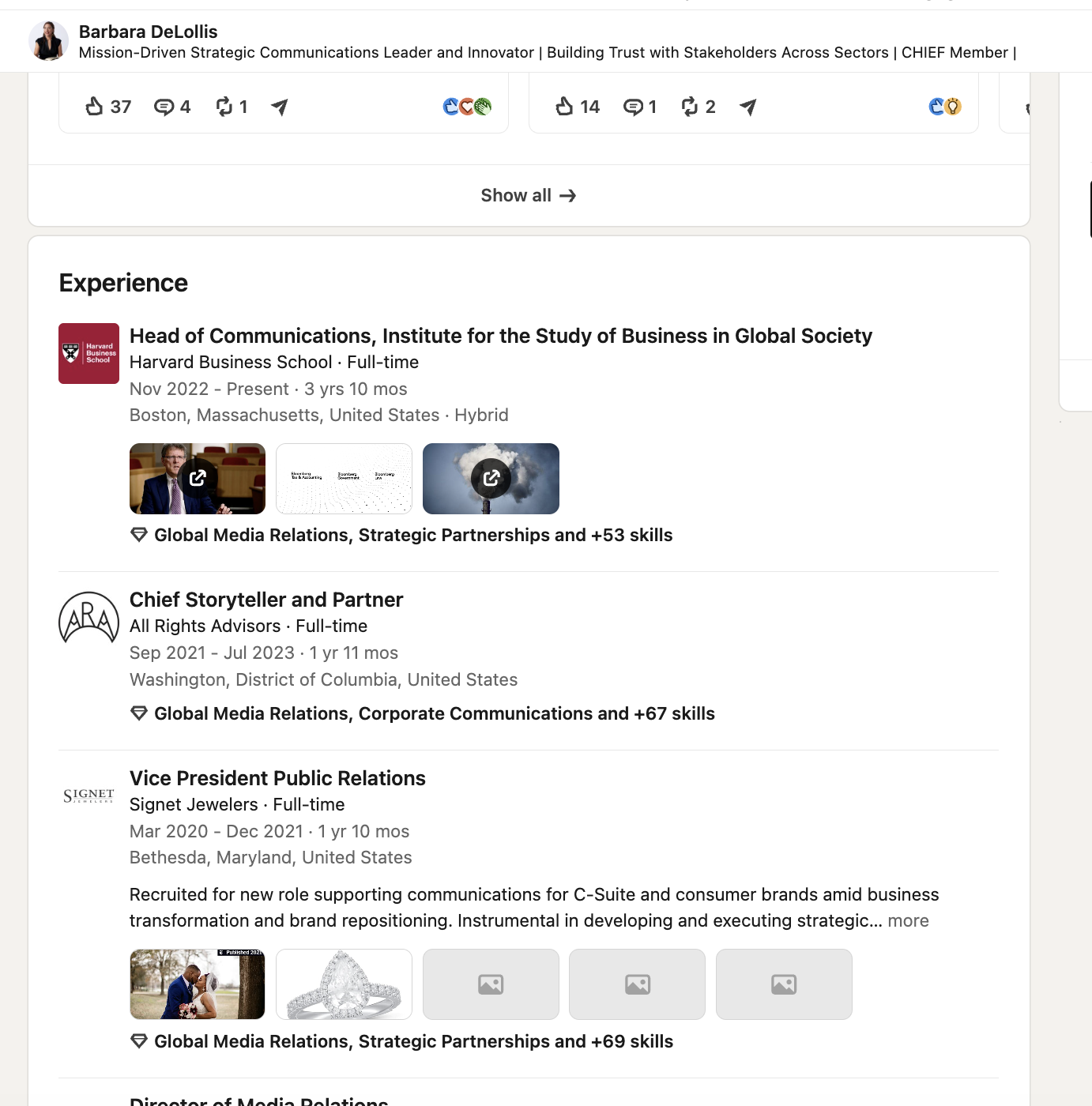
DeLollis, a former corporate communicator and luxury travel writer, has scrubbed her LinkedIn page of any references to SPD, where she worked for more than a year. Her page now says she has been communications director for Harvard’s Institute for the Study of Business in Global Society since 2022.

PubliCola is supported entirely by readers like you.
CLICK BELOW to become a one-time or monthly contributor.

Support PubliCola

2. KOMO News reporters and anchors voted narrowly—9 to 7—to leave their union, the Screen Actors Guild/American Federation of Television and Radio Artists (SAG-AFTRA) on Wednesday, with another half-dozen members apparently declining to vote. Unless SAG-AFTRA challenges the proceedings—unlikely, given that they reportedly raised no objections during or leading up to the vote—KOMO’s on-air talent will no longer be represented by a union.

As I reported last week, there are a number of reasons some at KOMO wanted out of the union, including the fact that they negotiate their contracts individually, rather than through SAG-AFTRA, whose contract guarantees a minimum salary that is much lower than the anchors and reporters make. The group already gets its health care through Sinclair, which owns KOMO, rather than the union.

3. I was a guest on Brian Callanan’s News, Views, and Brews podcast this week, where we had a great conversation about Barnes’ resignation (including my reporting on the ex-chief’s frequent absences from Seattle, which a recent guest incorrectly claimed was false or fabricated) the recent primary elections, and the passage of Mayor Katie Wilson’s legislation banning rental “junk fees.” Check it out.

Councilmembers Blame Mayor For Delayed SPD Press Conference, Criticize Removal of Former Chief Barnes

By Erica C. Barnett

When interim police chief Andre Sayles, mayoral public safety director Alison Holcomb, and SPD Captain Randy Hunt came to this week’s City Council public safety committee meeting to provide a “quick look” at the city’s response to the  recent shooting at Seattle Center, the briefing was scheduled for 15 minutes. It ended up taking well over an hour, as council members grilled Holcomb about why a press conference on July 26 didn’t happen until almost five hours after the shooting.

The meeting—which began with Rob Saka repeatedly bellowing, “Is there a killer on the loose?”—was largely political theater: The council wants the public to see them as tough and concerned with public safety.

But the tense session also revealed how eager some council members are to blame the mayor for any P.R. screwups on the night of the shooting—and absolve the police, including former chief Shon Barnes, who was out of town when gunfire broke out at the Bite of Seattle, as were Sayles and his fellow deputy chief Yvonne Underwood.

Debora Juarez, who was appointed to Cathy Moore’s seat after Moore quit the council last year, hammered away at Holcomb in a Court TV-style interrogation.

“I can call you Alison? Thank you,” Juarez began. “Because I want to be clear, I don’t want to do a gotcha moment. I’m not trying to humiliate anybody. I just want to understand.” Juarez then attempted to get Holcomb to agree that “the communication problem was between the mayor’s office and SPD,” that Wilson was “not allowing” an SPD public information officer, Brian Pritchard, to testify before the council, and that Wilson’s office “was not communicating with Seattle City Council” on the night of the shooting.

A timeline Kettle released this week shows that Wilson’s office was in touch with the council within less than a hour. That timeline also includes a text from Barnes saying he was working to get a conference call together shortly after 8, followed by a conference call that ended around 9:23, more than three hours after the shooting.

“I’m going to submit to you, Alison, and we both know how this works: I don’t think we need an investigation,” Juarez said. “I think you could tell us right now why there was a five-hour delay.”

Juarez also suggested that no one had any idea where Wilson even was, because she had her camera off during a Teams call the night of the shooting. “I’m not trying to create some cloak and dagger, but if I were the mayor, I would have [turned my camera on],” Juarez said. Then she suggested that Wilson asked the city’s Office of Inspector General to review the events of July 26 as a distraction from the fact that Wilson herself delayed the press conference five hours so that “dignitaries”—Senator Pramila Jayapal and Governor Bob Ferguson—could get there.

“We’re hearing… that some of the people in the mayor’s office didn’t know the difference between a mass hysteria, ‘we need a press conference now to calm people down’… and then later on you do the fancy political press conference and wait for dignitaries to arrive,” Juarez said.

PubliCola’s own reporting on the incident suggests the delay had multiple causes. Initially, SPD still considered the area an active crime scene with a potential shooter at large. Barnes, who was at a conference in Dallas, reportedly wanted a full briefing before he would allow SPD officials on the ground to address the press. Several of SPD’s media relations staffers were out of town, leaving one detective, Brian Pritchard, to answer questions at the scene. And finally, Ferguson and Jayapal wanted to be at the press conference, even if—as both have said—they did not ask the city to wait for them to get there. The balance of these forces, and any other reasons for the delay, will be among the subjects of the OIG’s report and a more detailed committee briefing on September 22.

Holcomb said the mayor’s office and public were less interested in why a press conference was delayed than “why didn’t the public receive more information sooner. … That’s a very different question about why didn’t a press conference happen on site at a certain time. Which, frankly, because you and I both know what’s happening here, is a political question. We’re concerned about public safety right now, and that’s what we’re focused on.”

PubliCola is supported entirely by readers like you.
CLICK BELOW to become a one-time or monthly contributor.

Support PubliCola

Councilmember Dan Strauss then jumped on the anti-Wilson bandwagon, echoing Juarez’ claim that Holcomb could easily tell the council what happened the night of the shooting if she really wanted to. “We don’t need to have an OIG investigation. We could answer those questions right now,” Strauss said.

“No, we can’t, because in fact I don’t know the answer to that question, and as I indicated in my answers to Councilmember Juarez, there were dozens of people who were texting and calling each other with lots of information that evening,” Holcomb responded.

A casual observer might wonder why the city council is making such a big deal out of a press conference that took place more than two weeks ago. After all, both SPD and the mayor put out information about the shooting on social media and via press release prior to the press conference and kept Kettle in the loop in real time.

But as the council monologues went on, it was clear that the council believes the mayor isn’t communicating sufficiently  with them before she makes major decisions, including executive decisions like firing the head of city departments.

“I’m going to talk now about the police chief being asked to resign, because it was similar in the way that [former Seattle City Light director] Dawn Lindell was asked, was fired, was asked to resign,” Strauss said as the brief passed the one-hour mark. “That same set of experiences that I had with Dawn Lindell being let go from the city occurred with Chief Barnes last week.”

As far as he could tell, Strauss continued, Wilson asked Barnes to step down as a fall guy for communication issues after the shooting. “The mayor asked the police chief to resign with very little information, and so the best that I can do is surmise that because there was some communication difference or difficulty, that the chief was asked to resign,” Strauss said.

Wilson signed a settlement agreement with Barnes that included a mutual nondisparagement clause, which almost certainly limits the extent to which she can badmouth the former chief’s performance. Instead, she has said that she has more insight into what’s going on at SPD, an executive department, than the council and outside observers.

That comment rubbed some councilmembers the wrong way. “When the mayor says, “You know, we have I have a better window” into the police chief’s performance, Kettle said, “what’s clear here is that she does not have a better window. She does not have a better window than I do. She does not have a better window than probably the majority of the council.”

As we’ve reported, there are many potential reasons Wilson may have let Barnes go, beyond his frequent trips to his family home in Chicago or his inappropriate response to a question about his travel schedule.

Interim Police Chief Andre Sayles Says He Won’t Be Barnes 2.0: “I’m All About Collaboration”

By Erica C. Barnett

Last week, after negotiating a minimum $741,000 settlement package with former police chief Shon Barnes, Mayor Katie Wilson announced she would be appointing one of Barnes’ two deputy chiefs, Andre Sayles, as interim police chief while the city begins a formal search and hiring process for the next permanent chief.

Barnes recruited Sayles last year from his job as police chief in Beloit, WI, about an hour south of Madison, where Barnes was previously chief. Like Barnes, Sayles has a family home in Illinois, a few miles outside Beloit (Barnes’ family home is in Chicago). where his wife continues to live; his kids also live in the area. His Washington state home, which he describes as his primary residence, is in east King County.

PubliCola sat down with Sayles at SPD headquarters last Friday for a conversation about the future of SPD, how his style and priorities differ from Barnes’, the culture at SPD, and more. I’ve edited our conversation for length and clarity.

Erica C, Barnett (PubliCola): Barnes recruited you to come to Seattle. You’ve mentioned that you’re personal friends. I’m curious why you decided to say yes to the interim chief job, given the circumstances of his departure and the fact that you’re so closely linked with him.

Andre Sayles: I never knew [Barnes] before January 2021. He came to my swearing-in April 2021 when I became police chief [in Beloit], and we kept in contact with each other professionally and developed a friendship personally after that. So when he presented [the Seattle deputy chief position] to me, I said, you know, I know I can be successful here. I can bring my personal touch to it, being a human first, and not being a chief or anything like that, and treating people with dignity and respect, not just inside the police department, but in the community as well. So I said, hey, let’s take this challenge because, you know, challenges help you grow.

PubliCola: What have you learned so far about the differences between policing in a small town like Beloit and a larger city like Seattle?

Sayles: I think sometimes it gets lost in the wording of ‘small’ that Beloit is a very diverse community. We dealt with a lot. There was a time where we were averaging anywhere between 10 and 12 homicides a year, for a city that’s anywhere between 38 and 40,000 people. That’s a lot of work for a quote-unquote small town. I truly believe policing is transferable. My skills and ability can go anywhere in this nation. As a patrol officer, I led homicide investigations. I led the drug and gang unit. It’s [a matter of] scaling your knowledge and skills to where you’re at.

PubliCola: Do you think that SPD has been doing that? Chief Barnes was doing a lot of community meetings, but they weren’t very well attended by actual community members. Will you change anything about how SPD does community outreach?

Sayles: Well, I think we have to remember if there’s 25 people in that meeting, sometimes people talk to 10 other people. So we are reaching people. But it’s a matter of getting more seats filled, more people to come to those meetings. And I think when we leave, we should provide a challenge to our community members: Hey, next time we have this meeting, bring two people with you. Because we want to hear from everyone that’s in this specific community. And let’s continue to do it, because I don’t want it to be a situation where we don’t show up.

But I would be happy if we showed up to a place and there was one person there, because that’s one person that’s dedicated to what we want to do for that community. Then that person is going to say, ‘Hey, they showed up five times. They’re committed to community policing.’

PubliCola: The city’s annual budget discussions are coming up, and there’s been a debate over whether SPD will slow down police hiring to stay within its budget. Can you talk about that possibility?

Sayles: I don’t know if we’re going to slow down, but we’re going to look at some steps to make sure that we’re able to get officers on the street in a timely manner. We may hire the same amount of people, but we may say, ‘All right, let’s take a two-three week break from hiring.’ So we can get people through the field training program, get them through [Basic Law Enforcement Academy], get them through post-BLEA, and then say, ‘All right, now let’s hire a certain amount of people.’ So it’s going to be a collective effort with our recruitment and retention team, and also the mayor’s office, to say, What does that look like? Let’s come up with a plan to say we’re going to hire X amount of officers during [each] quarter. That’s going to help the patrol staffing numbers and give that work-life balance back to our patrol officers to make sure that they can utilize their time away and be with their families.

PubliCola: To talk about the money, though, SPD will likely be over budget this year because you’re hiring more people than anticipated. There’s a huge budget deficit. Mayor Wilson has asked every department, including yours, to come up with very significant potential cuts. Is SPD going to cut its budget or resist taking any cuts?

Sayles: I think our biggest thing right now is to leave the people out of what we may put forward on the budget, because we want people, There’s some things that we may look at. Like—do we need to buy new chairs every year, or can we come up with a rotation for equipment for offices and things that nature, being very cognizant of the budget and being good stewards of the budget, and creating a roadmap and a plan within SPD, presenting it to the mayor’s office, presenting it to council members, and saying ‘This is what we’re committed to do.’ I think that’s what we’re going to do. We’ve been working diligently on that as an executive command staff team. I would like to bring in our captains and say, ‘What do you see in your precincts? What do you see in your unit?’ and have a group session on these things.

PubliCola: I saw that CARE Department Chief Amy Barden posted a photo of the two of you on Instagram this morning. In the past, she’s expressed some frustration about CARE not being authorized to respond to the kind of calls they were set up to respond to. Have you sat down with her and talked about her concerns? And will we see any changes with the relationship between SPD and CARE going forward?

Sayles: I met with Amy twice over the seven days I’ve been interim chief. I met Amy at a community meeting last year, where there was a situation that required CARE, and we co-responded to that situation together.

PubliCola: What was the situation?

Sayles: Then-mayor Bruce Harrell was at a Safeway talking [at an event promoting a food access initiative], and a gentleman was yelling and screaming. And we went over and we calmed down that situation together. So it’s going to be a new approach, because my ideas are similar to Chief Barnes, but they’re somewhat different, and my relationship with Amy is going to be different than Chief Barnes because I’m a different person. I’m a person that that is all about collaboration. Not saying that Chief Barnes was not, but I’m just talking about me specifically.

We’ve had a good conversation over the last week about some of the things that we want to do. So it’s bringing in SPD, bringing CARE to the table, bringing in Fire, bringing in the mayor’s office. And prior to us leaving the room, everybody agreeing that this is what we’re going to do, bringing in [the Seattle Police Officers Guild] and saying, ‘Hey, this is what we’re looking at,’ and putting a lock on that door before we leave, and everybody can walk out saying, ‘I like the collective idea that we came up with together.’

PubliCola: I want to ask a question about the Bite of Seattle shooting. I understand that you’re not going to be able to provide specific information, but there’s been a feeling of lost trust because there’s just still no new information coming out about what happened. What can you tell me about what’s going on with the investigation and why we don’t know anything yet?

Sayles: It’s one of those roadblocks in policing that some day, hopefully, we can get past in regards to the information that we can provide. I think the biggest thing is when we provide information, sometimes it gives that person that we may be looking for the idea and the advance knowledge of, ‘Oh, they know who I am.’ And we unfortunately sometimes have to keep that close to the vest because we have to proceed in our investigation with caution, and say, ‘We have this information. We can’t fully give it out to the community yet because, unfortunately, sometimes people help these suspects in these situations. I had a great talk with our investigators yesterday. Hopefully, in the coming days and coming weeks, there’s some things that’s going to happen that we will be able to talk about.

PubliCola is supported entirely by readers like you.
CLICK BELOW to become a one-time or monthly contributor.

Support PubliCola

PubliCola: I want to talk a little bit about the culture at SPD, which has been criticized as misogynist and anti-LGBTQ. Under former chief Barnes, there were a lot of problematic incidents and missed opportunities, including the way SPD handled the [anti-trans] Mayday USA rally last year. Do you think there’s room for improvement in SPD’s relationship with LGBTQ+ residents, and how will your  approach differ from Barnes’?

Sayles: People have identified that I came from outside, but I was actually a part of [SPD’s] LGBTQ+ Advisory Board until taking the interim position. I hadn’t seen anything in my 13, 14 months that would lead me to believe that’s what occurred. But I can’t be ignorant to what has been put out there and what has been said. So I want to strengthen that relationship. I think we’re making inroads to strengthen that relationship.

I know in July we had a meeting where there was a person that was trying to disrupt the meeting, and everyone in that group, from what I heard, actually was like, ‘Hey, the police are here. They’ve been here. They’ve been supportive of what we’re trying to do. Like, you can’t come in here and try to disrupt this meeting. And we’re developing a great relationship with the police department.’ I think it’s all about relationships and understanding that the things happened in the past, we have to be aware of it, but we also need to move past it and work on strengthening that relationship beyond some of the missteps that happened in the past. 

PubliCola: I’ve heard some critics and commentators say that the next permanent police chief needs be someone with roots in this community who rose up through the ranks at SPD, as opposed to someone who comes from elsewhere, like yourself. What do you think of that critique?

Sayles: I hope that we get a leader that wants to be involved in the community, someone that’s going to lead this department for our people inside this police department and outside this police department, not leading because you want a certain title. I think that’s the biggest thing, and that’s what it should be—a person that’s going to look at what SPD stands for: Service, pride, and dedication. If it’s a person from the inside, by all means, let’s go forward and be great. If it’s a person from outside, let’s forward, let’s go forward and be great.

PubliCola:  Are you applying?

Sayles: I have not had an opportunity to take a second to even think about that. It’s been a long week, and as things start to slow down for me a little bit. I think I’ll take a glance at it. But once again, I’m more focused on the people inside this police department—how can I help them?—and then also on our community members. I’m a person that’s selfless. I don’t really talk about myself and what I’ve done, and here’s this accolade or that accolade. I’m all about the people, and I’m all about a we mentality instead of a me mentality. So, if I decide to put in for it, I’ll decide to put in for it. But I haven’t thought about that because I’m focused on what we need to accomplish now.

PubliCola: Like Barnes, you still have a home in Illinois. What is your long-term plan, as far as moving to this area permanently versus keeping a home out of state?

Sayles: My home is in the Issaquah area. My secondary residence that I worked hard for is in Illinois. I asked the mayor when we talked, I said, ‘I just want to know that I have a place here in Seattle. Whenever there’s a permanent decision made, I would like to remain here.’ I came here because I believe my higher power put me here for a reason, and that is to be a leader within whatever role I have here at SPD.

I think I have shown that I’ve been very involved with our rank and file. I’ve been involved in our professional staff, and I’m getting myself out there in the community more than I have over the last year. I’ve been involved in the community, but now I want to be more involved in the community. And this is a place that I chose to come to. I uprooted myself to come out here because I believed in what the mission and vision was of Seattle before Chief Barnes, during Chief Barnes, and where we’re going to go in the future.