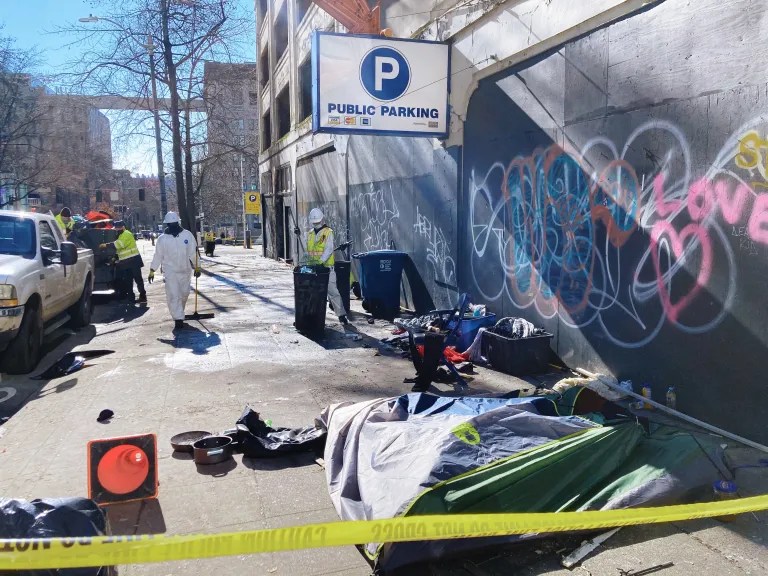
Last week marked the one-year anniversary of the Partnership for Zero, a $10 million public-private partnership aimed at ending visible unsheltered homelessness in downtown Seattle. During the official announcement on February 17, 2022, King County Regional Homelessness Authority CEO Marc Dones said they considered it “feasible” to reduce the number of people living unsheltered in the downtown core to “30-ish people” within a year. “Straightforwardly based on the data, yes,” it is doable, Dones said, “and then secondly, straightforwardly based on what we have to do to help people—yes.”
Since that announcement, the partnership between the KCRHA and We Are In, the umbrella group for the KCRHA’s philanthropic donors, has hit a number of milestones—including a “by-name list” of almost 1,000 people living downtown and the establishment of a “housing command center” to coordinate housing placements—but has not come close to the goal of housing or sheltering a large majority of people living unsheltered downtown. According to an announcement from We Are In and the KCRHA last week, the downtown effort has housed 56 people so far in a combination of permanent supportive, rent-restricted, and private-market housing—about 5 percent of the people the agency’s outreach workers have identified downtown.
As of last week, according to KCRHA spokeswoman Anne Martens, another 96 people were in “interim options”—mostly hotel rooms paid for by vouchers distributed by the Lived Experience Coalition—waiting for housing placements. Hundreds more have either filled out questionnaires about their housing needs, gotten new IDs, or are “moving through the housing process at three prioritized sites (specific encampments or geographic areas),” according to last week’s announcement.”
Jon Scholes, the director of the Downtown Seattle Association, told PubliCola that Partnership for Zero is “clearly behind schedule, and I think they clearly need to pick up the pace.”
The KCRHA is under intense pressure to resolve several encampments in and around the Chinatown/International District, which is in the Partnership for Zero area, as well as another longstanding encampment in North Seattle that neighborhood residents have called a threat to public safety. During a recent meeting of the KCRHA’s governing board, agency CEO Marc Dones said the agency is working to “activate pathways inside” for people living in those encampments, “inclusive of the existing shelter resources, emergency housing, and permanent housing as available.” Mostly, these pathways appear to involve hotel vouchers, not housing.
Jon Scholes, the director of the Downtown Seattle Association, told PubliCola that Partnership for Zero is “clearly behind schedule, and I think they clearly need to pick up the pace.” Most of the people the KCRHA’s outreach workers, known as systems advocates, have identified downtown have been homeless for years and have significant behavioral health conditions, Scholes added. “This is a population that can be challenging to get into housing quickly, and then once you get them there, to keep them there,” he said.
Enjoying this article? PubliCola is supported entirely by readers like you. Help keep PubliCola sustainable by CLICKING HERE to become a one-time or monthly contributor.
Still, Scholes said, he’s hopeful that “as they are able to free some resources up from the work in some of these encampments, they’re able to continue to move into the central neighborhoods of downtown.” Kylie Rolf, the DSA’s vice president for advocacy and economic development, added that “in the amount of time that the Unified Command Center has been operational and the system advocates have been on the ground, I think they have made remarkable progress.”
Martens said the agency learned several “key lessons and improvements” for the program in the first year. The first: “Setting up the infrastructure takes time.” Training the system advocates, setting up the housing command center, and creating a new outreach system has taken longer than expected, as has “gathering the documentation to obtain a photo ID” for people who have been living outside for years and, in many cases, don’t have an official address or other documents that could prove they are who they say they are.
The agency has retooled the concept of system advocates so that they no longer will stay with a single client through every stage of the shelter and housing process. Instead, “we’re increasing the efficiency of the Systems Advocates team by shifting advocates into specialized teams, instead of every advocate managing every step of the process,” according to a spokesperson.
Additionally, Martens said, the agency has retooled the concept of system advocates so that they no longer will stay with a single client through every stage of the shelter and housing process. Instead, she said, “we’re increasing the efficiency of the Systems Advocates team by shifting advocates into specialized teams, so instead of every advocate managing every step of the process, we now have teams of advocates focused on Outreach & Engagement, Housing Navigation, and Housing Stability.”
This appears to be a shift from the original concept of system advocates, who were supposed to be a single, “longitudinal” point of contact through every stage of the housing process, from identifying a person and getting them on a “by-name list” to connecting them to housing to ensuring that they have the resources they need to stay housed. We’ve reached out to the KCRHA for clarification about the currentrole of the system advocates.
Scholes said one complicating factor downtown is that many of the people causing a feeling of “disorder” downtown are fentanyl users who aren’t actually homeless. “They may be housed and they may have a fentanyl addiction, and that’s why they’re on the sidewalk. And we sort of shorthand it as homelessness… [but] they’re going to need a different set of interventions” than what the homelessness authority can provide.
Last week’s anniversary announcement included news that the Partnership for Zero has received another $1 million in funding, bringing the total to around $11 million. Although the KCRHA previously said it would use Medicaid funding to pay for the system navigators after last year (prompting skepticism from some Seattle councilmembers) the authority is paying for the outreach workers through its general budget, which is funded by the city of Seattle and King County.
Several criminal justice reform measures moved past last Friday’s deadline for bills to pass out of their committees of origin, including a bill sponsored by Rep. My-Linh Thai (D–41, Bellevue) that would give victims of unlawful police actions the right to sue for damages.
In Washington, and nearly every other state, “qualified immunity” is a doctrine established by the US Supreme Court that protects law enforcement officers from most civil misconduct lawsuits unless a person can prove that a previous case with very similar circumstances resulted in an officer or agency being held accountable. (Qualified immunity does not apply to use of excessive force.) In the past two legislative sessions, Rep. Thai introduced similar bills that would eliminate qualified immunity, but both failed to pass.
This time around, Thai’s bill no longer includes provisions giving the state attorney general’s office power to investigate and bring cases against police officers or law enforcement agencies for violating a person’s constitutional rights. As a result, it might have a better chance passing the House. (A separate bill, also sponsored by Thai, would give the attorney general the authority to investigate and sue law enforcement and corrections agencies.)
Thai’s bill could face a tougher road in the Senate, where police unions, local law enforcement agencies and the Association of Washington Cities have wielded considerable clout opposing similar bills in the past. Thirty-five states have tried and failed to eliminate qualified immunity since the protests over the murder of George Floyd in 2020, and only Colorado succeeded passing a law in 2020 that allows victims of misconduct to sue law enforcement agencies.
“Without accountability, there cannot be true justice,” Thai said in a press release. “This bill provides avenues to justice for victims of police misconduct. By holding municipalities accountable when their employees violate a resident’s state constitutional rights, I hope we can encourage them to properly train, support, and discipline their police forces.”
Candice Bock, a spokesperson for the Association of Washington cities, said the organization still opposed to Rep. Thai’s bill. “Our concern is that it’s not going to really lead to greater accountability – which I know is what the proponents hoped for,” Bock said. “It’s going to result in an increase in claims and litigation costs, and cities settling those claims because the litigation costs are too expensive.”
Two other bills to reform the state’s juvenile justice system made it out of their committees last week. One bill, sponsored by Sen. Yasmin Trudeau (D-27, Tacoma), would raise the minimum age for a child to be prosecuted in juvenile court from 8 years old to 13. The other, sponsored by Rep. David Hackney (D-11, Tukwila), would reform the state’s criminal sentencing system so that juvenile convictions no longer lead to longer sentences for crimes people commit as adults.
Bills that failed to make the deadline included one that would have prevented evidence gathered during police misconduct from being admissible in court, another that would have limited the use of solitary confinement, and one that would have allowed judges to consider releasing people who are serving long sentences for crimes they committed before the age of 25.
The five-year plan includes no new spending on tiny house villages.
By Erica C. Barnett
Members of the King County Regional Homelessness Authority’s governing board, including Mayor Bruce Harrell and City Council homelessness committee chair Andrew Lewis, expressed concerns over the scale and scope of the agency’s draft Five-Year Plan to address homelessness, which calls for 18,000 new shelter beds and parking spots for people living in their vehicles—and an annual price tag in the billions. Currently, the city of Seattle and King County are the authority’s only funders.
We dug into the details of the draft plan on Tuesday.
Harrell, who declined to fund any of the KCRHA’s requests for new programs in last year’s city budget, said he didn’t “see a route to achieve” the full five-year plan, which includes $8.4 billion in capital costs and between $1.7 and $3.4 billion in annual operations and maintenance costs. “That’s almost another city [budget],” he said. Instead, Harrell said, the authority should figure out what it can do with incremental increases of 5 or 10 percent a year and come back with a plan that focuses on responding to the immediate need for emergency shelter. “Maybe it’s there and maybe I’m just not seeing it, but I just want a little more meat there.”
In response to concerns from elected officials, KCRHA CEO Marc Dones the reason the plan zeroes out tiny houses is that “the modeling calls for fewer modular shelters than we currently have—it’s just math.”
Lewis echoed Harrell’s comments, saying he’d like to see a “price tag that is more within existing norms that can be nimble, responsive, and bring the kind of response we’re hearing from the public that they want to see … like hotel/motel acquisition, tiny homes, and pallet shelters that can be scaled with urgency and scaled more achievably within existing resources to mitigate those most significant encampments that are rightly causing significant community consternation.”
While the city declined to fund the KCRHA’s budget requests last year, they did pay for new emergency shelters and tiny houses, a type of shelter Dones has singled out for criticism for years. The agency’s five-year plan includes additional funding for every existing shelter type except tiny house villages, which are featured in a chart showing “$0” across the board.
Enjoying this article? PubliCola is supported entirely by readers like you. Help keep PubliCola sustainable by CLICKING HERE to become a one-time or monthly contributor. [/su_button
In response to questions from Seattle Councilmember Lisa Herbold, who noted that the five-year plan actually shows a 55-bed reduction in tiny house village spots, Dones said the reason the plan zeroes out tiny houses is that “the modeling calls for fewer modular shelters than we currently have—it’s just math.” As we reported last week, the KCRHA determined how much of each type of shelter the region needs based largely on interviews with 180 people experiencing homelessness about their needs; they did not ask any questions about specific shelter types. Dones said even though the plan shows an overall reduction in tiny houses, “we would not look to pull funding out of the existing THV stock or what has been funded in order to make the numbers and the math” match up with actual shelters on the ground.
The governing board isn’t scheduled to meet again until April, when they’re supposed to vote to approve the five-year plan. King County Councilmember Claudia Balducci and Herbold both questioned this timeline, saying they’d like an opportunity to review the final version and discuss it again publicly before voting to approve it. The authority is up against an 18-month deadline to approve the plan, which was originally supposed to be out last fall. The board— whose job is to sign off on the plan as approved by a separate implementation board, not to amend it—agreed to tentatively add one additional meeting in May to take a final vote on the plan.
Two years ago, as part of a slate of police reform bills, state legislators passed a law barring police officers from pursuing people who fail to pull over when an officer directs them to do so. The only exceptions were if the officer had probable cause to believe the person had committed a violent or sexual crime, or when the officer had reasonable suspicion—a lower standard—to believe they were driving under the influence of drugs or alcohol.
On Thursday, the House’s House Community Safety, Justice, and Reentry committee advanced an amended version of House Bill 1363, which would allow pursuits under the lower reasonable suspicion standard for a broad number of offenses, including any violent offense, but would not allow police pursuits for any non-violent property crimes. Organizations like the Washington Association of Sheriffs and Police Chiefs have blamed the change in the law has been blamed for a spike in property thefts statewide, particularly stolen vehicles. Law enforcement agencies across the state had been putting their weight behind the original version of the bill, sponsored by Rep. Alicia Rule (D-42, Blaine), that would have allowed pursuits for all criminal offenses.
Committee chair Roger Goodman (D-45, Redmond) put forward the new version of the bill, which he said is intended to “limit the scope of this bill, but also to keep the conversation going.” The bill includes a 2025 expiration date; if the legislature doesn’t adopt new pursuit rules before then, the rules for pursuits would automatically revert to the 2021 law.
Only one member of the committee, Rep. Darya Farivar (D-46, Seattle), voted against advancing HB 1363, saying she wants to make long-term changes to the current law this year. While 1363 moves forward on the House side, Democrats in the state senate are advancing a proposal to take a broader look at pursuits.
“I’ve never seen, in my 31 years of law enforcement, the state and the condition of our state when it comes to open lawlessness and complete disregard for our laws that keep the community safe.”—Kent Police Chief Rafael Padilla
When they passed police pursuit law in 2021 reform, legislators said they wanted to reduce the number of high-speed police pursuits because of the risk they posed to the public, including pedestrians. According to an analysis by retired University of Washington researcher Dr. Martina Morris, just three people (all bystanders) have been killed as the result of police pursuits since the new law went into effect in July 2021, compared to nine in a comparable period immediately pre-reform.
Advocates for changing the law, including multiple mayors (though not Bruce Harrell), the Association of Washington Cities (AWC), and the Washington Association of Sheriffs and Police Chiefs, said the new law resulted in significant numbers of people taking advantage of it to flee police.
Many cities (though not Seattle) included the issue at the top of their official legislative agenda for 2023. “In 2021, AWC was an engaged supporter on many of the police reforms that the Legislature adopted, but we understand that law enforcement is complex and that sometimes legislation needs revising when the impacts become clearer,” the AWC more than 200 local elected officials said in a letter to legislators this week. ”In the case of the limits adopted on police pursuits, we think revisions are necessary to improve public safety outcomes in our communities.”
“I’ve never seen, in my 31 years of law enforcement, the state and the condition of our state when it comes to open lawlessness and complete disregard for our laws that keep the community safe,” Kent Police Chief Rafael Padilla told the House Community Safety, Justice, & Reentry committee last month.
Police accountability advocates argue that rolling back the law would erase progress toward reform. “From our view, we’ve got something that’s working. It’s not fun, it’s not comfortable, we have a lot of work to do as a society to figure this stuff out. This bill absolutely does not represent what that positive change and momentum needs to be,” Kurtis Robinson, president of the Spokane NAACP speaking on behalf of the Washington Coalition for Police Accountability, told that committee.
Morris’ analysis found that the law has been effective. (An earlier version of the analysis included two deaths caused by a driver who believed he was being pursued. Morris removed that incident during a review of all the pursuit incidents after its inclusion was questioned.)
“Estimates are that on the order of 30 percent of all pursuits end in an accident. When I’m talking about the fatalities, these were the key thing we were interested in, but it’s the tip of the iceberg in terms of the damage that’s caused by pursuits.”—Retired UW researcher Dr. Martina Morris
Morris told PubliCola the benefits of reducing police pursuits go beyond lives saved. “There are public safety risks from pursuits. Fatalities are just one of the parts of the collateral damage with these vehicle pursuits,” she said. “There are also injuries, property damage, and estimates are that on the order of 30 percent of all pursuits end in an accident. When I’m talking about the fatalities, these were the key thing we were interested in, but it’s the tip of the iceberg in terms of the damage that’s caused by pursuits.”
The data primarily comes from the website fatalencounters.org, a database created by researchers at the University of Southern California to track all types of deaths occurring nationwide where police officers are involved. Individual police departments are not required to provide information on these events on their own, so the information has to be obtained through media reports.
An alternative to HB 1363 is currently working its way through the state senate. Senate Bill 5533, sponsored by former Washington State Trooper John Lovick (D-44, Lake Stevens) would keep current state law in place until 2024 while a work group within the state’s Criminal Justice Training Commission, comes up with a model pursuit policy for the state to adopt, and do so by fall of 2024. This proposed model policy would outline exactly when police should be able to pursue suspects, and would be created in coordination with representatives of the state’s law enforcement groups.
Any model policy would likely only be binding on police departments who wanted to adopt a more loose pursuit policy; cities like Seattle, which had more stringent requirements on when officers could pursue, would be able to leave those policies in place, leaving open the possibility that some departments could decide to stick with current state law.
But the bill creating a model policy has come under fire by some Republicans, like Sen. John Braun (R-20, Centralia) who said it would be “letting legislative Democrats off the hook” in an op-ed in the Seattle Times last week. Braun is pushing for an immediate fix.
But waiting would also provide additional time for Washington to see how the current law is impacting public safety— whether Dr. Morris’s conclusions continue to bear out. “I can’t create more time for this law to have been in place,” she said of the relatively small sample size at the heart of her study. “But the legislature can.”
On Wednesday, the Seattle Police and Fire Departments responded to questions from the Community Police Commission about some of the circumstances that may have contributed to the death of Jaahnavi Kandula, a 23-year-old pedestrian who was killed in a marked crosswalk by SPD Officer Kevin Dave. Dave was driving to join Seattle Fire Department EMTs at a suspected overdose in South Lake Union. According to the response from Seattle Fire Chief Harold Scoggins, Seattle Fire Department policy requires police to be present when SFD responds to overdoses, because “overdose patients can become violent during treatment to reverse the overdose.”
The CPC asked the Fire Department to explain the reason it requires police officers to be present when Fire responds to overdose calls, posing four questions about the policy, how it came about, and “What percentage of drug overdose calls prior to the implementation of this policy included compromised safety, assaults, and/or injuries to SFD personnel related to reversing the effects of an overdose?”
In his response, Seattle Fire Chief Harold Scoggins said that the requirement “goes back at least 20 years and is designed to provide scene safety for firefighters and paramedics as overdose patients can become violent during treatment to reverse the overdose.” He did not answer the CPC’s question about how common it is for people coming out of overdoses to be violent, saying only that “[e]ncountering combative patients or bystanders on emergency responses has unfortunately become a reality for firefighters and paramedics.”
Narcan (or naloxone), the widely available overdose reversal drug, is used daily by non-emergency responders, including drug users themselves, and other public employees are trained to use it in the absence of paramedics or any armed response. In 2019, then-Washington state health officer Kathy Lofy signed a “standing order” that made Narcan available over the counter without a prescription to any person who wants it, calling it a “very safe,” life-saving medication.
“When weighing the decision to respond using emergency driving, officers must consider if the incident is life threatening, road conditions, vehicle and pedestrian traffic, weather, speed, lighting, and their own driving abilities.”—Police Chief Adrian Diaz
In his letter, Scoggins said SFD has developed a “new method for tracking assaults and threatening behavior experienced by firefighters in the field,” in general, and has begun reporting this information. PubliCola has asked SFD for this data and will update this post with additional information when we receive it.
Seattle Police Chief Adrian Diaz also responded to the CPC’s questions. After describing the training officers receive in “emergency driving”—driving under emergency circumstances, such as a high-priority call where someone’s life is at risk—Diaz said officers are justified in taking “risks [that] “can result in severe consequences for the public and the officer. … When weighing the decision to respond using emergency driving…. [o]fficers must consider if the incident is life threatening, road conditions, vehicle and pedestrian traffic, weather, speed, lighting, and their own driving abilities.”
Diaz said the fact that the overdose was a Priority 1 call would not, in itself, necessitate emergency driving. “The priority level is a factor to consider but is not generally controlling,” Diaz wrote. “While many Priority 1 calls would warrant emergency driving under our current policy and training, not all do and officers are expected to consider the totality of the circumstances.”
PubliCola has filed a records request the audio from the initial 911 call; SPD categorically denied a separate request for all recorded audio related to the Kandula’s death, citing their ongoing investigation into the incident.
In a conversation with PubliCola last week, SPD Chief Adrian Diaz noted that Dave is a licensed EMT who was headed to the scene of a medical emergency, implying that he was on the way to respond to the reported overdose, not to provide security for the Fire Department. On February 6, the head of the Seattle Fire Fighters Union, Kenny Stuart, expressed frustration about SPD officers getting trained as EMTs and responding to medical emergencies like overdoses directly, saying this was the responsibility of the fire department, not SPD. (It’s a longstanding, ongoing issue.)
“Our EMS delivery system under the Medic One program is arguably the best in the country, and randomly allowing additional EMTs from other city departments to self-dispatch or to perform EMS functions at an incident does not improve or support the level of care we demand from this program,” Stuart wrote. “In fact, it unnecessarily complicates our response and diminishes the service that the public depends on and expects.”
Seattle Fire Department firefighters and paramedics are “the only personnel that are dispatched as EMTs” to medical emergencies, Stuart continued, “and they should be the only personnel who deliver EMS to the people of Seattle. We need our police officers to provide scene security and protect us so we can do our jobs effectively.”
Several years ago, SFD’s medical director told PubliCola the fire department preferred to use rescue breathing—a method to restore breathing in overdose victims without Narcan—followed by intravenous naloxone to facilitate a slower return to normal breathing without putting a person into instant opiate withdrawal. We’ve asked SFD whether this is still the department’s policy, and how the emergence of fentanyl has impacted overdose response, and will update this post when we hear back.
When King County and the city of Seattle established the King County Regional Homelessness Authority in 2019, the two governments signed an agreement that required the new agency to adopt a five-year implementation plan that would include, at a minimum, “strategies to reduce homelessness in at least the following populations: youth and young adults, families, veterans, single adults, seniors, and those experiencing acute behavioral health challenges.”
The draft plan the KCRHA released late last month later goes far beyond that mandate, proposing a series of actions that would—in combination with separate investments in permanent housing—effectively eliminate unsheltered homelessness in King County within five years, mostly by investing in shelter.
Overall, the plan proposes spending between $1.7 billion and $3.4 billion a year to add 18,000 new temporary spaces for people to live, including 7,100 new shelter or “emergency housing” beds, 3,800 medical respite beds for people with acute health-care needs, 4,600 new safe parking spaces for people living in RVs or their cars, and 2,600 beds for people who need addiction recovery support. Altogether, the proposal represents a more than fourfold increase in shelter beds and safe parking spots over just five years. Separately, the plan says the region will need to invest around $8.4 billion in one-time capital costs for permanent and “temporary housing,” a term that encompasses all kinds of shelter.
The focus on shelter and other forms of “temporary housing,” like recovery housing for people struggling with addiction, represents a turnaround from the region’s previous strategy of de-emphasizing shelter in favor of programs like rapid rehousing, which aims to move people directly from the street into private apartments, where they receive short-term subsidies but are expected to pay full rent within a matter of months. Rapid rehousing programs still exist (and can be successful), but they are no longer touted as a panacea the way they were during the Ed Murray administration.
“The plan is really structured around ending unsheltered homelessness, not all forms of homelessness, and that is important,” KCRHA CEO Marc Dones told PubliCola earlier this month. “We built this draft plan in relationship to what would be necessary in order to significantly reduce or eliminate folks sleeping outside, acknowledging that that doesn’t address the other forms of homelessness, like couchsurfing [or people living] doubled up. Things that like are also a significant concern. But we decided that we needed to go towards one thing first, and it was ‘people shouldn’t sleep outside.'”
Implementing the new plan would cost an order of magnitude more than what the region currently spends on homelessness. One reason for that is that the KCRHA, using a model created by the state Department of Commerce, now estimates that there are far more unhoused people in King County than any previous study has concluded—around 56,000, or roughly one out of every 50 people. That number dwarfs the county’s own 2021 estimate; it’s also significantly larger than the US Department of Housing and Urban Development’s estimate of 25,000 people experiencing homelessness across the entire state of Washington.
“For every unit of permanent, affordable housing that comes online, we don’t need as much temporary stuff. If there was a big push to site and develop permanently low-income housing, we could retool [the plan] literally over the course of a week.”—KCRHA CEO Marc Dones
Here’s another data point: As part of its effort to identify and permanently house everyone experiencing homelessness in downtown Seattle, Partnership for Zero, the KCRHA has spent part of the last year creating a “by-name list” of everyone experiencing homelessness in the area, which extends from Belltown to the Chinatown-International District. So far, they’ve identified around 800 people. Even assuming that number is an undercount, it suggests that almost all the homeless people in King County live outside downtown Seattle—an area originally chosen, in part, because it has one of the highest concentrations of homelessness in the county.
KCRHA community impact officer Owen Kajfasz, who leads the agency’s data team, said 56,000 only represents the “floor” for homelessness in King County—in other words, it could be an undercount. However, he acknowledged that the new estimate includes everyone who identified as homeless at any point during the year—including those who were only homeless for a short period, such as a week or a day, and who found places to live on their own.
The KCRHA’s Five-Year Plan includes no new spending on tiny houses, and actually assumes a reduction in the number of tiny house villages over the next five years.
Numerous studies, spanning decades, have concluded that a large number of people “self-resolve” their homelessness within a few days or weeks, although at least one recent analysis has found that number is decreasing. If the number of people who need longer-term interventions, such as case management and temporary housing, is only a fraction of the total people who are homeless in King County every year, the cost to shelter and assist those who need more help could be lower than the KCRHA’s eye-popping estimates.
“To say we need to stand up 18,000 emergency shelter beds, in absolute terms, for 53,000 people experiencing homelessness in King County doesn’t make sense,” said Low Income Housing Institute director Sharon Lee, whose organization operates low-income apartments and “tiny house village” shelters around the county. “The costs of adding spaces just for RVs and car safe parking total $139 million! This is not the correct strategy nor is this in any way financially feasible.”
Local political leaders praised KCRHA for laying out a plan to address unsheltered homelessness, but also seemed unconvinced that the proposal is politically or financially realistic.
A spokesman for Mayor Bruce Harrell, for example, said that while Harrell “supports KCHRA’s dedicated focus on ending unsheltered homelessness and prioritizing immediate and long-term solutions to help get people indoors with access to services and a path to recovery,” the city already funds the majority of the KCRHA’s budget and increased its contribution slightly last year “despite a significant budget deficit.” Last year, the KCRHA asked the city for an additional $54 million to fund 400 new shelter beds and 130 safe-parking spaces; they didn’t get it.
“For budget estimates included in the five-year proposal, we look forward to better understanding how existing investments will be applied and how we can unite support from local, state, and federal governments—along with private and philanthropic sources—to realistically meet budget expectations and advance solutions that drive tangible positive impact,” Harrell’s spokesman, Jamie Housen, said.
Seattle City Council homelessness committee chair Andrew Lewis said he has “faith and confidence that that (cost) number does reflect probably what the investment would be to truly end homelessness and have a flexible system where homelessness is brief, people can get rapidly rehoused, and everything else. That said, the product I would like to see is a corollary tactical, substantive plan … that we can implement in one to two years with things like pallet shelters, RV safe lots, tiny houses—things that people can see and have confidence that we can get on top of this problem.”
His fear, Lewis said, is that if Seattle doesn’t make a visible dent in unsheltered homelessness, people will lose confidence in strategies that work, like low-barrier housing for people struggling with addiction. “We did, in this biennium, make a half-billion-dollar investment in housing [through the city’s capital budget], and for a city, that is a really big contribution to the regional solution. So I think it is possible for us to build on that and continue to be a partner within the reasonable constraints of our means. But,” he added, “I do think it requires us to demonstrate visible progress with a shorter-term, tactical plan” that will build “currency” for larger investments later.
Lewis has been a longtime advocate for tiny house villages, noting that people living in encampments will often “accept” a referral to a tiny house after saying no to traditional shelter. Dones, in contrast, has argued repeatedly that tiny houses cost too much and don’t get people into housing fast enough. Notably, the Five-Year Plan proposes spending no new money on tiny houses, and actually proposes decreasing the number of tiny-house units by 55—a stark contrast to the rest of the proposal, which proposes large new investments in every other type of shelter.
According to the plan, just 1 percent of people experiencing homelessness told KCRHA researchers that they preferred tiny house villages to other forms of shelter.
However, that conclusion is based on extrapolation from 180 interviews in which researchers asked people a list of open-ended questions, such as “what things or people have been helpful to you?” These interviews were also used to estimate the number of people experiencing homelessness in last year’s “point-in-time count,” and to describe the living conditions of the county’s homeless population as a whole.
Researchers never asked respondents to identify which type of shelter they preferred. Instead, they asked then to describe, in an open-ended way, “an optimal condition that would support them to move on in their housing journey,” Dones said. The things they mentioned, Kajfasz added, “were very infrequently aligned with the tiny own village model.” For example, some people said they would prefer to have their own restrooms, or running water in their unit—in other words, a hotel room.
According to the plan, just 1 percent of people experiencing homelessness told KCRHA researchers that they preferred tiny house villages to other forms of shelter. However, that conclusion is based on extrapolation from 180 interviews in which researchers asked people a list of open-ended questions, such as “what things or people have been helpful to you?”
Lee called the KCRHA’s plan, which singled out tiny houses while lumping all other forms of shelter, including hotels, into a single category, “anti-tiny house,” adding, “we question the methodology and numbers.”
For example, “How come they don’t have breakout categories for congregate shelters, noncongregate shelters, hotels, and overnight shelters?” Lee said. “We actually need all of them.” During a recent meeting of the KCRHA’s implementation board, several speakers urged the committee to support funding for tiny house villages. After listening to their comments, board member and former Bellevue mayor John Chelminiak said, “I agree with the speakers today who say, ‘Don’t take options off the table,’ and this [plan] takes options off the table.”
Dones said the authority put tiny houses in their own micro-category because “the community has sort of held [tiny houses] apart from other forms of shelter investment,” adding, “I recognize this is a departure, but what I heard [from the interviews] is that folks do prefer hoteling or emergency housing. … There is a point at which ‘because they told me’ is enough.”
Even if the KCRHA were able to secure funding for a sizeable portion of its five-year plan, some of its elements—like the proposal to secure and open hundreds of parking lots across the county for people living in RVs and cars—seem obviously unworkable based on the region’s recent history trying and failing to open even one such lot.
Consider, for example, the fact that the city of Seattle has been trying unsuccessfully for well over a decade to create a single safe lot for people living in their cars or RVs. So far, every attempt has been a failure. Just last year, plans for a small RV safe lot in SoDo were scaled back, then shelved, due to opposition from people living in the adjacent Chinatown/International District neighborhood—long before neighborhood opposition doomed an adjacent shelter expansion.
LIHI, which was the only applicant for a contract from KCRHA to open an RV safe lot last year, told KOMO recently that they’ll need a 30,000-to-40,000-square-foot parking lot to hold just 35 RVs. After six months of looking, they have not found a suitable lot.
Dones said the plan could change based on feedback the KCRHA receives about the draft, including the public. (The three-week public comment period closed on February 8). The level of need the plan anticipates, they added, could change dramatically if state and regional invests in housing quickly. “For every unit of permanent, affordable housing that comes online, we don’t need as much temporary stuff,” Dones said. “If there was a big push to site and develop permanently low-income housing, we could retool it literally over the course of a week or so to say ‘Now we need this much.” The question, for many of the officials who’ve staked their hopes on the new authority, may not be “how much” but “how?”
Donate to The C Is for Crank's Laptop Retirement Fund
My computer is the single most important piece of equipment I own, and for much of the last five years, I’ve relied on my trusty 2015 MacBook Pro to write and edit posts, tweet up a storm from public meetings, file public records requests, edit transcripts and photos, and generally keep The C Is for Crank in operation. Now it’s time to retire my old machine and trade it in for a newer model.
I’d really appreciate any help my readers are willing to provide to help me defray the cost of this critical piece of office equipment. A new, faster machine (not to mention one without—ahem—an ever-so-slightly cracked screen) will make it easier to bring The C Is for Crank to you every day. My back will also be grateful as I rush from candidate debate to city council meeting to coffee shop back to City Hall. I accept contributions via Venmo (Erica-Barnett-7), Paypal, and by check at the address on my Support page. Thank you so much for your support!

 By Erica C. Barnett

 By Ryan Packer