Tag: shelter

After Planned Encampment Removals, Just 15 Percent Go to Shelter—and That’s the Best-Case Scenario

Slide from the city’s presentation on pre-announced encampment removals, which don’t include no-notice “obstruction” sweeps

By Erica C. Barnett

Mayor Bruce Harrell’s Unified Care Team, which removes encampments and informs their displaced residents about available shelter beds, made 1,352 offers of shelter during scheduled removals during the second quarter of this year, the Human Services Department reported this week. The number of shelter offers is greater than the number of individuals who received information about an open bed, because the number represents people who were told about shelter more than once.

Within that number, the UCT provided 554 “referrals,” in which a person said they would go to shelter. Finally, of that subset, there were 206 shelter enrollments, meaning that in 206 instances, a person with a referral actually showed up at a shelter and stayed there for at least one night. That number, which also includes duplicates, suggests that only around 15 percent of people who got a shelter “offer” actually took it; however, the true percentage of people getting into shelter after planned sweeps is probably much lower, because people tend to relocate once the city puts up signs announcing an impending encampment closure.

Another issue, committee chair Andrew Lewis noted, is that the numbers the Harrell Administration presented Thursday represent just a fraction of the total number of people displaced from encampments daily around the city—a number that also includes sweeps the city routinely conducts with no notice or offer of shelter or services.

An HSD staffer, strategic advisor Chris Klaeysen, presented the numbers to the council’s homelessness committee on Wednesday. Klaeysen demurred on a number of key questions, referring council members to Deputy Mayor Tiffany Washington, who wasn’t there.

Councilmember Teresa Mosqueda asked Klaeysen why his presentation focused so much on the fact that the UCT offers shelter to everyone remaining at an encampment, which is something they are required to do. “Just saying that 100 percent received offers of shelter when 15 … percent confirmed they went into it—I don’t see how that conforms with our requirement that they receive an offer of shelter that works for their individual needs,” Mosqueda said.

People “refuse” shelter, to use the city’s term, for many reasons, including restrictive shelter rules, concerns about theft, and the fact that most shelters are single-gender and require people to relinquish pets and leave their partners behind. Klaeysen said UCT members have started asking people why they decline shelter, but his presentation only included the top three reasons: People wanted to wait for a tiny house; didn’t “want shelter”; or didn’t want to be separated from their partner, family member, or friends.

Another issue, committee chair Andrew Lewis noted Wednesday, is that the numbers the Harrell Administration presented Thursday represent just a fraction of the total number of people displaced from encampments daily around the city—a number that also includes sweeps the city routinely conducts with no notice or offer of shelter or services. “I don’t have any baseline to compare [these numbers] to,” Lewis said.

Historically, the city has justified no-notice sweeps by saying that a person, tent, or other property constitutes an “obstruction” if it occupies public space. Last month, a King County Superior Court ruled that the city’s definition of obstruction is unconstitutionally broad, and that the city may be violating a ruling, Martin v. Boise, that prohibits cities from displacing people when they have nowhere to go. The city has said it plans to challenge that ruling.

In Last-Minute Bailout, State Provides $6 Million to Pay for Hotel Shelters That Ran Out of Money Last Month

By Erica C. Barnett

In the final days of the state legislative session, Seattle lawmakers quietly bailed out a hotel-based homeless shelter program that ran out of money in early April, using $6 million in “underspend” from a program that addresses encampments in state-owned rights-of-way to keep the hotels open while the King County Homelessness Authority tries to find places for hotel residents to go.

The KCRHA has until the end of June to spend the money, which can only be used to “maintain the operations of, and transition people out of, as appropriate, a hotel housing more than 100 people experiencing homelessness that is at imminent risk of closure due to a lack of funding,” according to language state Rep. Nicole Macri (D-43, Seattle) and Sen. Joe Nguyen (D-34, Seattle) inserted into this year’s supplemental budget.

“Generally speaking, a request of that amount coming this late would not have had the sympathy that it did. At that point, I was like, ‘I don’t want 300-plus families to be unsheltered.'”

—State Sen. Joe Nguyen[/perfectpullquote]

“[KCRHA CEO] Marc Dones reached out, saying they had discovered this crisis several weeks [earlier], saying they had been trying to figure out how to transition people” out of the hotels, Macri said. At the time, the KCRHA estimated there were more than 300 people living in rooms at six hotels, a number that has since dwindled. “They said this is an urgent need—it’s an immediate need right now.”

“Generally speaking, a request of that amount coming this late would not have had the sympathy that it did,” Nguyen said. “At that point… I was like, ‘I don’t want 300-plus families to be unsheltered.'”

Because it was so late in the session, Macri said, it wasn’t possible to just move the underspent dollars from one year’s budget to the next. A change like that would require legislation to reallocate the funds, which are earmarked for the highway encampment program. Instead, the state Department of Commerce provided supplemental budget language that allowed the KCRHA to use the leftover money, which would otherwise have gone back to the state’s general fund, to pay for the hotels.

As PubliCola reported exclusively earlier this month, the Lived Experience Coalition received a total of $1.3 million in federal grants through the United Way of King County, but the money ran out earlier this year, forcing a scramble to save the program.

The LEC, formed in 2018, is a group of people who have direct experience with homelessness or systems that homeless people frequently encounter, such as the mental health care system. Until last year, they had never been in charge of a shelter or housing program. The LEC has blamed the hotel crisis on its fiscal sponsor, a nonprofit called Building Changes, which denies responsibility for financial errors.

We Are In, the funder for Partnership for Zero, stepped up to pay for the hotels through the first week of April. (According to a spokesman, the two We Are In board members who are affiliated with the LEC recused themselves from the vote.) The KCRHA is planning an investigation into what happened with the hotels, which will be paid for by the Campion Advocacy Fund, one of We Are In’s funders. Later this month, the authority reportedly plans to discuss the hotels during a joint meeting of the agency’s governing and implementation boards.

Meanwhile, Dones has said the regional authority only recently became aware of the hotel funding crisis and had nothing to do with the LEC’s contract to run the hotels. However, the KCRHA’s own downtown outreach workers, known as systems advocates, placed dozens of people in the hotels this year as part of the Partnership for Zero, a public-private partnership aimed at ending unsheltered homelessness downtown.

It’s unclear why the KCRHA asked for so much spending authority. “I really left it to the executive branch to vet it and to determine, ‘is this a reasonable thing to do?'” State Rep. Nicole Macri said. “I didn’t get a clear accounting.”

At its peak, the hotel shelter program was spending more than $1 million a month to pay for about 250 hotel rooms, including rooms in two last-chance hotels for people who had been kicked out of other locations due to behavioral issues. If the KCRHA uses up the entire $6 million between April and the end of June, it will have spent $2 million a month.

It’s unclear why the KCRHA asked for so much spending authority. “I really left it to the executive branch to vet it and to determine, ‘is this a reasonable thing to do?'” Macri said. “I didn’t get a clear accounting. … It seems like a lot.” A Commerce Department staffer did not immediately respond to a request for comment on Tuesday.

When PubliCola inquired about the hotels this week, a KCRHA spokeswoman said “our team is continuing to match people to resources” and that it would be a day or two before they could provide details about plans to wind down the hotels and how much it will cost. “We’re still finalizing some of the locations and ensuring that everyone is taken care of,” the spokeswoman said Tuesday.

In a joint statement sent to PubliCola after this story was published, the offices of Gov. Jay Inslee, King County Executive Dow Constantine, and Seattle Mayor Bruce Harrell said, “This hotel voucher program was launched and operated independently from any city, regional, or state effort. When our teams were alerted to the situation, we worked with partners in the public and private sectors to identify potential solutions and coordinate with the King County Regional Homelessness Authority (KCRHA).”

“Without continued funding, hundreds of individuals that include families with children and seniors with significant health issues would likely return to living outside. Because of the vulnerability of this population, the Legislature approved the governor’s request for $6 million to further support this transition effort.”

Sharon Lee, the director of the Low-Income Housing Institute, said the KCRHA asked LIHI for access to some of its tiny houses, including units that are ordinarily reserved for referrals from the city’s HOPE Team, which offers shelter to people living in encampments. Many of those living at the hotels will need shelter that can accommodate special needs, including women and families fleeing domestic violence and well as people with debilitating mental and physical health issues.

In addition to her work as a legislator, Macri works as a deputy director at the Downtown Emergency Service Center, which provides shelter, health care, and housing. She said Dones initially asked for six months to move people out of the hotels, but that she suggested a quicker time frame “because of the high cost.” However, she noted that it can be challenging to find shelter and other resources for people with high needs, especially in a city with so few available shelter beds.

In 2021, DESC had to relocate 130 people from an emergency COVID shelter at Seattle Center to other locations when that shelter shut down. “Of course, DESC does operate other shelters, so we were able to slowly refer people to beds at DESC and other providers,” but even that took three months, Macri said. To make it work, “we had to redeploy staff [and] stop taking referrals”—a tradeoff that meant people living unsheltered were unable to access those shelter beds.

The right-of-way cleanup program, originally proposed by Gov. Jay Inslee to reduce the number of encampments on property owned by the Washington State Department of Transportation, funds JustCARE, a program headed up by the Public Defender Association that shifted its focus last year to provide case management and shelter exclusively for people living on state-owned rights-of-way. According to the Department of Commerce, the program was fully or partly responsible for sheltering or housing more than 300 people in King County. The The reallocation,  reduces the KCRHA’s 2022-2023 budget for right-of-way work from $45 million to $39 million.

Hotel Crisis Overshadows Other Pressing Issues for Homelessness Authority, Including Upcoming Budget Vote

By Erica C. Barnett

After an emergency meeting last Friday, the King County Regional Homelessness Authority sent dozens of its downtown outreach workers, known as system advocates, to four hotels where the majority of people temporarily sheltered by the Lived Experience Coalition have been staying, to assess what their needs are and where they can go now that funding for the LEC hotels has run out.

As PubliCola has reported, the LEC—an advocacy group made up of homeless and formerly homeless people who also appoint members to the KCRHA’s implementation board—received federal grants to move people from the streets into hotels across King County through a partnership with the nonprofit Building Changes, but ended up spending far more money than they had. Money from a philanthropic group called We Are In paid for the rooms, which recently totaled over 200, through April 7.

The KCRHA’s CEO, Marc Dones, has distanced the authority from the hotel debacle, saying they only “recently became aware” of the situation. However, KCRHA’s own system advocates used the LEC program this year to shelter dozens of people as part of an effort to end unsheltered homelessness downtown, which is partly financed by We Are In.

People living in least 55 of the LEC-funded hotel rooms are participants in the state-funded Recovery Navigator program, which provides resources for people with addiction, including co-occurring mental health disorders; that program is now responsible for those residents.

The KCHRA is reportedly trying to place other hotel residents in shelter through the United Way, Salvation Army, and other nonprofit agencies.

“KCRHA, with the support of King County, the City of Seattle, and We Are In, has moved into an active emergency response to address the financially unstable LEC motel shelter program,” a KCRHA spokeswoman told PubliCola Monday.

The challenges are significant: Hotel residents include people with significant physical and mental impairments, including a number of amputees, along with people staying in the hotels anonymously because they are fleeing domestic violence. People who can’t be placed in another shelter or housing will be “exited” to the streets, including several dozen the LEC said were planning to “self-resolve” by leaving without shelter or services.
“At this time, we have verified that there are a significant number of families with young children, seniors, and medically fragile individuals, and these groups are prioritized for placement in shelter and housing with appropriate care,” the KCRHA spokeswoman said.

“There Will Always Be a Crisis”

Dones was at the KCRHA’s emergency meeting on Friday, and did not attend a long-planned, all-day implementation board retreat at the same time. Portions of the retreat were audible at a publicly accessible Zoom link on Friday. During their discussion about an upcoming vote on the agency’s 2024 budget, board members expressed frustration that Dones didn’t show.

Dones has no formal contract or job description, board member Ross added, which will make it hard for the board to conduct a credible evaluation of their performance.

“[The hotel emergency] is one crisis, with up to 300 people, but there are thousands more out there,” board member Christopher Ross said. “There will always be a problem [or] a crisis. You should be able to have other people step up. And this crisis, by the way, has been going on for several weeks, so to miss the one day where you need to bond with your bosses—they are creating a hole by not being in this room.” Dones has no formal contract or job description, Ross added, which will make it hard for the board to conduct a credible evaluation of their performance.

Dones has suggested that the budget vote should be a pro forma matter, since the agency adopted a biennial budget last year, but the proposal includes an expansion of the agency to include 11 new staff positions (two of which are currently grant-funded). Board member Ben Maritz questioned the budget’s focus on adding administrative staff, including three human resources officers. “This budget ask doesn’t reflect our shared goal of getting as many more people inside as possible,” he said.

The budget also assumes that the KCRHA will be able to continue the Partnership for Zero project after private funding runs out. The agency plans to use $5.2 million in Medicaid funding through a program called Foundational Community Supports, which pays for “pre-tenancy services,” like case management, for Medicaid enrollees people with complex health problems that make it difficult to keep housing or hold a job.

Also during the retreat, the implementation board decided to have a special meeting Tuesday evening to go over the budget in more detail before approving it and passing it on to a separate governing committee made up largely of elected officials from around the region. That board, whose job is mostly limited to approving policies and strategies the implementation board recommends, is scheduled to meet this Thursday and pass the budget.

As Homeless Agencies Bicker Over Blame, Time Runs Out for Hundreds Living in Hotels

By Erica C. Barnett

Up to 250 people experiencing homelessness who have been living in hotels around the region could be back on the streets in the next few days now that funding for the hotels, provided through a one-year federal grant to a group of homeless and formerly homeless advocates called the Lived Experience Coalition, has abruptly run out. The people at risk of eviction include both individuals and families, and most have no housing plan in place.

Ordinarily, the LEC is not a housing or shelter provider; its primary role is advocating for policy solutions to homelessness and ensuring that people who’ve experienced homelessness have a seat at the table when policy decisions are made.

Last year, though, the LEC received a series of federal grants, including a $1 million, one-year grant to rent hotel rooms from FEMA’s Emergency Food and Shelter Program and another $330,000 to program to connect hotel residents to employment. The LEC signed an agreement with the nonprofit Building Changes to serve as its fiscal sponsor—a pass-through agency that distributes funds for new or grassroots organizations.

Over the past year, but particularly between January and March of this year, the LEC moved hundreds of people into hotel rooms funded by the federal grant. By March, cash flow was dire. As of early April, the estimated gap between the funding the LEC had on hand and what it owes various hotels totals more than $700,000, and the shortfall is ballooning at a rate of about $1.1 million a month, according to several sources familiar with the situation.

The King County Regional Homelessness Authority, which has distanced itself from the hotel program, also used the LEC hotel rooms to move people off the streets of downtown Seattle as part of a public-private partnership aimed at ending unsheltered homelessness downtown, called Partnership for Zero.

“We’ve been notifying [the LEC] about the cash issues for a year,” Building Changes executive director Daniel Zavala said. “We shared [concerns] on several occasions throughout 2022, and really in December of this last year we were more formally flagging some of the cash flow issues.”

In emails and memos obtained by PubliCola, the LEC denied this, and said Building Changes failed to provide them with information about their cash flow when they requested it.

“For a very long time, we were operating blindly which caused us to spend $370,000 more than the grant we were awarded,” LEC director LaMont Green wrote in an email detailing LEC’s grievances with Building Changes. “We consistently asked for the financial reports but to no avail. Building Changes made us aware of this gross overspend less than 2 months before year end. … Additionally, when LEC received financial reporting it was often inaccurate.”

Zavala, from Building Changes, disputes this account. “We provided financial information on numerous occasions to the LEC over the last year,” Zavala said. “We’re here because the LEC mismanaged its finances.”


But the crisis isn’t just about a single organization falling into arrears.

The King County Regional Homelessness Authority, which oversees the region’s response to homelessness, also used the LEC hotel rooms to move people off the streets of downtown Seattle as part of a public-private partnership aimed at ending unsheltered homelessness downtown, called Partnership for Zero.

The organization that runs Partnership for Zero, another nonprofit called We Are In, initially floated the idea of using $1 million of the remaining program funds to get the LEC out of arrears—and keep the hundreds of people living in the hotels from falling back into unsheltered homelessness.

As of two weeks ago, according to emails, We Are In planned to use $1 million of the $10 million it pledged for Partnership for Zero to pay for the hotels. “We will be allocating $1M of the remaining partnership for zero funds at KCRHA to the outstanding LEC hotel invoices,” We Are In director Felicia Salcedo wrote to Zavala on March 30.

Taking these funds out of Partnership for Zero, Dones responded in the same email thread, would “cause the KCRHA to pause hiring as these funds were obligated to support staffing. My team estimates that this will reduce the overall housing capacity of the project by at least 1/3 if not more.”

On Monday, We Are In spokesman Erik Houser said the organization ended up using $1 million of its own funds, separate from the Partnership for Zero, to pay the LEC’s outstanding invoices for the hotels. That money ran out on Friday, and Houser said it’s now up to “other partners,” including government funders, to address the problem.

A spokeswoman for the KCRHA said Monday that “together with public and private partners, we have been working to identify possible solutions.”


Last week, a frenzy of finger-pointing almost overshadowed the imminent human crisis.

In one email exchange with LEC director Green’s requests for help coordinating shelter or housing for people living in the hotels, for example, KCRHA CEO Marc Dones wrote, “As I have stated repeatedly this is not a kcrha program and funding decisions are not being made by kcrha staff. …  I am unclear how else to be of assistance.” It was a comment Dones would echo repeatedly throughout the week, and not without justification—the KCRHA was not involved in the original FEMA grant and played no part in the LEC’s partnership with Building Changes.

But the KCRHA was aware of the program. In fact, the agency’s own system advocates—outreach workers who connect people living unsheltered downtown to shelter and housing—were using the LEC hotel rooms to shelter people living downtown. Starting late last year, KCRHA staff utilized LEC-funded hotel rooms to shelter at least 90 people living in downtown Seattle, something PubliCola first reported back in February. According to an email Green sent to a group of agency and nonprofit partners last week, Green told Dones about the program in April 2022.

Green did not respond to a request for comment (in general, the LEC makes decisions and statements collectively) and the KCRHA declined to speak with PubliCola about the timeline. However, a KCRHA spokeswoman did confirm that of about 30 of the people KCRHA staffers moved into hotels through the LEC program were still in the hotels last week. The spokeswoman said all 30 were either moving into permanent housing or had housing plans in place.

Last week, with accusations flying between the LEC, Building Changes, and the KCRHA, Building Changes announced it was pulling its fiscal sponsorship from the LEC, which will be unable to receive or distribute funds until it obtains its own nonprofit status. The LEC sent a letter to Building Changes saying it would create “cruel and unusual duress” for Building Changes to drop its sponsorship without an exit strategy, but the decision appears final. “I can confirm that we have terminated our business relationship with the Lived Experience Coalition,” Zavala said.

Building Changes is also the fiscal sponsor for We Are In, which has pledged $10 million to the KCRHA for its Partnership for Zero work. That effort, which the KCRHA initially hoped to wrap up within a year, is behind schedule, in part, because landlords have been reluctant to rent to people with one-year subsidies without knowing what happens in “the 13th month,” according to an update from Dones in January.

As the program enters its second year, KCRHA is under pressure to show it’s making progress; We Are In is distributing its $10 million pledge in tranches, including an initial $4 million last year.


It’s unclear what, if any, funding is available to cover the hotel funding shortfall, which continues to grow every day the LEC’s clients remain in their rooms, which are distributed across several hotels in South and North King County, as well as one in Tacoma.

The implementation board includes three members (out of a current 13) who were appointed by the Lived Experience Coalition, including LEC co-founder and co-chair Okesha Brandon.

King County, which (along with the city of Seattle) is one of the KCRHA’s primary funders, says it does not have the money to pay for the LEC’s hotel bills. “We were recently made aware that the Lived Experience Coalition (LEC) is unable to maintain their temporary hoteling program, which had been used to shelter people experiencing homelessness,” a spokesman for King County Executive Dow Constantine said Friday.

“To determine how this situation occurred and ensure oversight and accountability, KCRHA is calling for a formal inquiry and audit of how the LEC program was managed and what will be done to prevent a similar situation in the future.”—King County Regional Homelessness Authority

“The hoteling program is independently run and managed by the LEC and is not a program within the KCRHA,” Constantine’s spokesman continued. “However, public and private partners are concerned about the impact on individuals currently sheltered in hotels and are working together to identify possible solutions.”

Spokespeople for Mayor Bruce Harrell and the city’s Human Services Department did not respond to requests for comments.

In a statement, the KCRHA said the agency was “recently made aware that the Lived Experience Coalition (LEC) is unable to maintain their temporary hoteling program, which had been used to shelter people experiencing homelessness.

“The LEC is an independent organization, and their hoteling program is not funded by KCRHA. However, we recognize that the closure of any shelter program has a significant impact on our communities and on the lives of the people given refuge in these hotels.”

The homelessness authority is “calling for a formal inquiry and audit of how the LEC program was managed and what will be done to prevent a similar situation in the future,” the statement concluded. Meanwhile, at press time, it was unclear what will happen to the people still staying in the LEC-funded hotels, and whether they’ll get to stay until they can move to other shelters or housing or be sent back out onto the street.

The KCRHA’s implementation board will meet on Wednesday, when Dones and the board are expected to discuss the hotel issue in public for the first time.

After Removing Encampment, Burien Considers the Options: Provide Shelter, Ban Camping, or Both?

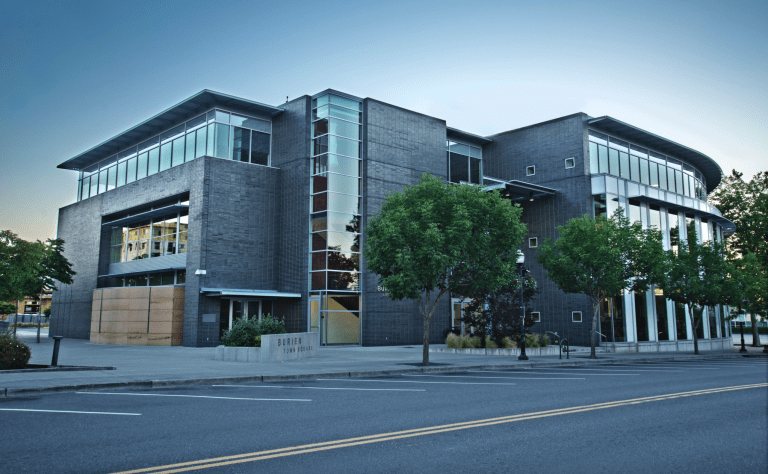
Image via City of Burien

By Erica C. Barnett

Last week, after failing to come up with an alternative location for a longstanding encampment on the west side of the building that houses both Burien City Hall and the local branch of the King County Library, the city of Burien formally evicted the 30 or so people who had been living there for months.

But they didn’t go far. As Scott Schaefer at the B-Town blog reported, most of the people forced out of the encampment moved to a city-owned site just one block west of City Hall, infuriating some residents and prompting demands for harsh anti-camping policies as well as sanctions against Burien Planning Commission Chair Charles Schaefer, who said he directed encampment residents to the new site.

This was the setting for Monday night’s Burien City Council meeting, where council members proposed several potential approaches to addressing encampments, including a total encampment ban in certain, unspecified “zones”; strict enforcement of drug laws; reinstating Burien’s overturned trespassing ordinance; and reallocating city funds to stand up a temporary encampment by the King County Courthouse a few blocks away. Burien already bans encampments in parks, but nowhere else, which is why the encampment next to City Hall was able to linger for so long.

During the meeting, Council member Jimmy Matta pushed back on an encampment ban proposed by Councilmember Stephanie Mora, noting that the Ninth Circuit US District Court, ruling in the Martin v. Boise case, barred cities from sweeping encampments unless shelter beds are available—and Burien has no year-round adult shelters or sanctioned encampments.

“I see the same things as you see,” Matta said. “I don’t like my children to see [those things]. I don’t like to see people using drugs. But at the same time, I know we don’t have the resources for [shelter], and on top of that, the Ninth Circuit court says that we have to have placements for them.” Cities like Seattle get around the requirement by sweeping encampments when shelter beds become available, Matta continued, but a similar approach in Burien would require the city to come up with funding and a location for a shelter—which, in turn, would likely face opposition from the same people who just want Burien’s homeless population gone. [Editor’s note: An earlier version of this story erroneously attributed this quote and the sentiments expressed in the preceding paragraph to City Manager Adolfo Bailon; we regret the error.]

This contingent was out in force at Monday’s council meeting, where public commenters who supported shelter, housing, and supportive services for encampment residents were greatly outnumbered by those demanding that the council eliminate the “campers” by any legal means. For an observer from Seattle, the tone of many comments were reminiscent of the debate about homeless encampments before and especially during the pandemic, when people frequently used dehumanizing terms and the language of eradication to talk about homeless Seattle residents.

“I wasn’t surprised by how people felt because of how things went down with the encampment being essentially relocated, rather than cleared. It’s also true that the people who were there were going to go somewhere… without a real solution that can pull people indoors instead of having them on the street.”—Burien LEAD program manager Aaron Burkhalter

One commenter, for example, referred to homeless people living in Burien as “this unpleasantness” and expressed his “shame, embarrassment, and utter disgust” that encampment residents were allowed to move one block, where they are now “in my front yard.” Another told council members they should “take [encampment residents] home with you” instead of allowing them to sleep on public property. An eighth-grade student at a local private school said she was “tired of seeing men’s privates everywhere I go,” adding that she was no longer able to run or walk in Burien because “the unhoused people have found a loophole in your system.” Several commenters referred conspiratorially to a “coordinated” effort to increase the number of homeless people in the city.

“I wasn’t surprised by how people felt because of how things went down with the encampment being essentially relocated, rather than cleared,” said Aaron Burkhalter, the LEAD project manager for Burien, who also spoke at Monday’s meeting. “It’s also true that the people who were there were going to go somewhere… without a real solution that can pull people indoors instead of having them on the street.”

At the end of the meeting, which , the council put off proposals to bring back the trespassing law and expand the city’s camping ban. During a special meeting next week, the council will hear more about a proposal to use the county-owned parking lot as a short-term managed encampment; receive information on how the State v. Blake decision, which overturned the state’s main drug possession law, impacts the city’s authority to crack down on drug use; and get an overview of camping bans in other cities, including Marysville and Lakewood.

The council will also consider sanctions against Planning Commissioner Schaefer for informing people they had the right to set up tents on city-owned property a block from City Hall; during the meeting, some commenters suggested he should be forced from his position for providing this information.

Burkhalter said he expects the city will remove the relocated encampment soon, scattering the people living there to “a number of different sites around the city.” While some, including City Manager Bailon, have expressed the hopeful thought that many of the encampment residents are from other cities and will move out of town, Burkhalter considers that wishful thinking.

Still, he said, he’s optimistic that the city will come up with a longer-term solution, such as temporary housing in a nearby hotel or in an existing residential building in Burien. “All the pieces are in place to get people into those spaces, and after that, it’s just a matter of how do we prioritize who gets placed in such a way that we are addressing criminal behavior and the public camping that people are so concerned about, in a way that people can get significant services,” Burkhalter said.

Despite Community Consensus, a Longtime Burien Encampment Scatters Because There’s Nowhere to Go

Members of the Burien City Council listen to testimony about an encampment just outside City Hall at a meeting in March.

By Erica C. Barnett

On Friday, the last few people who have been living in tents outside Burien’s city hall and downtown library building will pick up stakes and leave. Earlier this month, more than a year after the first tent appeared on the sidewalk on the west side of the building, the city plans to evict the encampment and its residents, who currently have nowhere to go except elsewhere in the city.

In a joint letter sent earlier this month, a group of local leaders including Burien City Manager Adolfo Bailon, Police Chief Ted Boe, Burien Toyota owner Dean Anderson, and the project manager for the LEAD outreach program in Burien, Aaron Burkthaler, asked King County to “access 30 units of the Health Through Housing program to provide a service that can have an immediate positive impact and save lives.” Health Through Housing is a county program that purchases multi-unit buildings, primarily hotels, to shelter and house people living throughout King County; it’s funded by a sales tax the King County Council passed in 2020.

Advocates for people living unsheltered say it’s the first time they can recall people with such different perspectives coming together to work toward a common goal. “I’ve never been in a situation like this before, where we as social workers are aligned so strongly with law enforcement and the city administration,” said Devin Majkut, the program manager for LEAD. “We’re all asking for the same thing, and getting nothing.”

The cluster of about 15 tents has been the subject of intense debate, and growing consternation, over the past few months.

Robin Desimone, who owns the Iris & Peony floral shop across the street from City Hall, says she’s “fed up” with the encampment, where she says she has seen “brazen activities going on,” including fires and drug use, “with no accountability for their actions.” Nonetheless, she said, she wants to see a solution that works for the people at the encampment, because removing the tents will just force people to move elsewhere in the city, including places like the alley behind her business.

“If I wanted to be in the middle of this, I would move my business to downtown Seattle,” Desimone said. “This is a small town and a small street. But behind the scenes, we’ve been trying to find solutions.”

Advocates and case managers say they’re encouraged by the city’s willingness to partner with them to advocate for funding and assistance from the county—and frustrated, along with them, by the county’s unwillingness to put some money and other resources toward the immediate problem posed by the encampment.

In significant ways, Burien has taken a more nuanced approach to its relatively small homeless population than its overwhelmed neighbor to the north. Four years ago, the city council passed a ban on “camping” in public parks, but did not prohibit people from sleeping in other public spaces, a tacit acknowledgement that people have to sleep somewhere. A court ruling called Martin v. Boise prohibits officials from sweeping encampments without offering people another place to go, and while cities like Seattle often elide that rule by providing shelter “offers” that are unappealing or inappropriate, Burien literally doesn’t have enough shelter for everyone living on its streets; hence, the incomplete encampment ban.

The scene outside the building that houses both City Hall and Burien’s King County Library System branch is a tangible result of this compromise: The encampment—which began as a single tent occupied by a hard-to-house couple who had a good relationship with the library—sprouted on a small concrete pad on the west side of the building just a few feet feet from Town Hall Park, where camping is illegal.  Although some neighbors, blaming encampment residents for everything from catalytic converter thefts to broken windows, clamored for a sweep, the police and Burien’s human services department refused, citing the law that allows them to be there.

But when a tent caught on fire last month, sending one encampment resident to the hospital with severe burns, the organization that controls the building—a condo association run jointly by the county library and city government—decided to evict the people living there, prompting a month-long scurry to find them somewhere to go.

Currently, there are no year-round adult shelters in Burien, and the city has no hotels that could be converted into shelter. During a recent city council meeting, City Manager Adolfo Bailon floated the idea of a sanctioned encampment or tiny house village, but said an 80-bed village would set the city back a million dollars.

It’s “unfortunate,” Desimone said. “A properly managed facility would be great and would solve a lot of our problems.” But funding for such a facility would have to come from the county or the KCRHA. “Our city can’t do that huge a lift—we don’t have that big of that economic base, and to be honest, we’re not going to be bringing any new businesses in with the situation as it is now.”

Burien’s general fund is around $35 million, about 2 percent the size of of Seattle’s. The city’s homeless population is also significantly smaller—around 200, at most, according to Burien human services manager Colleen Brandt-Schluter. Majkut says the number may be even lower, more like 75 to 100.

Advocates and case managers say they’re encouraged by the city’s willingness to partner with them to advocate for funding and assistance from the county—and frustrated, along with them, by the county’s unwillingness to put some money and other resources toward the immediate problem posed by the encampment.

Burien City Councilmember Kevin Schilling, who grew up in the city, said unhoused people have always used the library as a place to get warm, read the newspaper, and use the restrooms. What’s new, he said, is the “immediate, recent visibility of [homelessness] around City Hall.”

“This could be a case study about where there are missing links [and] folks are falling through the cracks,” Schilling said. “They’re not being housed, they’re not getting the services they need, and now we’re in the situation where they’ll be moved, but they won’t be moved anywhere [in particular] because we don’t have anywhere for them to go.”

Brandt-Schluter said telling people to go somewhere else will only make it harder for their case managers to find them and provide help with court dates, case plans, IDs, and housing assessments—the prerequisites for unsheltered people to access housing. “‘If not here, then where?’ is really our mantra right now, and we’ll continue to have to move people in and out of doorways, out of parks, out of City Hall, out of wherever, as long as there isn’t permanent supportive housing and shelter with services that folks can go to.”

“‘If not here, then where?’ is really our mantra right now, and we’ll continue to have to move people in and out of doorways, out of parks, out of City Hall, out of wherever, as long as there isn’t permanent supportive housing and shelter with services that folks can go to.”—Burien human services manager Colleen Brandt-Schluter

Not everyone believes it’s Burien’s job to help everyone living at the encampment.

At the recent council meeting, Bailon said he had “heard” that most of the encampment residents “had never lived here before,” and that “they may just return to where they came from, to where they thought was a safe place before relocating from that location to here.”

But Brandt-Schluter, who has met with the encampment residents personally, said almost all of them either “come from Burien or they’ve been in Burien a long time and consider Burien in their home.”

Although some officials and business owners have suggested sending people living unsheltered in Burien to Seattle, where there are more services, “a lot of these folks don’t want to go to Seattle,” Brandt-Schluter said. “They don’t feel safe going into Seattle, they’re afraid to leave their case manager and the people they’ve established relationships with. And there’s this human side of things, too, of trying to match people [with shelter and services] where they can be successful.”

Representatives from the KCRHA and DCHS told PubliCola they weren’t able to come up with any immediate housing or shelter solutions for any of the people living in the encampment. “There’s just nothing that’s been made available for those folks,” Majkut said, adding that LEAD and its outreach partner REACH were able to refer a few especially vulnerable people to shelters in Seattle. “I appreciate that the city leadership in Burien is committed to providing resources for people living unsheltered there, but they need help to do so from the county and the RHA.”

In the absence of some last-minute intervention, the people who have lived outside City Hall over the past several months will most likely scatter throughout Burien and its nearby greenbelts—a temporary resolution that does nothing to address the larger problem of homelessness in Burien. In the longer term, advocates are looking for sites for a future sanctioned encampment or tiny house village, including a former elementary school on the border with White Center where Transform Burien, a nonprofit that runs a food and clothing bank, is now located.

Majkut said two things stand out about the people who’ve been living in the encampment: Many have a history of profound trauma, including domestic violence, and all are eager to move into shelter or housing, “which is really rare. So it’s been particularly hard for our team to have all these folks say ‘I’m ready, let’s do this,’ and we have nothing to offer them.”