Tag: RVs

Campaign Fizz: Anti-RV “Eco Blocks” Surround Candidate’s Brewery, Two Polls Test Pro-Harrell Messaging

“Ecology blocks,” commonly used to prevent unhoused people from parking RVs in industrial areas, around Fremont Brewing’s Ballard production facility.

1. Dozens of “ecology blocks” have popped up around the Ballard production facility for Fremont Brewing, the craft-beer company owned by City Council Position 9 candidate Sara Nelson, blocking vehicles from parking in designated public parking areas along NW 47th and 48th Streets and on 9th Avenue Northwest. Although city law forbids blocking the public right-of-way, industrial businesses throughout the city have chosen to defy the law, using the blocks to prevent RVs from parking near their facilities in industrial areas from Ballard to Georgetown.

Fremont Brewing, however, is the only large industrial business owned by a candidate for city council.

The production facility, which is located in Ballard’s burgeoning brewery district, is adjacent to a small encampment that, on a recent visit, included several vans and RVs. The blocks, which are spaced too closely for a car to park between them, surround the block-long building on three sides, with several of the blocks set up in on-street parking directly behind signs indicating parking rules in the area. Using ecology blocks to prevent people from parking in the street, as Nelson’s brewery appears to have done, is illegal, but the Seattle Department of Transportation has declined so far to enforce the law, noting that the blocks are heavy and hard to move.

Next to Fremont Brewing, ecology blocks in the public right-of-way extend right up to a stop sign.

Nelson’s campaign didn’t return an email seeking confirmation that Fremont Brewing had placed the blocks around the production facility, and Nelson didn’t respond to an email sent to her business email address. 

The proliferation of RVs and other large vehicles in industrial areas is a product not just of Seattle’s homelessness crisis, but of parking rules that prohibit them everywhere else in the city. During the pandemic, when the city decided not to enforce a law that requires vehicles to move every 72 hours, many RVs stayed put, sparking a backlash among business owners who have turned to everything from boulders to fake “no parking” signs to prevent RVs from parking near their businesses.

2. A new online poll testing messages on homelessness suggests that the supporters of the “Compassion Seattle” ballot measure will have another outlet for their money—an independent expenditure campaign supporting mayoral candidate Bruce Harrell and other “candidates in local elections.”

The poll focuses on homelessness and policing, and tests three possible campaign names: Recover Seattle, Restore Seattle, and Take Back Seattle.
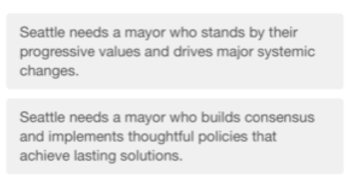
The questions ask voters to choose between statements that purport to represent the two mayoral candidates’ views, although the framing of all the questions is generally pro-Harrell. For example, a question on business describes two possible perspectives: “City leaders should make sure that local companies pay their fair share in taxes so that we have the resources we need to address Seattle’s challenges,” and “City leaders should partner with our local business community to encourage new businesses, keep taxes under control, and create more jobs with livable wages.”

Support PubliCola

PUBLICOLA NEEDS YOUR HELP.

If you’re reading this, we know you’re someone who appreciates deeply sourced breaking news, features, and analysis—along with guest columns from local opinion leaders, ongoing coverage of the kind of stories that get short shrift in mainstream media, and informed, incisive opinion writing about issues that matter.

We know there are a lot of publications competing for your dollars and attention, but PubliCola truly is different: We’re funded entirely by reader contributions—no ads, no paywalls, ever.

So if you get something out of this site, consider giving something back by kicking in a few dollars a month, or making a one-time contribution, to help us keep doing this work. If you prefer to Venmo or write a check, our Support page includes information about those options. Thank you for your ongoing readership and support.

Similarly, a question about homelessness contrasts “We have programs that will get the homeless off the street, but we don’t have enough revenue. The best way to solve homelessness is to properly fund existing programs by making sure corporations and the wealthy pay their fair share in taxes” with “We have the money to address homelessness in Seattle, but we need to make better decisions about what works and where new ideas are needed. An important first step is to make sure our parks and streets are safe for all people.”

Charter Amendment 29 would have required the city to fund thousands of new shelter beds without providing any additional funds while assuring that public spaces “remain open and clear of encampments.” Harrell has said he will implement every major provision of the amendment if elected.

3. A second poll that also circulated yesterday appears to be from the Harrell campaign itself. This poll tests out positive and negative messages about Harrell and asks respondents to say how convincing they find each statement. Continue reading “Campaign Fizz: Anti-RV “Eco Blocks” Surround Candidate’s Brewery, Two Polls Test Pro-Harrell Messaging”

“Eco Blocks” Are Concrete Signs of Seattle’s Failure to Address RV Homelessness

By Erica C. Barnett

Drive through Seattle’s industrial areas—Georgetown, South Park, parts of Ballard, and SoDo—and it’s hard to miss them: Bulky, horizontal concrete blocks lined up like giant Legos along the sides of the street, preventing large vehicles from parking by the roadside.

At Third and Brandon in Georgetown, around the corner from the headquarters of the LGBTQ+ health care organization Lifelong, a row of bright-white barricades prevent any vehicle longer than a passenger van from parking on the street. Along a quiet, wide stretch of road near West Marginal Way in South Park, graffiti is just starting to pop up on an older, graying line of blocks set a dozen feet apart across a chain-link fence from a modern apartment building.

The blocks, known as “ecology blocks” because they’re made of waste material that concrete producers would otherwise throw away, are there to prevent large vehicles—primarily RVs—from parking in front of businesses. They started proliferating in industrial areas, which are the only areas where Seattle allows RVs to park overnight, during the pandemic, when the city suspended rules requiring people to move their vehicles every 72 hours.

Equinox Studios owner Sam Farrazaino, who says the blocks have given his neighborhood the feel of a “war zone,” has installed a number of the blocks around land he owns in Georgetown, although he says he used his “eco blocks” to “define parking” for his business, painted them to make them more attractive, and did not put them in the public right-of-way. “It’s a complicated… debate,” said Farrazaino, who described a rat infestation on a lot surrounded with RVs that made the ground look like “a moving carpet.” On the other hand, he said, “We keep pushing people around and saying we solved the problem, but the end result of the people with the power and land being able to push out that people that don’t have power and don’t have land is terrible.”‘

Although most of the debate about unsheltered homelessness centers on people living in tents in so-called “unauthorized encampments” (in Seattle, there is no other kind), about a quarter of people living without shelter in the city live in RVs, which are only allowed to park overnight in industrial areas. The city dedicates few resources to helping this group, who are often seen as less vulnerable than tent residents and are unlikely to “accept” the city’s offers of shelter, because even so-called enhanced shelters, which are open during the day and allow people to bring their partners and pets, provide less privacy and autonomy than the most rundown RV.

Years of efforts by advocates and city council members to create “safe lots” for RV residents have been unsuccessful, thanks largely to neighborhood objections that have made it difficult to site lots for ordinary cars and trucks, much less RVs. And while the city council recently allocated $500,000 in American Rescue Plan Act (ARPA) funds could create safe parking spaces for between 20 and 30 RVs, that represents a tiny fraction of the need; according to the most recent count of homeless people in King County, nearly 1,000 people were living in RVs, and vehicular homelessness expert Graham Pruss, an academic researcher who has advised the city on the needs of people living in vehicles, says the true number is likely much higher.

“The reality is that the people who live in the vehicles and the people who own the businesses who are angry about the vehicles are all subject to the same problem: There is not a private place for the person who lives in that vehicle to park, and if they don’t have a place to park, they are forced to occupy that public street,” Pruss said.

Compounding the conflict, the city has used laws and informal policies, such as “No Parking 2-5 AM” signs, to push RVs deeper into nonresidential areas, usually far away from frequent transit lines, hygiene centers, and agencies that provide resources like job assistance and addiction treatment.

At the beginning of the pandemic, Mayor Jenny Durkan announced that the city would stop enforcing the 72-hour parking rule so that people could work from home; one year later, she announced she was reinstating the regulation, forcing people who had been living in one place for a year or more to get their vehicles in working order or risk losing them. 

Homeless service providers say the suspension of the rule had positive effects for vehicle residents, who didn’t have to deal with the daily stress of finding another place to park. “It was nice for them to have a reprieve where they didn’t have to move every 72 hours, where they could be in place and connect to service providers from one location and get more accomplished,” said Rebecca Gilley, the SoDo outreach coordinator for the homeless outreach group REACH. 

But it also led to increased conflicts with nearby business owners, who complained that people occupying space on the street were making it impossible for customers to park, committing crimes, and causing unhealthy and unsanitary conditions around their vehicles.

“There were folks who were here for a year and a half, blocking the whole sidewalk on both sides and blocking part of the travel lanes with all the stuff they had accumulated” around their RV, Farrazaino said. “If it was a house and the living conditions were the same as these, the county and the city would have shut it down and condemned the house.”

Placing ecology blocks or boulders in the public right-of-way without permission, as many businesses have done, is illegal under city law; theoretically, anyone who does so can be fined up to $4,000 for each individual violation.

The problem is, the blocks are cheap to put in place and expensive to remove. Farrazaino said he paid about $20 apiece for his ecology blocks, which he bought from Salmon Bay Sand and Gravel in Ballard. The biggest expense, he added, was moving them. “We drove back and forth to Salmon Bay with a big rental truck to get the ones we have here,” Farrazaino said. “It’s just a matter of moving them around with a forklift that can handle it.”

Removing the blocks would require the city to devote money, manpower, and storage space to addressing the problem, plus enforcement to ensure the blocks don’t come back. “Part of the challenge is that each ecology blocks weighs 1-2 tons, and more blocks continue appearing in new areas,” Seattle Department of Transportation spokesman Ethan Bergerson said. “Removing these massive obstructions is costly and our employees are busy completing important work to maintain our streets and infrastructure.”

Mariajose Barrera, who owns Mose Auto in Georgetown, said she installed ecology blocks near her business because of “the garbage, the nuisance, the crime that goes around some of the homeless encampments.” For example, she said, someone parked a large box truck outside her auto shop for several weeks and was using it to hold stolen goods; more recently, someone broke into her shop and stole thousands of dollars’ worth of tools.

“We’ve been working to be able to have parking for our own businesses and kind of deter people from long-term parking, because the garbage, the nuisances, the crime that goes around some of the homeless encampment—it’s really rough.” Barrera said. Seattle Public Utilities provides garbage pickup and sewage pump-out services to some RVs through its RV remediation and pump-out programs, but the utility can’t serve every site, so garbage, sewage, and gas and chemical spills remain persistent problems.

Support PubliCola

If you’re reading this, we know you’re someone who appreciates deeply sourced breaking news, features, and analysis—along with guest columns from local opinion leaders, ongoing coverage of the kind of stories that get short shrift in mainstream media, and informed, incisive opinion writing about issues that matter.

We know there are a lot of publications competing for your dollars and attention, but PubliCola truly is different: We’re funded entirely by reader contributions—no ads, no paywalls, ever.

So if you get something out of this site, consider giving something back by kicking in a few dollars a month, or making a one-time contribution, to help us keep doing this work. If you prefer to Venmo or write a check, our Support page includes information about those options. Thank you for your ongoing readership and support.

“Unfortunately, we’ve had set up these eco blocks because we’re not getting any other help from the city,” Barrera continued. “It’s unfair—we all work for our stuff and for these people to just come in take whatever they want, whenever they want, without any accountability is not okay.”

Part of his frustration, Farrazaino said, stems from the fact that the city has pushed people living in RVs into industrial areas, which make up just 12 percent of the city’s land. Gentrification in places like SoDo and industrial Ballard, where breweries and retail storefronts are overtaking traditional industrial businesses, has constrained options for vehicle residents even further; you’re less likely to get hassled or swept if you live next to a steel fabrication plant than in front of a popular bar. The result is more conflicts between RV residents and businesses in places like Georgetown and South Park, and the proliferation of barricades to keep them from coming back.

“SoDo is pushing everyone down here [to Georgetown] because they have a [business improvement area] and money to hire security,” Farrazaino said. A business advocacy group might give Georgetown or South Park more clout with the city; Erin Goodman, the director of the SoDo BIA, has pushed the city to crack down on RVs from the area for years, arguing that the presence of people living in vehicles has contributed to crime and filth in the area. Continue reading ““Eco Blocks” Are Concrete Signs of Seattle’s Failure to Address RV Homelessness”

Battle Over RVs in South Seattle Illustrates Need for Safe Spaces

L-R: The Gateway Park North site, the Georgetown Tiny House Village, and the future dog park site at the Georgetown Flume

by Erica C. Barnett

This is a story about a new park for people, a proposed park for dogs, and how confusion among at least four city departments has left more than a dozen people living in RVs and trailers in a state of limbo, living on disputed territory amid neighbors—including a permitted tiny house village—who want them gone.

It’s also, inevitably, a story about homelessness: A reminder, in a city where people without permanent places to live are routinely swept from place to place, that even the urgency of a global pandemic has not produced lasting solutions to a problem that is currently more visible than it has ever been. Because while the city’s policy of removing people from public spaces based largely on neighborhood complaints has subsided in the past year, that short-term reprieve hasn’t been coupled with enough new shelter or housing to get more than a few hundred of Seattle’s growing homeless population indoors on even a temporary basis.”

“We’ve been working very hard to try to transform that area into an off-leash dog park, and things can’t move forward on that when we have RVs on that plot of land.” Greg Ramirez, board chair, Georgetown Community Council

The story begins, as a lot of stories about homelessness seem to, in the Georgetown neighborhood, where the Seattle Parks Department is just starting construction on a new park facing the Duwamish River across from Boeing Field. The Gateway Park North project will improve and provide better access to a tiny piece of riverfront land that’s partly occupied by the out-of-commission Georgetown Pumping Station.

Since March, the city tacitly allowed people living in RVs, cars, and trailers to occupy the site, which is owned by the Seattle Parks Department. In early December, however, the department put  up signs announcing it was about to start work on the new park and warning RV residents that they needed to be gone by the following week. REACH, the nonprofit that had been doing outreach to the vehicle residents for the last eight months, worked quickly to figure out where the residents wanted to go and how to get them there; since many of the RVs had been sitting in place for longer than usual, 11 of them no longer ran.

“We talked about who needed to move and asked them, ‘Where do you guys want to go?’,” said Dawn Whitson, a REACH case manager who works in Georgetown. “They had already identified the site—the Georgetown Flume.”

Support PubliCola

If you’re reading this, we know you’re someone who appreciates deeply sourced breaking news, features, and analysis—along with guest columns from local opinion leaders, ongoing coverage of the kind of stories that get short shrift in mainstream media, and informed, incisive opinion writing about issues that matter. Earlier this month, we took a look back at just some of the work we’ve been able to do thanks to generous contributions from our readers, but those pieces represent just a handful of the hundreds of stories we’ve published this year.

We know there are a lot of publications competing for your dollars and attention, but PubliCola truly is different. We cover Seattle and King County on a budget that is funded entirely and exclusively by reader contributions—no ads, no paywalls, ever.

Being fully independent means that we cover the stories we consider most interesting and newsworthy, based on our own news judgment and feedback from readers about what matters to them, not what advertisers or corporate funders want us to write about. It also means that we need your support. So if you get something out of this site, consider giving something back by kicking in a few dollars a month, or making a one-time contribution, to help us keep doing this work. If you prefer to Venmo or write a check, our Support page includes information about those options. Thank you for your ongoing readership and support.

The Georgetown Flume—so named because it was the site of a flume that transported water from the Duwamish to the Georgetown Steam Plant, which closed in 1975—is another disused property a few blocks north of the pumping station site. Seattle City Light owns the land, but plans to give it to the Parks Department in exchange for a street vacation (the permanent closure of a public street) on property it owns in SoDo. Street vacations require some kind of public benefit; hence the trade to Parks. The plan is for the property to become a dog park for the surrounding neighborhood.

“We’ve been working very hard to try to transform that area into an off-leash dog park, and things can’t move forward on that when we have RVs on that plot of land,” Greg Ramirez, the board chair for the Georgetown Community Council, said. “We want to assist these individuals to find a better location, but this is not it. The flume is not that spot. Gateway Park North is not that spot.”

“If the city is going to pay for [RVs] to be towed to the impound yard, why won’t they pay for people to have places to go?”—Dawn Whitson, REACH

Georgetown is already the site of one longstanding tiny house village run by the Low Income Housing Institute, which the community council and other local groups initially opposed but which, according to Georgetown Tiny House Village Community Advisory Council chair Barbara Grace Hill, has since become “a big part of the neighborhood.” (According to LIHI director Sharon Lee, “we are on record supporting the dog park.”)

The issue, Georgetown residents say is that nobody at the city asked them what they thought of the idea. This, they say, is part of a pattern that has included not just the tiny house village but the proposed relocation of an overnight sobering center into a historic building in the neighborhood core—a proposal that would have put the sobering center far away from other city services. “It’s been a pattern with the city,” Hill said. After a neighborhood lawsuit helped sink the sobering center proposal, “it was like, again, ‘Would you please communicate with us? Would you please let us know what’s going on?'” Continue reading “Battle Over RVs in South Seattle Illustrates Need for Safe Spaces”

Planning Director Seeks Job In Boulder, More Details on Derelict RVs, and Throwing Cold Water on Bike Lane Praise

Image via City of Seattle

As the city council goes on its annual summer recess (and I return from a quick vacation), some notes on what’s been happening in the city over the past couple of weeks:

• Seattle Office of Planning and Development director Sam Assefa is a finalist for a job as head of the planning department in Boulder, CO, where he served as senior urban designer for six years. Assefa, a holdover from the Ed Murray administration whose standing in the Durkan administration has been in question for a while, has presided over the passage and implementation of the Housing Affordability and Livability Agenda (HALA), which included upzones in neighborhoods across Seattle, as well as the implementation of new rules designed to allow more density in single-family neighborhoods. Durkan has not made land use and zoning a top priority during her first two years in office, and many at the city have expressed surprise that Assefa has managed to stick around so long.

At the same time, the city is hiring a chief of staff for the department. (A similar position was recently created in the Human Services Department’s homelessness division, whose former director, Tiffany Washington, has moved to a position in the Department of Education and Early Learning.) The department is small—about 40 employees—prompting some to wonder whether this position is necessary, and to whom the new chief of staff will be accountable—the director, or the mayor.

Support The C Is for Crank
Sorry to interrupt your reading, but THIS IS IMPORTANT. The C Is for Crank is a one-person operation, supported entirely—and I mean entirely— by generous contributions from readers like you. If you enjoy the breaking news, commentary, and deep dives on issues that matter to you, please support this work by donating a few bucks a month to keep this reader-supported site going. I can’t do this work without support from readers like you. Your $5, $10, and $20 monthly donations allow me to do this work as my full-time job, so please become a sustaining supporter now. If you don’t wish to become a monthly contributor, you can always make a one-time donation via PayPal, Venmo (Erica-Barnett-7) or by mailing your contribution to P.O. Box 14328, Seattle, WA 98104. Thank you for keeping The C Is for Crank going and growing. I’m truly grateful for your support.

• Council members continued to question Mayor Jenny Durkan’s legislation aimed at curbing abuse by RV “landlords” who buy up “extensively damaged vehicles” and rent them out to people who would otherwise be unsheltered. The legislation would create new penalties, including fines and restitution requirements, for anyone who “allows” another person to live in an RV that meets two or more criteria, including cracked windows, visible trash, and leaks. The restitution—up to $2,000—would be paid directly by the RV owner, not the city. A companion administrative action by the mayor’s office authorizes the city to impound derelict RVs and destroy them along with their contents.

Durkan’s staffers didn’t appear in person at last Wednesday’s finance and neighborhoods committee hearing, but her office did provide a memo answering some of the questions the council posed earlier this month, including how common the problem of predatory RV rental really is.

Continue reading “Planning Director Seeks Job In Boulder, More Details on Derelict RVs, and Throwing Cold Water on Bike Lane Praise”

Council Overrides Mayor’s Soda Tax Veto, More Shakeups at the City, and Reframing the RV Crackdown

1. For those keeping track of the wave of departures from the mayor’s office and city departments, there’s a big one coming: Deputy Mayor David Moseley, who has been with Mayor Jenny Durkan’s office since the beginning of her administration (and who is married to Durkan’s longtime associate and frequent city consultant Anne Fennessy) is reportedly leaving at the end of the year. Moseley, the former head of Washington State Ferries, came out of retirement to take the job in 2017, so his departure isn’t a huge surprise, but it could engender a shift of power in the mayor’s office, depending on whether Durkan decides to appoint a new deputy (Moseley is one of three deputy mayors, along with Mike Fong and Shefali Ranganathan) or redistribute his responsibilities. Among other issue areas, Moseley oversees the mayor’s response to homelessness.

Durkan’s policy director, Edie Gilliss, recently left the mayor’s office for a job at the city’s Office of Sustainability and the Environment; her replacement, Adrienne Thompson, was previously Durkan’s labor policy advisor. Kiersten Grove, who advises the mayor on transportation, will leave Durkan’s office next month to become deputy director of the city’s Department of Finance and Administrative Services. And Michael Shiosaki—a Seattle Parks division director who’s perhaps better known as former mayor Ed Murray’s husband—reportedly lost his job at Parks last week, and will be transferring to a position at Seattle Public Utilities.

Support The C Is for Crank
Sorry to interrupt your reading, but THIS IS IMPORTANT. The C Is for Crank is a one-person operation, supported entirely—and I mean entirely— by generous contributions from readers like you. If you enjoy the breaking news, commentary, and deep dives on issues that matter to you, please support this work by donating a few bucks a month to keep this reader-supported site going. I can’t do this work without support from readers like you. Your $5, $10, and $20 monthly donations allow me to do this work as my full-time job, so please become a sustaining supporter now. If you don’t wish to become a monthly contributor, you can always make a one-time donation via PayPal, Venmo (Erica-Barnett-7) or by mailing your contribution to P.O. Box 14328, Seattle, WA 98104. Thank you for keeping The C Is for Crank going and growing. I’m truly grateful for your support.

Meanwhile, the homelessness division of the city’s Human Services Department—whose director, Tiffany Washington, is leaving for a position at the Department of Education and Early Learning next month—just got a new director: Diana Salazar, the former director of Imagine Los Angeles, an organization that helps homeless families in LA with case management and mentorship, started this morning. HSD director Jason Johnson’s announcement to staff on Friday reportedly coincided with the resignation of Ali Peters, the city’s planning and performance director for homelessness, who just came to the office in May. Jackie St. Louis, who headed up the Navigation Team and reportedly applied for the director position after Washington said she was stepping down, left last month.

The churn at the homelessness division comes as the city and county prepare to consolidate countywide homelessness operations into a single regional agency, with many city jobs moving over to that agency. According to city documents, the new regional authority will take over all programs having to do with homelessness prevention, outreach and engagement, diversion, day and hygiene centers, shelters and tiny house villages, rapid rehousing, transitional housing, data collection, and services associated with permanent supportive housing. The city would retain control of a handful of homelessness-related responsibilities, including the Navigation Team and building permanent supportive housing.


Image via Wikimedia Commons.

2. After a tense hearing last week over Mayor Durkan’s legislation that would allow the city to confiscate derelict vehicles and fine anyone who “allows” another person to live in one, city council members indicated this morning that the bill is unlikely to pass without significant amendments. Council member Mike O’Brien, who has proposed helping people living in RVs by creating “safe lots” for them to park en masse, said he would propose using surplus budget authority to create a $100,000 fund to assist people displaced from vehicles the city deems uninhabitable whether or not the council ultimately passes the underlying legislation.

“I asked the mayor’s folks last Friday, are there spaces available right now? Could we identify places for people to go that are 24/7 if we were to say you can’t live in this RV? I didn’t get a ‘yes’ answer.”—Council member Sally Bagshaw 

The mayor’s legislation, which would require RV “landlords” to pay restitution directly to their former tenants, does not guarantee payment and includes no funding to increase access to enhanced shelter or “tiny house village” encampments, which allow people to remain with their partners, pets, and possessions and are basically always at full capacity. Instead, the mayor’s staff said that vehicular residents displaced by the program would be shelter and services by the city’s Navigation Team, and acknowledged that just 10 to 15 percent of RV residents “accept” those services. Continue reading “Council Overrides Mayor’s Soda Tax Veto, More Shakeups at the City, and Reframing the RV Crackdown”

Tense Meeting Sets Up Fight Over Durkan’s “RV Ranching” Legislation

Mayor Jenny Durkan’s proposal to allow the city to fine and prosecute anyone who “allows” another person to live in an “extensively damaged” vehicle met with a cool reception in city council chambers this morning, particularly after the mayor’s director of Finance and Administrative Services, Calvin Goings, likened homeless people living in RVs to “dogs” living in inhumane conditions. (FAS oversees the city’s towing program).

Goings’ comment came after a testy exchange with council member Teresa Mosqueda, who took issue with Goings’ statement that “the foundational question” for the council was, “does the council agree this is a problem?” Goings said. If they agreed that it was a problem for people to be living in “squalor conditions,” Goings said, they had a “moral obligation” to support some version of the mayor’s legislation.

“If there were animals living like this, then we would seize those animals. Please tell me that Seattle is not a place where we would not allow a dog to live where we would allow human beings to live.”–Seattle Department of Finance and Administrative Services director Calvin Goings

“It’s very clear to me that the full council shares the concerns,” Mosqueda responded, noting that they have continued to push for more funding for shelter and services and have repeatedly increased the size of the mayor’s Navigation Team. But, she added, “when we’re looking at specific legislation, we have to look at the language here. Words matter. The words in the legislation matter.”

Goings responded: “If there were animals living like this, then we would seize those animals. Please tell me that Seattle is not a place where we would not allow a dog to live where we would allow human beings to live.”

Mosqueda was leaving the meeting during Goings’ comments, but council member Mike O’Brien piled on, noting that the mayor’s legislation neither defines “RV ranchers” (people who buy derelict RVs and lease them out) nor says how common the problem is. Although Goings and other mayoral officials at the table reiterated that the bill was meant to target “the predatory rentals of unsafe vehicles,” the legislation as written would allow the city to go after people who live in RVs with family members as well as people living in cars or RVs that meet just two of a long list of deficiencies that includes things like cracked windshields and leaking fluids.

“Do you know what we do for animals that need a home? We shelter them. We give them food. We give them a bath. This legislation does none of those things for these individuals.”—City Council member Teresa Mosqueda

“Are are we talking five? Are we talking 300?” O’Brien asked. (The city estimates that between two and five individuals are renting out RVs to other people, but has no exact number or estimate of how many RVs those two to five people own).  “I would expect someone to get that information.” O’Brien also noted that some of the photos Goings and staffers from the city’s RV remediation program and the mayor’s office showed in council chambers looked like examples of hoarding, which is also fairly common among people with homes.

Council member Sally Bagshaw asked why the legislation didn’t include any additional funding for enhanced shelter or tiny house villages, which would allow people living in tents or RVs to keep at least some of their possessions and wouldn’t require people to separate from their partners or pets. Tess Colby, the mayor’s homelessness advisor, described the Navigation Team’s outreach on “the day of the clean” (which, as I’ve reported, no longer routinely includes nonprofit outreach workers) and said that only 10 to 15 percent of people living in RVs tend to “accept services” when they’re offered.

Support The C Is for Crank
Sorry to interrupt your reading, but THIS IS IMPORTANT. The C Is for Crank is a one-person operation, supported entirely—and I mean entirely— by generous contributions from readers like you. If you enjoy the breaking news, commentary, and deep dives on issues that matter to you, please support this work by donating a few bucks a month to keep this reader-supported site going. I can’t do this work without support from readers like you. Your $5, $10, and $20 monthly subscriptions allow me to do this work as my full-time job, so please become a sustaining supporter now. If you don’t wish to become a monthly contributor, you can always make a one-time donation via PayPal, Venmo (Erica-Barnett-7) or by mailing your contribution to P.O. Box 14328, Seattle, WA 98104. Thank you for keeping The C Is for Crank going and growing. I’m truly grateful for your support.

The penalty for “RV ranchers” who rent substandard RVs will be up to $2,000—payable directly to their former “tenant” in the form of restitution—plus a $250-a-day fine and potential criminal charges. Bagshaw asked whether it’s realistic to believe people who own derelict RVs have that kind of money. “We believe that they do, and we also think that this is an important message to send to ranchers and  a disincentive to continue to do this,” Colby said.

After the meeting, Mosqueda said she found Goings’ comments comparing people living in RVs to “animals” living in abusive conditions “shocking” and off point. “Do you know what we do for animals that need a home?” Mosqueda said. “We shelter them. We give them food. We give them a bath. This legislation does none of those things for these individuals.”

“We’re actually supportive of is getting people into safe living situations, and nothing in that legislation was actually targeted toward helping individuals.”

The city council’s central staff wrote a memo outlining what the legislation would do, along with a number of questions for the council to consider, that is very much worth a read.