Tag: encampment removals

Shelter Enrollments from City Referrals, Already Under 50%, Dropped In First Months of 2022

Chart showing HOPE team shelter enrollment rates over timeBy Erica C. Barnett

A review of six months of data from the HOPE Team—the team of Seattle Human Services Department staffers who do outreach and offer shelter to people living at encampments the city is about to remove—shows that only around 36.5 percent of people who received shelter referrals from the HOPE Team actually showed up to that shelter and stayed there overnight. This number represents a 23 percent reduction in referrals from the 47.7 percent enrollment figure HSD reported in March.

The enrollment rate for the first two months of 2022—in winter, a time when people are typically most likely to move indoors—was even lower, just 33 percent. That means that out of every 100 people the HOPE team referred to shelter, fewer than a third actually showed up and stayed the night.

HSD provided its data in response to a records request from PubliCola.

A spokesman for the Human Services Department said the numbers they provided are lower than the true enrollment rate, because about a quarter of people who use homeless services have opted out of he the county’s Homeless Management Information System, which means that their identities are anonymous and can’t be tracked. For example, one shelter whose residents came exclusively from HSD referrals, Rosie’s tiny house village in the University District, had an official enrollment rate of just 52 percent, even though all 36 units were full.

However, the numbers HSD provided, which represent data from September 2021 through February 2022, are directly comparable to the 48 percent figure HSD itself reported for 2021. Both PubliCola’s numbers and HSD’s earlier report represent a straightforward comparison of referrals to confirmed enrollments, without factoring in people who have opted out of the county’s tracking system. For this reason, the more recent numbers—both the 36.5 percent enrollment rate for the last four months of 2021 and the 33 percent enrollment rate for early 2022—represent an apples to apples comparison to HSD’s own published figures.

The HOPE Team has exclusive access to about 800 shelter beds, or about a third of all shelter beds in the city; those beds can only be filled by the HOPE Team, which leads to a shortage of beds for other providers trying to find beds for clients who are actively seeking shelter, as opposed to those who happen to be in the path of an upcoming sweep. Between September 2021 and March 2022, the HOPE Team made 533 referrals to 20 shelters, including the now-closed Executive Pacific Hotel. Of those 533 referrals, just 195 resulted in someone staying at a shelter overnight.

Within the numbers, patterns emerge. In general, tiny house villages—private mini-shelters that are among the most desirable forms of shelter currently available in King County—had a much higher enrollment rate than congregate shelters: Three of the four highest-performing shelters on the HOPE Team’s list were tiny house villages. (I’ve excluded the unspecified category “enhanced shelter,” which accounts for 32 referrals and 10 enrollments, and any shelter that had fewer than 10 referrals over six months from this list.)

However, all three tiny house villages that had higher-than-average enrollments had one thing in common: They all opened during the six-month period the data encompasses. Friendship Heights, a tiny house village on Aurora that had the highest enrollment rate at 59 percent, opened last December; Rosie’s Village in the University District, with a 42 percent enrollment rate, opened last November; and the Interbay Tiny House Village, with a 47 percent enrollment rate, expanded to add 30 new units in November.

Similarly, the Benu Community Home—a men’s shelter with dorm-style rooms in the Central District—opened in November and had an enrollment rate of 50 percent.

As we reported in March, shelter referrals and enrollments went up in 2021 because hundreds of new permanent housing and shelter beds came online all at once, adding new supply to the shelter system that was immediately filled by people being removed from high-priority encampments. A separate report from City Council’s central staff revealed that nonprofit service providers requested shelter for their clients four times more often than the city provided a referral, meaning that the vast majority of people seeking shelter were unable to find it.

At the other end of the spectrum, the shelters with very low enrollment rates had a few things in common: Three of the four are basic shelters or “enhanced” shelters that offer services but little privacy. The other is Lakefront Community House—an enhanced shelter with single and double rooms in a former drug treatment center run by the Low-Income Housing Institute in North Seattle. Continue reading “Shelter Enrollments from City Referrals, Already Under 50%, Dropped In First Months of 2022”
City Asks Homelessness Authority to Require Nonprofits to Participate in Sweeps

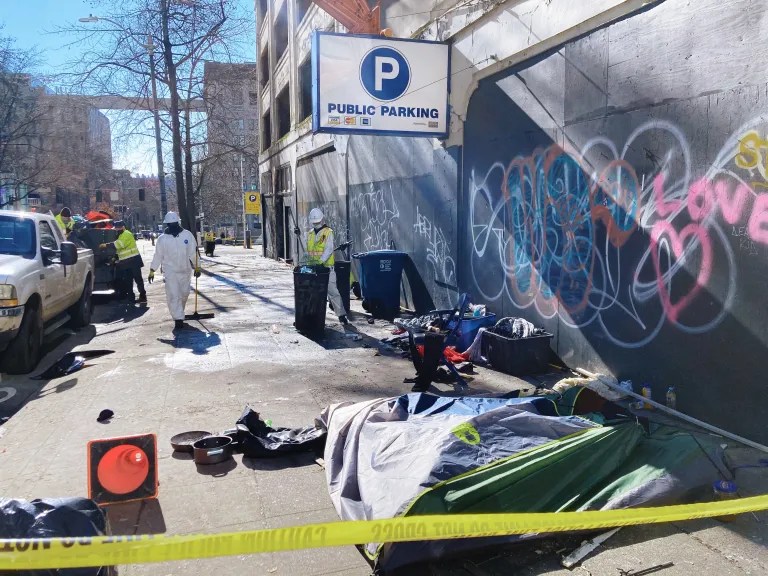
Tents and other items on the ground during a recent encampment sweep at City Hall
The city put up signs announcing this encampment across from city hall would be removed at 6am, giving residents less than two hours’ notice.

By Erica C. Barnett

The city’s Human Services Department has asked the King County Regional Homelessness Authority to modify its contracts with  outreach providers (including the city’s largest outreach provider, REACH) to require them to show up and offer services to unsheltered people up to the day their encampments are swept.

REACH does not have a strict policy against showing up before encampment sweeps; instead, they make decisions on a case by case basis, REACH director Chloe Gale said. In 2019, the group decided to withdraw from the Navigation Team, a group of police and city outreach workers that used to be in charge of encampment removals, because of concerns about their ability to build trust with clients while appearing to participate in sweeps.

UPDATE: On Friday, a spokeswoman for the KCHRA told PubliCola the authority “confirmed with the City that we are not making any contract modifications.”

In a message to council members, the department said that its HOPE Team—a group of city staffers that connects people whose encampments are about to be swept to beds in shelters to which the HOPE Team has exclusive access—is “often the only entity on site that’s willing to make shelter offers and connections during the posting period (i.e., the time between a site being posted and the time of the removal).”

A spokesman for Mayor Bruce Harrell said the mayor “support[s] providers offering outreach and service connections to encampments before the day of removal.”

UPDATE: On Friday, Deputy Mayor Tiffany Washington and KCRHA CEO Marc Dones said in an email to homeless service providers that “despite what you might have seen in [PubliCola’s] recent article” (the one you are currently reading), “KCRHA has not received any requests from the City of Seattle that would change our shared approach to outreach responsibilities.” The Human Services Department confirmed its request for contract changes, provided the request to PubliCola in full, and explained the intent of the request in more detail in an email, and PubliCola stands by our reporting.

REACH and other outreach providers’ “choice to withhold support is believed to be counterproductive to supporting those experiencing unsheltered homelessness,” HSD wrote. “We have asked KCRHA to modify their contracts in a way that uses the City’s funding to support our target population throughout the entire process rather than just a portion of it.”

In recent years, the city has largely abandoned the previous practice of providing 72 hours’ notice before it removes an encampment, a timeline that gave encampment residents time to move into shelter or relocate their tents. Instead, the city designates encampments as “obstructions,” a broad term that can be applied to any tent in any public space, and removes them with little or no advance notice.

This is not the first time the city has attempted to include a requirement to participate in sweeps in its contracts with outreach providers; former mayor Jenny Durkan made a similar attempt last year, but ultimately backed down after some nonprofits said they would refuse to sign contracts that included this stipulation.

Outreach providers’ “choice to withhold support is believed to be counterproductive to supporting those experiencing unsheltered homelessness,” HSD wrote. “While the funding for these contracts continues to come from the City of Seattle, the oversight of contracts, and the ability to modify those contracts, now live with KCRHA. We have asked KCRHA to modify their contracts in a way that uses the City’s funding to support our target population throughout the entire process rather than just a portion of it.”

Responding to questions about the city’s request during the council’s homelessness committee meeting Wednesday, KCRHA director Marc Dones said the authority had not “entered into any conversations at this point around modifying contracts with providers. What we are discussing at this point is working to support humane responses to folks that are at our prioritized encampments”—that is, encampments the city prioritizes for removal.

HSD spokeswoman Stasha Espinoza said HSD “has yet to request RHA’s assistance with making outreach available on the day of a removal, and that in for now, “HSD has asked their System Navigators”—the HOPE Team’s outreach workers—”to make offers of shelter prior to and during a removal. This includes transportation to a shelter if such services are requested.” Continue reading “City Asks Homelessness Authority to Require Nonprofits to Participate in Sweeps”

Council Questions Landmark Protections for Walgreen’s, Woodland Park Encampment Efforts In “Final Phase”

1. On Tuesday, the city council will impose new restrictions on construction or alterations at two historic landmarks: The Center for Wooden Boats in South Lake Union, and an early-20th-century houseboat known as the Wagner Floating Home.

One building that won’t be getting new protections—at least, not yet—is a one-story former bank building near downtown that, for more than a decade, has housed a drive-through Walgreen’s store. Fifteen years ago, the Seattle landmarks board granted landmark status to the building, which has a handsome facade on one side but is otherwise unremarkable. In its “statement of significance,” the landmarks board seemed to struggle to explain why, exactly, the building on Denny Way—one of multiple copies around Seattle of a building designed by a different architect—merited extraordinary protection. Among other points largely unrelated to the 1950 building itself, the board cited the defunct bank’s connection to the city’s logging history and the Denny Regrade, the history of drive-through banking in the US, and the “unprecedented freedom” of mid-century Modernist style.

It doesn’t take much for a building to win landmark status in Seattle; a building is only required to be at least 25 years old and meet one of a list of criteria that includes being “associated in a significant way with a significant aspect of the cultural, political, or economic heritage of the community, city, state or nation” or being characteristic of an area.

Landmarks status usually leads to limits on the demolition of, or changes to, buildings; the Walgreen’s building is unusual in that 15 years have passed since it first received landmark status. During a meeting of the council’s neighborhoods committee two weeks ago, an attorney with McCullough Hill, representing Walgreen’s, explained that protections would result in profits for the company, which could sell off the development rights for the site. This “transfer of development rights” would allow another developer add density elsewhere while preserving a one-story, car-oriented building in the middle of one of the city’s densest neighborhoods.

Committee chair Tammy Morales decided to delay imposing controls on the building, saying she was “just trying to understand what the benefit for the city is” of protecting the one-story Walgreen’s. We asked a similar question on Twitter. In our highly nonscientific poll, 89 percent opposed protecting the former bank. The committee will take up the landmarks question again at its next meeting on May 14.

2. Woodland Park, which Mayor Bruce Harrell used as the backdrop for his campaign vow to remove troublesome encampments, is still the site of a large encampment, several months after Harrell initially told neighboring residents it would be removed. The delay has allowed the city to use the same deliberate approach that was largely successful in relocating most of the people living at the Ballard Commons, which the city closed and fenced off last December. City Councilmember Dan Strauss and advocates for unsheltered people have been championing this approach, even as sweeps have ramped up dramatically since Harrell took office.

According to outreach workers and advocates who have been working with encampment residents over the past several months, the city has worked effectively to find shelter or temporary housing for several dozen people living at the encampment. As they did at the Commons, outreach workers with the nonprofit REACH and the Human Services Department’s HOPE Team created a list of 61 people living at the encampment in February and began working to move people on that list off site. At the same time, the city’s Parks Department set up portable toilets and started removing trash—two key factors that reduce the amount of visible garbage and human waste, which result when people don’t have places to throw stuff away and relieve themselves.

Data show that between September and March, just 196 of 534 people who received shelter referrals from the HOPE Team actually showed up at shelter within 48 hours and stayed for at least one night—an enrollment rate of less than 37 percent.

The result, according to Mayor Bruce Harrell’s office, has been “at least 30 referrals to shelter or housing,” including three housing referrals and 26 referrals to enhanced shelter or tiny house villages, in addition to 10 people who have “voluntarily relocated from the park” and are presumably living unsheltered elsewhere.

A spokesman for HSD said outreach “efforts will continue over the coming weeks in an attempt to resolve this encampment through outreach strategies alone.” However, advocates working at the encampment note that unsheltered people have continued to move to the area since February, when the city created its list; as a result, the encampment is scarcely smaller than it was when the city’s outreach efforts began. (The HSD spokesman notes that the city has referred at least five of the new people to shelters).

“We’re seeing people get into at least transitional shelter or tiny houses,” a neighbor who has been doing volunteer outreach at the encampment told PublICola. “We wish there were more staff to do [outreach and placements] and, really, more resources behind it.” Continue reading “Council Questions Landmark Protections for Walgreen’s, Woodland Park Encampment Efforts In “Final Phase””

Democrats Try to Counter Their Meek Housing Policy Achievements with Major Investments in Homelessness Programs

Low-Income Housing Institute tiny house village
Tiny houses, like this one in a village operated by the Low-Income Housing Institute, are a form of non-congregate shelter—the type of shelter Governor Jay Inslee says he wants to prioritize statewide.

by Leo Brine

As a counter to their meek policy achievements in Olympia this year, Democrats loaded their capital and operating budgets with historic investments in housing and homelessness response—$829 million, nearly half of which will go to local governments and nonprofits to develop new shelter and permanent housing. Governor Jay Inslee estimates the state will add 3,890 new housing units or shelter beds with $413 million in funding from the Housing Trust Fund and appropriations for rapid capital acquisitions.

The rest of the money ($416 million) will go to things like rent, mortgage, and utility debt assistance. An Inslee-backed bill to create a new office inside the Department of Social and Health Services to address homeless encampments in state-owned rights-of-way, like freeway underpasses, failed, but the budget includes $52 million that will go to local governments for the same purpose, including $7 million to help prevent future encampments in places where encampments have been removed.

Democrats killed several pieces of their own progressive housing legislation that would have created incentives for denser housing development after those bills were watered down by amendments from Republicans and other Democrats. In the house, they  killed Rep. Jessica Bateman’s (D-22, Olympia) denser housing bill (HB 1782) at the first legislative cutoff of the session. At the next cutoff, senate Democrats killed Rep. Sharon Shewmake’s (D-42, Bellingham) accessory dwelling unit legalization bill (HB 1660).

And on the final night of the session, the clock ran out on the year’s last hope for housing policy reform—a bill sponsored by Rep. Davina Duerr (D-1, Bothell) bill (HB 1099) that would have required cities to adjust their growth plans to reduce greenhouse gas emissions and vehicle miles traveled. The bill, which would have updated the state’s Growth Management Act to respond urgently to climate change, was a top priority for the environmental advocacy group Futurewise.

Inslee’s senior adviser for housing, Jim Baumgart, said Inslee wants to move away from “mats on a floor,” and “cots in a big open room” shelter model and toward a system where people get their own space. “If we can, the goal is always to get people into permanent housing. The way to end homelessness is to get people into permanent housing,” Baumgart said.

“It’s really hard to know what projects will come in and what those proposals will be for. Thomas said. “Our hope is the vast majority of the funds are for permanent housing solutions.”

Unfortunately, it’s not clear how much permanent housing the state will add with the Democrats’ investments. According to Baumgart,  “housing units” refers to “all non-congregate housing options,” from shelters  and transitional housing to permanent housing, supportive and otherwise.

Baumgart said it’s “really hard to estimate” that figure because of the rising cost of building materials and they don’t know which projects local governments and nonprofits will submit for grant funding.

Michele Thomas, from the Washington Low-Income Housing Alliance, is also trying to figure out how much permanent housing the budget creates, but says she won’t know for a while. She said the grants in the budget can go to a variety of projects that deal with homelessness, not just permanent housing. Continue reading “Democrats Try to Counter Their Meek Housing Policy Achievements with Major Investments in Homelessness Programs”

Most City Shelter “Referrals” Don’t Lead to Shelter, Police Preemptively Barricade Encampment Against Protests, City Says It Can’t Risk Handing HOPE Team to County

Chart showing trends in outreach and service connections by Navigation Team and HOPE Team
Source: Seattle City Council central staff report

1. Fewer than half the people referred to shelter by the city’s HOPE team last year actually showed up to shelter and stayed there for at least one night, according to data released by the city’s Human Services Department during a meeting of the city council’s homelessness committee this week.

The city’s HOPE Team, which provides shelter referrals to people living in encampments the city is about to remove, referred 1,072 people to shelter in 2021; of those, 512 enrolled in shelter, meaning that they showed up and slept in a shelter for at least one night within 48 hours of receiving a referral. The HOPE Team has exclusive access to about 800 beds, or a third of the shelter beds in the city.

HSD deputy director Michael Bailey told council members the department is prioritizing people in the highest-priority locations (like downtown Seattle and Woodland Park) for shelter first, along with “individuals with multiple vulnerabilities from all over.”

“As you know, we can’t overrule someone’s decision to decline shelter, but we can work with the individual to better understand their unique needs and the factors contributing to that decision,” Bailey said.

Although the number of referrals went up in 2021, that was largely because hundreds of new permanent housing and shelter beds came online all at once, adding new supply to the shelter system that was immediately filled by people being removed from high-priority encampments. As a separate report from the council’s central staff notes, nonprofit service providers requested shelter for their clients four times more often than the city provided a referral, meaning that the vast majority of people seeking shelter were unable to find it.

2. One of the persistent oddities of the city’s homelessness system is that the HOPE Team has remained at the City of Seattle, serving as a kind of vestigial arm of the disbanded Homelessness Strategy and Investments division, even as every other aspect of the homelessness system has transferred to the new King County Regional Homelessness Authority.

At Thursday’s meeting, Bailey introduced a somewhat novel explanation for the city’s decision to retain the HOPE Team: Without control over shelter referrals, Seattle risked violating rules that govern how and when the city can remove encampments. “The city is unable to shift this liability” to the RHA by making the authority responsible for outreach in advance of city-led encampment removals, the, Bailey said.

The Multi-Department Administrative Rules, or MDARs, require the city to provide 72 hours’ notice and offers of available shelter before removing an encampment, unless that encampment is an “obstruction” in the public right-of-way or poses an immediate danger to the public. For several years, the city has defined “obstruction” very broadly, allowing it to routinely skirt the 72 hour and shelter referral requirements whenever an encampment is in a public park, on a sidewalk, or on any other public property.

Following up by email in response to PubliCola’s questions, Bailey said the HOPE Team “remains a City entity because it allows the City to meet its obligation to comply with the encampment removal rules. … Specifically, the City must identify or provide alternative shelter before removing non-obstructing encampments. The City is unable to shift this obligation to the RHA, despite the contracts moving to RHA, and is thus responsible for ensuring that it has the resources necessary (i.e., the HOPE Team) to do this body of work in the event RHA or its service providers decline to assist.”

Routinely displacing people from downtown without notice may be fundamentally incompatible with intensive case management, which requires not just stability but the ability to locate clients when a resource, such as a treatment bed or tiny house, becomes available.

3. According to Mayor Bruce Harrell’s office, the HOPE Team did offer shelter referrals to 14 people (of 18 who were on site) when it removed an encampment under I-5 in the Chinatown/International District on Thursday, although it’s unclear how many of those people actually ended up in shelter. (A spokesman for the mayor’s office said the encampment was an obstruction.)

Although the sweep was typical in certain ways—the city routinely removes people from this location, a perennial encampment site that offers some protection from wind and rain —it was noteworthy in one respect: The presence of a phalanx of bike officers, who blocked off the encampment with police tape and issued verbal warnings that any protesters who tried to enter the area could be arrested.

Bike officers line the sidewalk outside an encampment removal at 9th and Jackson.

Prior to COVID, the city routinely stationed police outside encampments—a practice that tended to heighten tensions rather than alleviate them. Mayor Bruce Harrell appears to be reviving the practice; according to a spokesman for Harrell’s office, the city decided that “[g]iven potential protest activities, a larger SPD presence was required to ensure the safety of City workers and encampment residents” at yesterday’s removal. Stop the Sweeps Seattle posted photos of the city’s encampment removal notices on social media, but did not turn up in large numbers on Thursday.

The mayor’s office may have felt burned by a protest that temporarily halted the removal of a large encampment across the street from city hall. After a weekslong standoff with protesters, the city swept the encampment abruptly last week, barricading several blocks of downtown Seattle in an early-morning action that sparked numerous verbal confrontations between police officers and mutual aid workers who tried to enter the area.

According to Harrell’s spokesman, “The number of officers and their equipment is dependent on the circumstances of the removal and potential protest activities. Encampment removal teams have always worked in partnership with SPD, and SPD officers will continue to be onsite during removal activities.”

The city’s aggressive approach to encampments in public spaces downtown (which, technically, are almost all “obstructions” in that they occupy public space) could come into conflict with the regional homelessness authority’s recently launched “Partnership For Zero,” a plan to eliminate almost all encampments downtown through intensive case management, led by “peer navigators” who have been homeless themselves.

Sweeps scatter people and exacerbate the chaos of their lives. Routinely displacing people from downtown without notice may be fundamentally incompatible with intensive case management, which requires not just stability but the ability to locate clients when a resource, such as a treatment bed or tiny house, becomes available.

—Erica C. Barnett

Downtown Sweep Highlights Urgency of Resolving Seattle’s Other “Top-Priority Encampment,” Woodland Park

By Erica C. Barnett

Last Wednesday, police and parks department workers removed a highly visible encampment in downtown Seattle after a weekslong standoff between protesters and the city. Mayor Bruce Harrell justified the no-notice sweep by saying the encampment was an “obstruction to pedestrian access” along Fourth Avenue between James and Columbia Streets—a stretch of sidewalk that happens to be visible from the mayor’s office on the seventh floor of City Hall.

Across town, the sweep left advocates and outreach workers wondering whether the city would take similarly swift action to clear a controversial encampment at Woodland Park—the largest remaining park-based encampment in the city, and one Harrell has repeatedly identified as a top priority for his administration. During his campaign, for example, Harrell said the encampment would be gone by “January or February” of this year, “because I work with a sense of urgency.” In January, Harrell officially identified Woodland Park as a “top-priority” site. Then, last month, he re-emphasized the point in his state of the city speech, saying, “we will continue our efforts on top priorities like Woodland Park. … Woodland Park is a gem in our city—and trash, fires, continued inhumane conditions are not acceptable, period.”

Last month, a fire at a campsite in Woodland Park destroyed a tent and damaged a park shelter, prompting renewed neighborhood calls for the city to clear the encampment.

To address trash, the city installed five Dumpsters in the park at a cost of $2,000 each, according to a spokeswoman for the Parks Department.

City Councilmember Dan Strauss, who represents the neighborhood surrounding the park, has said the city will take a methodical approach to clearing the encampment—creating a list of every person living there, then moving each of them individually to appropriate shelter or housing before securing the area against future encampments and reclaiming it for general public use. The city took a similar approach at the Ballard Commons, with one major difference—when the city closed the Commons, dozens of new shelter and housing spots had just become available, making it much easier than usual to relocate people into places they actually wanted to be.

“I have heard about people coming to Woodland Park. We’re trying to make sure folks know, you’re not going to move here and get bumped up a list or anything like that.”—City Councilmember Dan Strauss

At Woodland Park, in contrast, the city must rely on its existing, inadequate pool of shelter and housing options—a tiny house here, a single bed in a gender-segregated shelter there—and hope that people both “accept” referrals to shelter and actually go shelter and stay there instead of coming back.

To that end, the city is reserving “approximately half” of whatever shelter beds open up for people living in Woodland Park, Harrell spokesman Jamie Housen said. “Otherwise, the timeline for making offers of shelter to those residing in Woodland Park would only be further extended given the number of people residing onsite”—between 60 and 80, according to outreach workers in the area.

Another difference between Woodland Park and the Ballard Commons is that Woodland Park is much larger and can’t easily be contained, like the Commons, by a fence. This makes it easy for new people to move in—which, Strauss acknowledges, they are doing now.

“I have heard about people coming to Woodland Park,” Strauss said, including some who have arrived specifically because they’ve heard that the city is making shelter and housing available to people living there. “We’re trying to make sure folks know, you’re not going to move here and get bumped up a list or anything like that.” Outreach workers say that when the city announces an encampment will be swept soon, people usually show up from other places, hoping to get access to shelter and services that are unavailable to people living elsewhere.

To ensure the list of people on the list for shelter and services at Woodland Park doesn’t get longer, outreach workers are creating a “by-name list” of people eligible for expedited access because they lived in the park before a certain date; those who arrive later will get “the same priority as everyone else in the city,” Strauss said. The city prioritizes people for shelter based on their “vulnerability,” a grim calculus that includes factors like a person’s age, disabilities, and the length of time they’ve been homeless. Currently, there are only a handful of shelter beds available on any night for the tens of thousands of people the King County Regional Homelessness Authority now estimates are homeless across the region.

Katie Jendrey, a volunteer with a mutual-aid group that has been working in Woodland Park for months, said the existence of a fixed “by-name list” suggests an officially sanctioned division of Woodland Park’s homeless population into haves and have-nots—those who might get shelter because they got there first, and those who will, by official city policy, be left behind.

“I do think the city is doing something right in doing intensive outreach over an extended time,” Jendrey said. But, she added, “we’ve been nervous about this by-name list thing, because the population always fluctuates. To say ‘We’ve got a list’ [is to say], ‘This is who we’re going to give services to, not those people.'” Continue reading “Downtown Sweep Highlights Urgency of Resolving Seattle’s Other “Top-Priority Encampment,” Woodland Park”