Tag: encampment removals

City Can Continue “Obstruction” Sweeps for Now; Ex-KCRHA Director Turns In First Work on City Contract

1. Last Friday, a state appeals court issued a ruling staying any enforcement of a King County Superior Court decision finding Seattle’s rules on “obstruction” encampment removals unconstitutional. The city defines an “obstruction” as any encampment, tent, person, or property that is located in virtually any public space, including remote areas of public parks. The stay comes in response to an appeal filed by City Attorney Ann Davison’s office on Friday, and allows the city to continue its practice of no-notice sweeps, which have ramped up dramatically under the Harrell Administration. Attorneys for the plaintiffs in the case have until August 11 to respond to the city’s appeal.

As we reported last month, two formerly homeless people, Bobby Kitcheon and Candace Ream, sued the city, with the help of the ACLU of Washington, after the city subjected them to repeated sweeps. According to the lawsuit, both Kitcheon and Ream lost all their possessions, including irreplaceable family mementos as well as IDs, insulin and other medications, and food, each time the city arrived to remove their tents from a new location.

In his order, Superior Court Judge David Keenan found that the city’s rule violates people’s privacy and constitutes “cruel punishment” under the state constitution because the city’s definition of “obstruction”—which includes any tent or person sleeping in any area of a public park, for example—”allows the City to move unhoused people who are not actual obstructions, without offering unhoused people shelter.” Under a Ninth Circuit ruling called Martin v. Boise, cities are not allowed to remove homeless people from a location without offering them shelter except in certain circumstances, including when a tent or person is blocking others from using a public space, such as a sidewalk.

The city’s appeal of the superior court ruling rests on the argument that the city’s rule allowing no-notice removals of encampments when they are “obstructions” can’t be “facially” invalid—that is, unenforceable on its face— because the rules can be applied constitutionally; in other words, because there are cases where a tent is actually obstructing the public use of a space, such as a sidewalk, the city is claiming the law can’t be invalid in its entirety.

The city attorney’s office, using outside attorneys, is also arguing that because the two plaintiffs are now housed and were never subject to civil or criminal charges, they lack standing to challenge the city. It’s worth noting that as a matter of practice, the city does not fine or charge people for sleeping in public; instead, it conducts sweeps.

Additionally, according to the city’s appeal, “even if respondents had standing, Mr. Kitcheon and Ms. Ream were not involuntarily homeless because they were repeatedly offered shelter by the City and voluntarily left City-funded shelter.” As we have reported many times, people often decline shelter or leave the shelter beds the city assigns them because the beds are not appropriate for their circumstances; in Kitcheon’s case, according to the lawsuit, the only shelters that were generally available were single-gender and would have forced him and his wife to separate.

Davison’s office also argued that people have no right to privacy inside their tents when those tents are located on public property. PubliCola is not a lawyer, but this does raise an obvious question about how far the city’s right to invade people’s personal space extends.

Over the weekend, for example, housed people camped out along Lake Washington during Seafair; would Davison claim a right to send workers to barge into those tents and seize everything inside them, since they are, according to the city’s own rules, obstructing the use of public space? Or does the city’s “heightened interest in protecting the health and safety of the community (both housed and unhoused) and accessible use of public property and rights of way” only apply when the people camped out in public space have nowhere else to go?

Page two of the four-page document representing 10 hours, or $2,500, of Dones’ $60,000 contract with the city.

2. PubliCola has received the second of 10 “deliverables” provided by former KCRHA director Marc Dones as part of their ongoing, $60,000 contract with the city of Seattle, which involves researching how Medicaid funding might be used to pay for homeless services.

The document, which—according to Dones’ contract—represents 10 hours’ worth of work, is a spare timeline and 375-word summary of the work Dones is supposed to do, including “framework development,” interviews with stakeholders, and “iterating the framework report” with Harrell’s office. The city is paying Dones through December.

As we’ve reported, Dones left the KCRHA at a time when many agency staffers and government officials with oversight authority over the agency had begun to express a lack of confidence in their leadership. The contract is worth three months’ salary for Dones—the minimum they would have been likely to receive in severance if they had been fired instead of leaving voluntarily.

After Planned Encampment Removals, Just 15 Percent Go to Shelter—and That’s the Best-Case Scenario

Slide from the city’s presentation on pre-announced encampment removals, which don’t include no-notice “obstruction” sweeps

By Erica C. Barnett

Mayor Bruce Harrell’s Unified Care Team, which removes encampments and informs their displaced residents about available shelter beds, made 1,352 offers of shelter during scheduled removals during the second quarter of this year, the Human Services Department reported this week. The number of shelter offers is greater than the number of individuals who received information about an open bed, because the number represents people who were told about shelter more than once.

Within that number, the UCT provided 554 “referrals,” in which a person said they would go to shelter. Finally, of that subset, there were 206 shelter enrollments, meaning that in 206 instances, a person with a referral actually showed up at a shelter and stayed there for at least one night. That number, which also includes duplicates, suggests that only around 15 percent of people who got a shelter “offer” actually took it; however, the true percentage of people getting into shelter after planned sweeps is probably much lower, because people tend to relocate once the city puts up signs announcing an impending encampment closure.

Another issue, committee chair Andrew Lewis noted, is that the numbers the Harrell Administration presented Thursday represent just a fraction of the total number of people displaced from encampments daily around the city—a number that also includes sweeps the city routinely conducts with no notice or offer of shelter or services.

An HSD staffer, strategic advisor Chris Klaeysen, presented the numbers to the council’s homelessness committee on Wednesday. Klaeysen demurred on a number of key questions, referring council members to Deputy Mayor Tiffany Washington, who wasn’t there.

Councilmember Teresa Mosqueda asked Klaeysen why his presentation focused so much on the fact that the UCT offers shelter to everyone remaining at an encampment, which is something they are required to do. “Just saying that 100 percent received offers of shelter when 15 … percent confirmed they went into it—I don’t see how that conforms with our requirement that they receive an offer of shelter that works for their individual needs,” Mosqueda said.

People “refuse” shelter, to use the city’s term, for many reasons, including restrictive shelter rules, concerns about theft, and the fact that most shelters are single-gender and require people to relinquish pets and leave their partners behind. Klaeysen said UCT members have started asking people why they decline shelter, but his presentation only included the top three reasons: People wanted to wait for a tiny house; didn’t “want shelter”; or didn’t want to be separated from their partner, family member, or friends.

Another issue, committee chair Andrew Lewis noted Wednesday, is that the numbers the Harrell Administration presented Thursday represent just a fraction of the total number of people displaced from encampments daily around the city—a number that also includes sweeps the city routinely conducts with no notice or offer of shelter or services. “I don’t have any baseline to compare [these numbers] to,” Lewis said.

Historically, the city has justified no-notice sweeps by saying that a person, tent, or other property constitutes an “obstruction” if it occupies public space. Last month, a King County Superior Court ruled that the city’s definition of obstruction is unconstitutionally broad, and that the city may be violating a ruling, Martin v. Boise, that prohibits cities from displacing people when they have nowhere to go. The city has said it plans to challenge that ruling.

City’s Primary Tool for Sweeping Encampments Without Notice Ruled Unconstitutional

Two after-the-fact notices after recent back-to-back sweeps in Occidental Park

By Erica C. Barnett

King County Superior Court Judge David Keenan ruled against the city of Seattle this week in a case brought by two unsheltered Seattle residents, Bobby Kitcheon and Candace Ream, whose tents were repeatedly swept by the city without notice.

In his ruling, Keenan found that although the city has the right to remove tents and other items without notice in some circumstances—for example, if they pose an imminent safety risk or completely block a sidewalk—the city has used an overbroad definition of “obstruction” to unconstitutionally invade people’s homes, destroy their property, and move them from place to place without offering shelter or other services. This invasion of privacy, Keenan wrote, is “no different than if one returned to their single-family stick-built house in any Seattle neighborhood after a personal errand to find that it had vanished.”

“Denying [the plaintiffs] any protected privacy in their homes would be yet one more permission slip to consider them not fully human,” Keenan added.

The ruling could force Seattle to narrow its rules for encampment removals so that they only apply to actual obstructions. (The city provides notice, information about available shelter beds, and property storage for some encampment removals, but those aren’t at issue in this lawsuit.)

“Denying [the plaintiffs] any protected privacy in their homes would be yet one more permission slip to consider them not fully human.”

Under rules established in 2017, the city can remove any “people, tents, personal property, garbage, debris or other objects related to an encampment” if those items are in a public park or on the sidewalk, on the grounds that they inherently constitute an “obstruction” to other people’s use of that public space. The city has routinely used this rule to justify sweeping encampments whether or not they actually obstruct anything—such as a handful of tents located in a secluded, heavily forested area of a public park.

“Since the definition was expanded in 2017, there has been a dramatic increase in obstruction removals, versus encampment removals that were subject to advance notice,” said Jazmyn Clark, director of the ACLU-WA’s Smart Justice Policy Program.

Removals that rely on this overbroad definition of “obstruction” constitute “cruel punishment” under the Washington state constitution, Keenan wrote, “because that definition allows the City to move unhoused people who are not actual obstructions, without offering unhoused people shelter.”

“There were circumstances in which unhoused folks would leave to, say, attend a doctor’s appointment, come back, and their entire home is just gone,” Clark said. “That is so disruptive and destabilizing— and then to have that practice continue over and over again; it just continually harms the folks that are most vulnerable because they have such limited resources to try to be able to start fresh.”

The case involved two unsheltered people who repeatedly lost all their belongings during no-notice sweeps. One of the plaintiffs, Bobby Kitcheon, described going through at least eight sweeps in less than four months, losing his wedding ring, his work boots, family heirlooms, and medication,  along with the tent and camping equipment he shared with his wife. Kitcheon said losing his work boots and equipment made it impossible for him to work, and that he and his wife now “feel like they have to be on constant alert and wake up every time someone walks by their home for fear that it is the City about to threaten them with arrest and destroy their property,” according to the lawsuit.

Keenan’s summary judgment is not the end of the road for the lawsuit, which is currently scheduled for trial in September. City Attorney Ann Davison could also choose to appeal the summary judgment ruling. In response to questions, a spokesperson for Davison’s office said, “at this point, the Seattle City Attorney’s Office is evaluating next steps.”

“Downtown Is You”: Harrell Unveils New Downtown Plan Against Backdrop of Anti-Sweeps Protest

Mayor Bruce Harrell speaks to a crowd of supporters and press at Westlake Park

By Erica C. Barnett

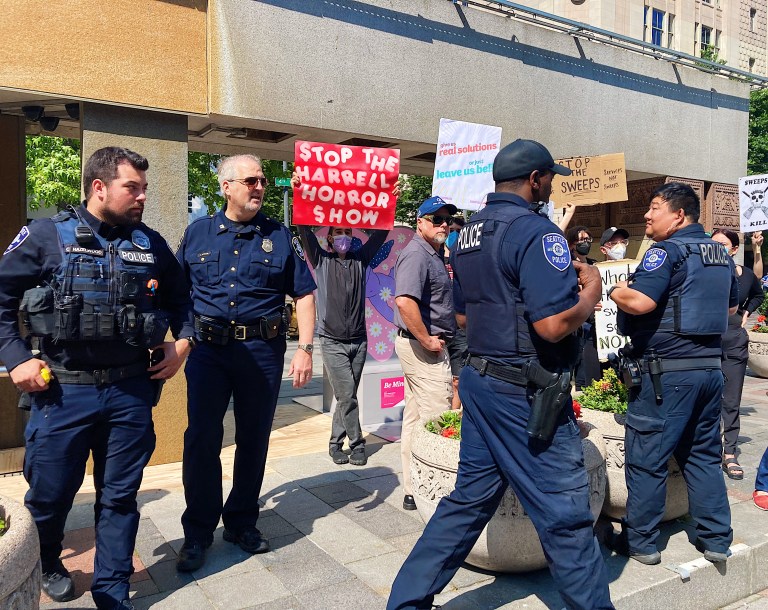
Mayor Bruce Harrell gathered supporters in Westlake Plaza Wednesday morning to announce his latest downtown activation plan, officially titled “Downtown Is You.” But the press event was initially sidelined by a group of anti-sweeps protesters holding signs and chanting, “stop the sweeps” and other slogans from a few feet away. After halting his prepared remarks, Harrell hopped down from the stage and attempted to get the protesters to be quiet, but gave up and returned to the stage after several responded that they didn’t trust his offer to talk to them in a different venue.

“Westlake Center is a center for civic engagement,” he told the audience. “Unfortunately, that’s not civic engagement—that’s just yelling.”

“These [unsheltered] folks you see down here, they’re not strangers to me. I grew up on these streets,” Harrell continued. Gesturing toward the group of young activists, he added: “How dare anyone say I’m going to sweep anybody. I don’t see anyone over there I grew up with.”

Under Harrell, the city has dramatically increased the speed and frequency of encampment removals.

The seven-point downtown plan Harrell announced Wednesday does not directly address encampments. However, it does envision a downtown occupied by shoppers, sports fans, and residents of new high-rise apartment towers along a section of Third Avenue between Stewart and Union Streets, where drug users and unsheltered people frequently congregate. The proposed upzone includes the block that includes a McDonald’s and a check cashing outlet as well as the block anchored by Ross Dress for Less.

At a press briefing on Tuesday, mayoral advisor (and soon-to-be deputy mayor) Tim Burgess said “several” developments in the area were “ready to go” once a proposed upzone goes through. The proposal would increase the maximum height for new buildings from 170 feet to 440 (460 if new developments include child care or education facilities) on about five blocks that are adjacent to a area where 450-foot-high buildings are already allowed. The city’s land use database does not include any active permits for these blocks.

On Tuesday, Burgess said the proposed rezone reflects “a recognition that we need to make some dramatic changes in order to shift what’s been several decades now of problematic street uses and disorder.”

Police almost outnumbered protesters during a demonstration at Mayor Bruce Harrell’s announcement of his downtown activation strategy.

Harrell’s plan also includes legislation to allow a broader mix of uses on the ground floor of buildings (apartments or conference spaces instead of retail, for example) and throughout buildings themselves, in the form of “vertical residential neighborhoods within buildings” that allow residents to access everything they need, from child care to retail stores to pickleball courts, inside their buildings.

The idea is a nod to the fact that—Harrell’s back-to-work order and admonishments notwithstanding—many people have continued to work at least partly from home, leaving significant vacancies in downtown office buildings. “I don’t think this is a philosophical shift away from retail” serving downtown office workers, McIntyre said Tuesday. “It’s embracing some flexibility and some new ideas and wanting to encourage a different mix on the ground floor area as the as the city continues to change.”

Another piece of legislation would make a half-block of Pike Street between First and Second Avenues pedestrian-only, connecting Pike Place Market Market to—well, one half-block of downtown directly adjacent to, but not part of, the market. (Asked whether the mayor would consider prohibiting car traffic in Pike Place Market—where pedestrians compete for space on the historic brick streets with exhaust-spewing cars—Office of Economic Development director Markham McIntyre said the city was still “talking to Pike Place Market … to figure out what what that might look like,” but had no immediate plans to get rid of cars in the Market, a change pedestrian advocates have been demanding for decades.


Beyond those concrete legislative proposals, the plan consists mostly of expanded pilot projects (doubling the number of businesses participating in Seattle Restored, a pop-up project that fills empty storefronts), initiatives that are already underway (reopening City Hall Park, “more murals” downtown), and ideas that are still very much in the whiteboard stages. It also incorporates many aspirational ideas that would require significant additional funding, such as completing the downtown streetcar, putting a lid over I-5, and creating a new “arts district” from South Lake Union to Pioneer Square.

Mayor Bruce Harrell speaks to a group of Stop the Sweeps protesters at Westlake Park.
Mayor Bruce Harrell briefly spoke to protesters before returning to his press event.

And, of course, it assumes a heavier police presence downtown—a mostly unspoken, but bedrock, element of the proposal. “Make Downtown Safe and Welcoming” is actually number one on the plan’s list of seven priorities, starting with arrests of people “distributing and selling illegal drugs” (and, presumably, using them—Harrell mentioned that a bill criminalizing drug possession and public use will likely pass in July). The safety plan also includes a number of initiatives to address addiction that Harrell announced in April, along with a plan to help private property owners remove graffiti—a particular burr under Harrell’s saddle.

Earlier this month, a federal judge issued an injunction barring the police from arresting people for tagging or graffiti, finding that Seattle’s broadly worded law “likely…violates the First and Fourteenth Amendments by being both vague and overbroad.” On Wednesday, I asked Harrell—who had just expounded on the difference, as he sees it, between “art” and “graffiti” (“One word: It’s unwanted”)—what he would do if the judge overturned the law.

“We have to have the ability to arrest people for unwanted graffiti, so if there’s precise language in the law that is unconstitutional, that is vague, that’s ambiguous, we have to fix it,” Harrell said. “If we lose the lawsuit, we go back to the drawing board and figure out what the deficiencies are in the law, and we fix it or remedy it.”

“This graffiti stuff just drives me nuts,” Harrell added.

Chamber Poll On Homelessness, Public Safety Shows That It Matters How You Frame the Questions

Graph showing high support among Seattle voters for removing encampments

By Erica C. Barnett

A new poll from the Greater Metro Chamber of Commerce, produced by EMC Research, reveals that many Seattle voters’ “top concern” has shifted from homelessness to crime, but fails to shed any light on the reasons behind the shift. whether this shift represents declining empathy toward people living on Seattle streets.

Overall, according to the poll of 700 registered Seattle voters, 57 percent of people named homelessness as one of the issues they were most “frustrated or concerned about,” followed by “crime/drugs/public safety” at 46 percent. Both categories declined slightly from last year, while “racial issues/policing/police brutality” and “taxes” ranked slightly higher as matters of public concern. Asked what changes would improve the “quality of life” in Seattle, “closing encampments in parks, on sidewalks,” and in public rights-of-way ranked number one on the list, with 79 percent of voters saying their lives would be improved by encampment removals.

“I think our voters are pretty sophisticated. This is a community that does not assume that all people experiencing homelessness are also committing crimes and does not conflate homelessness and criminal activity.”—Seattle Metro Chamber CEO Rachel Smith

During a media presentation on the poll results, Seattle Chamber CEO Rachel Smith said she believed voters are somewhat less concerned about homelessness because of “an all-hands-on-deck regional approach that has made a visible difference” in the number of tents on the street. As we’ve reported, Mayor Bruce Harrell has dramatically accelerated homeless encampment removals since taking office, and has proposed expanding the city’s homeless outreach and encampment removal team and making many temporary “cleanup” positions permanent.

“I think our voters are pretty sophisticated,” Smith continued. “This is a community that does not assume that all people experiencing homelessness are also committing crimes and does not conflate homelessness and criminal activity.” Andrew Thibault, an EMC partner, added that most of the voters in the survey identify as Democrats and progressives.

Breakdown by demographic category of support for encampment removals among Seattle voters

Like all the previous versions of this annual survey, the poll framed a question about homeless encampments in a misleading way that does not represent what the city actually offers unsheltered people during sweeps, nor the reasons people “refuse” shelter or services that may be unsuitable for their needs. The survey asked voters whether they would support the city “continu[ing] to close homeless encampments once people have been offered shelter and services, even if it means those who refuse help will be displaced.” Only 18 percent of respondents said they would oppose such a policy.

The problem is that this policy does not exist, nor can it be “continued.” In reality, the city has only “closed” two encampments—one at Woodland Park and another at the Ballard Commons, which remains fenced-off and inaccessible—by making individualized offers of shelter and services to encampment residents. Other than these exceptions, the city removes encampments the same way it always has—typically, by posting a notice two or three days in advance so people know they have to leave, giving encampment residents the option to take one of the handful of shelter beds typically available citywide on any night, and sweeping anyone who remains on site on the appointed day. That’s a far cry from “offering shelter and services” to people who, for whatever (presumably irrational) reason, “refuse” to take them.

As long as the question describes a far more ideal scenario than the one that actually exists, people who might oppose removals will likely continue supporting them—after all, who can blame the city for sweeping people who simply don’t want any help?

Voters, particularly Republicans and people living in North Seattle, said they felt less safe than they did last year and supported hiring more police; more than half also said they were “actively” thinking about leaving Seattle, largely because of crime. These question routinely get high positive responses, to the point that you might think bullets were routinely whizzing through the empty streets of Phinney Ridge and Laurelhurst, past empty houses abandoned by people fleeing the city.

Graphs showing support among all demographic categories, except Republicans, for "more housing in your neighborhood"

Poll respondents also said they didn’t trust the Seattle City Council to reform the police department—an oddly worded question, given that the mayor, not the council, oversees SPD and is responsible for setting policy for department. There was no corresponding question about the mayor. Blaming the council for problems at the police department and other departments that are controlled by the mayor is a longstanding Seattle pastime—one that reflects a general misunderstanding about how city government works that is exacerbated by polls suggesting the council has more power than it does.

Voters continue to support the general idea of “more housing in my neighborhood”; however, as in previous years, the Chamber’s poll doesn’t push that question beyond “duplexes and triplexes” to include denser housing types that might also include affordable housing. As the Urbanist noted in its coverage, the Chamber has supported legislation to increase density further in single-family areas and Smith said the framing of the question wasn’t meant to indicate that triplexes should be the upper limit.

The poll includes a demographic breakdown of respondents that lumps all BIPOC people into a single “POC” category—a grouping necessitated, according to Thibault, by the fact that breaking the categories down further would lead to an excessive margin of error. According to the crosstabs provided by EMC, the “POC” group included 26 Black voters in all, an average of fewer than nine Black respondents for each of three broad geographic areas sampled in the poll.

Harrell Budget Would Permanently Expand Encampment Cleanup and Removal Team

Deputy Mayor Tiffany Washington and Mayor Bruce Harrell

By Erica C. Barnett

Previewing a budget proposal the council will discuss Friday morning, Mayor Bruce Harrell said on Thursday that unless the city council renews and expands funding for encampment removal and response, the “significant decrease in tents in parks and on sidewalks” since he took office might go away.

“If that funding is not renewed … this level of service that we’re demonstrating will lapse. The progress we’re making in the city, building our ‘One Seattle,’ will lapse,” Harrell said.

Harrell has proposed spending just over $38 million on the Unified Care Team and the Clean City Initiative, two initiatives that encompass a wide variety of spending and staff across several city departments, including Parks, the Seattle Department of Transportation, and Seattle Public Utilities. The two programs include all of the city’s spending related to encampment removals, outreach, and trash pickup, including the city’s “purple bag” encampment trash abatement program.

A majority of that money, about $23 million, would continue existing programs. The rest would be new funding—$10 million to replace temporary federal dollars added during COVID, and $5 million in brand-new programming. 

According to council presentation, the new funding “could significantly increase the Unified Care Team’s capacity to conduct encampment removals” across the city.

Overall, Harrell’s budget would 61 new permanent positions to the city’s encampment removal, outreach, and cleanup efforts. Among other new positions, the money would pay for two new customer service representatives to respond to encampment complaints, six new “system navigators” to do outreach and make offers of shelter in advance of encampment removals, and 48 new permanent positions in SDOT and the parks department to coordinate and conduct encampment removals.

In addition to making a number of positions funded with one-time federal emergency dollars permanent, Harrell has proposed changing the way UCT staff are deployed. Instead of working as a citywide team, staffers would be assigned to one of six geographic areas, a change Harrell said would enable encampment response workers to become more familiar with the communities and organizations where they work.

Deputy Mayor Tiffany Washington said that since Harrell took office, the city has eliminated a backlog of “1,500 complaints related to unauthorized encampments” and continues to develop more tools to respond to and resolve encampment complaints.

“What that means,” Washington said, “is that… we send someone from the Unified Care Team to do an inspection and then we resolve the issue if we can. ‘Resolve’ could be RV remediation. It could be hauling away a burnt RV that had been sitting there for weeks. It could mean making a referral to shelter and then resolving the site. And so when we say we cleared [a request], it means that for all of those [1,500] requests, someone went to the site to do an inspection, put the data in the database, and then we either addressed it, or it self-resolved.”

Harrell’s proposal would also eliminate funding for street sinks that would have provided unsheltered people places to wash their hands, and would reduce spending on public “hygiene stations” (temporary restrooms) and mobile shower trailers for people experiencing homelessness, saving a total of $1.3 million.

The request for millions in additional funding for encampment cleanups comes at a time when the city is trying to close a $141 million shortfall that is projected to grow larger every year until at least 2025. According to an issue-identification presentation prepared for the city council’s budget committee, which will discuss Harrell’s proposal tomorrow morning, the new funding “could significantly increase [the UCT’s] capacity to conduct encampment removals” across the city.  A memo accompanying that presentation adds that, legally speaking, there’s no guarantee that the new funding won’t be used to “accelerate encampment removals.”

Harrell’s proposal would also eliminate funding for street sinks that would have provided unsheltered people places to wash their hands, and would reduce spending on public “hygiene stations” (temporary restrooms) and mobile shower trailers for people experiencing homelessness, saving a total of $1.3 million.

Harrell’s predecessor, Jenny Durkan, repeatedly refused to fund or implement the street-sink program, which could have helped prevent repeated outbreaks of diseases like shigella and hepatitis A among Seattle’s homeless population.

“We have to simultaneously improve service response to rapidly house people living in shelter, and coordinate strategies to ensure public spaces are open, safe, and can be used for their intended purpose,” Washington said. As we’ve reported, there are far more people living unsheltered in Seattle than there are available shelter beds, which means it is not even theoretically possible to shelter everyone who is living outdoors.

On Wednesday in downtown Seattle, officials formally announced an effort we reported on last month to create a unified “command center” to connect people living unsheltered downtown to housing and shelter.

On a practical level, what this means is that when the city sweeps an encampment, most of the people living there do not end up in shelter, but simply “self-resolve” by moving to another location. Outreach workers, including those employed by the city, may have only one or two shelter beds to offer to the people who remain on site, which may or may not be appropriate for the people who happen to remain in that encampment. Even when people do “accept” an offer of shelter, half or more don’t end up enrolling for even one night, a damning indictment of the shelter referral system the city uses in the overwhelming majority of encampment “resolutions.”

During his presentation Thursday, Harrell name-checked the King County Regional Homelessness Authority, which will receive around $90 million from the city next year—a $10 million bump. On Wednesday, Harrell, KCRHA director Marc Dones, and representatives from the US Department of Housing and Urban Development and King County Executive Dow Constantine’s office officially announced an effort we reported on last month to create a unified “command center” to connect people living unsheltered downtown to housing and shelter.

The center—technically a conference room at the city’s Emergency Operations Center downtown—is part of a public-private effort to reduce the number of unsheltered people downtown to “functional zero” by next year. The goal, KCRHA and HUD officials said, is to break down the “silos” that keep various parts of the homelessness system from working well with each other; for example, cities often require people to go through the shelter system before they “graduate” to housing, an extra step that can act as a barrier for people stuck in the homelessness system.

So far, according to data KCRHA provided this week, the agency’s outreach staff have connected with 665 people living unsheltered downtown and identified about 300 units of existing housing for them; the goal, Dones said Wednesday, is to offer people at least three housing options to choose from, instead of the typical one, and to reduce the barriers to housing faced by people who are homeless or poor.

“What we have built into our housing system for folks experiencing homelessness is this incredibly aggressive set of mechanisms that are all based on the idea that people who are poor are out to commit fraud at every turn,” Dones said. “This morning, we were talking about,  how do we not need any of the things [like ID cards and income checks] that we’re used to needing? And if we just had this piece of paper, with someone’s housing preferences on it, how can we have them housed in 12 hours?”

That concept, however, remains speculative; so far, the effort has not moved anyone into housing, and there is no funding for additional housing or shelter attached to the project.