Tag: Compassion Seattle

Harrell Promised 2,000 Units of Housing or Shelter by the End of His First Year. He Didn’t Deliver.

Mayor Bruce Harrell speaks at the opening of LIHI’s Dockside Apartments earlier this year, when he also unveiled his homelessness dashboard.

By Erica C. Barnett

When he ran for mayor in 2021, Bruce Harrell vowed to implement key elements of the Compassion Seattle ballot measure, an initiative that would have required the city to create  a total of 2,000 new “units (in addition to those already funded) of emergency or permanent housing with services.” If the measure had passed, Harrell, who supported it, would have been responsible for making the 2,000 new units happen.

After a state appeals court took Compassion Seattle off the table, candidate Harrell wasted no time in urging the city council to adopt key elements of the measure, saying that “the amendment-specified 2000 units of housing is critical to set in motion now.” He also rolled out a “homelessness action plan” that incorporated the 2,000-unit promise, and added that, if elected, he would “identify and begin the process of moving people into 1,000 units of housing within the first 6 months of taking office, and securing an additional 1,000 units by the end of year one.” 

Media outlets reported widely on this bold campaign promise, and the Seattle Times mentioned it as one of their reasons for endorsing Harrell. He even hired Compassion Seattle’s chief architect, former city council member Tim Burgess, as a top policy advisor.

So in his first year as mayor, did Harrell deliver? In a word, no. In a few words, not even close.

In 2022, Harrell did not deliver 2,000 new units of housing, even using the most generous interpretation of that campaign promise.  A detailed look at the 31 developments the administration says it “identified” this year shows that the vast majority were planned and funded before Harrell even took office, including many that former mayor Jenny Durkan hyped with media events and press announcements during her term. 

In fact, Durkan took credit for many of the exact same units the Harrell administration is counting toward their total. In 2021, for example, Durkan announced funding for 840 new housing units, primarily from the city’s 2016 housing levy; those units included LIHI’s Good Shepherd House, which Harrell’s dashboard counts among 1,912 units “identified” between January and September of last year, when the dashboard was last updated.) The following year, PubliCola was on hand when Durkan announced federal funding for several other LIHI projects on the list. 

But let’s say that Harrell, who likes sports metaphors, was just nudging the goalposts a bit—understandable, especially for such an ambitious promise in such a lousy budget year. (I even wrote a column calling Compassion Seattle an “unfunded mandate” that would either fail entirely or “succeed” by funding low-cost shelters instead of real solutions like permanent housing.) And indeed, over the last year, the mayor has suggested that he merely promised to identify 2,000 housing and shelter units, not create 2,000 new ones. As the dashboard puts it: “We have identified 1,912 total units of shelter so far, with only 88 units left to reach our goal of 2,000 units of shelter and housing identified by end of 2022.”

Even by this measure, however, the Harrell Administration can’t claim success.

PubliCola has documented, to the best of our ability, the year or date on which each housing or shelter development on the city’s list was announced. 

A review of these 1,912 units and shelter beds shows that fewer than 300 were newly planned or funded by the city in 2022. What’s more, around 100 shelter beds included on the list have been canceled, including 68 that were supposed to open as part of the abandoned SoDo shelter expansion. The city’s tally, which has not been updated since September, includes 40 high-acuity shelter beds and 28 tiny house-style Pallet shelters toward the total. Neither project is happening.

Candidates often make unrealistic promises to get elected; Compassion Seattle was, according to all the polls at the time, extremely popular, so it made sense for Harrell to incorporate it into his campaign. What’s harder to understand is why more of Harrell’s supporters—who professed to support housing, not just sweeping, people living in parks and city rights-of-way—aren’t asking why he failed to deliver.

The mayor and city council actually cut funding for one of the programs on the list last year. JustCare, the Public Defender Association’s pandemic-era hotel shelter program, would have to shrink from 84 beds to 50 if the PDA hadn’t secured one-time federal funding to make up for the city’s cuts.

Overall, of the 1,912 housing units and shelter beds on the city’s website, PubliCola could only identify 288 that were announced in 2022, after Harrell took office. Most of those—163—are existing apartment buildings that were purchased using emergency federal “rapid acquisition” funds, which allow housing agencies to quickly repurpose market-rate apartments for affordable housing. For example, the Low-Income Housing Institute recently purchased the Dockside Apartments on Greenlake Way North; the property served as a backdrop when Harrell announced the dashboard back in June.

The rest of the “identified” units are traditional permanent supportive housing, emergency shelter, such as tiny houses, and a 35-space RV safe lot. The city has tried and failed repeatedly to open similar parking lots for RV residents in the past; the most recent attempt was at the SoDo shelter site, and King County took it off the table under neighborhood pressure long before deciding to abandon the shelter expansion altogether.

Candidates often make unrealistic promises to get elected; Compassion Seattle was, according to all the polls at the time, extremely popular, so it made sense for Harrell to incorporate it into his campaign. What’s harder to understand is why more of Harrell’s supporters—who professed to support housing, not just sweeping, people living in parks and city rights-of-way—aren’t asking why he failed to deliver.

Harrell’s office did not immediately respond to questions sent early Tuesday afternoon; we’ll update this post if we hear back.

SPD Hosts Relationship Seminar by Demoted Ex-Chief, Compassion Seattle Passes the Hat; Ban on SPD Travel to Israel Fails

1. The Seattle Police Department’s ongoing push to scale up its officer wellness program is veering into intimate territory: Next week, former SPD assistant chief Nick Metz will host a dinner and relationship counseling workshop for officers alongside his wife, Dr. Sara Metz—a clinical psychologist who specializes in first responders. To sweeten the deal (and extend the “intimate” atmosphere?), the department is offering a limited number of complimentary hotel rooms to couples who attend the workshop.

After two years of staggering attrition, officer wellness programming has taken on a new significance for SPD. According to a flyer distributed to department employees, the Metz workshop is meant to address “relationship issues typically encountered by police officers”—a complaint that long predates the department’s current staffing crisis.

In November 2013, Interim Chief Jim Pugel demoted Metz from assistant chief to captain during a brief purge of department leaders Pugel believed were impediments to the reforms outlined in Seattle’s consent decree: an agreement with the US Department of Justice to correct a pattern of racial bias and excessive force by SPD officers. Within two months of his demotion, Metz briefly returned to the rank of assistant chief under new Interim SPD Chief Harry Bailey before leaving the department entirely to lead the Aurora, Colorado police department in 2015.

Metz retired in October 2019 to join his wife’s counseling practice; his retirement came on the heels of the death of Elijah McClain, a 23-year-old unarmed Black man whom Aurora police officers placed in a chokehold while paramedics administered a fatal dose of ketamine. A Colorado grand jury indicted three of the officers and two paramedics for manslaughter and negligent homicide earlier this month.

The campaign, which raised more than a million dollars in its effort to get Charter Amendment 29 on the ballot, owes Seattle-based Foster Garvey more than $216,000 for legal services, according to reports filed at the Public Disclosure Commission—and that’s on top of $44,000 the campaign already paid the firm.

At the time of his exit from SPD, Metz was also at the center of a lawsuit against the department by a sergeant who said she experienced retaliation for complaining about Metz’s preferential assignment of lucrative overtime hours to a small group of his closest friends. A King County Superior Court jury later ruled against the department, awarding $2.8 million to the sergeant and a captain who sided with her.

2. Compassion Seattle, the business-backed campaign that wanted to change the Seattle City Charter to require the city to add thousands of shelter beds with no new money in order to keep public spaces “free and clear” of encampments, is asking supporters to help them pay their debts, including hundreds of thousands of dollars in legal bills to defend the initiative. As PubliCola reported, a King County Superior Court judge roundly rejected the measure as outside the scope of the initiative process, a ruling that the state Court of Appeals upheld one week later.

In an email to supporters, the campaign declared a kind of moral victory, crediting themselves with “chang[ing] the civic conversation” by raising homelessness as an issue. “Help us communicate our message effectively and retire our debt,” the email says.

The campaign, which raised more than a million dollars in its effort to get Charter Amendment 29 on the ballot, owes Seattle-based Foster Garvey more than $216,000 for legal services, according to reports filed at the Public Disclosure Commission—and that’s on top of $44,000 the campaign already paid the firm.

Other notable campaign debts and expenditures include: $22,000 to the Downtown Seattle Association;$232,000 to political consulting firm Cerillon N4 Partners; $98,000 to political consulting firm Blue Wave Partners; $151,000 to political consulting firm The Feary Group; and $1.1 million to the Utah-based signature-gathering firm Landslide Political.

In its letter, the Compassion Seattle campaign notes that “We successfully gathered more than 60,000 signatures on petitions.” That depends on your definition of “success”; in reality, almost half of those signatures were tossed out as invalid, meaning that the campaign and its supporters—mostly large downtown real estate interests—spent about $32 for each of 34,714 valid signatures. 

3. After a nearly three-hour debate, the city council voted narrowly to reject Councilmember Kshama Sawant’s “End the Deadly Exchange” legislation, which would have banned Seattle police officers and management from training in, participating in “exchange” programs with, or taking any official travel to Israel. Although Councilmembers Andrew Lewis and Lorena González abstained during a committee vote on the bill, saying they hoped to work with Sawant to refine the legislation to make it a more neutral condemnation of countries that commit human rights abuses, they both voted “no” in full council, along with Dan Strauss, Debora Juarez, and Alex Pedersen. Continue reading “SPD Hosts Relationship Seminar by Demoted Ex-Chief, Compassion Seattle Passes the Hat; Ban on SPD Travel to Israel Fails”

Campaign Fizz: Anti-RV “Eco Blocks” Surround Candidate’s Brewery, Two Polls Test Pro-Harrell Messaging

“Ecology blocks,” commonly used to prevent unhoused people from parking RVs in industrial areas, around Fremont Brewing’s Ballard production facility.

1. Dozens of “ecology blocks” have popped up around the Ballard production facility for Fremont Brewing, the craft-beer company owned by City Council Position 9 candidate Sara Nelson, blocking vehicles from parking in designated public parking areas along NW 47th and 48th Streets and on 9th Avenue Northwest. Although city law forbids blocking the public right-of-way, industrial businesses throughout the city have chosen to defy the law, using the blocks to prevent RVs from parking near their facilities in industrial areas from Ballard to Georgetown.

Fremont Brewing, however, is the only large industrial business owned by a candidate for city council.
The production facility, which is located in Ballard’s burgeoning brewery district, is adjacent to a small encampment that, on a recent visit, included several vans and RVs. The blocks, which are spaced too closely for a car to park between them, surround the block-long building on three sides, with several of the blocks set up in on-street parking directly behind signs indicating parking rules in the area. Using ecology blocks to prevent people from parking in the street, as Nelson’s brewery appears to have done, is illegal, but the Seattle Department of Transportation has declined so far to enforce the law, noting that the blocks are heavy and hard to move.

Next to Fremont Brewing, ecology blocks in the public right-of-way extend right up to a stop sign.

Nelson’s campaign didn’t return an email seeking confirmation that Fremont Brewing had placed the blocks around the production facility, and Nelson didn’t respond to an email sent to her business email address. 

The proliferation of RVs and other large vehicles in industrial areas is a product not just of Seattle’s homelessness crisis, but of parking rules that prohibit them everywhere else in the city. During the pandemic, when the city decided not to enforce a law that requires vehicles to move every 72 hours, many RVs stayed put, sparking a backlash among business owners who have turned to everything from boulders to fake “no parking” signs to prevent RVs from parking near their businesses.

2. A new online poll testing messages on homelessness suggests that the supporters of the “Compassion Seattle” ballot measure will have another outlet for their money—an independent expenditure campaign supporting mayoral candidate Bruce Harrell and other “candidates in local elections.”

The poll focuses on homelessness and policing, and tests three possible campaign names: Recover Seattle, Restore Seattle, and Take Back Seattle.

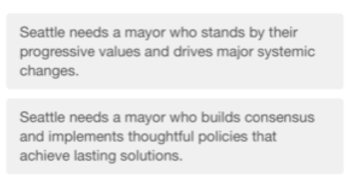
The questions ask voters to choose between statements that purport to represent the two mayoral candidates’ views, although the framing of all the questions is generally pro-Harrell. For example, a question on business describes two possible perspectives: “City leaders should make sure that local companies pay their fair share in taxes so that we have the resources we need to address Seattle’s challenges,” and “City leaders should partner with our local business community to encourage new businesses, keep taxes under control, and create more jobs with livable wages.”

Support PubliCola

PUBLICOLA NEEDS YOUR HELP.

If you’re reading this, we know you’re someone who appreciates deeply sourced breaking news, features, and analysis—along with guest columns from local opinion leaders, ongoing coverage of the kind of stories that get short shrift in mainstream media, and informed, incisive opinion writing about issues that matter.

We know there are a lot of publications competing for your dollars and attention, but PubliCola truly is different: We’re funded entirely by reader contributions—no ads, no paywalls, ever.

So if you get something out of this site, consider giving something back by kicking in a few dollars a month, or making a one-time contribution, to help us keep doing this work. If you prefer to Venmo or write a check, our Support page includes information about those options. Thank you for your ongoing readership and support.

Similarly, a question about homelessness contrasts “We have programs that will get the homeless off the street, but we don’t have enough revenue. The best way to solve homelessness is to properly fund existing programs by making sure corporations and the wealthy pay their fair share in taxes” with “We have the money to address homelessness in Seattle, but we need to make better decisions about what works and where new ideas are needed. An important first step is to make sure our parks and streets are safe for all people.”

Charter Amendment 29 would have required the city to fund thousands of new shelter beds without providing any additional funds while assuring that public spaces “remain open and clear of encampments.” Harrell has said he will implement every major provision of the amendment if elected.

3. A second poll that also circulated yesterday appears to be from the Harrell campaign itself. This poll tests out positive and negative messages about Harrell and asks respondents to say how convincing they find each statement. Continue reading “Campaign Fizz: Anti-RV “Eco Blocks” Surround Candidate’s Brewery, Two Polls Test Pro-Harrell Messaging”

“Compassion Seattle” Is Dead. Now What?

By Katie Wilson

Two years ago, Seattle’s corporate set learned that money can’t buy you the Seattle City Council. Now they’re finding out it can’t even buy a measly amendment to the city charter.

I’ve written before about how Charter Amendment 29, promoted by the business-backed group “Compassion Seattle,” was an expensive unfunded mandate with troublingly unclear implications for the city’s approach to unsheltered homelessness. Last month, a King County Superior Court judge struck it from the ballot for wholly different reasons: It’s a misuse of the initiative process, conflicting with state law and usurping the city’s legislative prerogatives. The state Court of Appeals denied Compassion Seattle’s appeal of the ruling on Friday.

To be clear, I wasn’t an impassive observer in this process. The organization I work for, the Transit Riders Union, was a plaintiff in the lawsuit along with the American Civil Liberties Union of Washington and the Seattle/King County Coalition on Homelessness. TRU is also a part of House Our Neighbors!, the grassroots coalition convened by Real Change to oppose Compassion Seattle.

So yeah, I feel like running some victory laps. But going in circles, even metaphorically, is the last thing to be doing right now. There’s a good reason many thousands of Seattleites would have voted for the measure: It sounded great. It promised to do something about the ever-worsening homelessness crisis. With compassion, no less! It was a false promise, but attractive because the crisis is so vast, so heartbreaking and so visible.

So, what now? Here are four ways forward.

1. The city should make it easier, faster and cheaper to site and build shelter and permanent housing. CA 29 promised to do this by expediting project applications and waiving land use code requirements and permitting fees. This is one part of the measure that was actually good policy, but it also illustrates why the whole enterprise was so wrongheaded. Land use and zoning falls under the purview of the city’s legislative process and can’t be decided by initiative.

There’s a good reason many thousands of Seattleites would have voted for the measure: It sounded great. It promised to do something about the ever-worsening homelessness crisis. With compassion, no less! It was a false promise, but attractive because the crisis is so vast, so heartbreaking and so visible.

Siting shelter and housing for homeless people is often controversial. Suppose CA 29 passed and the city began fast-tracking projects; if disgruntled neighbors sued, they’d probably win. The Seattle City Council already took action in early 2021 to make it easier to site and build permanent supportive housing. The Urbanist reported on that effort here. Next year, Seattle’s new mayor and council should work together to make more changes like these the right way, by developing and passing legislation to allow projects to move forward faster.

2. The city should make smart use of new revenue flowing in from the JumpStart tax—a payroll tax paid by Seattle’s largest corporations—as well as the remainder of the city’s federal American Rescue Plan Act allocation, which will be budgeted this fall. JumpStart’s first year was focused on economic relief from the COVID-19 crisis. But that’s about to change. “Starting next year, two-thirds of the JumpStart funds are for housing and homelessness,” Seattle Councilmember Teresa Mosqueda said. “That’s about $135 million annually for emergency housing, long-term housing solutions and everything in between.”

In July, Mosqueda and her council colleagues passed legislation creating a dedicated fund for revenues from the new tax, to help ensure they’re funneled to their intended uses.

This by itself won’t be enough to create 2,000 units of “emergency or permanent housing” in a single year, as CA 29 arbitrarily stipulated, let alone all the permanent supportive housing and deeply affordable housing that’s needed, but it’s a great start.

3. To go further, the city will need to explore new sources of progressive revenue. Last fall, King County enacted the Health Through Housing Initiative, funded by a one percent sales tax, to scale up its efforts on chronic homelessness; that’s not a progressive tax, but it is buying a lot of hotels. Seattle can do its part without further taxing poor people. Should it raise the JumpStart tax? Design a city income tax? Siphon off some unearned wealth? Push for other new options from the state legislature? City leaders should create a task force made up of policy experts and community stakeholders to research what’s possible and report back on the options.

4.  One of the most unrealistic pieces of CA 29 was the suggestion that the city should suddenly (and with no new funding) start playing a major role in providing mental health and substance use disorder treatment, services that are currently managed mainly through county and state agencies. The city should acknowledge that behavioral health services are a county and state responsibility and work in partnership with King County and state legislators to fund behavioral health care for people experiencing homelessness.

One promising idea comes from 43rd District Rep. Frank Chopp, who points out that health care is the proper responsibility of state government . He’s developing a proposal called “a prescription for a home,” which he hopes to advance in next year’s legislative session. It begins from the recognition that chronic homelessness is usually related to chronic health conditions, which are nearly impossible to heal or treat successfully without housing. Just as the state now funds health care through Apple Health for qualifying individuals, people experiencing chronic homelessness would have a right to a home and wraparound services.

“The core of the program would be funded right out of the state general fund,” Chopp said. Phased in over time, “it would be part of the state Medicaid budget, like nursing homes, like home care, like prescription drugs.” With the state taking on more responsibility for addressing chronic homelessness, local governments could focus on building housing for the rest of the homeless population and for low-wage workers.

Support PubliCola

PUBLICOLA NEEDS YOUR HELP.

If you’re reading this, we know you’re someone who appreciates deeply sourced breaking news, features, and analysis—along with guest columns from local opinion leaders, ongoing coverage of the kind of stories that get short shrift in mainstream media, and informed, incisive opinion writing about issues that matter.

We know there are a lot of publications competing for your dollars and attention, but PubliCola truly is different: We’re funded entirely by reader contributions—no ads, no paywalls, ever.

So if you get something out of this site, consider giving something back by kicking in a few dollars a month, or making a one-time contribution, to help us keep doing this work. If you prefer to Venmo or write a check, our Support page includes information about those options. Thank you for your ongoing readership and support.

So much for what I think; with CA 29 off the ballot, what are its backers and opponents up to?

“We need to start treating housing as a human right, not an exploitative venture,” said Tiffani McCoy, advocacy director at Real Change. “For-profit housing will never be the answer to our housing needs. We need to immediately start shifting housing away from the private, for profit sector and into the public sphere. We need social housing now.” The House Our Neighbors! coalition, she says, isn’t going away — it’s planning its next steps.

Compassion Seattle, meanwhile, is urging supporters to pay attention to the city elections.

“We can still make our voices heard in the elections for Mayor, City Council, and City Attorney,” the campaign said in a statement. “In each race, the difference between the candidates is defined by who supports what the Charter Amendment was attempting to accomplish and who does not.”

Continue reading ““Compassion Seattle” Is Dead. Now What?”

“Compassion Seattle” Charter Amendment Won’t Appear On November Ballot

By Erica C. Barnett

The Washington State Court of Appeals denied the Compassion Seattle campaign’s appeal of a lower-court ruling striking down their proposed Seattle charter amendment on homelessness this morning, and the measure will not appear on the November ballot.

In its ruling, the appeals court did not give any specific reason for denying the campaign’s appeal, which it filed on Tuesday after strongly suggesting it would not do so after last week’s King County Superior Court ruling. Knoll Lowney, an attorney for a coalition of groups opposing the measure, told PubliCola this week that he expected to prevail, in part, because Compassion Seattle “appealed without coming up with any appellate arguments.” Instead, the campaign’s appeal relied on the same arguments it made in its initial response to the lawsuit against the initiative.

Compassion Seattle said in a statement that the appeals court ruling “means that Seattle voters must change who is in charge if they want a change to the city’s failed approach to addressing the homelessness crisis. While we are deeply disappointed, we will continue to share evidence that our amendment’s approach can make a necessary and noticeable difference for those living unsheltered in our parks and other public spaces.”

Support PubliCola

PUBLICOLA NEEDS YOUR HELP.

If you’re reading this, we know you’re someone who appreciates deeply sourced breaking news, features, and analysis—along with guest columns from local opinion leaders, ongoing coverage of the kind of stories that get short shrift in mainstream media, and informed, incisive opinion writing about issues that matter.

We know there are a lot of publications competing for your dollars and attention, but PubliCola truly is different: We’re funded entirely by reader contributions—no ads, no paywalls, ever.

So if you get something out of this site, consider giving something back by kicking in a few dollars a month, or making a one-time contribution, to help us keep doing this work. If you prefer to Venmo or write a check, our Support page includes information about those options. Thank you for your ongoing readership and support.

As we reported this morning, mayoral candidate Bruce Harrell has said that if he’s elected, he will implement all the major policies the charter amendment would have mandated. Those include mandating that the city spend 12 percent of its budget on homelessness, requiring the city to fund 2,000 new “permanent or emergency housing” (realistically, shelter) units in one year, and keeping streets, sidewalks, parks and other public spaces “open and clear of encampments.”

So what does this ruling mean for the mayoral campaign going forward? Compassion Seattle —and its founder, former council member Tim Burgess, whose “People for Seattle” PAC bombarded voters with negative ads targeting council candidates and incumbents in 2017—clearly hoped that the charter amendment would frame the entire election.

Now that it’s dead, Harrell will have to push for its provisions in isolation, and hope that voters don’t realize that the city council, not the mayor, funds projects through the annual budget process. (Honestly, not the worst assumption.) His opponent, current council president Lorena González, will no longer have to respond to the question “Why don’t you support Compassion Seattle?” at every turn, but will also need to present an alternative to Harrell’s spend-then-sweep proposal that does more than respond to the charter amendment’s proposed spending mandates.

The Compassion Seattle campaign cost more than a million dollars, funded mostly by dozens of large donations from a who’s-who of downtown real estate interests, as well as consultant Tim Ceis, who helped draft the measure. Burgess gave just over $1,000 to the campaign.

Compassion Seattle Appeals Ruling Striking Down Ballot Measure on Homelessness

By Erica C. Barnett

Defying expectations, Compassion Seattle has appealed last week’s King County Superior Court ruling that their proposed ballot initiative, Charter Amendment 29, was beyond the scope of the initiative process. The state Court of Appeals is expected to hear the case on Friday. If the appeals court decided to stay the lower court’s ruling, the measure could still make it onto the November ballot, although it would cause a certain amount of chaos at King County Elections, which is currently putting ballots together in multiple languages for more than 400 unique jurisdictions.

Last week, Judge Catherine Shaffer ruled that the charter amendment, which would require the city to fund 2,000 shelter beds or housing units next year using existing resources, violated state law giving local governments, not local voters, the authority to write budgets and adopt policies on land use and homelessness. To remove this authority from local jurisdictions, Shaffer said, would require a vote by the people of the entire state.”You can’t amend a city charter to conflict with state law,” Shaffer said, because “that would be local folks seeking to overturn the will of the state population as expressed through our state representatives in legislation. And that’s not how it works.”

Attorney Knoll Lowney said he’s not surprised that Compassion Seattle “felt the desire to appeal, but I’m surprised that they appealed without coming up with any appellate arguments.”

Compassion Seattle, the campaign for the charter amendment, said last week that they didn’t believe the appeals court could resolve an appeal in time for the measure to appear on the November ballot. (Charter amendments can only be on the ballot during local general elections, which come once every two years). In a statement Tuesday, the campaign said that Judge Shaffer’s ruling “caused an outpouring of support over the weekend from supporters who want us to press on with an appeal. We decided that we must take this action to represent the interests of tens of thousands of voters who signed petitions to put this amendment on the ballot.”

Compassion Seattle has raised more than a million dollars, almost all of it from large real estate developers and commercial property owners in downtown Seattle.

Knoll Lowney, the attorney for the ACLU of Washington, Transit Riders Union, and the Seattle/King County Coalition on Homelessness, who sued to stop the measure, said he’s not surprised that Compassion Seattle “felt the desire to appeal, but I’m surprised that they appealed without coming up with any appellate arguments.” In their emergency motion requesting a stay, Compassion Seattle’s attorneys reiterate many of the same arguments they made in the original case— the same arguments Judge Shaffer rejected. “The appellate court is not going to resurrect this measure—I don’t see that happening,” Lowney said.

“We decided that we must take this action to represent the interests of tens of thousands of voters who signed petitions to put this amendment on the ballot.”—Compassion Seattle statement

If the appeals court does allow the charter amendment to move forward, King County Elections will have to scramble. Elections spokeswoman Kendall LeVan Hodson says the elections office is already building ballots in four languages for more than 430 sub-jurisdictions within King County, and any delay or late addition to local ballots makes it harder to hit two September deadlines to print ballots and mail them to service members overseas.

“Obviously, will comply with whatever the court directs us to do,” she said, but it might take some doing; for example, the elections office could create two different potential ballots, one with Charter Amendment 29 and one without, for all its jurisdictions within Seattle. “We’ll make something work” if it comes to that, she said.