

1. Earlier this year, as part of the the city’s efforts to spiff up downtown Seattle in the runup to MLB All-Star Week, Mayor Bruce Harrell wrote the US Postal Service with an urgent request: Let the city cover the outside of your building at Third and Union with murals or wall banners to help “improve conditions on the street.” At the time, there were several large graffiti tags on the outside the building along with someunpainted plywood panels.
 “The City wants to make sure our downtown looks clean and feels safe. However, the current condition of the Post Office is inconsistent with our goal,” Harrell wrote on June 2, in a letter hand-delivered to the local acting postmaster. “The City will pay all costs associated with the murals or wall banners.”
As anyone who frequents downtown Seattle knows, the city plastered the neighborhood with large paste-up portraits of players in the weeks before the All-Star Game; for a while, working in the area was a bit like living inside a promotional installation for baseball.
When the USPS declined the city’s offer to decorate their building, mayoral advisor Tim Burgess responded by threatening legal action.
“The City may be compelled to take action regarding the graffiti on the building, violating the city code,” Burgess wrote on June 20. “Your building looks terrible and contributes to blight.” In a copy of the letter PubliCola received through a records request, those two lines were highlighted for emphasis.
One week earlier, US District Judge Marsha Pechman had issued an injunction barring the city from enforcing its law against graffiti, agreeing with several protesters arrested for chalking outside SPD’s East Precinct that the law is overbroad and likely unconstitutional. However, the mayor’s office noted, Burgess’ threat referred to civil action, which is different than the criminal charges at issue in the federal case.
“I would also point out that the University District post office has a mural painting on it that the UW completed. So permission can be and has been granted in the past,” Burgess’ email continued.
The US Postal Service responded to Burgess’ threat by, in effect, rolling its bureaucratic eyes. “Considering how agitated they are about the exterior, is there a reason we cannot get a coat of paint put on the outlined areas right before the all-star game next month?” a local USPS customer relations manager wrote to USPS higher-ups. Six days later, the postal service sent its response to the city—photos of the building, its exterior wall painted flat government gray and “ready for All-Star game this week.”
The mayor’s office confirmed this sequence of events.
2. Speaking of the graffiti injunction: On August 1, the Office of Police Accountability (OPA) dismissed a series of complaints against six police officers who arrested the four protesters who subsequently sued the city, concluding that the arrests did not constitute biased policing or retaliation against the protesters for chalking messages that criticized police.
In the report, OPA director Gino Betts agreed with the arresting officers that the arrests had nothing to do with the content of the chalked messages, which criticized police, but were “based on property damage—which [an officer who witnessed the arrests] described as a crime—and the cleanup efforts that would ensue rather than the community members’ positions.” At the time, Betts’ report notes, the law banning any kind of alteration to public property was in effect, so the protesters were breaking the law by chalking messages on the temporary walls surrounding the East Precinct.
Additionally, according to the report, at least one of the officers who made the arrests didn’t see the specific messages, “undermining the allegation that [one of the officers] retaliated based on the political message inscribed on the wall.”
In her preliminary injunction against the city, Judge Pechman wrote that the officers clearly retaliated against the four protesters, using the “astonishing degree of discretion” police have under the current law to “to retaliate against criticisms written by Plaintiffs, four peaceful protesters who Defendants arrested for writing political messages in ordinary charcoal and children’s sidewalk chalk in an open and traditional public forum. Defendants selectively enforced [the law] against Plaintiffs’ criticisms while tolerating politically neutral and pro-government chalking,” such as pro-SPD messages chalked on sidewalks by police supporters. “Such viewpoint discrimination,” Pechman wrote, “the Constitution does not allow.”
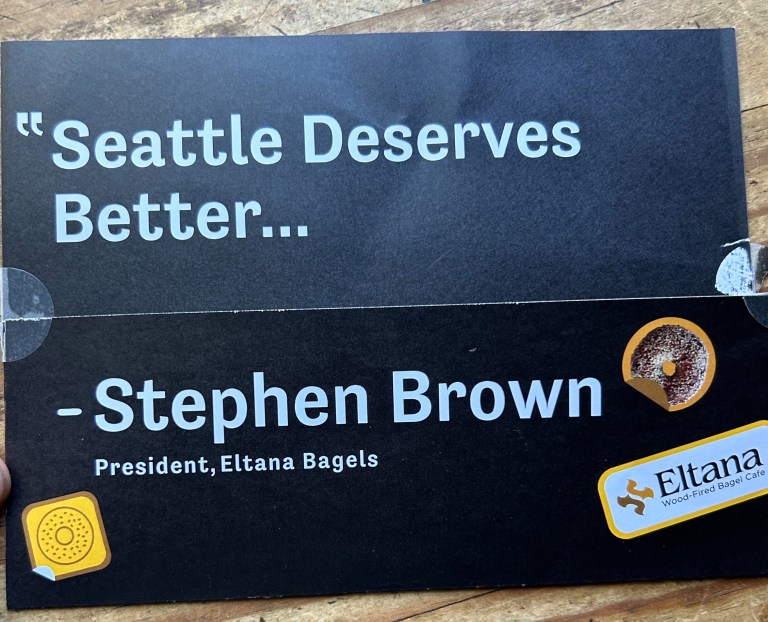
 The mailers, which went out shortly before ballots arrive for the August 1 primary, read, “Seattle Deserves Better… – Stephen Brown” and open to reveal the word “…Bagels!” along with an offer for free bagels valued at $25. About half the mailers went out to addresses in West Seattle, which does not have an Eltana location. (Brown says Eltana targeted people who live near grocery stores that sell the bagels).
 Last month, a federal judge, Marsha Pechman,
  Schaefer said he was acting as a private individual, and not in his capacity as a volunteer member of the planning board, when he, along with Councilmember Cydney Moore, informed people who had been living at an encampment next to City Hall that it would be legal for them to set up tents on a nearby piece of city-owned property that some condo owners have been using as a dog relief area.
 The deputy, George Alvarez, was driving an unmarked Yukon SUV and in plainclothes when he and his partner, Josh Lerum, began following a stolen truck driven by Black Diamond resident Anthony Chilcott.
 1. A new
  The largest portion of this loss was not, however, due to development in single-family neighborhoods,