The King County Jail in downtown Seattle has lacked potable water since Thursday, September 29, and people incarcerated at the jail have been relying on bottled water for the past week, PubliCola has confirmed.
According to a spokesman for the county’s Department of Adult and Juvenile Detention (DAJD), the county “has had the tap water in the jail tested multiple times in multiple locations, and all tests have indicated that the water meets EPA standards for drinking water. However, since the water is still cloudy, we are providing bottled water for drinking and cooking purposes.” The jail has “ample supplies of bottled water,” the spokesman said.
According to the president of the King County Corrections Guild, Dennis Folk, inmates are allowed one bottle of water at a time and can trade in empties for new bottles. This restriction, Folk said, makes it less likely that people will melt the plastic bottles to turn them into weapons or fill them with urine or feces to fling at guards or other inmates.
However, it’s unclear how frequently people inside the jail are actually getting access to water.
“What we are hearing is that there is rationing of water and people are having to choose between hydration or hygiene, and there just isn’t enough water available,” the president of the public defense union (SEIU 925), Molly Gilbert, said.
A spokesman for the jail said there is no rationing and that DADJ offers water “at every meal, periodically throughout the day, during medication delivery, and per request of jail residents.”
PubliCola reported the news exclusively on Twitter Thursday morning.
According to an email from King County Department of Adult and Juvenile Detention (DAJD) director Allen Nance to the King County Department of Public Defense, the department became aware of “complaints related to water quality” last week (according to Folk, the water coming out of the taps was brown). “We immediately implemented bottled water for all persons in custody and staff out of an abundance of caution,” Nance wrote.
“We have women in the jail who are having their period and they’re unable to get a change of underwear for the week,” Gilbert said. “It’s inhumane, it’s unconstitutional, and it’s a clear liability for the county.”—Molly Gilbert, SEIU 925, King County Public Defense Chapter
Water testing found high “turbidity,” or cloudiness—basically, foreign particles in water that can indicate the presence of disease-causing microbes—and the water has remained off since then while the county has tried to figure out the source of the problem. In his email, Nance said the brown water may have resulted from faulty screens on the water heaters at the jail. According to the DAJD spokesman, the county has sent samples of the water for testing and expects to get the results back tomorrow.
The ongoing water shutoff is just the most recent example of ongoing problems at the jail that have severely limited residents’ access to medical care, attorneys, and time outside their cells. In a survey conducted by the ACLU of Washington in late September, public defenders reported that their clients often lacked access to basic medical care, such as treatment for injuries and dental care, and medication, including everything from insulin to psychiatric meds. When there aren’t enough guards on duty, Gilbert said, escorts for the jail nurses who hand out medication are often the first thing to go. Responding to Gilbert’s statements, the jail spokesman said there are “few if any instances when medication passes would be affected by corrections officer staffing” and that the jail delivers medication even during staffing shortages.
Most of the ongoing issues at the jail stem directly from a worsening staffing shortage, combined with a growing population as the county books more people on misdemeanor charges and transfers inmates from the Regional Justice Center in Kent, whose setup requires more guards per incarcerated person. In recent months, staffing shortages at the jail have led to frequent lockdowns, in which people are locked in their cells 23 hours a day, and defense attorneys report waiting hours to meet with clients, who have to be escorted to meeting areas by guards who are in short supply.
In January, the unions for the public defenders and jail guards joined forces to ask county officials to reduce the population at the downtown jail. Although that request was in response to COVID outbreaks, the staffing shortages that were at issue back then have only worsened in the intervening months.
“We have women in the jail who are having their period and they’re unable to get a change of underwear for the week,” Gilbert said. “It’s inhumane, it’s unconstitutional, and it’s a clear liability for the county.” The jail spokesman disputes this and says jail inmates regularly receive fresh clothes regularly, and can get clean underwear whenever they want.
King County offers hiring bonuses for guards at both the adult and youth detention centers, but hiring hasn’t kept up with attrition as guards burn out and leave. Booking fewer people into the jail would be one solution—about half the people in the downtown jail are booked for three days or less—but that idea is politically unpopular at a time when perceptions of crime have increased. One candidate for King County Prosecutor, Federal Way mayor Jim Ferrell, recently signed on to an “open letter” from eight South King County mayors calling for more felony bookings and “incarceration to ensure… public safety.”
In July 2020, King County Executive Dow Constantine committed publicly to closing down the Patricia H. Clark Children and Family Justice Center (CFJC), saying it was time to shift “public dollars away from systems that are rooted in oppression and into those that maintain public health and safety.”
“Today I commit King County to converting the remaining youth detention units at the CFJC to other uses as quickly as possible, and no later than 2025,” Constantine announced in a Twitter thread that noted the connection between police murders of Black people and mass incarceration. About half the kids King County incarcerates are Black, a group that makes up about 6 percent of the county population, and about 18 percent are white, compared to 69 percent of the county.
Constantine’s announcement came at a time of heightened public scrutiny of the criminal legal system in the immediate aftermath of George Floyd’s murder by police in Minneapolis. The youth detention center had opened just five months earlier, replacing a decrepit, 212-bed facility next door, and stood largely empty because of COVID and a general reduction in youth arrests. The population would hover at about 20 young people throughout the next year, peaking at 26 and dipping to just 17 in August 2021.
One year later, however, the trend has reversed. In August, the average daily population at the youth jail was 41; on October 3, it was 42, including four kids charged as adults. While the population at the jail has grown, the number of guards at the jail has declined; as of September, 22 of 91 juvenile detention officer positions were unfilled, down from about six vacancies in the fall of 2020—a shortfall of 24 percent.
The timeline for closing down the youth detention center could also get a reality check. Closing the jail requires alternatives to incarceration that don’t exist yet, and the process to come up with those alternatives, which will likely include restrictive housing for youth who present a danger to the community, is proceeding slowly.
The increase in the number of young people incarcerated at the CFJC is exacerbated by a similarly steep decline in the number of people working at the jail. A representative of the Juvenile Detention Guild told PubliCola that juvenile corrections officers are leaving their jobs more than twice as fast as the county can hire replacements. Understaffing has also impacted other positions at the facility, which has at times been short on nurses and other medical staff. The high attrition rate has created a shortage not just of workers but experience—a gap that shows no sign of closing even as the county ramps up financial incentives to get new hires in the door.
Understaffing has contributed to the frequent use of solitary confinement, a practice that persists even though it was officially banned in 2017. Jail officials acknowledge that they use “room confinement” when there aren’t enough staff to let kids into common areas safely, but there is no legal distinction between “room confinement” and other euphemisms for isolating kids in their cells for up to 20 hours a day.
Solitary confinement leads to stress, boredom, and fights, and has contributed to a reported uptick in assaults on guards and other staff. According to the juvenile guards’ union representative, “We hire staff who want to work with youth, but they are leaving [because] it is an unsafe work environment, we have to lock youth in their dorms for extended periods of time, [and we] do not have sufficient staffing to provide services to the youth.”
King County officials are aware that keeping kids in their cells is a problem, but the use of the practice has been escalating. In July, there were 13 days when kids were locked in their cells between 18 and 20 hours a day because of short staffing at the jail. Additionally, an independent monitor’s report released in May found a “significant increase” in the number of times youth were put in “restrictive housing” (solitary confinement) because of a risk of “imminent and significant physical harm to the youth or others,” along with a spike in the length of this form of confinement; in the first quarter of this year, 41 kids were put in restrictive housing for an average of 6 hours per session.
Nick Straley, an attorney with Columbia Legal Services, says the Department of Adult and Juvenile Detention (DAJD) is skirting laws that were passed specifically to prevent the department from doing exactly what it’s doing now. “The King County Council should get involved and pass strict requirements that force DAJD to do the right thing because we know they aren’t” on their own, Straley said.
King County Councilmember Girmay Zahilay—who, like most of the nine county council members, visited the CFJC recently to get a better sense of conditions at the jail—said he was “shocked” to learn recently that the county still effectively allows solitary confinement for youth.
“If we literally don’t have the staffing to monitor people, I understand why that creates a different kind of situation, but it still is alarming, because from an experiential perspective rather than a technical perspective, the youth experience that the same way,” Zahilay said. “All the reasons we don’t want solitary confinement for youth are still true in that scenario, and we have to do everything we can to change those circumstances.”
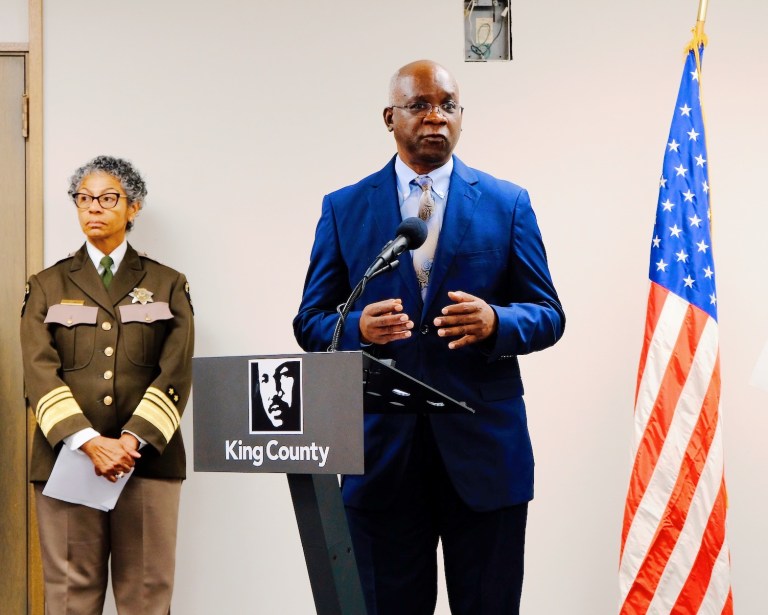
Department of Adult and Juvenile Detention Director Allen Nance (background: King County Sheriff Patti Cole-Tindall)
For adolescents, confinement is a particularly harsh punishment, depriving them of not only of chances to interact with other kids and adults but making it harder to schedule visits with attorneys and family members. During visits, kids are separated from their family members by Plexiglas, depriving them of the chance to hug their parents or hold their own children.
“There have been issues with parents not being able to have contact with their kids and only being able to see each other through Plexiglas,” a COVID-era innovation that prevents direct contact between family members and incarcerated youth, CLS’ Straley says. “The reality is that you’ve got the bare minimum level of humane treatment, and simply not having enough staff isn’t the only reason. They need to have more staff, and/or they need to have fewer kids in jail.”
There’s little consensus about why the county is locking up more kids at a time when youth detention is supposedly on a path to extinction. Jimmy Hung, who leads the juvenile division of the King County Prosecutor’s Office, attributes the reversal to an uptick in violent crime among both young people and adults. “And it’s not isolated to King County; it’s throughout the country,” Hung said. “We are dealing with aftermath of a once-in-a-century global pandemic, and that has also collided with the continuing escalation and increase in just the sheer number of firearms we have in our community.”
Straley believes the “perception out there that crime is running out of hand” is also contributing to harsher sentences from judges. “I think that perception is not accurate, but that’s the perception, and judges are aware of that and they adjust the sentence accordingly,” he said.
A DADJ spokesman, Noah Haglund, said another reason more kids are being detained is that incarcerated youth are being incarcerated longer, particularly the small percentage of kids charged as adults, whose average stay at the CFJC is 284 days; for kids detained on juvenile charges, it’s 17. Both averages have increased over the last five years.
Whatever the reasons, the number of kids at the youth jail is growing, and the number of staff at the jail is not keeping up.
DAJD director Allen Nance, appointed to the position last month after three years as head of the juvenile division, told PubliCola recently that the department “recognize[s]that not only do we need to do a better job recruiting quality folks to work with our young people in custody, but we also have to work diligently to implement strategies to keep the employees that we have today.”
Currently, the department offers hiring bonuses of $7,500 for new hires and $15,000 for lateral hires, as well as $5,000 to any county staffer who recruits a new detention officer for the adult or youth detention center. (Jobs at the adult jail pay slightly better).
However, the county lacks any significant programs to retain jail staffers once they’re hired—a major problem, given how many leave after they experience the challenges of the job; according to the union representative, “many staff will forfeit the money versus staying due to conditions” at the jail, including low morale, lack of support from DAJD leadership, poor schedules, and a lack of transparency about what will happen to CFJC staff if and when the facility closes.
Rod Dembowski, a King County council member who has been skeptical of the 2025 closure date, said during a recent council meeting that one reason the CFJC may be having trouble hiring guards is that the jobs offer no long-term security. “Why would someone come on to this job or stay in this job if it’s going to be gone in two or three years?” Dembowski said. “It’s not a real great career incentive and that may be hampering us.”
Hiring bonuses remain the primary tool the county uses to recruit new guards at both the juvenile and adult jail, which is also facing a crippling staff shortage. But county rules require newly hired jail staff to pay part of their bonuses back if they stay less than three years, which means that a guard hired today would have to stay at the CFJC until 2025, when the facility is supposed to close, with no guarantee of a new position.
“Our office’s position has always been that zero youth detention is a goal that we should strive for, and it’s aspirational. I don’t believe that we can truly reach zero youth detention before I’m gone, but maybe for my daughter and my grandkids we can see that [happen].”—King County Prosecutor’s Office Juvenile Division Director Jimmy Hung
At the same time, the juvenile detention department currently relies heavily on mandatory overtime, which falls primarily on new hires. Nance, the DAJD director, said “we definitely intend to reduce over-reliance on mandatory overtime, and in fact, incentivize individuals to voluntarily work overtime,” but did not offer specifics when we asked him about the issue in September.
Nance also said the department is “in the process of finalizing” retention incentives for existing staff, “recognizing that those individuals who have already made the commitment to stay at the detention facility through 2025 deserve an opportunity to work in an environment where they are valued, where they where they are well compensated, and where we go above and beyond wherever we possibly can to support their continued employment in the department.”
Nance did not offer more details about the department’s strategy to keep the staff it has.
Nor is it clear whether the youth detention center will actually close in 2025—or ever. Earlier this year, planning for the closure shifted from the DAJD to the Department of Community and Human Services (DCHS) in recognition of the fact that closing the youth detention center will require standing up community-based alternatives to incarceration, including housing that is more humane than a jail. Continue reading “Fewer Staff, More Incarcerated Kids, and Frequent Solitary Confinement as Youth Jail Closure Deadline Approaches”→
Department of Adult and Juvenile Detention director Allen Nance, King County Sheriff Patti Cole–Tindall
King County Executive Dow Constantine previewed his 2023 public safety budget on Monday, announcing his plans for new spending on police recruitment, diversion programs, corrections officers in the adult and youth jails, and body cameras for sheriff’s deputies—along with 140 new security officers for Metro buses and other investments.
The proposed new investments, which are part of an upcoming annual budget proposal that will be amended and approved by the King County Council, include:
$2.4 million for Vital, a program that targets “high utilizers” of the criminal justice system by providing case management and wraparound services;
$7.3 million for Restorative Community Pathways, a pre-filing diversion program for youth who commit certain first-time felonies;
$5 million for body-worn cameras, which every deputy would be required to wear by the end of 20205;
$21 million to hire 140 new security officers for King County Metro buses, transit centers, and stops.
King County Metro deputy general manager Michelle Allison said the bus agency needs more uniformed security officers on and off the buses to respond to concerns from riders and bus drivers that the bus system is unsafe. “Having more safety personnel is helpful for our riders and for our employees,” Allison said. “These folks acts act as a deterrent, and provide support for our customers and our colleagues.”
Sheriff Patti Cole-Tindall said the sheriff’s office has supported body-worn video for officers for at least the past decade, but that “it just takes time” to implement major changes. “We have to complete collective bargaining,” she said. “I think the time is right for cameras because our deputies actually want them. The community expects us to have them that accountability and transparency piece. It’s happening now, and I think that’s the important thing.”
Responding to questions about hiring,Cole-Tindall said her office has already hired 50 new deputies this year, and hopes to hire another 70 in the next two years.
The sheriff’s office isn’t the only county agency that has had trouble not just recruiting but retaining staff. The problem has been particularly acute at the county’s Department of Adult and Juvenile Detention, where understaffing at both the adult and youth jails has led to repeated lockdowns and the increased use of solitary confinement, including in the county’s Child and Family Justice Center (CFJC), which is supposed to shut down by 2025.
Retention, particularly at the juvenile jail, is a problem: more than 20 of the 90 juvenile detention officer positions are currently vacant, and far more officers have left their jobs at the CFJC than the county has been able to hire.
Nance said his department is “currently working on a plan” to restore in-person visits for family members and social service providers by the end of the year. Additionally, he said, the department plans to restore full booking hours at the Kent and downtown Seattle jails by early next year; currently, bookings at the Maleng Regional Justice Center in Kent are by appointment only, and the downtown jail has shut down booking three times in recent months because of staffing shortage.
Over the next two years, Nance added, DADJ will bring on 100 new adult correctional officers and 30 officers for the juvenile jail. Currently, the county offers hiring bonuses of up to $15,000 for new recruits. However, retention, particularly at the juvenile jail, is a problem: more than 20 of the 90 juvenile detention officer positions are currently vacant, and far more officers have left their jobs at the CFJC than the county has been able to hire. New recruits have to pay the bonuses back if they don’t stay for three years; with the youth jail slated for closure in 2025, this presents a challenge: It’s harder to nail new employees to a three-year commitment when they know they may be out of a job at the end of that period.
1. Officials from King County and advocates from community-based diversion programs responded Tuesday to what King County Executive Dow Constantine called “misinformation” about Restorative Community Pathways, a diversion program for young people that provides services and support for young people accused of first-time felony offenses, along with restitution and services for the people they’ve harmed.
“We’ve heard a lot of misinformation recently about the county’s juvenile diversion program and demonstrably false correlation to increased crime,” Constantine said. Earlier this year, King County Councilmember Reagan Dunn, a Republican, called for putting a “pause” on the program, which had just been approved two months earlier.
Federal Way mayor Jim Ferrell, who’s running for prosecutor this year, has called the program an “outrageous breach of public trust” that contributes to gun violence, something Constantine and the current prosecutor, Dan Satterberg, deny. “Officials and others in positions of public trust should take care to rely on facts, not hyperbole and data, not anecdotes,” Constantine said.
Satterberg emphasized that the county is still prosecuting serious crimes. “Lest people think this is all we’re doing, that we’re diverting all our cases away, I want to make it quite clear that the context here is that diversion … is but a small facet of the complex approach to public safety, crime, and justice that we have here in King County,” Satterberg said.
So far, about 380 kids have been referred to RCP programs, which are run by nine different community-based organizations, including Community Passageways, a youth diversion program that uses credible messengers to divert young people from the school-to-prison pipeline. Of those 380, 145 have completed the program, and just 8 percent have committed another offense, compared to about 20 percent of kids who go.through the traditional juvenile justice system.
“These young men standing behind me are the perfect model of what restorative justice looks like and how it works in our community,” Community Passageways director Dominque Davis said, gesturing toward four young men who went through his group’s program. “Right now, they shouldn’t be standing behind me. But because of the collaboration with county departments, and because of the work we’ve done in community with our partner organizations,” he said, they had not only graduated from the program but were working as case managers and business owners in their communities.
When Discovery Institute activist Jonathan Choe contacts county departments, including the executive’s, they have a standard response: “We decline to participate in your project.
2. Former KOMO reporter Jonathan Choe, who now produces anti-homeless videos for the far-right creationist think tank that spawned Chris Rufo, attended Tuesday’s press conference but didn’t ask any questions, despite the fact that only two reporters—myself and Omari Salisbury from Converge Media—plus a handful of camera operators were in the room, which left a lot of dead air.
Once the press conference was over and people started leaving, Choe began loudly demanding that Constantine respond to a question “about public safety.” When Constantine continued to walk away, Choe chased him down a hallway, nearly mowing down his chief of staff, “Mr Constantine, I’m asking about the Chinatown International district — why are you ignoring me?” he shouted theatrically, demanding to know if he would place a “moratorium” on a planned homeless shelter expansion in SoDo that, according to Choe, “the vast majority of the Chinatown-International District community opposes.”
Standing outside the elevator, Constantine responded: “You are not actually a journalist.” Reminding Choe why he was holding an iPhone, not a TV microphone, he added: “You were fired for promoting the Proud Boys.” (Choe was fired by Sinclair-owned KOMO TV after praising the insurrectionist group and posting a montage from their rally, encouraging viewers to attend the rally and learn about the Proud Boys’ “cause and mission.”) Choe continued arguing with Constantine’s staff, bellowing “I’m a journalist” when they told him they would only talk to legitimate media outlets.
Constantine’s response to Choe stood in marked contrast to that of Seattle Mayor Bruce Harrell, who has been known to let press conferences run long in order to politely answer Choe’s questions. When Choe contacts county departments, including the executive’s, they have a standard response: “We decline to participate in your project.”
The shelter complex, which would add 150 shelter spots, a tiny house village, and an RV safe lot to an existing 270-bed shelter in SoDo, has been the subject of significant debate in the nearby Chinatown/International District community. Advocates such as Friends of the CID have argued that the complex, which will be run by the county, is another example of systemic racism—concentrating services for homeless and low-income people in an already vulnerable community without consulting them.
King County’s juvenile detention center is confining more young people, and keeping them isolated in their cells more often, than at any point since early 2019, a report from the independent team monitoring the county’s compliance with a law restricting the use of solitary confinement at the youth jail concluded.
The team, represented by consultant (and former Seattle Office of Police Accountability director) Kathryn Olson, presented its findings for the first quarter of 2022 to the King County Council’s law and justice committee Tuesday.
As of Tuesday, there were about 42 young people incarcerated at the county’s Children and Family Justice Center (CFJC) in Seattle—a dramatic increase since last year, when King County Executive touted an average daily population of just 15 as he announced steps the county was taking toward emptying and closing the youth jail by 2025.
Most—38—of those incarcerated at the youth jail are facing juvenile charges for serious crimes, including robbery, kidnapping, assault, and rape; four are youth facing charges as adults.
At the same time, the CFJC—like the two adult jails—is dramatically understaffed, with about a quarter of juvenile detention officer positions unfilled. The county is offering bonuses of up to $15,000 for guards, and several other positions are vacant, including two nurse positions, according to a government jobs board.
According to the report, this combination of crowding and understaffing has contributed to an uptick in fights between incarcerated kids and assaults on staff; this, in turn, has led to more instances of “restrictive housing”—solitary confinement—which is supposed to be limited to no more than four hours at a time.
In addition to restrictive housing in response to behavioral issues, kids are often being confined in their rooms for hours—in some cases, for the majority of the day—for no reason other than that there aren’t enough staff to monitor them. Records from the county show more than 150 instances in both June and July in which young people were held in their cells for more than 18 hours a day, including the 12 overnight hours allowed for sleep—significantly longer than the four-hour maximum imposed by county law. According to a council staff report, this kind of confinement does “not constitute ‘solitary confinement’ under county code or state law, and therefore is permitted.”
Committee chair Girmay Zahilay said it was “shocking” that locking kids in their rooms because of understaffing doesn’t count as solitary confinement, because “experientially, it’s the same thing…. what are the universe of resources that we need to address this issue [to create] clearly defined plan to get from where we are, which is an alarming situation to where we should be, which is healthy youth?”
Understaffing in youth detention is also impacting detainees’ ability to go to class. According to the report, “youth at CFJC who were recently interviewed complained that due to reoccurring staff shortages, they frequently have missed most classes on a regularly scheduled school day.”
“Until staffing shortages are resolved, until other employment issues that are impacting some of the programming services are resolved… we’re just going to continue to see some of these issues,” Olson said.
1. The City Council’s public safety committee voted 4-1, with Councilmember Teresa Mosqueda voting “no,” to approve a package of police recruitment and hiring incentives that will include hiring bonuses of up to $30,000, four new recruitment-related positions (a recruitment manager, two recruiters, and an administrative staffer), and $150,000 to search for a new chief of police.
Sara Nelson, Alex Pedersen, Andrew Lewis, and committee chair Lisa Herbold voted for the legislation, originally proposed by Mayor Bruce Harrell.
According to a staff analysis, the hiring bonuses alone—$7,500 for new recruits and $30,000 for trained officers who transfer from other police departments departments—will cost around $3.8 million over four years, including around $1.5 million in 2022, $289,000 of that for the hiring incentives alone.
Before voting against the plan, Mosqueda noted that studies have consistently found that financial incentives have little impact on recruitment and retention, and have the potential to harm morale among officers working alongside newcomers recruited with large up-front payments. “What they’ve said is what they need is not additional money, but a place to bring people” in crisis, Mosqueda said. “A PR firm for SPD won’t help that. A hiring incentive approach won’t help that. Marketing won’t help that. [And] $150,000 for a police chief search won’t help that.”
The full council will vote on (and likely pass) the legislation next Monday.
2. Tuesday’s meeting also gave the council a look at SPD’s 2022 budget and staffing levels. Although the department lost 109 officers due to “separations” (resignations and retirements) in the first half of the year—significantly more than either SPD or council staff projected—there may actually be more officers on the streets by the end of 2022 than there were in 2021.
That’s because an unusually high number of officers went on extended leave starting immediately after the protests against police violence in summer 2020. Many more officers joined them after the city instituted its vaccine mandate in October 2021. Although these signposts are only indicators—SPD doesn’t provide information about why officers go on leave—the spikes in the chart correspond closely to those two events.
Historically, between 30 and 70 officers (out of a force that numbered close to 1,400) would be on extended leave at any given time; at the end of 2019, for example, 49 officers were on extended leave and unavailable for service. Typically, officers on extended leave are burning up their paid leave before they retire, since they can’t cash it out; after the vaccine mandate went into effect, some officers who did not want to get vaccinated went on leave as well. The numbers don’t include officers who are on administrative leave related to misconduct allegations.
After the city’s vaccine mandate took effect, 181 officers, or 16 percent of the police force, were out on extended leave.
The number of officers on extended grew slightly through the first half of 2020, in the early days of the COVID pandemic—a time when SPD was reluctant to grant leave to first responders. That number exploded in the months that followed the protests, nearly tripling between March and the end of 2020, when 137 officers were out on extended leave—more than 10 percent of the force. The number shrunk slightly, then exploded again, to 181, in the fall of 2021, after the vaccine mandate took effect. During that period, 181 officers, or 16 percent of the entire police force, were out on extended leave.
Since then, the gap has begun to close as some of those officers return to work after long periods off, at least temporarily offsetting losses from officers leaving the force.
A reduction in the number of police officers doesn’t translate to savings on a one-to-one basis, for a couple of reasons: Each officer who leaves SPD gets separation pay, which comes out of the budget, and fewer officers generally translates into more overtime costs. Currently, the city has paid out two-thirds of all the separation pay it budgeted for this year, and that only accounts for officers who left through the end of May. SPD is also spending more than anticipated on overtime, including patrol hours and staffing outside events; currently, the department is on track to go between $2 million and $3 million over its budget for 2022.
The department has been reluctant to scale back staffing at events like Mariners and Seahawks games, where officers direct traffic and provide security. At Tuesday’s meeting, Police Chief Adrian Diaz said SPD has “had to say no to many special events” because of understaffing and the need to dedicate officers to “emphasis patrol” areas like Third and Pine downtown and 12th and Jackson in the International District.
3. The discussion about overtime bled into a conversation about alternatives to policing—an issue Lewis has begun bringing up at nearly every SPD-related briefing. The basic question: After promising for more than two years to transfer some responsibilities, such as responding to low-risk 911 calls, into civilian hands, why has Seattle fallen so far behind other cities like Albuquerque, Denver, and Houston?
SPD, as we’ve reported, has argued that it needs to do a complex risk analysis before relinquishing control over any of the calls it currently handles, and Harrell’s office has generally concurred, laying out a lengthy timeline that could result in a transfer of some call types some time in 2024.
However, in the city’s latest quarterly report to the monitor overseeing the federal consent decree with SPD, the city attorney’s office reported that the city, “in the short term, will explore and execute potential pilot programs for diversified 911 response systems, as well as evaluate whether existing resources can be redeployed or more efficiently deployed on staffing projects like Special Events to increase SPD or alternative response to priority three and four calls in the near term, without engaging in costly expenditures in the face of a prospective budget deficit.”
This marks a change from the city’s previous position that a pilot can only happen after a lengthy data analysis. Lewis, Herbold, and others on the council have argued that SPD is already not responding to low-risk Priority 3 and 4 calls, so it doesn’t take work away from officers to deploy unarmed responders to some of those calls.




 By Erica C. Barnett
 1. The City Council’s public safety committee voted 4-1, with Councilmember Teresa Mosqueda voting “no,” to approve a package of police recruitment and hiring incentives that will include hiring bonuses of up to $30,000, four new recruitment-related positions (a recruitment manager, two recruiters, and an administrative staffer), and $150,000 to search for a new chief of police.