Tag: Rob Saka

Harrell Considered Hiring Ceis to Embed in Homelessness Authority, Council Starts Government 101 Briefings

Editor’s note: Due to a glitch, this article went out to newsletter subscribers earlier today but was not published on the site. We apologize for any confusion.

Mayor Bruce Harrell reportedly planned to hire controversial consultant Tim Ceis to serve as a city representative inside the King County Regional Homelessness Authority, where Ceis would work to reorganize and “fix” the organization, according to several sources. The plan to embed Ceis inside KCRHA hasn’t happened—PubliCola hears the mayor’s office decided it would be “too controversial”—but Harrell did manage to more or less singlehandedly appoint his longtime ally (and Garfield football teammate) L. Darrell Powell as the agency’s latest interim director.

It’s unclear whether the mayor plans to send someone other than Ceis over to the homelessness authority, which he recently criticized (along with Seattle-King County Public Health) to the Seattle Times, characterizing both the KCRHA and Public Health – Seattle & King County as “county” functions that should be doing a better job addressing homelessness and fentanyl, respectively, than they are. The city is actually a joint partner in both efforts, and provides a majority of KCRHA’s funding.

Ceis, a former deputy mayor whom Harrell hired to advocate for changes to Sound Transit’s station locations last year (Ceis received $310,000 to push for a plan that will eliminate stations near First Hill and in the Chinatown/International District), was recently criticized for his efforts to elevate business-backed candidate Tanya Woo, the business-backed candidate who lost last November to District 2 council incumbent Tammy Morales, to the city council. The eight elected councilmembers appointed Woo to replace former citywide councilmember Teresa Mosqueda late last month.

Neither Ceis nor Mayor Harrell’s office responded to requests for comment.

Now that Woo’s appointment is complete, the council has said it plans to get to work implementing the policy changes they promised during their campaigns, like hiring more police officers, getting “back to basics” like reducing visible drug use and filling potholes, and finding waste and inefficiencies in every city department.

PubliCola is supported entirely by readers like you. CLICK BELOW to become a one-time or monthly contributor.

Support PubliCola

(Why they couldn’t start holding committees during the first month of their terms is unclear. The new council decided not to hold a single committee meeting until filling the vacant position. In contrast, the council filled the most recent several vacancies while holding committees and conducting a typical full roster of council business.)

But first, the new council members’ committee agendas consist of a series of Government 101-style briefings from city departments and council staff about what the departments do, how the division of powers works when it comes to the budget and executive departments, and how the city functions as a whole. On Monday, council central staff director Ben Noble held a briefing to explain how the city budget works. Throughout, new councilmembers offered suggestions about how the budget could change this year—including adopting a whole “new model” for budgeting, “benchmarking” Seattle’s spending on certain areas (say: homelessness or transportation) in comparison to what other cities, such as Houston, do; and “driving efficiencies” by “consolidating functions” that are being done by multiple departments.

“Taxpayers need to see some good return on investments, and members of the public, they’re just not seeing that today. And I think the number one area where the members of the public are seeing lack of ROI is in our homelessness spending.”—Councilmember Rob Saka

Councilmember Rob Saka, in particular, said he would like to see the overall city budget (written by the mayor’s budget office, but amended and approved by the council), change to reflect the values of the “two-thirds net new council,” which is politically to the right of the previous council. “We need to align our budget priorities with the priorities of everyone here that sits at the dais,” Saka said, “not that of previous councils.” Specifically, he added, the city’s “taxpayers… need to see some good return on investments, and members of the public, they’re just not seeing that today. And … I think the number one area where the members of the public are seeing lack of ROI is in our homelessness spending.”

Saka, along with new councilmember Maritza Rivera, promised to “audit the budget” during his campaign. On Monday, both said that they do not think a full “budget audit” is affordable or feasible. (The exact definition of a “full budget audit” has always been vague, and the city already conducts routine audits of its departments).

“It would be great to audit the full budget, but that’s not practical,” Rivera said. This is something their opponents noted repeatedly on the campaign trail, but both stuck with their “audit the budget” promise until the end of the campaign, abandoning it only once they were securely on the council.

And Then There Were Eight: Council Narrows Down Nominees for Open Seat

Overhead of shot of Seattle City Council sitting at the dais
Seattle Channel screenshot.

By Erica C. Barnett

Each of the eight current Seattle City Councilmembers nominated one person each to serve as the replacement for former councilmember Teresa Mosqueda on Friday, narrowing down the list of 72 candidates whose applications just became public yesterday to eight.

Most of them will be familiar names to anyone who has been reading this site. Council members went one by one starting with Bob Kettle (who ousted Andrew Lewis last year), so the nominations don’t necessarily reflect which candidate was each council member’s first pick. They are:

Tanya Woo, the Chinatown-International District activist who fought against the expansion of a homeless shelter in SoDo and narrowly lost her race against District 2 incumbent Tammy Morales in November. (Bob Kettle)

Linh Thai, a former staffer for Congressman Adam Smith who was most recently the head of a veterans’ service organization. (Joy Hollingsworth).

Mark Solomon, a crime prevention coordinator with the Seattle Police Department who ran against Morales in 2019, when she was first elected to the council. (Rob Saka)

Juan Cotto, a a neighborhood activist from South Seattle who works as government affairs director for Bloodworks Northwest. (Maritza Rivera)

Mari Sugiyama, a Human Services Department manager who got a recent boost from a letter signed by 300 supporters, which I wrote about yesterday. (Tammy Morales).

Neha Nariya, the owner of the Civic Hotel in Queen Anne, which has served as emergency shelter (during the early days of the pandemic) and, more recently, as the site of harm reduction-based lodging through Purpose Dignity Action’s CoLEAD program. (Cathy Moore)

Steve Strand, the captain of SPD’s West Precinct. (Sara Nelson).

Vivian Song, a member of the Seattle School Board. (Dan Strauss).

If PubliCola was taking bets, the odds are on Woo, who several council members said would have been their first pick if they’d been at the front of the nominating line (Moore and Rivera, plus Saka, who mentioned her and a couple of people who didn’t make the cut). By installing Woo immediately after she lost an election, the council wouldn’t just be overturning the will of the voters, but requiring Morales to serve alongside the person she defeated—not a great look for a council that can’t stop talking about the new era of good feelings their election will usher in at city hall.

Beyond that, it’s unclear whether Woo—who received fewer than 13,000 votes in all, and whose support is strongly rooted in the CID—can win citywide, particularly in a Presidential election year when general electorate in Seattle will be younger and more progressive than in the low-turnout, non-mayoral odd-year election in which Woo narrowly lost. But apparently some on the council think she can; council president Sara Nelson, for example, said her “first criterion” for choosing a new colleague was that they must be “somebody who was going to run for office this year” and win.

After describing West Precinct Captain Steve Strand’s attributes, Nelson changed her mind, interrupting her own comments to say “You know what? I’ve convinced myself,” and nominate him after all.

“I would like the person that is in this seat to be the person who is going to have to live with those decisions that they make over the next nine months,” Nelson said. “The tendency to promise more than we can deliver long term is what I believe has gotten us into this position, and so I am very much looking for somebody who’s going to be willing to be accountable for the decisions that they make when they’re at this dais.” It’s not clear which council members she was referring to with that comment—of her colleagues that didn’t seek reelection last year, only one, Alex Pedersen, had served just one term before bowing out; the rest were veterans (Herbold, Juarez, Sawant) or ran and lost (Lewis).

Besides Nelson, most council members said the characteristics they were looking for in a new colleague were things like commitment to the city, community support, and expertise in at least one issue area—standard stuff. The only exception: Rob Saka, who said that after “collaboration,” his primary requirement is that they must be “someone who doesn’t view me as the enemy. Someone who doesn’t view any of my colleagues as the enemy either.”

“It’s unfortunate that that is something that have to have to say as something we should specifically avoid in this day and age,” Saka continued. “But that’s where we are. That’s a point where … we need to move move beyond that. So, let us move beyond the divisive, toxic, inappropriate rhetoric of ‘enemy.'” Noting that he is an Air Force veteran, Saka said he had spent time on combat missions “fighting against enemies. And what we’re doing [on the council] does not create or engender an enemy mindset or mentality.”

Saka did not specify who was trying to create an “enemy” mentality on the past or current council, or whether any of the 72 applicants had prompted this concern.

There was one more odd moment near the end of the meeting. It came during Nelson’s comments, which were initially about how she didn’t plan to nominate Strand, given that there were so many good candidates already. But, after describing Strand’s attributes—he has “partnered with multiple city departments, human service providers, businesses, and community based organizations to address homelessness, drug addiction, organized retail theft, [and] coordinated operations to target predatory drug dealers that fueled the fentanyl crisis”—she changed her mind, interrupting her own comments to say “You know what? I’ve convinced myself,” and nominate Strand after all.


Yesterday, Strand sent an email to all West Precinct staff that made it sound like he’d be going away for a while.

“I will leave my door open and light on for the next week and a half so you can come up and take a look” inside the office, the email—which, he insisted, was “not a going away speech”—said. “Outside the door you’ll see my Officer of the Year plaque from 1999. The handcuffs are Zsolt’s and were placed on all 326 arrestees we made that year.” Zsolt is Zsolt Dornay, a notorious officer who shot an unarmed DUI attorney in a brawl on Post Alley that may have started when he drove his motorcycle through a crowd, was suspended in 1995 for a violent road-rage incident, was suspended again for drunk driving in 2010, and was sued (and suspended) for allegedly assaulting a handcuffed man.

The email also encourages officers and staff to check out his military awards and gear, along with various other memorabilia, but warns “Don’t drink the snake wine, not sure what would happen.”

Councilmember-Elect Saka Compared 8-Inch Road Divider to Trump’s Border Wall

Partial map of the RapidRide road safety improvement project on Delridge; the arrow points to the daycare Saka says the city is discriminating against.

By Erica C. Barnett

City Councilmember-elect Rob Saka, a former Meta attorney who will represent West Seattle’s District 1 starting next year, sent a series of increasingly heated emails to Seattle Department of Transportation employees during 2021 and 2022 seeking the removal of a road divider that SDOT installed in front of his kids’ preschool. The divider was part of the RapidRide H project connecting Burien, White Center, and West Seattle to downtown.

The curb-like divider is a variation on a common traffic calming device known as a hardened centerline. The curb, which replaced a double yellow line, physically prevents northbound drivers from making an illegal left turn to access homes and businesses on the west side of the street, including a bilingual preschool called the Refugee and Immigrant Family Center. According to an April 2022 South Seattle Emerald story about the dispute, Saka’s two children attended the preschool as of last year.

In the email thread (reproduced in part here), which PubliCola obtained through a records request, Saka compared the mid-block traffic barrier to Trump’s border wall and said it was “triggering” and “severely traumatizing” to immigrants who “have faced significant trauma during their perilous journeys, including by navigating divisive structures and barriers designed to exclude lives in the US.”

“First, it might be helpful to reset on physical barriers as a social construct and how SDOT’s dangerous barrier here has severely traumatized and upset our community at the Refugee & Immigrant Family Center (RIFC),” Saka wrote. “Historically, barriers have been used to exclude, isolate, divide, discriminate against, project power over, subjugate, render less than status to, punish, segregate, humiliate/embarrass, harass, degrade, and so much more.”

“Historically, barriers have been used to exclude, isolate, divide, discriminate against, project power over, subjugate, render less than status to, punish, segregate, humiliate/embarrass, harass, degrade, and so much more,” Saka told project staff last March. “More recently, the Trump administration sought to build an enormous wall on the southern border with Mexico – presumably, to exclude certain individuals deemed ‘undesirable’ in the name of national security.”

The border wall is a 30-foot-high barrier, spanning hundreds of miles, that has contributed to the deaths of countless migrants, including a growing number of deaths and injuries due to falls. The Delridge barrier is an 8-inch-high road divider that runs for about 100 feet. Although Saka described the divider as “highly unique and bizarre,” SDOT has installed similar road treatments across the city, including along 15th Ave. NW in Ballard and Rainier Ave. South between I-90 and the Rainier Valley.

Even before SDOT installed the divider, left turns were illegal along the length of the RapidRide project, which also includes new bike lanes on both sides of the street. The divider is one of many new road treatments designed to keep people from attempting to pass stopped buses and prevent collisions with pedestrians and cyclists.

Many of the new safety measures along Delridge are much larger and more permanent than the raised centerline outside the RIFC. Just to the north of the preschool, for example, a new RapidRide bus stop in front of Louisa Boren K-8 school features a raised concrete island in the middle of Delridge, along with wide markings between the lanes to indicate that drivers should not turn left or pass buses at the RapidRide stop. Immediately to the north, a broad, landscaped median protects patrons at the Delridge library from cars turning illegally into the bike lanes and parking lot.

Nationwide, about a quarter of all car crashes involving pedestrians are caused by a driver turning left and hitting someone in their path.

The South Seattle Emerald’s story about the preschool’s concerns also notes that the new bike lane took out several parking spaces parents had used to drop off and pick up their kids.

POV: Driving north on Delridge Way SW, the new barrier blocks drivers from turning into a new bike lane and the sidewalk used by transit riders. It also prevents illegal left turns into a preschool parking lot.

In his emails, Saka suggested that community members, not roadway designers at SDOT, were in the best position to know what keeps their roadways safe.

For clarity, we don’t need a secretive ‘design team’ to impose their errant decisions on us in the name of ‘public safety’. Nor do we need a benevolent king to do the same,” Saka wrote. (Emphasis in original.) “SDOT must immediately remove the most egregious feature – a concrete barrier that directly targets our RIFC community and was erected without our prior consultation, input, or knowledge.”

In April 2022, an SDOT public engagement manager offered to set up a meeting with Saka to discuss the project. Saka responded that he would only meet the SDOT team if the agency guaranteed in advance that they would remove the barrier. “Like I mentioned earlier, we need this pretty simple confirmation from SDOT in order to ensure any meeting would be an effective and efficient use of time,” Saka wrote. “I strongly urge you to NOT overthink your response.”

SDOT has not yet responded to PubliCola’s inquiries about the project, and Saka did not respond to detailed questions sent on Tuesday. The operator of the RIFC also did not immediately respond to questions sent Thursday. A search of court records did not show any legal action by Saka, either on his own or on behalf of the preschool, and the road divider remains in place.

Single-Issue City Attorney Backs Candidates Who Support Drug Prosecutions; District 1 Candidate Rob Saka Benefits from Bagel Mailers

1. In a last-minute endorsement (of sorts), Seattle City Attorney Ann Davison sent out a mass email on Saturday urging voters to support the city council candidates who have consistently supported legislation—which will almost certainly pass later this summer—that would empower her to prosecute drug users for simple possession and for using drugs, other than alcohol and marijuana, in public. The law would incorporate a new state law into city law, granting the city attorney the authortiy prosecute misdemeanor-level drug use and possession.

The letter painted an apocalyptic picture of the city where Davison serves as chief local prosecutor.
“Parents should be able to take their kids on the bus without inhaling plumes of fentanyl smoke. We all should be able to walk in our parks and sidewalks without stepping over needles and drug paraphernalia. We should be able to get to work without dodging a gauntlet of drug deals,” Davison wrote.

“Unfortunately, some members of City Council voted not to allow Seattle to adopt our new State law on drugs. For me to have authority to prosecute and intervene, the new state law must be put into our city code by City Council.”

Although Davison’s letter, sent from her campaign email address, claims the proposed law would empower her to “intervene” in drug users’ cycle of addiction, the law itself is silent on intervention and diversion. In reality, according to a city council staff analysis, the legislation only gives the city attorney the authority to prosecute.

The city council candidates who unequivocally said yes to a Seattle Times survey question about prosecuting drug users, according to a survey conducted by the Seattle Times, are, in order of district: Rob Saka and Phil Tavel (District 1); George Artem and Ken Wilson (District 4); Boegert Bibby (District 5); Pete Hanning, Victoria Palmer, and Shea Wilson (District 6); Bob Kettle, Olga Sagan, Aaron Marshall, Wade Sowders, and Isabelle Kerner (District 7). District 7 incumbent Andrew Lewis also told the Seattle Times he supports prosecuting drug users, but because he cast the tie-breaking vote against the bill before saying he would support it, he does not meet Davison’s criteria.

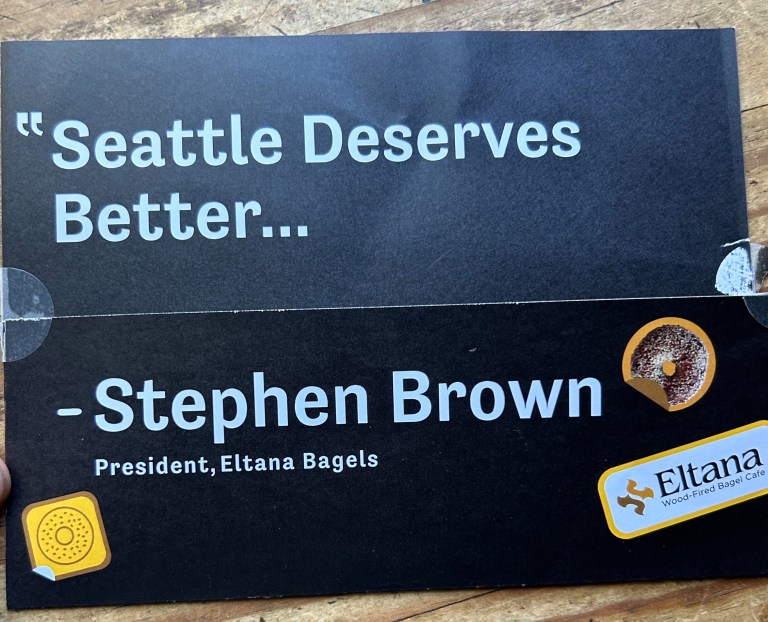
2. Meta attorney Rob Saka, a frontrunner in District 1, may be the primary beneficiary of billboards and mailers advertising Eltana Bagels, the company founded by another D1 candidate, Stephen Brown. As we’ve reported, Brown has insisted the mailers and billboards, which look strikingly similar to his campaign materials, were just ordinary advertising for the Montreal-style bagel stores.

That didn’t stand up to scrutiny by the Seattle Ethics and Elections Commission, however: The mailers, which featured the phrase “Seattle Deserves Better…—Stephen Brown” and offered $25 in free bagels, look like campaign literature, and the billboards—which also featured Brown’s name—were mostly located in District 1, which does not have a single Eltana store. After conferring with Ethics and Elections director Wayne Barnett, the Brown campaign filed an amended campaign report that included $33,000 for the West Seattle portion of the mailing and billboards.

Last week, the ethics commission went even further, voting—in response to a request from Saka—to allow him to raise and spend more than $93,750, the maximum allowed under Seattle election law unless another candidate goes above the spending cap. Ordinarily, this happens when a candidate’s own campaign spending, plus independent expenditures on their behalf, breaches the cap, but the city also allows candidates to spend more than the mandatory maximum if another candidate violates election law.

Ironically, Saka himself has already benefited from tens of thousands of dollars in spending from an independent expenditure campaign backed by real estate moguls and a Trump-donating billionaire, putting him over the limit himself. Maren Costa, a labor-backed candidate, requested a lift on the cap for her own campaign and received it last week.

Because last week’s hearing was about Saka’s motion to lift the cap, the Brown campaign’s $33,000 valuation for the mailers was not in question. The commission will likely seek a new valuation, but hasn’t yet, so as of now, the old, under-the-limit valuation stands. This creates a bizarre Schrödinger’s cap situation in which the Brown campaign has both spent more than the legal limit (according to the ethics commission) and is within the limit (according to the commission’s executive director and the campaign itself).

Campaign Fizz: The Case of the Carbon-Copy Mailers

1. Elliott Bay Neighbors and University Neighbors, two independent expenditure groups funded by local real estate developers and Republican donors, including Trump 2020 contributor George Petrie, sent out mailers supporting District 1 city council candidate Rob Saka and District 4 candidate Maritza Rivera. The identically worded mailers include the same factual errors about the history of homelessness in Seattle.

One one side, the Saka/Rivera mailers both promise “[Saka/Rivera] is endorsed by people you know and trust,” followed by a quote from a supporter (Community Police Commission member Harriett Walden and Attorney General Bob Ferguson, respectively) and a snippet of the Seattle Times’ endorsement for that candidate.

On the flip side, both feature the headline “After years of failure on homelessness…” followed by a list of six points in time (plus “2023: UTTER FAILURE”) that are supposed to represent that failure.

The timeline—whose only job is to be a timeline—includes two dates that are wrong. Mayor Ed Murray declared a homelessness emergency in 2015, not 2016, and the JumpStart payroll tax (“additional taxes for housing”) passed in 2020, not 2021. Perhaps more substantively, Murray’s declaration, King County’s Ten-Year Plan to End Homelessness; the “failure” of that plan; and the establishment of the original Nickelsville encampment have nothing to do with the city council; they were the responsibility of Ed Murray, King County, King County, and a group of unsheltered people, respectively.

Although the mailer describes JumpStart as “additional taxes for housing,” the fund was (pretty famously) crippled in its first few years as former mayor Durkan and current Mayor Harrell used it to backfill shortfalls in other spending areas, and does not exclusively pay for housing.

According to campaign finance reports, the mailers were designed by a consultant in Wisconsin.

Direct campaign donations are limited in Seattle, but independent political committees can spend unlimited amounts supporting or opposing candidates and ballot measures. Two of the chief supporters of the pro-Saka and -Rivera campaigns, George Petrie (and his wife Alyssa) and John Goodman, contributed a total of $190,000 to a pro-Bruce Harrell campaign and $100,000 to Compassion Seattle, the unfunded shelter and encampment-clearing mandate that a judge struck from the ballot for going beyond the scope of a local initiative.

2. Stephen Brown, the founder of Eltana Bagels and a candidate for City Council Position 1 (West Seattle), reported spending $33,577 to reimburse Eltana for billboards and mailers that appeared to promote Brown’s campaign. The mailers read “Seattle Deserves Better…—Stephen Brown” on the outside and opened to reveal an offer for $25 in free bagels. Brown maintained that the billboards and mailers, along with a Youtube video that concluded, “Stephen Brown fixed the bagel problem in Seattle—who knows what’s next?” had nothing to do with his campaign.

The Seattle Ethics and Elections Commission disagreed, sending Brown a list of questions about the ads and warning him that his campaign could no longer access public funding if he did not “resolve this issue.”

Had Brown not resolved the issue by paying for the ads, the ethics commission could’ve added his official campaign mailers to the pile of evidence suggesting the Eltana ads were meant to support his campaign. The design of the Vote Stephen Brown ad is extremely similar to the Eltana ad, from the fonts to the striking deep-purple-and-yellow color scheme to the photos of bagels to the choice of fonts.

3. Saka, who is one of Brown’s competitors, has asked the elections commission to lift spending limits for his campaign, arguing that Brown understated the true value of the ads and mailers and has actually spent more than the $93,750 limit for candidates using the city’s democracy voucher program. The ethics commission will hold a meeting tomorrow to consider his request.

UPDATE: Turns out our prediction (that the commission wouldn’t grant Saka’s request because they had already accepted a $33,000 estimate for the Eltana billboards and mailers) was wrong: The commission voted to grant the request on Thursday, agreeing with Saka’s campaign that the Brown campaign should have included the full value of all the money Eltana spent advertising bagels/Brown citywide, and not just in District 1.

During a lengthy discussion, commission director Wayne Barnett argued that it wouldn’t make much sense to advertise a West Seattle campaign in, say, Ballard. Commissioner Zach Pekelis, an attorney at Pacific Law Group, countered that ordinarily “we don’t think of campaign expendtures being discounted based on the efficacy or the inefficacy of the campaign expenditure,” and noted that if a District 1 campaign directly spent money on ads in another district, it “would definitely count” as a campaign expense.