Tag: Election 2023

Primary Election Voters Show Support for Harrell Agenda

City Councilmember Dan Strauss, shown in Ballard with Mayor Bruce Harrell, is the only incumbent who received more than 50 percent of the vote Tuesday night.

By Erica C. Barnett

A majority of Seattle’s primary election voters cast their votes Tuesday night for city council candidates who favor encampment sweeps, claim they’ll improve public safety by hiring hundreds of cops, and support arresting people for drug possession and public use.

The results are a proxy endorsement for the Harrell Administration—and a sign of how difficult it may be for progressives to maintain voices on the council who won’t rubber-stamp the mayor’s agenda. Unless the left-leaning underdog candidates who did come through—including experienced urbanist Alex Hudson in District 3—can overcome the odds, Harrell’s popular sweeps agenda could soon face minimal council opposition.

Although the most progressive candidate received a plurality of votes in several races—urbanist Ron Davis, for example, finished the night with 41 percent in Northeast Seattle’s District 4—that result was usually offset by a group of candidates splitting the conservative/centrist vote.

What this means for November is that nearly every council race will feature a progressive or progressive-ish candidate fighting for votes against a centrist candidate who didn’t command a majority in the primary but will scoop up all the more conservative votes when just two candidates are on the ballot.

And unlike progressives, the latter group will be lavishly funded; independent expenditure campaigns backed by big business and real estate interests have already spent tens of thousands of dollars on misleading ads supporting Harrell Administration staffer Maritza Rivera in District 4 and Meta attorney Rob Saka in District 1 (West Seattle), a template that helped propel one-term District 4 Councilmember Alex Pedersen to victory in 2019. (In notable contrast to similar candidates, Saka got just 25 percent of the vote despite relentlessly parroting Harrell-adjacent talking points.)

This assessment comes with a couple of significant caveats. So far, King County Elections has only counted the ballots of about 23 percent of eligible voters, a total that will continue to rise as later—generally more progressive—ballots are counted. In 2019, the last time all seven districted council seats were up for grabs, about 40 percent of eligible voters cast ballots in the primary.

Although Lewis did an immediate about-face and said he would support criminalizing drugs at the local level, the Seattle Times and Lewis’ opponents have treated the initial vote as a critical litmus test, putting Lewis on the back foot against his more conservative opponent, Bob Kettle.

The other thing to keep in mind when reading results is that people who vote in August, a time when many voters are out of town or not paying attention to local elections, trend more conservative than the larger group that votes in November.

Despite these caveats, the vote often skewed conservative even in races where the most progressive candidate took first place. Take Davis, who had a strong lead against runner-up Rivera last night with 41 percent of the vote. Rivera, the candidate of choice for Seattle’s business establishment, had a weak showing with 34 percent, but the second and third runners-up, Republican George Artem and two-time candidate Kenneth Wilson, shared a combined 25 percent (most of that, 23 percent, coming from Wilson)—a 59 percent majority for a centrist-to-conservative vision.

Already, Davis seems to be walking back some of his early progressive pronouncements; in a recent campaign mailer, he echoed Rivera’s promise to reduce 911 response times to five minutes, an utterly unrealistic goal that goes far beyond the police department’s own seven-minute goal.

District 5 (North Seattle) offers another good example. Thanks in part to an endorsement from the Stranger, equity consultant Christiana Obeysumner is currently defeating community advocate Nilu Jenks for second place by 21 to 19 percent. That puts former judge Cathy Moore in the lead with a weak 32 percent that could grow significantly if voters fail to respond to Obeysumner’s lefty housing justice agenda.

And even in the district that has repeatedly elected socialist Kshama Sawant, District 3 (Central District, Capitol Hill), progressive former Transportation Choices Coalition director Alex Hudson trailed Harrell-endorsed candidate Joy Hollingsworth, 40 to 32 percent.

Incumbents will face an uphill battle, too, including one—District 7 candidate Andrew Lewis—who has been pilloried by opponents over a single vote, against a drug criminalization bill sought by City Attorney Ann Davison. Although Lewis did an immediate about-face and said he would support the bill, the Seattle Times and Lewis’ opponents have treated the initial vote as a critical litmus test, putting Lewis on the back foot against opponent Bob Kettle, a Navy veteran who has focused on Lewis’ 2020 support for police defunding, who got 33 percent of the vote Tuesday night to Lewis’ 41 percent. On its own, a result in the low 40s is alarming for an incumbent, and Kettle will scoop up votes from people who voted for SPD officer Aaron Marshall and Piroshky Piroshky owner Olga Sagan, a favorite of the “Seattle Is Dying” crowd. Together, those three candidates currently share 54 percent of the vote.

In District 2, Morales is looking a little stronger against Chinatown-International District neighborhood advocate Woo, who led the battle against an expansion of a Salvation Army shelter in SoDo, a few blocks from the CID. As of Tuesday, Morales had 48 percent to Woo’s 45.

Dan Strauss, in District 6 (Northwest Seattle), is the only incumbent who ended election night with more than 50 percent, to former Red Door bar owner Pete Hanning’s surprisingly weak showing of 29 percent. Earlier this year, Strauss’ district shifted boundaries to include wealthy, conservative west Magnolia, which used to be in Lewis’ district; Strauss’ pitch to voters has shifted too, as he’s disavowed his previous support for reducing police funding and replacing some cops with civilian first responders.

Meanwhile, a similar scenario is playing out in Burien, where incumbent Cydney Moore is currently trailing two challengers, Linda Akey and Rut Perez-Studer. Moore has been a vocal supporter of people living unsheltered in the city, telling residents of an encampment the city swept earlier this year about another location where they were legally allowed and voting to accept funding from King County for a temporary shelter in the city. Akey is a frequent presence at Burien council meetings, arguing that the council needs to ban encampments and punish “disruptive behaviors” like drinking and using drugs in public. As of Tuesday, Moore had 26 percent to Akey’s 32 percent and Perez-Studer’s 28 percent.

Votes will continue to roll in over the next few days, with results landing on the county elections page around 4:00 every day.

Single-Issue City Attorney Backs Candidates Who Support Drug Prosecutions; District 1 Candidate Rob Saka Benefits from Bagel Mailers

1. In a last-minute endorsement (of sorts), Seattle City Attorney Ann Davison sent out a mass email on Saturday urging voters to support the city council candidates who have consistently supported legislation—which will almost certainly pass later this summer—that would empower her to prosecute drug users for simple possession and for using drugs, other than alcohol and marijuana, in public. The law would incorporate a new state law into city law, granting the city attorney the authortiy prosecute misdemeanor-level drug use and possession.

The letter painted an apocalyptic picture of the city where Davison serves as chief local prosecutor.
“Parents should be able to take their kids on the bus without inhaling plumes of fentanyl smoke. We all should be able to walk in our parks and sidewalks without stepping over needles and drug paraphernalia. We should be able to get to work without dodging a gauntlet of drug deals,” Davison wrote.

“Unfortunately, some members of City Council voted not to allow Seattle to adopt our new State law on drugs. For me to have authority to prosecute and intervene, the new state law must be put into our city code by City Council.”

Although Davison’s letter, sent from her campaign email address, claims the proposed law would empower her to “intervene” in drug users’ cycle of addiction, the law itself is silent on intervention and diversion. In reality, according to a city council staff analysis, the legislation only gives the city attorney the authority to prosecute.

The city council candidates who unequivocally said yes to a Seattle Times survey question about prosecuting drug users, according to a survey conducted by the Seattle Times, are, in order of district: Rob Saka and Phil Tavel (District 1); George Artem and Ken Wilson (District 4); Boegert Bibby (District 5); Pete Hanning, Victoria Palmer, and Shea Wilson (District 6); Bob Kettle, Olga Sagan, Aaron Marshall, Wade Sowders, and Isabelle Kerner (District 7). District 7 incumbent Andrew Lewis also told the Seattle Times he supports prosecuting drug users, but because he cast the tie-breaking vote against the bill before saying he would support it, he does not meet Davison’s criteria.

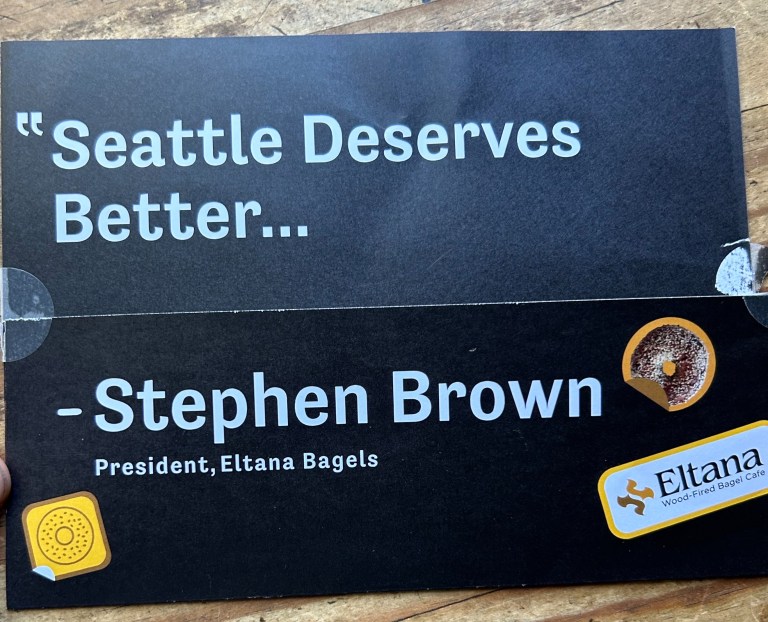
2. Meta attorney Rob Saka, a frontrunner in District 1, may be the primary beneficiary of billboards and mailers advertising Eltana Bagels, the company founded by another D1 candidate, Stephen Brown. As we’ve reported, Brown has insisted the mailers and billboards, which look strikingly similar to his campaign materials, were just ordinary advertising for the Montreal-style bagel stores.

That didn’t stand up to scrutiny by the Seattle Ethics and Elections Commission, however: The mailers, which featured the phrase “Seattle Deserves Better…—Stephen Brown” and offered $25 in free bagels, look like campaign literature, and the billboards—which also featured Brown’s name—were mostly located in District 1, which does not have a single Eltana store. After conferring with Ethics and Elections director Wayne Barnett, the Brown campaign filed an amended campaign report that included $33,000 for the West Seattle portion of the mailing and billboards.

Last week, the ethics commission went even further, voting—in response to a request from Saka—to allow him to raise and spend more than $93,750, the maximum allowed under Seattle election law unless another candidate goes above the spending cap. Ordinarily, this happens when a candidate’s own campaign spending, plus independent expenditures on their behalf, breaches the cap, but the city also allows candidates to spend more than the mandatory maximum if another candidate violates election law.

Ironically, Saka himself has already benefited from tens of thousands of dollars in spending from an independent expenditure campaign backed by real estate moguls and a Trump-donating billionaire, putting him over the limit himself. Maren Costa, a labor-backed candidate, requested a lift on the cap for her own campaign and received it last week.

Because last week’s hearing was about Saka’s motion to lift the cap, the Brown campaign’s $33,000 valuation for the mailers was not in question. The commission will likely seek a new valuation, but hasn’t yet, so as of now, the old, under-the-limit valuation stands. This creates a bizarre Schrödinger’s cap situation in which the Brown campaign has both spent more than the legal limit (according to the ethics commission) and is within the limit (according to the commission’s executive director and the campaign itself).

Rules Change Would Mandate In-Person Council Meetings; Port Candidate Was Sued for Alleged Role in Ponzi Scheme

1. City Councilmember Sara Nelson has proposed changes to council rules that would require all members to attend council meetings in person except in a limited list of circumstances, such as: If a council member has an infectious disease, if the meeting is at night or off-site, or if they are taking care of a sick family member or friend. Nelson’s proposed rule change would also require members who attend a meeting remotely to turn their video on during votes.

During a meeting of the council’s governance committee last week, Nelson said she appreciated the convenience of remote meetings but worried that they violated the spirit of the state Open Public Meetings Act. “Witnessing one’s representative or the governing body on screen is is not the same as seeing them in person, watching interactions among members, being able to share a glance or a smile with someone at the dais, and maybe even interact before the meeting,” Nelson said.

Remote attendance also discourages people from coming to see council meetings in public, Nelson added, “because why would somebody schlep all the way to City Hall when they could just watch a meeting on on Seattle Channel and then make a make public comment by phone?”

Committee chair Debora Juarez, who is immunocompromised and has attended council meetings remotely for most of the pandemic, said she agreed that in-person meetings are ideal but noted that exposure to COVID is still a safety issue, especially for people who are at higher risk of serious illness. “As a matter [of] principle, I don’t think that I can physically make eight people physically come to work every day and physically show up on the dais,” Juarez said. “I’m going to have to appeal to their judgment and defer to them.”

Juarez also noted that remote attendance has made life easier for council members with young children to balance their kids’ needs with their obligations as public officials, and has made public comment accessible to a more diverse group of voices, including people who are disabled, those with jobs they can’t leave in the middle of the day, and people who don’t want the hassle and expense of paying to park or using public transit to get downtown.

A work group that considered the proposed rule changes, including another rule (backed by Juarez) that would restrict public comment in council committees to items on the agenda, kept Nelson’s proposal on the table but did not include it in the underlying legislation, meaning Nelson would need to convince her colleagues to put the language in the bill. The committee rejected outright a separate proposal that would have required the Seattle Channel to broadcast the faces of people who comment remotely.

2. The campaign website for Jesse Tam, a former banker who’s running for the Port of Seattle Commission seat currently held by Fred Felleman, touts Tam’s financial and banking experience, noting that he “successfully organized and launched the first international private banking practice in the State of Washington” and “provided services for his banking clients between the Pacific Rim and many European nations” before “departing from the banking industry” for a new career in real estate.

In an email to PubliCola, Tam called the lawsuit a “frivolous civil lawsuit that was filed by a foreign unknown organization” and noted that it was dismissed with prejudice. The terms of the settlement are still confidential.

That description omits the incident that preceded Tam’s departure from banking: A massive lawsuit, filed on behalf 4,200 Indonesian investors, alleging that the bank Tam founded, Regal Financial Bank, helped promote a massive Ponzi scheme that defrauded clients of up to $600 million. The investors sued Tam and his bank for $175 million for their alleged involvement in the scheme. Tam’s bank settled for an undisclosed amount, and Tam has consistently denied any wrongdoing.

In an email to PubliCola, Tam called the lawsuit a “frivolous civil lawsuit that was filed by a foreign unknown organization” and noted that it was dismissed with prejudice. The terms of the settlement are still confidential.

According to a report from the Seattle P-I in 2009, Tam founded Regal Financial Bank in 2001, aided by money from a firm called Dressel Investments, which won over clients, many of them new to investing, by promising incredible returns of 24 to 28 percent. But “during the six years that followed, nearly all of the at least $300 million taken in by the company was used to repay other investors,” the P-I reported—a classic Ponzi scheme.

The lawsuit claimed that Tam “had full and complete knowledge” of the Ponzi scheme, traveled to Indonesia with a Dressel partner, and used the money Dressel took in from these investors to start his bank in 2001. “Dressel continued to be an important client at the bank until 2006, when the alleged Ponzi scheme began to collapse,” Northwest Asian Weekly reported in 2011.

Tam left the bank in 2009 and says his departure came “during the midst of the global financial crisis and had no association with the lawsuit. Regal Financial Bank was merged with Northwest Bank in Seattle in January of 2015 and it is currently operating in downtown Seattle,” he said. Tam currently runs an financial management consulting firm.

Campaign Fizz: The Case of the Carbon-Copy Mailers

1. Elliott Bay Neighbors and University Neighbors, two independent expenditure groups funded by local real estate developers and Republican donors, including Trump 2020 contributor George Petrie, sent out mailers supporting District 1 city council candidate Rob Saka and District 4 candidate Maritza Rivera. The identically worded mailers include the same factual errors about the history of homelessness in Seattle.

One one side, the Saka/Rivera mailers both promise “[Saka/Rivera] is endorsed by people you know and trust,” followed by a quote from a supporter (Community Police Commission member Harriett Walden and Attorney General Bob Ferguson, respectively) and a snippet of the Seattle Times’ endorsement for that candidate.

On the flip side, both feature the headline “After years of failure on homelessness…” followed by a list of six points in time (plus “2023: UTTER FAILURE”) that are supposed to represent that failure.

The timeline—whose only job is to be a timeline—includes two dates that are wrong. Mayor Ed Murray declared a homelessness emergency in 2015, not 2016, and the JumpStart payroll tax (“additional taxes for housing”) passed in 2020, not 2021. Perhaps more substantively, Murray’s declaration, King County’s Ten-Year Plan to End Homelessness; the “failure” of that plan; and the establishment of the original Nickelsville encampment have nothing to do with the city council; they were the responsibility of Ed Murray, King County, King County, and a group of unsheltered people, respectively.

Although the mailer describes JumpStart as “additional taxes for housing,” the fund was (pretty famously) crippled in its first few years as former mayor Durkan and current Mayor Harrell used it to backfill shortfalls in other spending areas, and does not exclusively pay for housing.

According to campaign finance reports, the mailers were designed by a consultant in Wisconsin.

Direct campaign donations are limited in Seattle, but independent political committees can spend unlimited amounts supporting or opposing candidates and ballot measures. Two of the chief supporters of the pro-Saka and -Rivera campaigns, George Petrie (and his wife Alyssa) and John Goodman, contributed a total of $190,000 to a pro-Bruce Harrell campaign and $100,000 to Compassion Seattle, the unfunded shelter and encampment-clearing mandate that a judge struck from the ballot for going beyond the scope of a local initiative.

2. Stephen Brown, the founder of Eltana Bagels and a candidate for City Council Position 1 (West Seattle), reported spending $33,577 to reimburse Eltana for billboards and mailers that appeared to promote Brown’s campaign. The mailers read “Seattle Deserves Better…—Stephen Brown” on the outside and opened to reveal an offer for $25 in free bagels. Brown maintained that the billboards and mailers, along with a Youtube video that concluded, “Stephen Brown fixed the bagel problem in Seattle—who knows what’s next?” had nothing to do with his campaign.

The Seattle Ethics and Elections Commission disagreed, sending Brown a list of questions about the ads and warning him that his campaign could no longer access public funding if he did not “resolve this issue.”

Had Brown not resolved the issue by paying for the ads, the ethics commission could’ve added his official campaign mailers to the pile of evidence suggesting the Eltana ads were meant to support his campaign. The design of the Vote Stephen Brown ad is extremely similar to the Eltana ad, from the fonts to the striking deep-purple-and-yellow color scheme to the photos of bagels to the choice of fonts.

3. Saka, who is one of Brown’s competitors, has asked the elections commission to lift spending limits for his campaign, arguing that Brown understated the true value of the ads and mailers and has actually spent more than the $93,750 limit for candidates using the city’s democracy voucher program. The ethics commission will hold a meeting tomorrow to consider his request.

UPDATE: Turns out our prediction (that the commission wouldn’t grant Saka’s request because they had already accepted a $33,000 estimate for the Eltana billboards and mailers) was wrong: The commission voted to grant the request on Thursday, agreeing with Saka’s campaign that the Brown campaign should have included the full value of all the money Eltana spent advertising bagels/Brown citywide, and not just in District 1.

During a lengthy discussion, commission director Wayne Barnett argued that it wouldn’t make much sense to advertise a West Seattle campaign in, say, Ballard. Commissioner Zach Pekelis, an attorney at Pacific Law Group, countered that ordinarily “we don’t think of campaign expendtures being discounted based on the efficacy or the inefficacy of the campaign expenditure,” and noted that if a District 1 campaign directly spent money on ads in another district, it “would definitely count” as a campaign expense.

City Council District 5: PubliCola Picks Nilu Jenks

District 5—far North Seattle—includes some of the wealthiest, most homogenous single-family neighborhoods in the city along with areas, like Lake City, that are dense, diverse immigrant hubs. Politically, the district tends to favor centrist candidates like incumbent Debora Juarez, a moderate who has supported punitive responses to encampments and drug use and was the target of protests when she opposed efforts to reduce police funding by 50 percent in 2020.

PubliCola Picks graphicThat’s all preface to say that neither of the top two candidates in this race—Nilu Jenks and Cathy Moore—set PubliCola’s progressive heart aflame.

A third candidate, equity consultant Christiana Obeysumner, would bring her own lived experience and long resume  as a housing navigator, clinical support specialist, and equity consultant to the job of addressing homelessness. When we spoke with Obeysumner, she demonstrated a detailed understanding of what it will take to house thousands of people experiencing different kinds of homelessness, from people with addiction and other disabilities to those who are couch-surfing or living in motels; she is also an impassioned advocate for the rights of sex workers.

For District 5, PubliCola picks Nilu Jenks—a climate and pedestrian safety advocate who we believe will take a thoughtful, nuanced approach to headline-grabbing issues, like police hiring and public drug use, while fighting for safe streets, climate resiliency hubs, and expanded access to shelter.

Like every candidate, Jenks came to our interview prepared to answer questions about police hiring and homelessness. (For the record, she thinks the goal of 1,400 officers is unrealistic, supports civilian alternatives to police for crisis calls, and thinks the city should establish a right to shelter.) But what really got her animated was talking about how Seattle needs to change over the coming decades to accommodate the thousands of people who will move here, many of them “climate refugees” from other parts of the country.

“Every other major city has sidewalks,” she said. “Why can’t we figure this out?”

The best way to respond to this growth, Jenks told us, is to plan for it now, by turning underdeveloped parts of the city—like the area around the future 130th Street light rail station—into dense, appealing neighborhoods. That means increasing height limits, planting trees, widening sidewalks, and slowing traffic so that people can cross the street without risking their lives.

Acknowledging that sidewalks are expensive, Jenks said she would start with areas that have the highest fatality rate, like Aurora Ave. N just south of Shoreline., neighborhoods with large immigrant and BIPOC populations, and areas that lack even one safe route for kids to walk to school. “Every other major city has sidewalks,” she said. “Why can’t we figure this out?”

Jenks also impressed us with her creative, district-level approach to achieving the city’s climate goals. One of her first priorities, Jenks said, would be establishing a climate resilience hub in North Seattle, which would serve as both a community center and a place where people could escape from increasingly severe weather caused by climate change. The city will open its first resilience hub in Beacon Hill, but Jenks says the north end—whose obsolete Lake City Community Center closed in April after a fire—would benefit from a new community center that doubles as a refuge from smoky summers.

She has also proposed providing free heat pumps—a cleaner source of central heating and cooling—to landlords who agree to limit rent increases, along with a right to shelter that would include locations where people could escape summer heat and wildfire smoke during the day.

To pay for some of these priorities, Jenks said she would propose a land-value tax—a tax on the value of a piece of property, regardless of what’s on it—because it would encourage property owners to maximize their land use (housing instead of empty parking lots) and would be more stable than a tax on vacant properties, which is designed to reduce vacancies.

Cathy Moore, a retired judge and former public defender, offered some intriguing ideas during our interview—for example, she said she would oppose any contract for police officers that did not include the same concessions made by the Seattle Police Management Association last year, including a reduced standard of proof for police misconduct and new restrictions on arbitrators, who frequently reverse disciplinary decisions.  But on most issues, from density (she supports the outdated urban village strategy) to police funding (she wants more of it), her views tracked closely with the council’s most conservative members, Alex Pedersen and Sara Nelson, and the Harrell Administration.

For District 5, PubliCola picks Nilu Jenks.

PubliCola’s editorial board is Erica C. Barnett and Josh Feit.

City Council District 4: PubliCola Picks Ron Davis

The race to replace anti-housing activist and one-term councilmember Alex Pedersen provides a clear contrast between an urbanist with a clear plan to build a city where people of all incomes can live in safe, vibrant, walkable neighborhoods, and a candidate whose campaign centers on hiring an unrealistic number of police and a business-as-usual approach to growth that would keep Seattle stratified and unaffordable.

PubliCola Picks graphicRon Davis, our pick for council District 4, would represent a massive upgrade for the district, which has been represented for the past four years by a guy whose most lasting achievement is a rule allowing council members to sit out votes on resolutions they find distasteful. Davis, in contrast to both Pedersen and the other frontrunner in this race, Office of Arts and Culture deputy director Maritza Rivera, is a real-deal urbanist who knows what makes successful cities work—frequent transit, abundant housing, and community-based public safety that includes bustling, vibrant neighborhoods—not just police.

Davis isn’t satisfied with the state legislature’s timid vision for fourplexes and the occasional six-unit apartment building directly adjacent to transit. In fact, he considers this vision—a light edit of the existing “urban village” strategy that confines renters to busy arterials and preserves leafy enclaves for single-family homeowners—anathema to equity and affordability. “To lock up that land, is really an act of economic and social vandalism to people around us and climate,” Davis told us. “The 15-minute city concept”—the idea that everyone should be able to access what they need within 15 minutes without a car—is ”supposed to be that every person lives in a 15-minute city, not little 15-minute neighborhoods that are stuck on arterials everyone can drive through.”

In contrast to his opponent, who says she “won’t rest” until there are enough police officers to reduce 911 response times to 5 minutes or less, Davis is realistic about police hiring and supports focusing on alternatives, including automated traffic cameras and civilian behavioral health crisis responders, while the city continues to hire police.

Instead of building walls around neighborhoods (or, as Rivera has proposed, imposing new design standards to ensure multi-unit buildings resemble nearby single-family houses), Davis wants to encourage development everywhere, by adopting a community-backed “Alternative 6” version of the Seattle Comprehensive Plan, eliminating parking mandates for new housing. He also wants to plant trees in historically disadvantaged communities, rather than using “tree protection” as a cudgel to prevent new housing, as Pedersen did; provide development bonuses (additional height and density) in new buildings that include affordable housing; target affordable housing in high-opportunity neighborhoods while creating a right to return for people displaced from gentrifying areas; and impose new taxes on vacant buildings and surface parking lots, which take up space that could be used for housing.

Davis is a tech guy whose does enterprise sales consulting for startups, but he comes from a working-class background and often talks about the personal experiences that helped shape his views. Instead of prosecuting and jailing drug users, Davis supports supervised consumption centers staffed with medical workers who can reverse or prevent overdoses and help people access treatment when they’re ready—an approach that has proven far more successful than mandatory and jail-based approaches. Speaking about a friend he lost to addiction, Davis said that if jail was actually a solution, “I would have hauled him there myself.”

In contrast to his opponent Rivera, who says she “won’t rest” until there are enough police officers to reduce 911 response times to 5 minutes or less, Davis is realistic about police hiring and supports focusing on alternatives, including automated traffic cameras and civilian behavioral health crisis responders, while the city continues to hire police. “We do need to increase police responsiveness times,” Davis said at a recent forum, but “we need to do this without magical thinking”—a reference to his opponent’s campaign pablum vow to hire 400 new police officers at a time when SPD’s actual staffing plan predicts a net gain of 15 new officers this year.

Rivera has a clear and admirable commitment to reducing gun violence by investing in community-based violence interruption programs and enforcing laws that are meant to prevent people who commit domestic violence from owning firearms. But her proposed solutions to other pressing issues is to simply double down on approaches that haven’t worked, such as addressing the fentanyl addiction crisis by prosecuting “repeat offenders” and dedicating even more of Seattle’s budget to the police department, which already receives a quarter of the city’s annual spending.

Rivera has repeatedly claimed, falsely, that the city council “voted to defund the police”—an unsubtle dog whistle that suggests she’s more interested in winning over Pedersen’s fan base than solving the very problems of public safety, addiction, and homelessness in this district.

PubliCola picks Ron Davis.

PubliCola’s editorial board is Erica C. Barnett and Josh Feit.