Tag: campaign finance

Mega Campaign Fizz: Compassion Seattle, Mayoral Money News, González Polls on Homelessness, and Much More!

1. Compassion Seattle, the group backing an initiative that would require the city to divert funds from other purposes to pay for 2,000 shelter beds in order to “clear” parks for housed people to use, announced Thursday that it had collected 64,155 signatures—about twice as many as the number of valid signatures the campaign needs to get the measure on the November ballot.

Even in victory, the campaign claimed to be the victim of “harassment, theft of petitions, assault and significant time delays”—claims it has made in multiple emails to supporters. The campaign did not immediately respond to questions about the incidents, including a request for case numbers in the event that they reported any of the alleged crimes to Seattle police.

UPDATE: In response to PubliCola’s questions, Compassion Seattle provided a list of eight incidents involving signature gatherers. Six involved people ripping clipboards out of people’s hands or destroying signature sheets. The remaining two examples were more dramatic; in one case, someone threw a garbage can at the signature gatherer, and in the other, a woman was “harassed and pushed down” on Capitol Hill.

2. Mayoral candidate Andrew Grant Houston received permission from the Seattle Ethics and Elections Commission on Thursday to raise money beyond the legal maximum under Seattle’s democracy voucher program, which limits mayoral campaign fundraising to $400,000 in the primary election. Houston argued (and the commission agreed) that mayoral candidate Bruce Harrell has already exceeded the cap through his own fundraising and that of a political action committee organized on his behalf.

Under city election law, any candidate who has maxed out on campaign spending or fundraising, unless the excess is “minor” or “inadvertent,” can seek a release from the cap as soon as another campaign, or the combination of a campaign and an independent expenditure (IE) campaign acting on the candidate’s behalf, has busted through the cap.

Because IE campaigns can raise and spend unlimited dollars from any source, IE fundraising routinely provides leads to a campaign fundraising free-for-all. Houston’s release from the cap will trigger other candidates who have reached the fundraising limit to seek similar permission to raise and spend more money, effectively neutralizing rules adopted by initiative in 2015 aimed at limiting the impact of money on elections. The initiative, known as Honest Elections, created the voucher program, which gives $100 to every Seattle registered voter to spend on the candidate or candidates of their choice; it also imposed a number of campaign-finance rules, including new contribution and spending limits.

During the 2019 election, the campaigns for city council candidates Jon Grant and Teresa Mosqueda, including a pro-Mosqueda PAC, raised and spent more than $1 million despite a total “campaign valuation” (fundraising) limit of $300,000. Similarly, spending on behalf of successful mayoral candidate Jenny Durkan totaled well over $2 million, despite a formal cap of $800,000.

Ultimately, the only thing that will stem out-of-control spending is a court ruling overturning or limiting the impact of Citizens United, the Supreme Court ruling that effectively barred limits on campaign spending by corporations and interest groups. Limiting spending by candidates but not committees, commission chair Richard Shordt pointed out Thursday, would limit the “voices” of “the thousands of Seattleites who are using their democracy vouchers” to support campaigns.

3. An online poll—apparently conducted on behalf of mayoral candidate Lorena González’s campaign—tested messages for and against the candidate in a hypothetical election between González and her former council colleague Bruce Harrell, who is currently the presumptive frontrunner.

The poll, which focuses on homelessness, describes González as a former civil rights attorney who was inspired to run “after watching Jenny Durkan give big corporations too much say in city government, side with the police union when cops tear-gassed Seattleites, and let the homelessness crises get worse”; it describes Harrell, more generically, as a former council president who “has the experience and skills to unite our city.” Continue reading “Mega Campaign Fizz: Compassion Seattle, Mayoral Money News, González Polls on Homelessness, and Much More!”

Seattle’s New Campaign Finance Legislation, Explained

This story originally appeared in the South Seattle Emerald.

Seattle’s city council recently passed two significant new pieces of campaign finance legislation aimed at reducing the influence of big corporations like Amazon in local elections, with a third bill still ongoing revisions. The first bill bans contributions from “foreign-influenced” corporations; the second creates new disclosure requirements for political ads, and the third—which sponsor Lorena Gonzalez has said she will bring back once she returns from maternity leave this spring—would limit contributions to political groups to $5,000.

If you’re wondering what this means for future elections, you’re not alone. Here are the answers to some of the most common questions about the Clean Campaigns Act—starting with the big one.

Does this mean Amazon will be banned from throwing millions of dollars at the next election? 

Amazon, which helped quash efforts to tax large corporations to fund homeless services in 2018, gave nearly $1.5 million to Civic Alliance for a Sound Economy, a political action committee (PAC) run by the Seattle Metro Chamber of Commerce, last year. The contribution, which made up 60 percent of CASE’s 2019 funding, paid for ads, mail campaigns, and direct outreach to voters on behalf of “pro-business” candidates in all seven council races.

The package of legislation could limit the influence of Amazon and other big companies in two crucial ways. First, the legislation passed this month bars contributions from “foreign-influenced” companies—defined as companies of which a single foreign owner controls more than 1 percent, or where a group of foreign owners control more than 5 percent. This, as Kevin Schofield has reported at SCC Insight, would bar contributions from Amazon, Uber, and Airbnb, among others.

The second piece of legislation—the one the council hasn’t passed—would limit contributions to independent expenditure groups to $5,000, while allowing groups with a large number of small (under $100) donations to give up to $10,000 to PACs. If the contribution limit had been in place last year, Amazon wouldn’t have been the only company affected: The Chamber PAC alone received $2.24 million in contributions above the proposed new limit, an amount that dwarfs the $183,000 they received in contributions of $5,000 or less.

Support The C Is for Crank
The C Is for Crank is supported entirely by generous contributions from readers like you. If you enjoy the breaking news, commentary, and deep dives on issues that matter to you, please support this work by donating a few bucks a month to keep this reader-supported, ad-free site going. Your $5, $10, and $20 monthly donations allow me to do this work as my full-time job, so please become a sustaining supporter now. If you don’t wish to become a monthly contributor, you can always make a one-time donation via PayPal, Venmo (Erica-Barnett-7) or by mailing your contribution to P.O. Box 14328, Seattle, WA 98104. Thank you for keeping The C Is for Crank going and growing. I’m truly grateful for your support.

Why is the council going after foreign ownership? Seems a little… Specific.

Supporters of the legislation have argued that because federal law bans direct contributions by foreign nationals, a ban on giving by “foreign-influenced” contributions closes a loophole that allows citizens of other countries to influence elections by investing in US companies, which are allowed to spend money on political campaigns.

But the real issue at play is that the infamous Citizens United Supreme Court decision, which gave corporations nearly infinite power to spend money to influence elections, leaves few avenues for governments to place limits on corporate spending. One such avenue is the ban on direct foreign contributions, which the Court has upheld. So the gamble here is that if the legislation is challenged up to the Supreme Court level, the Court will be more sympathetic to arguments about foreign influence than it would be to arguments for limiting corporate spending in general. Continue reading “Seattle’s New Campaign Finance Legislation, Explained”

Council May Push to Regulate PACs, Which Spent As Much As $18 Per Vote in August Primary

Big spenders: Moms for Seattle’s pro-Murakami push cost $7 per vote.

1. The Seattle Ethics and Elections Commission expressed skepticism yesterday about a long-shot effort by council member and state attorney general candidate Lorena Gonzalez to stem the influence of political action committees on local elections by imposing new contribution limits and disclosure requirements on such groups. Commissioners said they supported the idea of limiting corporate campaign contributions as a policy, but questioned whether it was a good idea for the city to pass a law that would be subject to immediate legal challenge.

“I support the legislation, but I am also incredibly pragmatic [and] I’m not sure I support Seattle paying for this lawsuit,’” SEEC commissioner Eileen Norton said.

Gonzalez’ legislation would prohibit companies with foreign ownership (such as Uber) from contributing to independent expenditure campaigns; cap contributions to PACs at $5,000; and require PACs to maintain detailed, publicly available records about their contributors and how they spent their money. Currently, there are no caps on how much a person, company, or organization can contribute to a PAC, and no requirement that PACs detail where their money is going.

The proponents’ legal theory rests on the hope that the Supreme Court, or an en banc panel of the entire federal Ninth Circuit District Court, will overturn previous rulings (by a D.C. circuit court and a three-judge panel of the Ninth Circuit, respectively) concluding that local governments do not have the authority to regulate PAC contributions. In the Citizens United ruling, the Supreme Court struck down restrictions on corporate spending on the grounds that corporations have the same rights to free “speech” as individual citizens.

“I’m not a betting woman, but I think I would be willing to bet my mortgage on [a lawsuit].”—Seattle Ethics and Election commissioner Eileen Norton.

Predictably, corporate spending ballooned across the nation, including in local races like Seattle’s mayoral and council elections. PAC spending on this year’s seven city council races has already outpaced total independent spending in the 2015 election, when all nine council seats were up for grabs; in every case, the candidate supported by corporate or (in one case) labor spending made it through to the general election.

The contribution limit would be the most significant shift, and the one most open to legal challenge. This year, for example Amazon contributed $250,000 to the Seattle Metro Chamber’s PAC, while Bellevue charter-school proponent Katherine Binder poured $25,000 into Moms for Seattle, a group that targeted liberal incumbents with Photoshopped images of playgrounds taken over by homeless encampments, graffiti, and trash. And UNITE HERE Local 8, a New York City-based union, spent $150,000 on TV ads promoting Andrew Lewis in District 7.

Support The C Is for Crank
Sorry to interrupt your reading, but THIS IS IMPORTANT. The C Is for Crank is a one-person operation, supported entirely—and I mean entirely— by generous contributions from readers like you. If you enjoy the breaking news, commentary, and deep dives on issues that matter to you, please support this work by donating a few bucks a month to keep this reader-supported site going. I can’t do this work without support from readers like you. Your $5, $10, and $20 monthly donations allow me to do this work as my full-time job, so please become a sustaining supporter now. If you don’t wish to become a monthly contributor, you can always make a one-time donation via PayPal, Venmo (Erica-Barnett-7) or by mailing your contribution to P.O. Box 14328, Seattle, WA 98104. Thank you for keeping The C Is for Crank going and growing. I’m truly grateful for your support.

John Bonifaz, an attorney with the group Free Speech for People who helped draft the legislation, said yesterday that Long Beach, FL is the only other US city that has passed similar regulations. So far, that law has not been subject to legal challenge. In Seattle, there is little doubt that someone will sue to stop Gonzalez’ proposal from taking effect. “I’m not a betting woman, but I think I would be willing to bet my mortgage on that one,” Norton, the SEEC commissioner, said.

2. Speaking of unfettered campaign spending, here’s a quick-and-dirty look at how much this year’s three most active (and largest) campaign PACs—Moms for Seattle, People for Seattle, and the Chamber’s Civic Alliance for a Sound Economy—spent promoting their candidates (or tearing down their opponents) on a dollars-per-vote basis. These numbers are rough (and probably a little on the low side) because these PACs chose not to itemize many of their expenditures, and because more expenditures will show up on future reports as the campaigns pay off rolling debts. (In lieu of an exact breakdown, I’ve divided the total amount of non-itemized expenditures by these groups and added it to their itemized expenditures on specific candidates, except in the case of Moms, whose record-keeping is almost completely opaque.) Despite those caveats, the numbers are a way of measuring how much these groups are willing to spend to influence your vote. Continue reading “Council May Push to Regulate PACs, Which Spent As Much As $18 Per Vote in August Primary”

Election Crank: But Wait—It Gets Even MORE Confusing

Some campaign updates as the August 6 primary (and the narrowing of the Seattle City Council elections from dozens of candidates to just 14) approaches…

1. As I reported on Twitter last weekend, the political action committee for the Seattle Metro Chamber of Commerce, Civic Alliance for a Sound Economy, just spent more than $307,000 on mail, canvassing, literature, and direct mail for its endorsed candidates in all seven city council races.

But the bulk of the money—$260,350—went to three candidates: Lisa Herbold challenger Phillip Tavel, who ran for the same position in 2015 and didn’t make it through the primary ($77,750); former Capitol Hill Chamber of Commerce leader Egan Orion, who’s challenging Kshama Sawant ($107,400); and Seattle Police Department  crime prevention coordinator Mark Solomon, who’s running for the seat being vacated by Bruce Harrell, where community organizer Tammy Morales is the presumed frontrunner ($75,200).

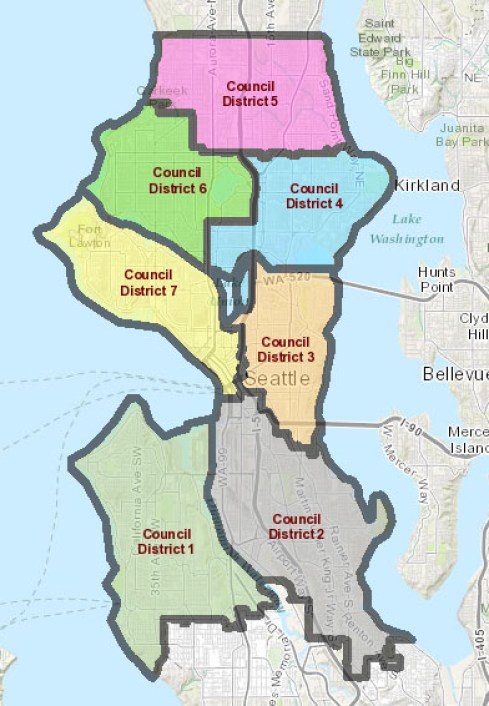
The Chamber’s PAC is spending smaller amounts of money on the other five candidates the group endorsed in June: former Tim Burgess aide Alex Pedersen, running in Northeast Seattle’s District 4; Debora Juarez, the incumbent in North Seattle’s District 5; ex-council member Heidi Wills and physician Jay Fathi, both running for Northwest Seattle’s District 6; and former Seattle police chief Jim Pugel and commercial real estate consultant Michael George,  running to represent downtown, Queen Anne, and Magnolia in District 7.

Next week, Jay Fathi (D6) and Michael George (D7) will ask to be released from the $75,000 spending cap on the grounds that the Seattle Chamber is spending money on behalf of one of their competitors—Wills in Fathi’s case, and Pugel in George’s. Of course, CASE is also spending money on behalf of Fathi and George in those races, so both are essentially arguing that they should be released from the spending cap because of spending by their own political benefactors.

2. Candidates for districted city council seats who participate in the democracy voucher program are theoretically limited to raising and spending a maximum of $75,000 in the primary election (and another $75,000 in the general), but that isn’t how it’s working out in practice. As of this writing, at least 16 candidates running for the seven districted council seats have asked to have their spending caps, or the caps on both spending and contributions, lifted because their opponents have either raised more than $75,000 or have had more than $75,000 spent on their behalf. (SEEC director Wayne Barnett provided a list of candidates who’ve been released from the caps).

Under the somewhat byzantine rules of the city’s new system, candidates in this year’s council elections who accept public funding through democracy vouchers (coupons worth $100 that are given to every Seattle voter to spend on the candidate or candidates of their choice) can’t spend more than $75,000 unless one of two things happens: a) another candidate in the race who isn’t participating in the voucher system, and therefore isn’t subject to spending limits, spends more than $75,000, or b) a political action committee spends enough on behalf of a candidate that the total expenditures on that candidate’s behalf top $75,000. In the former situation (when, say, Kshama Sawant outspends all of her opponents and isn’t subject to democracy voucher caps), candidates can ask to have both the spending limit and the $250 cap on individual contributions lifted. (The contribution limit for non-voucher candidates is $500). In the latter situatiom (when, say, the Seattle Metro’s PAC spends $77,000 to defeat incumbent Lisa Herbold, but no candidate in the race has spent more than $75,000 on their own), the candidates can only be released from spending, but not contribution, limits.

Support The C Is for Crank
Sorry to interrupt your reading, but THIS IS IMPORTANT. The C Is for Crank is a one-person operation, supported entirely—and I mean entirely— by generous contributions from readers like you. If you enjoy the breaking news, commentary, and deep dives on issues that matter to you, please support this work by donating a few bucks a month to keep this reader-supported site going. I can’t do this work without support from readers like you. Your $5, $10, and $20 monthly donations allow me to do this work as my full-time job, so please become a sustaining supporter now. If you don’t wish to become a monthly contributor, you can always make a one-time donation via PayPal, Venmo (Erica-Barnett-7) or by mailing your contribution to P.O. Box 14328, Seattle, WA 98104. Thank you for keeping The C Is for Crank going and growing. I’m truly grateful for your support.

The candidates who have been given approval to spend more than $75,000 are: Lisa Herbold in District 1 (because of CASE spending on Phil Tavel’s behalf); Tammy Morales, Phyllis Porter, Christopher Peguero, and Mark Solomon in District 2 (because Ari Hoffman has raised more than $75,000, they are also released from contribution caps—including Solomon, who is also benefiting from the Chamber’s largesse); Ami Nguyen, Logan Bowers, Pat Murakami, Zach DeWolf, and Egan Orion in District 3 (because Kshama Sawant has raised more than $75,000, all the other candidates are also released from contribution caps; Orion, like Solomon, is getting help from the Chamber as well); Emily Myers and Shaun Scott in District 4 (because of CASE spending on Alex Pedersen’s behalf); no one (!) in District 5 (as of July 2, incumbent Debora Juarez had raised just $43,000); Dan Strauss, Kate Martin, and Sergio Garcia in District 6 (because of CASE spending on Jay Fathi and Heidi Wills’ behalf); and Andrew Lewis in District 7 (because of CASE spending on behalf of Jim Pugel and Michael George.)

Whew!

But wait: It gets even more confusing. Next Tuesday, July 8, Fathi (D6) and George (D7) will both appear in front of the Seattle Ethics and Elections Commission to ask to be released from the $75,000 spending cap on the grounds that CASE is spending money on behalf of one of their competitors—Wills in Fathi’s case, and Pugel in George’s. Of course, CASE is also spending money on behalf of Fathi and George in those races, so both are essentially arguing that they should be released from the spending cap because of spending by their own political benefactors.

This will look even weirder if, as seems likely, CASE puts out literature suggesting that voters pick either George or Pugel, and either Wills or Fathi, in those races—a scenario that will benefit all four candidates, not just Wills and Pugel. Not only that: George, Fathi, and CASE all share a financial compliance firm, Blue Wave Politics, which means that the same company is behind the campaigns benefiting from CASE spending, the campaigns asking to be allowed to spend more money because of CASE spending, and CASE itself. Pretty sure that this wasn’t exactly what the backers of democracy vouchers had in mind when they said the system would help get money out of politics.

Not only that: George, Fathi, and CASE all share a financial compliance firm, which means that the same company is behind the campaigns benefiting from CASE spending, the campaigns asking to be allowed to spend more money because of CASE spending, and CASE itself.

3. Speak Out Seattle, a group of self-described “concerned citizens” that held a series of controversial campaign forums earlier this year, has released its own list of endorsements—a roster that could have been lifted straight from the Facebook page of Safe Seattle, an online group that promotes conspiracy theories, false allegations, and harmful “solutions” for Seattle’s homelessness crisis. The candidates SOS has endorsed, in order of district, are: Ex-cop Brendan Kolding (District 1); both Solomon and conservative business owner Ari Hoffman (District 2); Mount Baker neighborhood activist Pat Murakami (District 3); Pedersen (District 4); attorney Ann Davison Sattler (District 5); Wills; and George. Safe Seattle, which is separate from SOS but has expressed many of the same views about homelessness, housing, and addiction, has frequently promoted Davison Sattler and Hoffman on their Facebook page.

When I entered the furthest-left positions on AlignVote’s questions about homelessness, “safe injection,” and housing in District 2, it suggested I vote for stunt candidate Omari Tahir-Garrett.

<

4. Davison Sattler created quite a stir at a recent candidate forum in District 5, which I was moderating, when she responded to a question about reducing emissions by calling climate change a “luxury item” compared to immediate problems like “keeping our city clean.”

Over shouts of disbelief from some audience members, Davison Sattler continued: “If we cannot even keep our city clean, I feel like we are in no place to be talking about issues like this. This is absurd that we are talking about this, yet we cannot keep our city clean. … We have to be taking care of things that are clearly on everyone’s minds, which is the state of our streets.”

During the same debate, Davison Sattler said she supported a “FEMA-style response” to homelessness; suggested putting a new North Seattle community center inside a new police precinct across the street from North Seattle Community College, where the event was being held; and said that some businesses near a now-dismantled authorized encampment at Licton Springs “could not even keep their employees for more than a few hours” because they had to wade through human feces, litter, and needles near the encampments.

No word yet on how candidates and activists who talk about the presence of “human feces” all over the city’s sidewalks can distinguish human from dog feces in a city where housed dogs outnumber unsheltered humans by about 45 to 1.

D5 candidate Ann Davison Sattler created a stir when she responded to a question about reducing emissions by calling climate change a “luxury item” compared to immediate problems like “keeping our city clean.”

5. SOS leader Steve Murch has created a voter guide called AlignVote, which (like SOS) purports to be a “nonpartisan” and unbiased guide to the candidates’ positions. In reality, the tool functions as a push poll for SOS’s positions on supervised consumption sites, rent control, and other issues—characterizing rent control, for example, as a policy that imposes “further restrictions on what prices landlords can charge.” (Another question, about police accountability, prevented these two possible responses as a binary choice: “The Seattle Police Department has major work to still do to restore more fairness and equity” and “The City Council needs to be more supportive of our police.”) When I entered the furthest-left positions on AlignVote’s questions about homelessness, “safe injection,” and housing in District 2, it suggested I vote for stunt candidate Omari Tahir-Garrett.

Council Campaign Fundraising: Who’s Raking It In and Who’s Lagging Behind

We’re about two months away from the May 15 filing deadline for city council elections, the point when no more candidates can add their names to the 52 (as of this posting) who have put their names in contention. Will the number grow to 70, for an average of 10 candidates per council race on the ballot? Will any of these candidates raise any money, or are the top two in most races already a foregone conclusion? How much money will be spent in this election, the first election under the new district system in which none of the candidates are holdovers from the pre-district system?

Those questions are obviously speculative, but a look at the money—who’s raising it, who’s spending it, and who’s benefiting—can provide some clues. Here are a few observations from the first month in which candidates have ramped up (or, in some cases, slacked off) on raising and spending on their campaigns.

A quick note about campaign fundraising figures: Cash on hand numbers are approximate, because campaigns only disclose expenditures at the end of the month. I haven’t provided cash on hand numbers for every candidate, because those numbers are less relevant now than they will be further along in the campaign, when candidates need money to drum up votes and every dollar really counts. Because many candidates choose to report contributions as they come in—a practice that becomes mandatory in the final days of the campaign—contributions are often more up to date than expenditures. When a candidate has not reported any contributions after their most recent monthly filing, I will note “as of February 28” to make that clear.

Democracy vouchers are a form of public campaign financing the city of Seattle first started using in 2017. To qualify, candidates must get at least 150 signatures and 150 donations of $10 or more from Seattle residents. Every Seattle resident received four vouchers worth $25 each, which they can contribute to any qualifying candidate. Candidates who accept democracy vouchers are subject to campaign contribution and spending limits, including an individual contribution cap of $250. Candidates who don’t participate aren’t subject to those limits, and can take contributions up to $500.

Support The C Is for Crank
If you like the work I’m doing here, and would like to support this page financially, please support me by becoming a monthly donor on Patreon or PayPal.  For just $5, $10, or $20 a month (or whatever you can give), you can help keep this site going, and help me continue to dedicate the many hours it takes to bring you stories like this one every week. This site is funded entirely by contributions from readers, which pay for the time I put into reporting and writing for this blog and on social media, as well as reporting-related and office expenses.  If you don’t wish to become a monthly contributor, you can always make a one-time donation via PayPal, Venmo (Erica-Barnett-7) or by mailing your contribution to P.O. Box 14328, Seattle, WA 98104. Thank you for reading, and I’m truly grateful for your support.

In District 1 (West Seattle), incumbent Lisa Herbold has raised the most from actual contributors, with $13,014 in contributions and about $11,996 on hand. Phillip Tavel, an attorney who got 18 percent of the vote in his run for the same seat in 2015, reported more contributions as of February 28—$17,571—but $10,590 of that was Tavel’s own money. Meanwhile, Tavel has spent $16,565. Once other debts are factored in, Tavel has a negative balance of $9,599.

Some of Tavel’s expenses, interestingly, came in the form of refunds to supporters who gave $500—the maximum contribution for candidates who aren’t accepting democracy vouchers. Tavel’s largest contribution is now $250, indicating that he now hopes to take advantage of the public financing program. As of February 28, he had 61 contributors from Seattle—89 shy of the 150 Seattle voters whose signatures and contributions he will need to qualify.

The other District 1 candidates haven’t made much of a play so far; one, SPD lieutenant and two-time state house candidate Brendan Kolding, has seemingly done nothing except loan himself money and pay it back. He has contributions from 33 Seattle residents, plus four out-of-towners with the last name Kolding.

In District 2, Ari Hoffman—the Safe Seattle-backed candidate who was in the news, most recently, for promoting an unfounded conspiracy theory about a beheading-by-saw in a homeless encampment near the Mount Baker light rail station—leads the pack in fundraising with $20,280, in part because he is not seeking democracy vouchers and can accept $500 contributions. (His latest contribution list includes two dozen such donations). Hoffman shares a campaign manager named Veronica Garcia with Ann Sattler, who is running against incumbent Debora Juarez in District 5. He has spent about $350 on Facebook ads so far.

Tammy Morales—who made it through the primary for the same seat in 2015 and narrowly lost to council incumbent Bruce Harrell—has brought in $17,699 in contributions so far, a number that will likely grow quickly (in 2015, running against an incumbent, she raised nearly $75,000). As of the end of February, Morales had a negative balance of $2,609; $3,075 in new contributions reported on March 13 should just push her into the black.

Christopher Peguero, a Seattle City Light employee and community advocate, has raised just $6,435 so far—$3,544 of that from Peguero himself—but is making decent progress toward qualifying for vouchers, with 118 contributors. South Seattle bike advocate Phyllis Porter has raised $2,618, but had already spent $12,212 as of February 28—most of that on consultants CD Strategic ($7,857) and Blue Wave Political Partners ($4,366), putting her $10,285 in the hole. Mark Solomon, SPD’s crime prevention coordinator for south and southwest Seattle, has raised $4,307. The majority of that money (53%) comes from outside city limits, but it also includes a large number of small, democracy voucher-level contributions of $10 or $20; so far, Solomon has 45 contributions toward the 150 required to qualify.

The race for District 3 presents an interesting financial picture because the incumbent, Kshama Sawant, is not taking democracy vouchers (she says she needs to be able to raise as much as possible in anticipation of “big-business” groups spending up to a million dollars to defeat her.) Partly as a result, Sawant is blowing her opponents away in fundraising, with $50,948 in contributions so far, including a Bernie-approved $27 donation to herself. So far, the overwhelming majority (84 percent) of Sawant’s contributions come from outside her district, with half her contributions coming from outside the city of Seattle itself. More than half of Sawant’s donations are maxed-out $500 contributions.

So far, the onslaught of corporate-backed candidates Sawant predicted has not materialized. King County public defender Ami Nguyen has raised about $11,398, mostly (72%) from out of town. Sawant’s closest competitor, Hashtag Cannabis owner Logan Bowers, has raised $30,572 so far, including $5,800 in democracy vouchers. A quarter of that money comes from inside District 3 (for incumbent Sawant, that number is 16%.) Bowers has spent a fair amount—about $1,300—to access the Washington State Democrats’ donor database.

Nine candidates are running in District 4, which incumbent Rob Johnson is abdicating after a single term, so I’ll limit my fundraising-related comments to the handful with significant contributions. (Obviously, it’s early days, so any of the candidates I don’t mention here, like Abel Pacheco and Cathy Tuttle, could have a fundraising surge later on.) First on that list is Alex Pedersen, a former aide to ex-council member Tim Burgess who expressed some potentially incendiary views about transit and homelessness on his since-deleted neighborhood newsletter. Pedersen has raised $44,954 so far, including $12,050 from democracy vouchers—a number that goes down to $26,518 once $18,436 of Pedersen’s own money is excluded. Pedersen’s contributors include 2015 District 4 candidate Tony Provine (creator of the infamous “bulldozers are coming” campaign mailer), Fremont property magnate and anti-bike-lane activist Suzie Burke; and well-known anti-density activists Toby Thaler, Bill Bradburd, and Susanna Lin (Lin and Thaler are on the board of Seattle Fair Growth, a group that helped sue to stop the Mandatory Housing Affordability plan the city council is finally adopting on Monday).

Emily Myers, a Ph. D candidate at the University of Washington, has raised $8,028 so far, including several hundred in $27 contributions (and 86% of it from outside her district). Shaun Scott, who is running as a member of the Democratic Socialists, has raised $14,884, including about 60 $27 contributions. No District 4 candidate other than Pedersen has qualified for democracy vouchers so far, although Scott appears to have enough qualifying contributions (the city’s democracy website does not indicate how many signatures a candidate is gathered until he or she turns them in). Nineteen-year-old college student Ethan Hunter, the subject of several fluffy media profiles when he announced he was running earlier this year, has reported no campaign activity since December 12.

District 5 incumbent Debora Juarez rarely lets a turn at the mic go by without mentioning her North Seattle district, and her relentless advocacy for her district has paid off in the form of a fairly frictionless campaign so far. Her opponents include two perennial candidates, plus Thornton Creek Alliance activist John Lombard, and attorney and former Seattle Supersonics employee Ann Sattler, who appears to be running on a law-and-order platform and is not seeking democracy vouchers. Sattler has raised $9,237,  a number that includes $4,137 of her own money. (Most of the remaining $5,000 is from $500 contributions). Juarez, meanwhile, has raised $10,500 and has registered, but not yet qualified for, democracy  vouchers.

District 6, the seat being vacated by 10-year incumbent Mike O’Brien, is the most crowded council race so far, with a dozen candidates competing to represent Northwest Seattle. It’s safe to say, though, that most of those candidates aren’t viable, and that one, former council member Heidi Wills, is already a likely frontrunner based on name recognition alone, even though she hasn’t raised much money (just $1,370, for a negative balance of $2,285 after the cost of building her website is factored in) since declaring her candidacy earlier this month. Jay Fathi, a Fremont doctor who hired local campaign veteran Christian Sinderman as his campaign consultant, is seeking to qualify for vouchers (he has 102 qualifying contributions so far), and is in the red, or just above it, despite $15,695 in contributions because he owes $12,769 to Sinderman’s firm.

Two other candidates raising money in District 6 are Jon Lisbin, who received 13% in his 2015 candidate for the same position (he’s raised $13,036, including $6,010 in contributions from himself), Dan Strauss, a legislative aide to District 7 incumbent Sally Bagshaw ($11,133), and Kate Martin, who previously ran for school board and mayor and was behind an unsuccessful campaign to preserve a section of the Alaskan Way Viaduct as part of an elevated waterfront park ($6,175).

District 7 incumbent Sally Bagshaw is the fourth council incumbent to announce her retirement this year, and eight candidates have lined up so far to seek her old job. So far, the clear frontrunner appears to be former interim police chief Jim Pugel, who has started racking up progressive endorsements and has raised nearly twice as much as his two leading competitors, with $35,796 in contributions (about a third of them, interestingly, from people who list “not employed” as their employment status, which usually indicates someone is retired). Pugel also appears to be using Sinderman’s firm, Northwest Passage, as his primary consultant. Andrew Lewis, the onetime campaign manager for former council member Nick Licata, has raised $19,155, which includes contributions from several former local, county, and state elected officials (Peter Steinbrueck, Martha Choe, Larry Phillips). Kidder Matthews development consultant Michael George has raised $18,325, largely from people in the development and building industry (and 51% from outside city limits). Naveed Jamali and Jason Williams also have relatively active campaigns; I’ll report more on their fundraising if it picks up significantly. So far, only Lewis has qualified for democracy vouchers (and has received $2,950 in voucher form); George and Williams are both seeking to qualify, and Jamali is not participating.

For up-to-date election information, check out the Seattle Ethics and Elections Commission’s campaign website. For current information on democracy vouchers, go to the city’s Democracy Voucher page.

Sawant, Predicting $1 Million in PAC Spending Against Her, Won’t Participate in Democracy Voucher Program

At her reelection kickoff rally/press conference at Saba Ethiopian Restaurant in the Central District Thursday morning, District 3 city council incumbent Kshama Sawant said she will not participate in the city’s “democracy voucher” program, because its spending limits would make it impossible for her to compete against “corporate [political action committees] and Republican and Democratic establishment people” who want her out of office. Sawant has been in office for six years, including one full four-year term as the council member for District 3, which includes a swath of east-central Seattle between Montlake and the Central District, along with part of Beacon Hill.

“We’re going to have, definitely, more than half a million, probably a million [dollars] thrown at this race to try and defeat us,” Sawant predicted. “As long as corporate PACs and big business lobbyists and big developers don’t have a spending cap, working people need dollars to fuel their campaign, and we do that unapologetically.” Last time she ran, Sawant outspent her challenger, Pam Banks, by nearly $100,000; independent expenditures for Banks totaled about $40,000, while IEs for Sawant or against Banks came to about $27,000.

Democracy vouchers, adopted by voters as part of a package of election reforms in 2015, are supposed to serve two purposes: To level the playing field so that people don’t have to be rich or well-connected to run for office; and to give ordinary people a financial stake in local elections, by providing every Seattle voter with $100 to spend on the candidate or candidates of their choice. In 2017, when two council seats were on the ballot, five council candidates participated in the program, spending a total of almost $1 million. Two of those candidates, Jon Grant and Teresa Mosqueda (who was elected to council Position 8) repeatedly (and successfully) petitioned the city to raise the cap on contributions from $250 to $500. The city also released both candidates from the $300,000 total spending cap, making the first election under the new system one of the most expensive—at $818,000 between the two candidates—in recent Seattle history.

Candidates running for district seats face lower spending limits—$150,000 for the primary and the general combined—and the same $250 contribution limit. By opting out of the program, Sawant will be able to accept contributions of up to $500 and will face no total cap on spending.

Sawant’s claim that business PACs and “CEOs” will amass a million dollars to defeat her is impossible to prove until it happens, and recent history doesn’t provide an exact comparison. The last district elections, in 2015, occurred before the current spending limits and the advent of democracy vouchers, and the only election with democracy vouchers so far included only citywide candidates. But it’s noteworthy that in 2015, Sawant, as an incumbent, outspent all other candidates in her own and every other district—including candidates who actually were targeted by PACs that spent hundreds of thousands of dollars, like District 1 council member Lisa Herbold. The big PAC money that year was for Herbold opponent Shannon Braddock ($229,000),Position 9 candidate (and pre-districts council incumbent) Tim Burgess ($219,000), and District 4 victor Rob Johnson ($80,000)—not for or against Sawant. Two years later, both business and labor PACs maxed out at roughly similar levels. So there’s no precedent for the kind of PAC spending Sawant is predicting in any local council race—including her own most recent reelection bid.

Support

Although Squirrel Chops owner and Socialist Alternative party member Shirley Henderson—who hosted a rare in-district meet-and-greet with Sawant at her salon/coffee shop in the new Central apartment building at 23rd and Union last year—praised Sawant’s “accessibility” on Thursday, the council member has been criticized for focusing on issues outside her district and being unresponsive to constituents outside her political circle. Sawant characterized claims that she is unresponsive to people in her district as farcical. “I think there are going to be countless people in the district who would not only disagree with that assessment but who would find that patently untrue and, quite honestly, absurd,” she said. “If you look at just the day-to-day work that we do— first of all, we get dozens of phone calls every day, emails, and other forms of communication. People come in personally. People talk to me in grocery stores, coffee shops, just walking along the street, and we hear about their day-to-day situations related to parks or crosswalks or potholes or any other situation. … We work tirelessly to help address those issues.” (Anecdotally, as a reporter and a resident of District 3, I have heard complaints from Sawant’s constituents that her office is unresponsive to emails and requests for meetings; I have also seen emails to Sawant’s office complaining about her focus on issues specific to other parts of the city, like the “Save the Showbox” campaign.)

But, she added, the “overarching” issues in the district are the same ones that impact the entire city—”the lack of affordable housing [and] the fact that the entire character of our district and of our city is transforming, where ordinary working people and their families … are getting pushed out of the city because the rents have skyrocketed and the city is becoming a playground for the wealthy and corporate developers.” Say what you will about Sawant, but she’s always on brand.