Opponents of campaign finance reform have frequently predicted that lower contribution limits will lead to an increase in independent expenditures—unlimited spends on behalf of a candidate without that candidate’s direct approval or participation—but it’s unlikely that any of them could have predicted that the first big local IE beneficiary would be an obscure candidate in a far-northeast Seattle district who entered the race just before filing deadline and had only raised a little over $10,000 two weeks before the primary.
But that’s exactly what happened this afternoon, when the National Association of Realtors dropped a $48,000 bombshell on District 5 candidate Kris Lethin’s very long-shot campaign for city council. Reported as a IE for “electioneering communications,” the 48 grand went toward “mail, calls, and online ads” on Lethin’s behalf.
If I was surprised at the Realtors’ largesse, imagine how Lethin felt when he found out–which he did this evening, when I called him to ask how the expenditure had come about. Literally, that was the first he’d heard of it.
“Holy shit!” Lethin shouted when I told him, followed by, “I didn’t have any idea! That’s awesome. That’s amazing. Wow. Seriously, I had no idea.” He added: “Wow. I feel like I just had a kid or something.”
“Dude,” he continued, “I have been running my entire campaign by myself from my living room, with no campaign staff, no campaign manager, no campaign treasurer. … That’s like three times the amount of money I’ve raised myself.” (Four, actually.) It was also more than Lethin says he earned in real-estate commissions last year.
Lethin said that although he has no idea why the Realtors singled out his campaign, other than the fact that he’s “definitely the only guy in Seattle that has said no to rent control and this linkage fee,” a now-moribund proposal to tax new development, “I am completely grateful. Frankly, this has been so hard. It’s encouraging that they think enough of my effort” to spend the money, he said. “I hope I don’t owe them anything. … I hope the Realtors are perceived as good people in Seattle.” (I can’t speak for Seattle, but I’d say they’re perceived as a conservative business group along the lines of the Seattle Chamber, and make of that what you will.)
Speaking of the Chamber, Lethin says he’s going back to interview with the Civic Alliance for a Sound Economy (CASE), the Chamber PAC, to talk about a possible endorsement. (CASE did not endorse in District 5 for the primary).
Lethin, whose father in Anchorage has given generously to Republican candidates over the years, calls himself an independent and says he won’t declare himself a Democrat now just because he’s running for office. “Hopefully, average people who aren’t really concerned about party [affiliation] will see me as just a local guy who cares,” Lethin says.
I have calls out to the Seattle Ethics and Elections Commission and the Realtors and I’ll update with any response from them tomorrow.
Bruce Harrell does not need your “yes or no crap.”
It’s nearly impossible to judge candidate “performance” at an unscripted, barely moderated event like last week’s District 2 forum without writing first about why it was a fiasco, and in this case the answer boiled down to three words: Josh Farris acolytes. Or: Unprepared forum moderator. Or, even shorter: No crowd control.
Whichever way you characterize it, the issue was that Farris, the relatively soft-spoken, seemingly reasonable, socialist-leaning third candidate in the Southeast Seattle district, showed up accompanied by a cadre of noisy, boisterous, disrespectful fans. Meanwhile, the moderator, Lakewood Seward Park Community Club board member Jeannie O’Brien, made essentially no effort to discipline the Farrisites by asking them to be quiet or stop heckling, creating an atmosphere of chaos that allowed them to commandeer a mic later and stretch the two-hour forum—which, again, featured just three candidates—until nearly 10:00 at night. (The Lakewood forum became the community’s de facto introduction to the three candidates after the 37th District Democrats canceled a forum for the 2nd and 3rd District races because Kshama Sawant, the popular Socialist council incumbent, like Farris, is not a Democrat).
But I’m getting ahead of myself. Here’s the lay of the land in District 2. Bruce Harrell, longtime council incumbent and Seward Park resident, is running for the new District 2 seat. His main challenger is food-systems nonprofit manager Tammy Morales, another Seward Park resident who is running on a platform of affordability, police accountability (an issue on which she frequently attacks Harrell, who’s head of the council’s Public Safety Committee), and general “progressive values.: Flanking both of them on the left is Farris, a Occupy Wall Streeter and Iraq war veteran who’s running on an anti-eviction platform.
The trouble started right after Farris’ intro wrapped up and his supporters, mostly young guys who had ringed the room, started screaming and cheering uproariously, prompting an elderly lady in the front row to whisper to the Farris supporter next to hear, “Please stop screaming. I’m wearing hearing aids.” When the screamer continued screaming anyway, she explained further the hearing aids are “basically little microphones in my ears,” prompting the women next to her to begin openly mocking her, setting the tone for an evening that was frequently punctuated by cheers and interruptions from hecklers.
Through all the noise (or perhaps because of it), I was reminded of something I forget about Bruce Harrell between elections: The man suffers no bullshit from his audience. And despite his affinity for binders full of notes (a security blanket that was clearly visible on the table in front of him), Harrell’s a strong campaigner, and he doesn’t back down when challenged even if his challenger, like Morales (and Farris), doesn’t pose much of a threat. Last week’s forum was no different, and at times it was fun to watch Harrell (act? play?) indignant when Morales tried to paint him as “someone who claims to be a social justice advocate but fails to step up for working people,” or who only became interested in “investing in the community after he’s been [on the council] eight years.”
“My question is a series of statements.”
Harrell—who previously said he’d “never had so much fight in me as I have [in running] for this position”—responded, in full non sequitur battle mode, “I’ve never been afraid of anything—never. I don’t do things on the basis of fear. That’s a baseless accusation.”
The most striking difference between this debate and the council forums I’ve been to in the North End was the extent to which the issues down south are almost the reverse image of those that dominate up north. Whereas in the North End, people expressed concern about ugly apartment buildings coming in and depreciating single-family property values, the Lakewood forum centered on preserving racial diversity, keeping rents affordable, and preventing gentrification. Whereas everyone in the North End seemed obsessed with sidewalks to connect their single-family neighborhoods to local schools, the main transportation issues that came up in Southeast Seattle were the proposed restriping of Rainier Ave. S. to accommodate bike or bus lanes, and the fact that Sound Transit light rail has been so successful that many rail commuters are driving into Southeast Seattle and parking their cars on neighborhood streets, reducing the parking supply for residents.
All three candidates bemoaned gentrification, but they differed on what (if anything) to do about it. Morales suggested that the city should subsidize “not just very low-income housing, but housing for average workers who need a place to stay,” while Harrell said he would help improve Southeast business districts by prohibiting the “clustering” of marijuana retailers in the Rainier Valley. Currently, Rainier Ave. S is home to around a dozen medical-marijuana shops, some of which feature signs boasting “Open until midnight!” and offering free samples for first-time buyers.
And all three candidates agreed that the city needs to adopt a “linkage fee,” a citywide tax on new development, to help make developers “pay their fair share,” in Harrell’s words, to subsidize affordable housing. Farris, a new homeowner who called himself “basically homeless” (he was recently kicked out of his apartment following a long dispute with his landlord and is currently in between those two places), also said the city should adopt anti-eviction laws, a “blight tax” on banks that buy foreclosed homes, and rent control.
When the issue of transportation came up, all three displayed the familiar mix of conflicting opinions that often come up in discussions about “road diets,” the (fictitious) “war on cars,” and bike lanes. For example, while Harrell declared himself a passionate supporter of restriping Rainier to slow traffic and improve safety (“I don’t want another life lost on Rainier Avenue … If it takes a minute off your schedule, then start a minute earlier!”), he also said cyclists should be content to ride on “neighborhood streets” and that “I don’t think there should be a prohibition” on new park-and-ride lots in the city.
Morales followed up on Harrell’s park-and-ride comment by declaring herself “flummoxed” at the fact that the city does not allow new park-and-rides next to light rail stations (city officials prefer transit-oriented development to acres of bare pavement) and said she generally can’t walk the mile between her house and light rail because “sometimes I like to wear heels” and because she has young kids.
Farris, who is white, awkwardly attempted to demonstrate his cultural competency by talking about the need for more crossings on Rainier: “You see elderly folks crossing [Rainier] who don’t understand that when a car’s coming, you have to stop. It’s not part of the culture. I’ve been to Vietnam, and when a car’s coming, you just walk out into the street and expect them to stop. That doesn’t happen here.”
The evening ended in what was supposed to be a Q&A with the audience. The problem was, no one was screening questions, and O’Brien neither enforced nor even provided any parameters before declaring it open-mike. Or, as I tweeted:
And guess what, I was right. The unscreened “questions” turned out to be mostly lengthy speeches by Farris supporters about everything from the new juvenile detention center (Harrell: “The jail is not controlled by the city … You can shake your head all you want, but I want some bad people locked up”), to how to solve the affordable housing crisis (Harrell again: “I’m 56 years old. I don’t need people to applaud the linkage fee… Let’s not cheapen this process with this yes or no crap”), to whether the candidates would “give up” most of their salaries, as Farris has promised to do in the alternate universe in which he gets elected.
While new homeowner Farris used this last question as a chance once again to highlight his poverty (“I’m sleeping on a couch… It’s hard to be poor”), Harrell responding by saying that he earns his keep.
“If your question is, Would I give 50 percent of my salary to charity?, the answer is no,” Harrell said. “I would not be willing to do that. I have two kids in college and bills to pay, and I work very, very hard for it.”
After several more questions, and many more speeches (including one by a Farris supporter who claimed to have come to Harrell’s office seeking help “with tears in my eyes, representing Latino families and all families in the city”), the forum was over and everyone drifted into the night, a bit more knowledgeable and probably a little more confused than when they went in.
It’s not your imagination. They do all look like they’re at different debates.
The sun was beating, not streaming, through the windows of the gym at the private Bush School in Madison Valley Monday evening, and the candidates were looking (and acting) wilted. The District 3 council candidates’ forum, put on jointly by the Madison Valley and Madison Park Community Councils, featured a sedate, well-behaved contingent of ladies and gentlemen of a certain age alongside a slightly-muted cadre of red-clad Sawant socialists.
Everyone on stage seemed like they could use some crackers and a nap. Former newscaster Lee Carter (who proudly isn’t raising any money) struck a grumpy note in his opening statement, saying that he was running “because of the dishonest way the incumbent has represented the people of this city by representing herself as a nonpartisan candidate.” (Sawant is an avowed, and very vocal, member of the Socialist Alternative party.) Morgan Beach was unusually muted (the women’s rights activist has been a force at previous debates), and Rod Hearne awkwardly read his answers from notes.
That left Sawant and Banks to bring the fireworks, and they didn’t disappoint. Banks started it off by pointing out that she’s one of only two candidates in the race (the other being Carter) “who can say I’ve lived in the district for 20 years” (Sawant emigrated from India in 2006). Minutes later, in a statement aimed directly at the incumbent, Banks said that council members don’t reach consensus by “berating or belittling your colleagues.” And still later, she said that rent control, Sawant’s signature post-$15 minimum wage issue, “is not the answer, because it doesn’t encourage [the development of] units and it generates false hope.” Banks said she supported using the city’s bonding capacity to build publicly funded housing.
Although Sawant didn’t respond to Banks directly, she did allude to Banks’ supposed membership in the ranks of “corporate politicians” “awash in corporate cash” in response to an unrelated question about communicating with people in the district. (Her response, when she got to it, was, “My office has provided an open door to City Hall to the many who are left out of the political process in Seattle.”)
Reading out loud from a thick sheaf of papers, Sawant returned again and again to another talking point, the need to adopt “the maximum linkage fee” (a square-footage tax on development) to ensure developers pay for affordable housing. Asked during a yes-or-no lightning around about the fee proposal, Banks said she did not. Note: A reader who was at the event corrected my original report—that Banks waffled on linkage fees—in the comments, and the video confirms that she did not.
That opened the door for Sawant to declare that candidates like Banks “who take campaign funds from real estate corporations like Vulcan show that they will not be able to build affordable housing nor represent our neighborhoods.” (As I noted in a previous post, Sawant is conflating corporations and the people who work there; while it’s certainly true that an overwhelming influx from people who work for developers could make a candidate more pro-development, Banks actually received just contributions from two high-ranking Vulcan employees, Phil Fujii and Pearl Leung).
The two women also disagreed on the idea of a local income tax (Banks: no, Sawant, enthusiastically: yes), and whether the city should limit the number of recreational pot shops in a single neighborhood, such as the Central District (Sawant said no, Banks said yes).
Banks Sawant also disagreed about the idea of a citywide income tax and, somewhat surprisingly, Mayor Ed Murray’s proposed $930 million transportation levy. Although both waffled when asked if they supported the levy, called Move Seattle, Sawant actually sounded somewhat enthusiastic about some of the levy’s marquee projects, saying she supported protected bike lanes and neighborhood greenways. She added, however, that “corporate politicians” like Murray had historically prioritized the deep-bore tunnel over basic improvements like those in Move Seattle. Banks, in contrast, said she worried that “we are taxing ourselves out of our city. We need to look at ways to raise money without increasing property taxes.” (Council member Nick Licata, along with Sawant, has proposed amendments that would replace some of Move Seattle’s property tax funding with taxes on parking and businesses.)
Another area of contrast, if not disagreement, came when the candidates were asked how the city could grow without destroying the “character” of Seattle’s neighborhoods. Sawant used the question as an opportunity to again stump for the highest-possible development tax, stronger just-cause eviction laws, and a “Bertha-size investment in affordable housing,” while Banks said she believed the city has ignored neighborhoods that weren’t designated as urban centers or urban villages during neighborhood planning in the 1990s, and said she was disappointed that “we spent hundreds of thousands on neighborhood plans that just went on a shelf and collected dust.”
Interestingly, none of the candidates in this very urban, car-optional district had ridden the bus more than three times in the past week; Beach was the outlier on the high end with three bus trips, and Banks and Sawant were on the low end, reporting zero and one bus trip in the past seven days, respectively.
(Note: This post has been updated to reflect reports filed after I posted Wednesday night.)
I’ll have a post or two about the two very different forums I was at this week (including one that went until nearly 10:00 last night) shortly, but first, a little campaign-finance update for the numbers nerds. Like last month, I’m focusing on the raw numbers and where they’re coming from, with a little analysis thrown in for kicks. Much as I’d like to start off with District 3, where Pamela Banks raised more than any candidate in any race so far (as I post this tonight, Sawant has still not reported her monthly totals), these races are in order, and there are nine of them, so we’ll start over in West Seattle and make our way back to the mainland.
A quick note before I dive in to the numbers: I’ve noticed that despite protests from some candidates against contemporaneous reporting—the practice of reporting contributions as they come in rather than keeping them secret until deadline day—seems to be becoming more common in these council races. If so, that’s a heartening sign—too often, campaigns eschew transparency in the interest of dropping a payload of contributions at the last minute, to shock and awe their competitors (and potential contributors, and the media) into thinking they’re a juggernaut.
These days, though, as more candidates embrace sharing information with the public, hoarding campaign finance data starts to look less like a smart strategy and more like dissembling. Proponents of this practice say people who release their information right away are trying to look stronger than they are; tell that to Michael Maddux, one of two contenders who could defeat incumbent council member Jean Godden in District 4, or Herbold, a frontrunner in the 1st, both of whom have been reporting contemporaneously.
On to the numbers.
In District 1, Shannon Braddock, an aide to King County Council member Joe McDermott, continued to outpace her likely general-election opponent Lisa Herbold, aide to outgoing city council member Nick Licata, in sheer monthly numbers, reporting $17,760 to Herbold’s $9,733, although both are close in total dollars raised and money in the bank. Braddock has raised $45,280 total, and has $16,173 on hand, while Herbold has raised $40,132 total, with $22,024 on hand. Third-place rival Brianna Thomas, a community organizer, brought in $3,427 for a totla of $22,576, with $10,050 on hand. Thomas had the lowest average contribution, at $103 (compared to Herbold’s $122 and Braddock’s $161), but Herbold had the most contributors overall—303, compared to Thomas’ 173 and Braddock’s 160.
Moving to Southeast Seattle, District 2 showed a widening gulf between incumbent Bruce Harrell and his main challenger, food-systems advocate Tammy Morales. Although Harrell hasn’t filed a report from May, even his early numbers ($7,100 reported on individual contribution reports) represent twice as much as Morales, who raised $3,474 in May for a total of $37,391 raised and just $7,067 on hand. As of the end of April, Harrell had $107,459 on hand. Josh Farris, the Occupy activist who recently got evicted from his apartment after a long dispute with his landlord (and subsequently bought a house), raised $5,557, for a total of $6,922 with $296 on hand.
Update: Harrell reported raising $23,346 in May, for a total raised of $158,888, and $120,660 on hand. Nearly a third (31%) of his contributions are from out of town, and he has 692 individual contributors. Maybe those fundraising numbers are one reason Morales has gone on the offensive against Harrell to a greater extent than she did initially—attacks sometimes work when money won’t.
Incumbent Kshama Sawant has not released numbers for May yet either, except $3,947 previously reported, so I’ll use her space to note something I’ve mentioned on Twitter before: Sawant takes every possible opportunity to point out that she is “the only candidate who does not take money from corporations or big business.” Which is true—and if some supremely misinformed big business ever offered her money, I’m sure Sawant would say no. But the thing is, neither do most other candidates, simply because big (and small) businesses don’t give much money directly to city council campaigns. Looking at Banks’ list of contributors, I see just a few companies, including: local consulting firm Strategies 360 ($700), food truck Jemil’s Big Easy ($699), billboard company Total Outdoor ($350), and a few local businesses that made smaller contributions.
Those low numbers don’t prove there isn’t massive corporate influence in council races, Sawant’s defenders have told me, because it’s the employees of the company who give, and that’s just as good as the companies contributing themselves. I won’t run through all the companies whose employers have given to supposed corporatist Banks (you can find the list here), but I will take a moment to list some of the corporations whose workers give to Sawant. Because if the assumption is that employees share the political views of their employers when they contribute, surely Sawant can be judged by the people signing her contributors’ paychecks. Among them: Microsoft. Zillow. Amazon. Tableau. The Canadian National Railway. US Bank. And Boeing.
The point here is that unless you can point to a specific instance or event in which workers were directly pressured to give to a certain candidate, it’s unfair to trash an opponent because of where his or her contributors work. Sticking strictly to outright contributions from corporations, Sawant simply doesn’t have a case against her “corporate elite” opponent Banks.
Banks, by the way, raised $42,690 in May, for a total of $91,123 total, with $60,589 on hand. The biggest employer of Banks’ contributors? The City of Seattle.
Also of note: As of the end of April, 37 percent of Sawant’s money came from out of town, and 86 percent overall came from outside the council district she’s seeking to represent. For Banks, those numbers are 22 percent and 67 percent, respectively.
Update: Sawant filed her report this morning, the day after the deadline (in fact, during the last six months, she reported one or more days late at the end of four monthly reporting periods.) In May, she raised $32,303, for total of $113,973, with $8,279 on hand. She’s spending a lot of the money she raises on handbills, ads, and campaign staff—eight campaign staffers, plus two campaign consultants (Jonathan Rosenblum and the ubiquitous Philip Locker). The location of her contributors (in the district, outside, or outside Seattle) remains unclear, as 27 percent have not yet been coded by the Seattle Ethics and Elections Commission, byt right now 26 percent are listed as being out-of-town locations.
(Morgan Beach raised $1,807, for a total of $12,314 with $2,825 on hand, and Rod Hearne has not yet reported.)
Update: Hearne reports raising $6,597 in May, bringing his total raised to $53,994, with $22,096 on hand.
In Northeast Seattle’s District 4, incumbent council member Godden had a limp month, to say the least, raising just $7,715 for a total of $79,113, with $19,539 on hand. That’s less than her opponent Johnson, who raised $9,695 in May (with a total of %56,649 and $19,811 on hand), and just above the other leading challenger, Michael Maddux, who raised $6,026 for a total 419,423, with $7,922 on hand. Another challenger, neighborhood activist Tony Provine, raised $4,067, for a total of $17,401 total (two-thirds of that from Provine itself), and was in the red by a whopping $8,922. Maddux’s average contribution was among the lowest in any race (meaning: Not driven up by maxed-out big donors), at $92 to Johnson’s $180 and Godden’s $221.
Hearne, Lee Carter, Banks, Beach, Sawant
The crowded race for North Seattle’s District 5, where conventional wisdom has Methodist minister Sandy Brown handily winning the primary, has five candidates fighting for second place. This month, Brown brought in $11,580 for a total of $58,118, and has $3,705 on hand. Debadutta Dash, a first-generation immigrant who goes by “Dash” for campaign purposes, reported $13,362, bringing his total to $25,203, with $9,579 on hand—although 78 percent of that total was from out of town. Dash also reported hiring former Mike McGinn transportation advisor David Hiller as his consultant.
Meanwhile, scrappy housing activist Mercedes Elizalde raised just $1,921 this month, for a total of $6,432 with $2,104 on hand, which isn’t a lot, but I’m including her here because she’s often the most interesting person on stage at North Seattle campaign debates. Attorney Debora Juarez, another presumptive frontrunner, raised $16,825 for total of $34,622 with $22,337 on hand, and Planned Parenthood organizer Halei Watkins raised $2,385 for a total of $13,064, with $1,850 on hand.
Burgess, Persak, Grant’s chair, Roderick
Heading back southward, incumbent council member Mike O’Brien is still holding steady in the 6th, with $11,096 raised this past month for a total of $43,940, with a comfortable $27,642 on hand. His challenger, neighborhood activist Catherine Weatbrook, won’t win but she did bring in a respectable $5,970 this month, for a total of $19,051 with $5,974 on hand. (Has anyone told Weatbrook that O’Brien is the poster child for linkage fees, and has consistently supported imposing development taxes even higher than those the council is discussing?)
In the sprawling 7th, which includes her home neighborhood, downtown, incumbent council member Sally Bagshaw remained essentially unchallenged, with supposed big-money tech guy Gus Hartmann reporting no contributions so far (he does still have until midnight tonight), and Bagshaw reporting fundraising of $7,150 this month for a total of $62,307, with $16,739 on hand. Although Bagshaw literally represents the downtown establishment, a boogeyman districts backers hoped to vanquish, no one credible and well-financed ever stepped forward to challenge her. Hmm.
Incumbent Tim Burgess is seeking to stay on the council via the citywide Position 8, and he’s raising money like he isn’t taking it for granted. Burgess brought in $37,202 this month for a total of $183,745, with $138,838 on hand. That six-digit number is surely intimidating for challengers like John Roderick (who raised $11,739 for a total of $67,325, with $36,053 on hand), but it must be chilling for a third candidate, former Tenants Union director Jon Grant, who raised just $4,722 this month, for a total of $28,552 with $20,545 on hand.
A fourth candidate, longshoreman John Persak, reported $4,135 this month for a total of $27,270, with $9,285 on hand; a quarter of that money is from Persak himself. Of the four candidates, Roderick had the most individual contributions (606 to Burgess’ 502), but Burgess had the highest number of contributions from inside Seattle—87 percent. Half of Grant’s contributions were from out of town, as were 59 percent of Roderick’s.
Finally, in the race that perhaps offers the clearest contrast between the frontrunners, citywide Position 9, Central District neighborhood activist Bill Bradburd raised $5,876, for a total of $53,415 and $23,358 on hand, to Mayor Ed Murray’s former legal counsel, Lorena Gonzalez, who reported $23,415 this month for a total of $92,486, with $58,147 on hand. A third candidate, urban planner Alon Bassok, has not yet reported.
Update: Bassok reported raising $3,852 in May, for a total of $19,277, with $7,566 on hand.
A sprawling but tightly run forum hosted by the Maple Leaf Community Council last night showcased a group of candidates growing more comfortable in the often-parochial milieu of neighborhood politics (seriously: One of the questions for every candidate was, “How long have you lived here?”), and more comfortable in their (sometimes newfound) roles as political figures.
On the most-improved list among those seeking the four seats representing the North End neighborhood (the 4th and 5th district seats, plus Positions 8 and 9): Council incumbent Tim Burgess (seeking the Position 8 open seat), arts and streetcar advocate John Roderick (also running for Position 8), and former Transportation Choices Coalition director Rob Johnson (running against Jean Godden in the 4th). That isn’t a knock on other impressive candidates like Michael Maddux (D4), Mercedes Elizalde (D5), Bill Bradburd (Position 8), Deborah Juarez (D5), but a recognition that other candidates have gotten their legs after somewhat shaky starts.
Burgess’ weakness, as I mentioned in a post about an earlier North Seattle forum, has been his Elder Statesman persona–his attempt to project gravitas by dutifully citing all his accomplishments on the council (universal pre-K? check; nurse-family partnership? check) in a way that all but screams, “What the hell do you whippersnappers think you’re doing, taking on Father Time over here?” Let’s remember that Burgess himself defeated an incumbent, single-term council member David Della, in 2007, making him a relative newcomer on the council.
Last night, in contrast, Burgess was on point, specific, and prepared to answer questions about ground-level district issues. Literally: Asked about how he would pay for sidewalks in Maple Leaf, Burgess roled out a three-part plan that involved divorcing the cost of drainage improvements from sidewalk costs (a big reason, he said, that sidewalks are so expensive), help the Department of Neighborhoods determine whether the city should let neighborhoods set up local improvement districts (LIDs) to pay for sidewalks; and prioritize sidewalks in areas where the city will be able to fully fund them, rather than places where Seattle will have to seek matching funds from the state or feds to finish the work.
In general, Burgess acted like a scrapper fighting gamely to keep his job, rather than an beloved leader insulted that his charges would dare challenge his benevolent dictatorship.
Sandy Brown wins the socks straw poll.
Roderick, running in the same race, seemed more engaged and less out of his depth than at previous events (his proposed “ring of streetcars circling the city” notwithstanding). Instead of talking about liquid salt batteries and gondolas, he focused on density as both an inescapable fact (“We have people coming here and we need to accommodate them”) and a solution to gentrification (“we have to build big around Northgate to [help] accommodate all the people who want to live in Seattle.”) Roderick was equally specific about sidewalks (an issue the moderator, Maple Leaf community activist David Miller, asked of every candidate), saying he would dedicate parking meter revenue from streets without sidewalks to building sidewalks there, and put school speed camera revenue toward sidewalks in school zones.
Johnson, meanwhile, was pragmatic but specific in his responses, citing the need to “integrate our environmental priorities between all departments so we can get the goal of being carbon-neutral by 2035 and suggesting the city increase levy funding for sidewalks instead of trying to pass a local improvement district or fund sidewalks out of general city dollars.
District Four candidate Jean Godden, the three-term incumbent who sleepwalked through a recent forum at Roosevelt High School, acquitted herself last night by staying alert and relatively on-point. She did, however, introduce herself to audience members by pointing out her age (84) with a Cathy Allen-imprinted non sequitur of an opening statement: “I have been an incumbent for some time, and people ask me why it is that I want to run again. And I look around at my opponents (two guys under 40, plus one in his 50s), and I think, Oh, my god, I’ve got jeans that are older than most of these guys.” And her go-to line for all questions was still “I like what the mayor’s proposing,” rather than, say, “Here are some ideas of my own.”
Unlike other candidates who seem to have expanded their horizons beyond the issue they hope will define them, District 4 candidate Tony Provine doubled down on his support for impact fees on new development, bringing it up at least three times (my notes at one point just read, “impact fees impact fees impact fees”), including in response to the question, “What committee would you like to chair?” (Answer: Land use, because it would be a platform for legislation imposing linkage fees.)
Planned Parenthood organizer Halei Watkins and Low-Income Housing Institute employee Elizalde, both running in the 5th, had surprisingly impassioned responses to questions about sidewalk funding, also known as The Most Important Issue Facing North Seattle Ever. Watkins declared, with emphasis, that “I firmly do not believe in a [Local Improvement District]” to pay for sidewalks. “I believe it’s an equity issue. When you look at areas with no sidewalks, they’re low-income. Northgate Elementary has the highest ratio of free or reduced lunches in the city. Asking them to double tax themselves is not equitable in any way.”
On a similar note, Elizalde said the city’s frame of “safe routes to school” ignores all the other ways people in North Seattle get around. Instead of limiting new sidewalks to routes that serve schools, she said, “We need safe routes to grocery stores. We need safe routes to transit. We need safe routes to jobs.”
Neither proposed a specific funding source for sidewalks, which are among the city’s most expensive forms of transportation investment.
In his element: Bill Bradburd.
(Meanwhile, long-shot candidate Kris Lethin suggested he would deal with missing crosswalks by taking a lesson from the Alaska fishing village where he used to live: “Go to Home Depot and pick up a can of paint.”)
Of all the District 5 candidate, only Sandy Brown, a Methodist pastor and former head of the Church Council, dared to suggest that “not everyone wants sidewalks in North Seattle” as their first priority, and said what mattered most to him was public safety and prompt police response. “Why it take four to six hours for police to respond” to property crime?, Brown asked.
Finally, in Position 9, neighborhood and anti-microhousing activist Bill Bradburd was in his element in front of the crowd of longtime homeowners.
vowing fervently to stop “giving away too much to developers” and impose greater impact fees on new development, as well as crack down on what he sees as the rampant misuse of the city’s multifamily tax exemption program, which provides a tax break for developers who agree to make a certain percentage of their new buildings affordable. Bradburd said the definition of affordability–in some cases, 80 percent of area median income–is high, and that providing tax incentives for developers to build small studios, or microhousing, is “absurd. They need to be using the tax exemption to produce family-size housing.”
Bradburd also got in a plug for inclusionary zoning—a regulatory system in which a city requires all new development in designated areas to include a certain percentage of affordable units, often accompanied by an increase in density*—and indicated that he does not support Mayor Ed Murray’s Move Seattle transportation levy and does not believe the Seattle 2035 comprehensive plan update does enough for trees.
Even more details, believe it or not—including outtakes from Alex “Fucking Nazis” Tsimerman and some of the other candidates I didn’t talk about in detail here—on my Twitter timeline.
*Alon Bassok, another candidate in the 9th, has proposed a similar scheme, but his would be universal (one in five units affordable to people making minimum wage, currently $11 an hour) and would increase heights by 50 percent, so that “A four-story building becomes six. A six-story building becomes nine,” and so on. But it’s not that simple. Steel framing, which you need to build much taller than six stories, is much more expensive than building with wood. Add to that extra cost of Bassok’s very expensive affordability mandate, which would force developers to keep rents at an estimated $575 a month for a minimum wage earner, and there’s no way a nine-story steel-framed building pencils out.
The main thing I learned after schlepping up to Jane Addams Middle School and then back down to Southeast Seattle for (very informative and well-run) District 5 city council campaign forum on Monday is that I need better shoes if I’m going to be schlepping all around the city in this New Council Order. (This latest one involved a bus ride to Lake City, a rather epic urban hike, a ride to the U District, and a transfer in Southeast Seattle to get back home well after 10 at night).
But it wasn’t all solipsistic mental whining over first-world problems for this south-end girl. I also learned a few things that I’m not sure the candidates would have revealed if the questions were less pointed or the room more politically diverse.
In no particular order:
1) Virtually all the District 5 candidates, including those who’ve paid lip service to density in other venues, are hungry to win over anti-density homeowners.
Frontrunner Sandy Brown, for example (who told an earlier audience that he was “in favor of smart but green density” in urban villages), said his “primary response to density” was to ask, “Where is the design review commission? I’m pretty tired of seeing [buildings with five or six stories of residential over one story of retail] across Seattle, the same building materials with slightly different colors.” Brown said the city needs to adopt “stronger design review guidelines” determining how new buildings can look, and added that he doesn’t like city rules that mandate retail on the ground floor of low-rise buildings in dense urban areas.
Most of the other candidates (excluding Debadutta Dash, who said the city needs to grow “vertically, not sideways) piled on. Mercedes Elizalde said the city needs to build parking in “family neighborhoods” (as a childless degenerates, I object to being excluded!) and Kris Lethin made the Department of Planning and Development sounds like the Trilateral Commission, “saying, This is going to be where growth is going to be” instead of letting the city grow “naturally.”
2) Cognitive dissonance is strong with these candidates. Most of the eight had no problem saying they want to see lots more affordable housing in one breath, and saying that they also support higher taxes on all new development in the next. Halei Watkins, for example, said she supported mandatory one-for-one replacement for all demolished housing (a once-fringe idea that has become extremely popular among almost all candidates in all the races, at least until they’re actually elected and asked to implement it), but also agreed with policies, like the linkage fee, that discourage new development (especially in non-central areas) that could ease pressure on housing prices.
Brown, meanwhile, pointed out that many people were displaced with the demise of SROs (single-room occupancy hotels, which housed many single men until several decades ago), and said transit-oriented development could portend a similar mass displacement. “The problem with transit-oriented development along link Light rail is that we have the possibility of losing some of that low-income housing to build more market rate housing. There should be replacement housing … and mitigation fees.”
3) As some feared, district elections may be encouraging quantity over quality. At least two of the now-eight Fifth District candidates entered at the last minute and seem unable to explain why they want the job. (“I heard they were asking people to run for council” is not a sufficient reason.) Kris Lethin is a former shoe salesman-turned-loan-officer who seems familiar (ish) with city issues but talked mostly about very specific details from his resume, while Hugh Russell, who works at North Seattle Community College, said he would “like to get involved with transportation” (a bit worrying, given that he also said the bus gets him from downtown to Northgate in five minutes) but really didn’t seem to know why he was on the stage.
4) There’s a right way and a wrong way to do rapid-fire, yes/no questions. Doing it the wrong way leads to mostly unanimous responses. Doing it the right way, as the three north-end groups that ran this forum mostly did, can actually illuminate how candidates feel about the issues. For example, when asked whether all new development should have to have parking so that people don’t have to walk further to their houses, only two candidates–Elizalde and Debora Juarez–said no. And when asked about rent control (not technically part of the lightning round, but a yes/no question), most candidates actually spurned simple answers and pointed out that rent control is currently illegal before suggesting other ways they would seek to impose price controls on housing.
5) Try as you might, you can’t candidate-forum and community-potluck your way to diversity. When an audience member asked the candidates how they would they would work to get diverse racial, ethnic, and cultural populations in North Seattle to “mingle and learn from each other,” their suggestions were pretty flat. Lethin suggesting holding dinners with “cultural theme[s],” while Watkins said vaguely that the city should do “proactive outreach” to diverse communities, and that building a new community gathering place (a big topic of conversation Monday night, as neighborhood activists are currently trying to win city funding for a new community center in Lake City) would not be enough on its own. “We can build it, but it doesn’t necessarily mean people are going to come,” Watkins said.
Elizalde had by far the most specific response to this question, suggesting festival streets, a new senior center, and greater city investment in the neighborhoods department so that neighborhood groups can more easily seek small grants from the city.
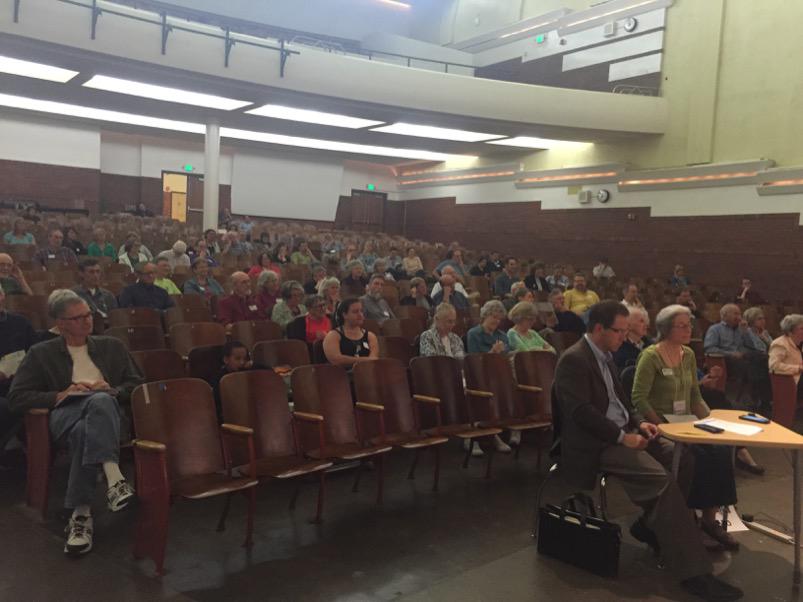
The problem couldn’t have been illustrated any better by the audience itself.
If there’s an upcoming forum in your community that I should know about, comment here or drop me a line at erica c barnett at gmail.