Tag: light rail

Sound Transit Sacrifices Light Rail to Ballard, Moves Long-Deferred Graham Station Forward, in Latest “Realignment” Plan

By Erica C. Barnett

The Sound Transit board voted to approve a new “affordable” light rail plan on Thursday afternoon that indefinitely defers construction of light rail to Ballard, builds rail to West Seattle without a planned station on SW Avalon Way, and adds the long-deferred Graham Street Station back to the list of “fully funded” projects.

The cuts, or “realignment,” are Sound Transit’s response to a projected $34.5 billion budget shortfall over the next two decades. In order to restore Ballard and other projects that voters approved in the 2016 Sound Transit 3 plan, the agency will have to come up with between $9 billion and $11 billion in new revenues or cost savings.

The Ballard extension, which would include stops at Seattle Center and NW Market St. would have had the highest ridership in the entire system, with around 150,000 daily boardings—a point City Councilmember Dan Strauss, who represents the neighborhood, has made repeatedly in his effort to get Ballard back on the map. Under the new plan, the “Ballard extension” will terminate at Seattle Center, miles from Ballard, prompting Strauss to urge the board to “, change the name of the alignment—not the Ballard Link Extension, but the Downtown Tunnel.”

Since voters approved the Sound Transit 3 plan in 2016, Ballard has been upzoned by the city three times and grown in population, making it perhaps the most obvious contender in the region for a light rail stop. ”

The board rejected an amendment from Strauss that would have prioritized building the extension to Ballard over building a second light rail tunnel through downtown Seattle. Instead, they adopted two amendments that essentially direct Sound Transit to look for cost savings and new revenue and ask staff to come back with a date for opening the Ballard line.

Those amendments—from King County Executive Girmay Zahilay and Strauss, respectively—are essentially nonbinding and, unlike Strauss’ amendment to add Ballard to Sound Transit’s “funded projects” list, do not commit Sound Transit to actually build light rail to Ballard.

In rejecting Strauss’ amendment, board members said they were actually saving the rest of the light rail system, including the “spine” between Everett and Tacoma and light rail to Issaquah and Kirkland. Everett Mayor Cassie Franklin, who proposed an unsuccessful amendment to table Strauss’ proposal instead of voting on it, said the Ballard proposal “puts the entire system at risk, and for me that is an absolute deal breaker. We cannot risk the entirety of the system for this exploration, and we have to protect the delivery of light rail to all communities.”

Seattle Mayor Katie Wilson, who appeared to be leaning toward a “no” vote on Strauss’ proposal on Wednesday, cast one of just four votes in its favor on Thursday (the others were Strauss, Renton Councilmember Ed Prince, and King County Councilmember Teresa Mosqueda).

There was positive news for Seattle light rail supporters on the other end of the line, as the board approved a change that moved the long-deferred Graham Street infill station to the “funded” project list. Advocates have been pushing the board to restore the station, which will fill a two-mile gap between the Columbia City and Othello stations, for decades, ever since Sound Transit “deferred” the voter-approved station for cost savings in the early 2000s.

The Graham amendment, sponsored by Wilson and Zahilay, commits the city to spend up to $30 million on the street-level station; combined with $25 million from an existing federal grant, that would leave a gap of about $130 million, ST’s deputy executive director for enterprise planning, said. The county has not formally committed any funds to the station.

At a rally at the Filipino Community Center Wednesday afternoon, Wilson, Zahilay, and City Councilmembers Dionne Foster and Alexis Mercedes Rinck supported a vote in favor of the station, which was originally proposed as part of the voter-approve Sound Move plan that first funded light and commuter rail in 1996. Without the amendment, the Graham Street Station would have remained among the projects Sound Transit plans to advance to 100 percent design.

“Just a few weeks ago, I had the privilege of being here with so many community members, some of whom I’m looking at right now, at a fantastic rally,” Foster said Wednesday. “And at that rally I looked around and I said, ‘Did we organize for 100% design, or did we organize for trains we can ride?’ And today we have our answer: We organized for trains that we can ride!”

PubliCola is supported entirely by readers like you.
CLICK BELOW to become a one-time or monthly contributor.

Support PubliCola


The Graham Street saga may be coming to a close, 30 years after voters approved the station in the 1996 Sound Move measure. (The station still has a $130 million budget gap, so construction is still far from a done deal). But the length of time it took just to get Graham—a street-level infill station that won’t require new track, much less a water crossing—back on the “funded” list is warning sign for anyone who believed that when they voted to fund light rail to Ballard, they were actually funding light rail to Ballard.

As Councilmember Rinck put it during public comment before the vote, light rail to Ballard “is not a ‘nice to have.’ This is essential infrastructure for the largest city in Washington state.”

The cuts the board made yesterday are the fourth, and by far the largest, “realignment” in Sound Transit’s history, and their magnitude appeared to surprise many board members when the agency announced the $34.5 billion shortfall last year.

The repeated realignments have led some advocates to urge changes to the way the agency is governed. Currently, the board that oversees and makes policy decisions for Sound Transit is made up of an ever-changing roster of elected officials from around the region. This setup was designed to ensure accountability—elected officials, unlike staff, can theoretically be booted for decisions voters don’t like—but it also means the board has no technical experts and little institutional knowledge, since most elected positions turn over frequently.

One of the longest-serving Sound Transit board members, King County Councilmember Claudia Balducci, told PubliCola after Wednesday’s meeting that she thinks it’s time to reconsider how Sound Transit is governed. (As Balducci noted during the meeting, “I have gone gray in the service of expanding transit in this region.” More than 15 years ago, I covered her battle against fellow Bellevue City Councilmember Kevin Wallace to build light rail on the Eastside.)

“I really do think it’s time to start talking about governance,” Balducci said. “If we’re in this constant cycle of crisis, recovery, crisis, recovery, crisis, recovery, maybe a board full of people who are expert at transit running a transit agency and delivering transit projects would be more attuned.”

“I’m an experienced amateur, but an amateur,” Balducci continued. “None of us are experts. How did we not see $35 billion creeping up on us? A hole that big opened up before we took this on. …  Maybe it’s time to evolve.”

Balducci cast one of just two votes, along with Strauss, against the final “realignment” package. (She was one of just three votes, along with Walker and Wilson, against an amendment that moved $100 million away from the Issaquah light rail extension to fund a parking garage in Renton). “I hope to vote yes in the fall,” when staff have a more detailed financial plan, Balducci said before her vote. “But to get from here to there, I want to see more progress on transparency, around the dates that we are delivering projects,” and a “path for Ballard better than we have today.”

Editor’s note: This post originally said the Ballard station would have seen nearly 150,000 daily boardings; in fact, that projection is for the entire Ballard extension. We have corrected the error.

Expert Panel “Disappointed” In Sound Transit’s Lack of Progress on Recommendations to Avoid Overruns, Delay

With Sound Transit poised to enter the most intense period of capital spending in its history, an advisory group expressed alarm at the agency’s apparent lack of urgency on key recommendations.

By Erica C. Barnett

A panel of outside experts established last year to help Sound Transit reduce delays to its burgeoning portfolio of megaprojects expressed disappointment last week with the agency’s progress on six recommendations it made in February, noting that many are just now getting underway after many months of delay. With the agency entering the most intense period of capital expansion in its history, members of the Technical Advisory Group (TAG) told Sound Transit’s executive committee on Wednesday, the agency needs to act aggressively to avoid major overruns and delays.

“We’re trying to up your game in order to get the dollar to go a lot further. I want to make sure you understand the value of that,” TAG member Grace Crunican told the board committee. “That’s why we’re nervous about the fact that you’re not up and running. We came to you saying, ‘Hey, let’s go,’ and it’s a year later, and, ‘hey, we haven’t gone.’”

The TAG’s recommendations included restoring lost trust between the Sound Transit board and top agency staff, including CEO Julie Timm; empowering staff to take action, such as signing off on contract changes, without running every decision up the management chain; and hiring an “experienced megaproject capital program executive team” to oversee the expansion of light rail to Tacoma, Lynnwood, Ballard, and West Seattle. The agency’s deputy CEO in charge of system expansion, longtime Sound Transit staffer Brooke Belman, quietly announced she was leaving earlier this year.

“I think we talked about it being a wave, and the wave was coming. The wave is not coming. It is on us right now. And that means the sense of urgency of moving forward with our recommendations is very, very real.”—Sound Transit Technical Advisory Group member Ken Johnsen

Since the recommendations came out, TAG members said, the agency has shown little urgency about putting them into practice. “It’s important to me that the top leadership embrace these changes and work on them diligently, and we’re a long way off from ‘diligently’ at this point,” Sound Transit board member Claudia Balducci told PubliCola.

“There’s been some work—we voted recently to change our contract approval thresholds so that more contracts can be completed and moved by the CEO… but when you get a recommendation that says you need to rebuild trust… that feels to me like something where there needed to be some intentional time invested by the board and the CEO and management to work on that.”

Meanwhile, Sound Transit continues to approach a point in its schedule where it will need to spend between about $5 billion and $8 billion a year to stay on track—a level of annual spending that will dwarf everything Sound Transit has built to date. “We have to change the way we do business,” Balducci said. Every day of delay, Technical Advisory Group (TAG) member Ken Johnsen told the committee, could have cascading effects on Sound Transit’s ability to deliver the projects it has promised, some of which are already running years behind schedule.

Pointing to a chart that shows the amount of money Sound Transit needs to spend on its projects each year in order to avoid major overruns and delays, Johnsen said, “if we sometimes sound overly aggressive on our sense of urgency and why these things need to be moving, it’s because of that chart. I think we talked about it being a wave, and the wave was coming. The wave is not coming. It is on us right now. And that means the sense of urgency of moving forward with our recommendations is very, very real.”

A key issue the TAG noted in its initial report was that “Sound Transit’s current culture appears to discourage decision-making”—staff either don’t feel like they can make decisions on their own, or don’t do so “for fear of making the wrong one and getting reprimanded.” These issues can produce delays that cause contractors to bid on projects where they know they’ll get paid on time and consistently; already, according to the February TAG report, top-tier contractors prefer to seek contracts with other agencies because of long delays getting invoices approved and paid.

“I feel that our recommendations were pretty clear and concise, but that’s not what we saw in these first meetings,” TAG member Connie Crawford, added. “And just the fact that it’s eight months later, nine months later, when we’re having the kickoff meetings [with staff]—that’s been a disappointment to us.”

After the discussion last week, the board went into executive session to discuss a performance review for Sound Transit CEO Julie Timm, who has been at the agency since last September. When they returned to the dais, after extending the session multiple times, the committee no longer had a quorum and had to end the meeting. However, questions about Timm’s future at the agency may be answered on Friday, when her performance evaluation is on the agenda for the board’s public meeting.

New State Housing Laws Could Mean Big Changes for Seattle

Under the new law, the area within a quarter mile of frequent transit, like light rail, can have up to six units per residential lot. Photo by Brett V, via Wikimedia Commons

By Ryan Packer

House Bill 1110, which allows new multifamily housing near transit stops, will impact residential neighborhoods in cities of all sizes across Washington state.

But some of the biggest changes will be in Seattle. The legislation, which passed last week, ties density to public transit infrastructure, allowing significantly more density—up to six units per lot—in areas near frequent transit stops.

The bill requires larger cities, including Seattle, to allow four residential units on every lot, and to allow six units on lots within a quarter-mile walking distance of bus rapid transit, light rail, and streetcar stops.

That means that in significant segments of Queen Anne, Madrona, Wallingford, and Mount Baker, where property owners are currently limited to building two accessory dwelling units—like a basement apartment and a backyard cottage—courtyard apartments, six-unit apartment buildings, and townhouses will now be legal.

Seattle’s lobbyists quietly worked to support bills like HB 1110 throughout the session, while trying to make sure they wouldn’t interfere with the city’s own density laws, such as Mandatory Housing Affordability; MHA requires developers to provide affordable housing or contribute to an affordable housing fee when building in the cities’ designated “urban villages.”

“It’s still Seattle and there’s still a process that we still have to go through, but I do think by having these frameworks in place now, it’s going to be able to help accelerate some of the development that we need, and have needed for a long time.”—Sen. Joe Nguyen (D-34)

“I think it’s going to have a huge impact on Seattle,” Senator Joe Nguyen (D-34), whose district includes Pioneer Square, West Seattle, and Burien, said.

“Obviously, I don’t think it will be perfect, because it’s still Seattle and there’s still a process that we still have to go through, but I do think by having these frameworks in place now, it’s going to be able to help accelerate some of the development that we need, and have needed for a long time,” he said.

The legislature also made some significant changes to how the State Environmental Policy Act (SEPA) affects individual housing projects. Currently, as part of the official SEPA review process, anyone can appeal a proposed housing project over its potential impacts, such as loss of views, increased noise, or traffic. These delays can add months or years to project timelines, even if they’re ultimately dismissed. A group called Save Madison Valley, for example, appealed a proposed mixed housing and retail development featuring a PCC in both 2018 and 2020, delaying the project.

Senate Bill 5412, sponsored by Senator Jesse Salomon (D-32, Shoreline), will limit those appeals. Under the adopted bill, if a proposed housing project complies with a city’s existing comprehensive plan, it will be categorically exempt from SEPA review, eliminating the lengthy appeal process that’s now common for developments that are controversial for reasons that have nothing to do with local environmental law.

The final version of the bill includes a provision that allows projects in Seattle to take advantage of it before other cities in Washington.

“A lot of the costs that are associated with delay and with litigation get passed on in the high cost of housing,” Councilmember Andrew Lewis, who represents downtown, Queen Anne, and Magnolia, said. “Ultimately as consumers we pay for all the lawyers that interject into these processes along the way.”

“We can legalize increased density, but it’s not going to come very quickly if you keep in place a lot of the tactics and methods that people use to slow it down or to whittle the ambition of the projects down,” he said.

“The debate [now] really is about how we can be thinking about new nodes of development, or new corridors where denser development will happen. How are we thinking about integrating things like corner stores, or other basic or essential services, into those neighborhoods?”—Futurewise Executive Director Alex Brennan

Lewis says intense environmental review of dense housing in the middle of cities is counterproductive and notes that dense housing provides an environmental benefit in its own right. “In the aggregate, it has a colossal environmental benefit. If we are unable to build a significant amount of new housing units in the City of Seattle, in an efficient amount of time, we’re just going to have compounding challenges relating to climate.”

A spokesman for the Seattle Department of Construction and Inspections said it was too early to say how the new batch of housing legislation would impact SDCI’s work.

The collective impact of changes to statewide zoning will impact Seattle’s comprehensive plan update, due in 2024, as city planners grapple with how to accommodate at least 112,000 new units of housing—Seattle’s share of King County’s growth target—over the next two decades. The zoning provisions in HB 1110 automatically take effect six months after that update to the comprehensive plan.

Alex Brennan, the director of Futurewise, a statewide smart growth advocacy group, says allowing four housing units per lot increases Seattle’s options for future growth. “We don’t have to fight for that baseline anymore,” he said. “So, the debate really is about how we can be thinking about new nodes of development, or new corridors where denser development will happen. How are we thinking about integrating things like corner stores, or other basic or essential services, into those neighborhoods?”

Growth Is Coming. The Legislature Needs to Plan for It.

David Shankbone, CC BY-SA 3.0, via Wikimedia Commons

By Alex Brennan

When I was growing up here in the 1980s, Seattle was one of the most affordable cities in the country. My parents rented a house for $100 a month, allowing them to save enough for a down payment before I was born. Since then, the city’s unique combination of affordability, natural beauty, and economic dynamism has attracted people from all over the world to our region, further enriching our cultural diversity, civic engagement, and economy.

Unfortunately, housing has not kept up with growth—especially where we need it most. Now Seattle’s housing is some of the most expensive in the world. Many of my childhood friends have been priced out and many beloved newer friends are struggling to stay. These problems extend across the state.

Since the 1950s, popular culture has sold us a vision of prosperity where you get a big house with a big yard and drive everywhere. Suburban property owners, developers, and other powerful interests rigged a land use system that stripped away other options. This growth pattern has damaged critical wildlife habitat and prime farmland, strained infrastructure, isolated households, and priced out whole communities. We were sold a bad bill of goods.

Standing in the way are a handful of small but powerful suburban cities, home to some of the wealthiest people in the world. Many welcoming people live in these places, but the organized voices representing them in Olympia are saying no—no to taking their share of growth, no to affordable housing options, no to people who do not have cars or cannot drive, and no to sharing their parks and schools.

This old model for growth is broken and cannot meet our needs. We need a new model that offers housing for Washingtonians at every income level—especially near jobs, transit, and essential goods and services. That is why this year, a broad, unlikely coalition of business and labor, environmentalists and developers, affordable housing providers and social justice advocates have come together to support new housing options in addition to new ways to design and invest in our communities. Our success moving past the House-of-origin cutoff shows that, after years of advocacy and coalition building, we finally have an opportunity to make this new vision a reality. Right now, legislators have three important bills before them:

HB 1110 would allow duplexes in most single family neighborhoods across the state, and triplexes, fourplexes, and some sixplexes in larger cities. These more diverse housing types, often termed “missing middle” because they fill in the gap between single-family homes and larger apartment buildings, are essential for providing lower cost options in all our neighborhoods.

SB 5466 would set minimum densities near light rail stations and other high-capacity transit. We need to let more people live near the transit that can provide access to major job centers and essential goods and services without getting stuck in traffic. This legislation, which  also provides incentives and funding for affordability and requires that cities develop anti-displacement plans for high displacement neighborhoods that are impacted.

HB 1181 incorporates climate change into the State Growth Management Act, the framework for how our state, cities, and counties plan for growth. Local governments will be directed to implement local policies and investments that will create more compact, walkable, transit-oriented neighborhoods that reduce the need to drive.

These three policies are also part of a broader package of housing policies including the Covenant Homeownership Act, which addresses past racial discrimination in mortgage lending and makes record investments in the state housing trust fund. Together, this broader package will move Washington toward a more sustainable and inclusive future.

Standing in the way are a handful of small but powerful suburban cities, home to some of the wealthiest people in the world. Many welcoming people live in these places, but the organized voices representing them in Olympia are saying no—no to taking their share of growth, no to affordable housing options, no to people who do not have cars or cannot drive, and no to sharing their parks and schools.

But we can make a different choice. We can ensure that working class communities from all races, ethnicities, and backgrounds have a place in our state. Our housing options, just like our communities, should be plentiful and diverse with everything you need—fresh groceries, the doctor’s office, your favorite restaurant, parks and libraries—available within easy reach of your home. Whether you want to live in a big city or a small town, we all deserve an affordable home in a neighborhood built for people and communities.

I feel lucky to live in the city where I grew up. I want other long-time residents to be able to stay and thrive in their communities and I want to welcome new people to come here and enjoy what makes Washington such a great state. We have the tools. Now it is our legislators’ turn to fulfill this promise and pass these important bills this session.

Alex Brennan is the Executive Director of Futurewise. Born and raised in Seattle, he now resides in Capitol Hill and works across the state. Futurewise is leading campaigns to pass HB 1181, HB 1110, and SB 5466.


City Paid Consultant Tim Ceis $280,000 to “Encourage Agreement” and Build “Community Consensus” for Harrell’s Light Rail Route

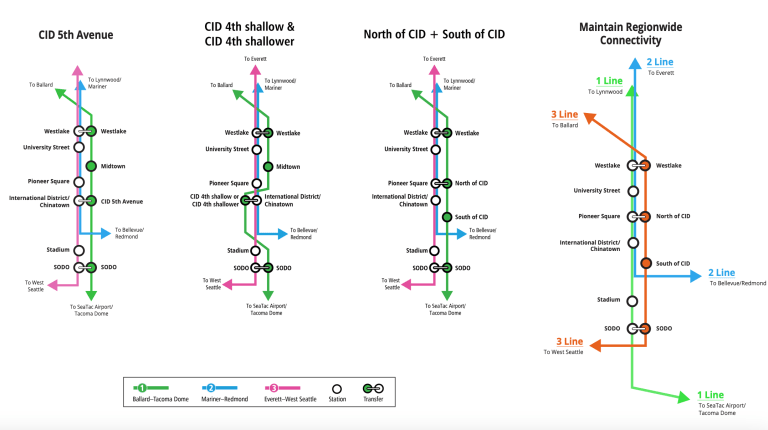
Four potential light rail routes through the CID; the Sound Transit board adopted the third route from left, which Seattle Mayor Bruce Harrell sponsored, as its preferred alternative last week.

By Erica C. Barnett

The city of Seattle spent $280,000 over the past year paying longtime local consultant Tim Ceis—a former deputy mayor widely known as “the Shark” for his combative, “Machiavellian” style—to lobby Sound Transit on a West Seattle-to-Ballard light rail extension, PubliCola has learned. The no-bid, sole-source contract falls just under the maximum amount, $285,000, that city agencies can legally pay consultants before they have to solicit public bids.

According to Ceis’ contract, his work included building “community consensus” on behalf of the city’s preferred light rail alternative—a controversial last-minute option that eliminates long-planned stations serving the Chinatown-International District and First Hill in favor of a second station in Pioneer Square and a new station a few blocks from the existing Stadium Station. Mayoral spokesman Jamie Housen said the contract amounts to around 20 hours of work a week, although it’s unclear how many hours Ceis has actually worked on the mayor’s behalf.

Harrell sponsored the new alternative with the support of King County Executive Dow Constantine, at a meeting where the Sound Transit board adopted Harrell’s proposal as its preferred alternative last week.

According to a redacted copy of Ceis’ amended contract, his work for the city involved “developing and representing the Mayor’s position” on the light-rail route, “developing positive board-level relationships that support Seattle’s goals for [the West Seattle-Ballard Light Rail Extension] and enable effective decision-making at the ST Board” and “encourag[ing] agreement around recommendations and modifications considered by the ST Board.” Formally, the contract is between the Seattle Department of Transportation, which answers to the mayor, and Ceis’ firm, Ceis Bayne East.

Update March 29: At PubliCola’s request, the city’s website has been updated to include Ceis’ original contract, which was not publicly available until today. The contract includes heavy redactions, including a blacked-out page titled “Consultant costs and estimated hours,” as seen above. State public disclosure law requires disclosure of public documents except in specifically, clearly defined cases; I’ve asked which exemption they believe Ceis’ contract terms fall under.

Update April 3: After PubliCola asked for a legal justification for redacting Ceis’ costs and estimated hours, the Seattle Department of Transportation provided unredacted copies of the original contract and the amended version. Both show that Ceis claimed 20 hours of work per week at $250 an hour—a rate that’s significantly lower than what consultants at Ceis’ level (both as a partner in his own firm and with his decades of experience) generally charge. Ceis’ contract does not require a specific accounting of hours.

Harrell and King County Executive Dow Constantine have repeatedly suggested that “the CID community” was united in support of a light rail alternative that bypasses their neighborhood, but the illusion of that consensus was decisively broken when thousands of people signed a petition supporting a station in Chinatown, and dozens showed up to hold signs and testify against a route that skips their neighborhood, last week.

Under the contract, Ceis was responsible for getting “key constituencies” to support the mayor’s preferred route and station locations and helping them craft their “comments and positions” in favor of this route.

Supporters of the “north-south” alternative have argued that “the CID community” was united in support of a light rail alternative that bypasses their neighborhood, but the illusion of that consensus was decisively broken when thousands of people signed a petition supporting a station in Chinatown, and dozens showed up to hold signs and testify against a route that skips their neighborhood, last week.

Ceis and his firm are being paid significantly more per year than Anne Fennessy, a consultant hired by then-mayor Jenny Durkan to serve as the city’s dedicated representative to Sound Transit in 2018. Fennessy’s $180,000-a-year contract raised eyebrows both for its size and the fact that Fennessy was a personal friend of Durkan’s. Fennessy’s work consisted largely of representing the city in meetings with Sound Transit staff and coordinating technical input, according to her contract.

Ceis’ firm, which helped draft the Compassion Seattle initiative, received $25,000 for its work on Compassion Seattle, the failed initiative on homelessness that Harrell adopted as a pillar of his homelessness policy. Ceis maxed out to Harrell’s mayoral campaign in 2021 and worked behind the scenes on an independent expenditure committee supporting Harrell.

Ceis directed our questions about his contract to Harrell’s office. Housen said Ceis “filled a gap” when the city was transitioning between dedicated representatives to Sound Transit, “providing expertise, analysis, and historical context over the last year.”

Sound Transit Board Adopts Major Last-Minute Changes to 2016 Light Rail Plan, Skipping Chinatown and First Hill

By Erica C. Barnett

After five hours of public testimony and a lengthy, often contentious debate, the Sound Transit board voted Thursday to adopt as its “preferred option” for the light rail extension through downtown Seattle a last-minute, back-of-the-napkin alternative that eliminates two long-planned stations serving the Chinatown-International District (CID) and First Hill neighborhoods in favor of new stations at Pioneer Square and just north of the current Stadium Station. The plan represents a stark departure from the Sound Transit 3 package voters approved in 2016, which included both the CID and “Midtown” stations.

The board also voted to keep a Fourth Avenue “shallower” station option on the table for further study.

King County Executive Dow Constantine, who promoted the new “north-south” option in his recent State of the County speech, said keeping Fourth on the table would give people “false hope” about the possibility of a future station in Chinatown, while arguing, along with Harrell, that skipping the CID entirely was what “the community” wanted.

But the meeting, which I covered in real time on Twitter, starkly illustrated what should have been obvious to Sound Transit board members all along: Far from being a monolith united in opposition to a station in Chinatown, the CID community is starkly divided, with a large contingent favoring a station that actually serves the neighborhood, even if it means ten years or more of construction on Fourth Avenue.

Advocates for both alternatives sorted themselves, over the course of the meeting, into two sign-waving groups on either side of the meeting room—black T-shirts and white signs against the CID station on the left, and a larger group of red T-shirts and signs supporting the station on the right. Each group clapped and hollered when someone testified in favor of their position—a clear sign, if the board needed one, that the prevailing narrative about a single “community” opposed to the CID station had always been reductive and condescending.

This wasn’t what County Executive Dow Constantine and Mayor Bruce Harrell had in mind when they introduced the new  “north-south” alternative just two months ago. Both men have argued that skipping over the CID is the best way to avoid harming a vulnerable community. Constantine has also portrayed a second Pioneer Square station as an opportunity to develop a whole “new neighborhood” where the King County Administration Building and downtown jail currently stand, part of what he’s calling his “Civic Campus Initiative.”

“Quite candidly, [the new option] came organically from the community. There are no backroom deals being made. We’ve been trying to be transparent. We’re trying to work openly and thinking out loud as things evolve.” —Seattle Mayor Bruce Harrell

Harrell, who attended the meeting virtually from out of town, has argued that moving the station out of Chinatown is the only option that prevents Sound Transit from repeating the region’s legacy of disinvestment, redlining, and harmful development in the neighborhood, which was divided by I-5 in the 1960s.

“A construction period for 10 to 12 years could cause irreparable harm,” Harrell said. “And this is a treasure; this is a gem.” Suggesting repeatedly that Fourth Avenue supporters were looking at the issue from a  “pure transit plane,” Harrell said equity was more important than what makes sense for transit riders who may just be passing through the neighborhood.

“Quite candidly, [the new option] came organically from the community,” Harrell said. As someone on the pro-CID station side of the room yelled, “Not true!” Harrell continued, “There are no backroom deals being made. We’ve been trying to be transparent. We’re trying to work openly and thinking out loud as things evolve.”

Many community members who testified—including the leaders of the Seattle CID Preservation and Development Authority (SCIPDA) and Uwajimaya—argued that the majority of people in the CID actually support keeping the station in the neighborhood, as long as Sound Transit provides mitigation for construction impacts. “Simply put, this is the best choice for the future of our community,” said Jared Johnson, the co-executive director of SCIPDA. “To have a world-class transit hub at the doorstep of the CID means a future full of opportunity and connectivity for our residents and businesses.”

King County Councilmember Dave Upthegrove, who cast the lone “no” vote on the new north-south option, said, “Construction impacts are temporary. The benefits of transit in a community are permanent.”

Not only will eliminating the CID station kill all future hope of a single Seattle transit hub where people can transfer between Sounder, Amtrak, light rail, and buses, it will cut off access to the neighborhood from Southeast Seattle, another community that has been neglected and poorly served by major infrastructure projects, like Sound Transit’s current at-grade light rail line. Under the preferred alternative, future riders between the south end and the CID will have to transfer between two stations at SoDo or go to Pioneer Square, transfer, and head back in the direction they came from.

Additionally, riders from the CID who want to access the new lines will have to either walk north to a new station near City Hall, at Fifth and James, or travel north several blocks from a station at the current site of a Salvation Army shelter in a forbidding, industrial part of south downtown crisscrossed by multi-lane arterial roads and bordered on the south by the elevated I-90 on-ramps, as the Urbanist has documented.

“It’s powerful to look out over the hearing room and see seniors, people of color, calling on us to support the Fourth Avenue option. Construction impacts are temporary. The benefits of transit in a community are permanent.”—King County Councilmember Dave Upthegrove

As public commenters with limited mobility noted Thursday, walking long distances, especially up steep hills like the one on James St., isn’t an option for everybody; in practice, the new “north” and “south” stations will be inaccessible to them and many other people, particularly elders, living in the area.

Although Constantine said continuing to study the Fourth Avenue option would create “false hope” for those who support it, both he and Harrell joined a strong board majority in voting for an amendment by King County Councilmember Claudia Balducci and Washington State Department of Transportation director Roger Millar to continue studying that alternative.

Balducci was less successful, however, with another amendment (also co-sponsored by Millar) that would re-connect the “spine” of the system—which will be split into segments when expansion lines to Ballard and West Seattle open —preserving the existing connection between South Seattle and the CID and keeping a one-seat ride from Lynnwood to Tacoma.

Constantine, in a back-and-forth with Sound Transit planning director Don Billen, argued that the board rejected a similar plan in 2015 for reasons that still apply today. “We have to stop going back and reconsidering everything we’ve ever decided,” he concluded.

Balducci, exasperated, responded that the only reason she proposed her alternative in the first place was because Constantine just put two brand-new, never-before-considered stations on the table. “The reason I bring this up now is not just because I want to re-litigate things we thought about eight years ago, but because there’s a significant new proposal on the table that changes the way the system works,” Balducci said.

The cost and feasibility of the new stations and the tunnel that would connect them is unknown, as is the cost of mitigation the agency may have to provide for eliminating the Midtown Station, which would have served First Hill. If the north-south option goes forward, it will be the second time Sound Transit has cut First Hill out of its plans; when the agency eliminated the original First Hill station in 2005, it ended up having to pay for a new First Hill streetcar.

Although Seattle City Councilmember Debora Juarez said eliminating a station in First Hill would not raise the same equity concerns as building a light rail station in the CID, the Transportation Choices Coalition has noted that thousands of the 15,500 riders who would commute to that station are hospital workers who commute from outside the city, including Pierce and South King County.

Several Sound Transit board members raised concerns not merely about the details of the new station proposal, but about the implications of moving forward so decisively on station options that have barely been studied, have no engineering behind them, and whose true costs are still unknown. Although current cost estimates put the Fourth Avenue “shallower” option as much as $800 million more expensive than the “baseline” alternative, that baseline—a hub at Fifth Avenue that would have provided the most direct access to existing transit lines—was rejected long ago because of equity concerns, and should probably be retired as a point of comparison. In addition, much of the additional cost would come from replacing a City of Seattle-owned viaduct near Union Station—a disruptive project that will need to be completed eventually, whether the light rail station happens or not.

A small contingent of advocates showed up yesterday to make the case for station options at the other end of the downtown segment in South Lake Union, where the board is considering two alternative sites along Denny Way—a preferred alternative at Westlake Avenue, and a second option at Terry Ave. N. Harrell proposed keeping the Terry option on the table because of construction impacts at Westlake.