Category: Transportation

Turns Out the City Will Remove Anti-Homeless Eco-Blocks After All—But Only For Their Own Projects

By Erica C. Barnett

On Tuesday, Seattle Department of Transportation crews removed some of the dozens of concrete “eco-blocks,” including many originally installed by Fremont Brewing to prevent homeless people from setting up tents or parking their RVs there, that abut a patch of mulched dirt known as the Leary Triangle.

They did not, however, remove any of the dozens of blocks that still surround the brewery, which is owned by Seattle City Councilmember Sara Nelson and her husband Matt Lincecum. The blocks have sprung up all around the city to prevent people who live in their vehicles from parking in industrial areas, which are the only parts of the city where RVs and oversized vehicles can park overnight. Fremont’s eco-blocks occupy two full block faces and prevent anyone, including neighborhood residents and visitors, from parking on either street without being in the roadway.

Placing obstructions in the public right-of-way, including sidewalks, curb space, and parking strips, is unambiguously illegal under the Seattle Municipal Code, which authorizes the city to order property owners to remove obstructions at their own expense. However, the city has chosen not to enforce the law; when PubliCola asked about the proliferation of eco-blocks last year, SDOT director Greg Spotts said the department wouldn’t prioritize removing eco-blocks, a point he reiterated later on Twitter.

SDOT is also a partner in the city’s Unified Care Team, a group of city workers that removes homeless encampments and RVs from public spaces.

A spokeswoman for SDOT said the department removed the blocks “as a part of a larger City of Seattle project to reopen Leary Triangle.” After the city is done with its work on site, she said, the area where the blocks once stood will become a four-hour parking zone, to “make it easier for people visiting Leary Triangle and nearby businesses to park for a short period of time.” Removing the eco-blocks from the surrounding streets would create more parking spaces, but turning the area around the new dog park into a four-hour parking zone will have the effect of permanently banishing people who live in RVs or other vehicles.

PubliCola asked SDOT why they didn’t remove the other eco-blocks that surround Fremont Brewing, since they, too, are preventing “people visiting Leary Triangle and nearby businesses” from parkingfor any period. “The concrete blocks were removed in this location due to construction from a larger project to reopen Leary Triangle,” the spokeswoman said. “The circumstances are unique to this location.”


Full 911 Audio Sheds More Light on SPD’s Explanation for Deadly Crash; Bill Expanding Police Pursuits Passes Legislature

1. Unredacted audio of the 911 call to which Seattle police officer Kevin Dave was allegedly responding when he struck and killed student Jaahnavi Kandula in January further confirms that the caller had used cocaine, not opiates, and was breathing heavily but calm when he called 911 to report that he was “freaking out.” PubliCola obtained the audio through a records request.

Police Chief Adrian Diaz has said Dave was responding “as an EMT” to provide medical aid at a Priority 1 overdose call when he hit Kandula. Dave is certified as an EMT, but there is no evidence beyond Diaz’ statement that he was responding as a medic rather than a police officer, and the 911 call itself contradicts that claim.

SPD has also said police need to be present when Fire Department medics are reviving someone from an opiate overdose in order to provide backup if the person is violent when they come to and to keep people from stealing items or intervening while SFD medics are occupied with rescue breathing and other lifesaving measures. However, the full recording of the 911 call makes it clear that the caller had used cocaine, not opiates, and told the dispatcher his symptoms were “starting to go away” by the end of the six-and-a-half-minute call.

In the first moments of the recording, the caller, a man in his 20s, told the dispatcher, “I did cocaine and I don’t know if I’m having an overdose. I think I’m over-amped.” After being transferred to a dispatcher for Medic One, the Seattle Fire Department’s emergency medical response team, the caller added that he was “trying not to freak out” and was standing outside his apartment building. “Do you think you’ve overdosed?” the dispatcher asked. “I looked it up and I think so,” he said. “I’m extremely anxious,” the caller added, and “shaking a little bit.”

The original dispatcher then kept the man on the line, telling him to breathe and getting more information. “Am I going to get in trouble?” the man asked. “Oh, no,” the dispatcher responded. “I’m still just kind of freaking out right now, but it’s starting to go away,” the caller said. By the end of the call, the dispatcher and caller were joking about the weather. “At least it’s not raining today, right?” the dispatcher said. “That’s one way to look at it, yeah,” the caller responded.

SPD is doing an internal investigation into whether Dave was acting within SPD policy when he hit Kandula in a marked and lighted South Lake Union intersection. Three months after the crash, the department has not said when it will conclude its investigation.

2. The state senate gave final approval Monday to a bill that will lower the standard of evidence required for police officers across the state to initiate vehicle pursuits, sending the bill to Governor Jay Inslee’s desk.

Under SB 5352, sponsored by Senator John Lovick (D-44 Lake Stevens), officers will only need to have a “reasonable suspicion” that a driver has committed a violent crime or is driving under the influence. The bill reverses a 2021 change in state law that raised the standard for most offenses, apart from DUI, to a higher “probable cause” standard, which requires more evidence, with the aim of reducing pursuits overall.

The policy change nearly failed to move forward earlier this session, when state house leaders declined to bring their version of the bill to the floor for a vote ahead of a key deadline, prompting state senate leaders, in a dramatic move, to bring the bill to the floor even though it had never received a hearing in that chamber.

“I am asking you to vote no because the people trusted us, and they are disappointed that we are rolling back something that they thought put us on the first step to accountability.” —Debra Entenman (D-47, Covington)

Inslee is expected to sign the bill. “I think we need to move this needle, I think that’s where the public is,” he said in early March. 

The house approved the bill on April 10, with opposition from both Republicans who wanted it to go further and allow more pursuits for non-violent offenses like auto thefts, and from Democrats who say the current policy, which allows fewer pursuits, is saving lives.

Many Democrats view the reversal as a step back for police accountability in Washington. Before the house floor vote earlier this month, Representative Debra Entenman (D-47, Covington) noted that the bill reversed recommendations made by legislative task force created in 2020 in response to nationwide protests over racial injustice.

“I am asking you to vote no because the people trusted us…and they are disappointed that we are rolling back something that they thought put us on the first step to accountability,” she said. 

Last year, the legislature rolled back another 2021 law that prevented police from using force to prevent people from walking away from investigative stops, also known as Terry stops.

A previous version of the pursuit bill included a 2025 sunset date, but that’s no longer in the bill. Some of Washington’s largest police departments, like Seattle and Tacoma, already have policies in place that require a higher standard of evidence to pursue a suspect.

—Erica C. Barnett, Ryan Packer

Despite Deadly 2022, Traffic Safety Bills Fail to Gain Traction

By Ryan Packer

After 2022—the deadliest year on Washington state roadways since the early 1990—it seemed likely that traffic safety would get significant attention during this year’s legislative session. But following a key early March deadline for bills to pass out of their house of origin, a number of promising bills are off the table.

A bill to reduce Washington’s blood-alcohol threshold for a DUI from 0.08 percent to 0.05 percent was a top priority for safety advocates, winning early support from a broad group of transportation sector organizatios, including the National Transportation Safety Board (NTSB), the Washington Traffic Safety Commission, and the National Safety Council. However, the bill failed to make it through the Senate, in part because legislators opted to debate a bill allowing more police pursuits instead during the final hours before a key deadline.

Another safety bill that failed to advance would have required car dealers to put warning labels on large trucks and SUVs that are designed in a way that puts pedestrians and cyclists at greater risk; the bill would have also increased fines for traffic infractions committed by people driving those vehicles. For decades, federal programs have rated the “crashworthiness” of specific types of cars and trucks, but as Americans have opted for larger and larger SUVs, that rating hasn’t taken the safety of people outside the vehicle into account,

A bill that would have prohibited drivers from turning right at any red light within 1,000 feet of a school, park, or other high-traffic public facility received strong support from walking and biking advocacy organizations but never got a committee vote in either the house or the senate. In 2018, Washington, D.C. piloted right-turn-on-red restrictions at 100 high-volume intersections, finding a 92 percent reduction in drivers failing to yield to pedestrians compared to before the restrictions were added. Based on that data, the district broadly adopted the restrictions citywide in 2022.

There is data showing that Black people are getting stopped at a rate of four times their share of the population, and unhoused individuals make up half of jaywalking stops. [The law against ‘jaywalking’] isn’t being enforced to promote safety.”—Matthew Sutherland, Transportation Choices Coalition

Legislators also weren’t ready to pass a bill that would have prohibited traffic stops for non-moving violations like broken taillights, or a proposal that would have to banned most “jaywalking” stops of pedestrians crossing outside legal intersections. One issue was that there isn’t enough data yet to determine the impact eliminating such laws has on pedestrian safety.

“Certainly [we] want to look at how we reduce disproportionality in our transportation space, but we need to flesh out how this fits into an overall safety strategy,” Marko Liias (D-21, Edmonds), chair of the Senate’s transportation committee, told PubliCola.

Matthew Sutherland, the Advocacy Director at Transportation Choices Coalition, said police use jaywalking stops as a pretext for targeting vulnerable people.  “Folks are being harassed,” he said. “There is data showing that Black people are getting stopped at a rate of four times their share of the population, and unhoused individuals make up half of jaywalking stops. This isn’t being enforced to promote safety.” Sutherland also noted that the jaywalking bill would have shifted more of the burden of pedestrian safety from pedestrians onto drivers, a controversial element of the proposal.

Liias said some bills didn’t advance because they weren’t bolstered with enough relevant supporting data. “I’m really trying to ensure that we’re data-driven.,” he said. “When we talk to vulnerable [road] users, we know right-turn-on-red is a problem. I think we now need to build the evidence and be able to articulate that piece of it, because we’re asking for a culture shift … and I think people are reluctant to do that without the full picture.”

Convincing data didn’t seem to help the proposal to drop Washington’s blood-alcohol content threshold for a DUI to 0.05 percent, however. Utah, the first state to adopt the lower limit in 2019, saw a double-digit drop in statewide traffic fatalities in the year after the new law took effect, without a corresponding rise in alcohol-related traffic stops or arrests. The bill was expected to prevent around 30-40 deaths in Washington state annually, but it received significant pushback from the restaurant and hospitality industries, which were concerned about increased liability for servers and bartenders who overserved patrons. Supporters of the bill, including Gov. Jay Inslee, said they looked forward to its return next year.

Liias pointed to several traffic safety bills that are still advancing where the impacts are more clear-cut. One bill would allow the Washington State Department of Transportation to use automated cameras to ticket drivers speeding on state highways. Another would require drivers under 25 to complete a driver’s education class before receiving their license, eliminating the current loophole allowing drivers 18 and older to get a license after passing a written test. Only around half of drivers under 25 licensed in Washington have received comprehensive driver training and those who have not have a crash rate that’s significantly higher than those who have.

“I knew coming into session that we aren’t going to achieve Target Zero in the next two years,” Sen. Marko Liias said, refering to a goal Washington has had in place since 2000 to eliminate serious traffic-related injuries and fatalities. “I think we’ve put this issue on the map, and now we’re starting to build that comprehensive set of policies that will help us get headed in the right direction toward zero.”

But Liias also noted the significant hurdles to changing behavior, even with the potential benefit of saving lives. “We’re used to doing things across the safety space in one way, and shifting to a new framework and a mindset takes time for folks.”

In the other chamber, Representative Jake Fey (D-27, Tacoma), chair of the house transportation committee, said there has been some progress on traffic safety, citing a bill that will provide hiring incentives to Washington State Trooper recruits: $10,000 over two years for cadets and $15,000 over two years for lateral hires from different police departments. That bill is now in the Senate after passing the House with only one vote in opposition.

Fey told PubliCola he considers efforts to increase the number of police on state roadways complementary with trying to reduce unnecessary stops. “Part of the intent was to make troopers and other law enforcement available for other important work, and not dealing with minor things that have the net effect of targeting certain populations,” Fey said. But with Democrats incredibly divided over police issues, hope for future movement on the issue could be dim.

With nationwide trends, like vehicle design, generally outside of state control also having a big impact on increasing traffic fatality numbers, the best legislators were hoping for was small progress on the issue this session. “I knew coming into session that we aren’t going to achieve Target Zero in the next two years,” Liias said, refering to a goal Washington has had in place since 2000 to eliminate serious traffic-related injuries and fatalities. “I think we’ve put this issue on the map, and now we’re starting to build that comprehensive set of policies that will help us get headed in the right direction toward zero.”


Light Rail Board Members Seek Middle Ground as Plan to Skip Chinatown, Midtown Stations Moves Forward

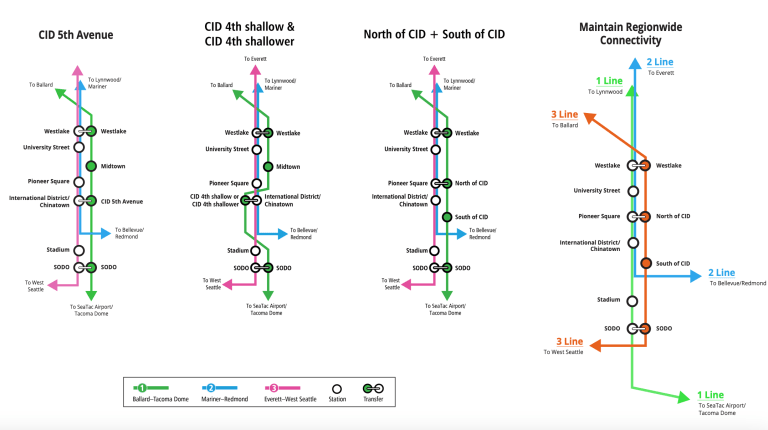
Dow Constantine and Bruce Harrell have proposed a “North-South” light rail plan that would eliminate planned Chinatown-International District and Midtown stations. A compromise proposal, sponsored by Claudia Balducci and Roger Millar, would restore the “spine” of the system and keep some connections to the CID.

By Erica C. Barnett

On Wednesday, in advance of a Sound Transit board meeting that could reshape a long-planned light rail expansion linking downtown Seattle to Ballard and West Seattle, King County Councilmember and Sound Transit board member Claudia Balducci proposed an alternative route that preserves the existing “spine” of the system while eliminating a planned station in the Chinatown International District (CID). Voters approved the expansion, called “ST3,” in 2016.

The last-minute proposal is a direct response to, and amendment of, another last-minute proposal backed by King County Executive Dow Constantine and Mayor Bruce Harrell, who is sponsoring the motion. That “north-south” plan, which has no cost estimates, engineering, or design, would take a new light rail station on Fourth Avenue in Chinatown off the table, eliminate a planned “Midtown” station that would have served First Hill, and add a new “south of CID” station a few blocks north of the existing Stadium station south of downtown.

The big advantage to his plan, according to Constantine, is that in addition to eliminating the disruptive and harmful impacts of construction in Chinatown, it would set the stage for a whole new “neighborhood” centered around the site of the current King County Administration Building.

Compared to the “north-south” proposal, Sound Transit board member Claudia Balducc said, “this option would mean less out of direction travel and better connections for South and East riders [and] retain a one seat ride from South Seattle, South King and Pierce to the CID.”

Balducci’s proposal, co-sponsored by Washington State Department of Transportation director Roger Millar, would re-connect the “spine” of the system—which, under all previous plans, would be split into segments when expansion lines to Ballard and West Seattle open in the 2030s—keeping a one-seat ride from Lynnwood to Tacoma and, importantly, preserving the existing connection between South Seattle and the CID, which Constantine’s plan would eliminate. Essentially, it would create a true Ballard-to-West Seattle line (which no previous plans would do) while preserving connections to Chinatown from the east and south.

Compared to the “north-south” proposal, Balducci said, “this option would mean less out of direction travel and better connections for South and East riders [and] retain a one seat ride from South Seattle, South King and Pierce to the CID.”

Either of the two north-south options would eliminate the “Midtown” station, which would come the closest of any station to the dense First Hill neighborhood—echoing a similar decision in 2005, when the Sound Transit board voted to scrap a long-planned station in the neighborhood, a decision that eventually produced the First Hill streetcar.

“If Midtown Station goes away, then they need to understand that what they’ve done is eliminate the highest ridership station in all of ST3 and that is going to require that they mitigate the hell out of it,” said Transportation Choices Coalition Alex Hudson, who noted that many of the people who work in First Hill hospitals live south of Seattle and could have used the new light rail line to commute to their jobs. “That’s 15,500 people who were counting on excellent [rail] service and have been paying for it and won’t get it—that’s not small change. That’s a real harm.”

Mitigating for the loss of the Midtown station, which could come in the form of expanded bus or other transit service in the area, will add costs to the project—eating into any savings from eliminating the station, Hudson said.

TCC wants the Sound Transit board to keep an existing option, the Fourth Avenue “shallower” option, on the table; as long as they’re considering an unstudied plan, she said, the board should keep a more thoroughly vetted option on the table. Balducci has introduced a second amendment that would keep that option on the table, and said that since the new Constantine-Harrell plan will require a supplemental environmental impact statement, “we should use that time to also study and improve the 4th option as much as possible. Then we’ll have the ability to make the most informed choice,” Balducci said.

“Before we walk away from the option to have a great transit hub on 4th that could both serve the CID and connect our light rail lines most effectively to each other, Sounder, Amtrak and other modes, I’m asking that the agency look harder at ways to address community concerns,” Balducci added.

It’s unclear whether Balducci and Millar’s proposals will gain traction, or if the Constantine-Harrell plan has so much momentum that it will steamroll efforts to keep other options on the table. The board meets tomorrow at 1:30 pm.

Strauss Burke-Gilman Trail Proposal Revamps Rejected “Leary Alternative”

The “Leary Alternative,” with Councilmember Dan Strauss’ proposed change to an older version of the proposal marked inBu blue.

By Erica C. Barnett

When Seattle City Councilmember Dan Strauss announced, earlier this month, that he had come up with a plan to break a 29-year deadlock and complete the long-delayed Burke-Gilman Trail through Ballard, the response from local outlets who have covered the battle over the years ranged from mild praise to rapturous enthusiasm.

Seattle Bike Blog said Strauss’ proposed “Leary Alternative,” which would avoid conflicts with the industrial businesses that have stalled the trail’s completion with legal tactics for decades, marked “the biggest development in the Missing Link saga in years,” but noted that it could “spell doom” for a straightforward trail extension along Shilshole, the “missing link” of the trail. On the ecstatic end of the spectrum, the Stranger raved, “By God, Dan Strauss May Have Done It” in a piece touting Strauss’ plan to “satisfy everyone who’s had soooo much to say for the past two [sic] decades.”

Longtime bike advocates, however, noticed something about the plan: It wasn’t new. In fact, the city already painstakingly studied a very similar proposal, also known as the Leary Alternative, in a 2016 draft environmental impact statement (DEIS). The DEIS evaluated several plans to complete the Missing Link, including the Shilshole route, and concluded that Leary could be less safe for cyclists than the Shilshole option, in part because it included 13 intersections where cars and trucks would have to drive directly across the path.

“A connection on Leary that is built is safer than a connection on Shilshole that is never built.”—City Councilmember Dan Strauss

That’s “the most [intersections] of any of the alternative routes and substantially more than any existing portion of the [Burke-Gilman Trail], potentially making it a less desirable route for bicyclists and other trail users,” according to the DEIS—and potentially delaying trail users an average of 15-25 seconds when vehicles periodically block the trail. The Leary Alternative would also require sacrificing sidewalk space along parts of Market St., and could slow down buses on six different King County Metro routes, the report concluded.

Strauss says his plan, which shortens the distance bikes would spend alongside busy Leary Way by several blocks compared to the original Leary option, could be the breakthrough that resolves an apparently intractable conflict. “A connection on Leary that is built is safer than a connection on Shilshole that is never built,” Strauss said. Since the debate over the missing link began, the city completed work on a three-block stretch of path between 24th Ave. NW and the Ballard Locks; if that stretch had been completed in 2004, Strauss said, he wouldn’t have been riding his bike on the street several blocks north and gotten hit by a car.

Strauss also argues that Ballard has changed dramatically since advocates first started pushing for a trail along Shilshole three decades ago. “Ballard has gotten more dense,” he said. “We used to have industrial businesses on Market, Leary, Ballard [Ave. NW] and Shilshole, and in today’s Ballard, Market, Leary, and Ballard are almost exclusively commercial while Shilshole remains almost completely industrial.” The DEIS remarked on this transformation seven years ago, noting that a trail along Market and Leary “would run through [a] busy commercial district, which would provide a different recreational experience”—with more people going in and out of businesses on foot, for example—than the rest of the Burke-Gilman Trail.

“There’s a lot going on, and a lot of opportunities for conflict. Any [Leary Way NW] design would have to be really aggressive in prioritizing the safe movement of people on bikes, people walking, as well as all the other people using the space for other purposes.”—Cascade Bicycle Club policy director Vicky Clarke

“There’s a lot going on, and a lot of opportunities for conflict” along Market and Leary, said Vicky Clarke, the policy director for Cascade Bicycle Club. “Any design would have to be really aggressive in prioritizing the safe movement of people on bikes, people walking, as well as all the other people using the space for other purposes,” like crossing from parking spaces to stores ad waiting for the bus.

The proposed route also includes a large number of utility poles that the trail will have to “wiggle around,” Clarke said. “When you’re designing around a bus stop or utility poles or businesses, it has the potential to erode the user experience, safety, and comfort, so there’s a lot of challenges to designing this route.”

Strauss has asked Mayor Bruce Harrell and Seattle Department of Transportation director Greg Spotts to study his alternative using money set aside to complete the trail. But even if the city decides to end the “missing link” impasse by building a revamped Leary alternative, Clarke notes that “there’s still going to be people biking on Shilshole because it’s the most simple and direct route to connect with the existing Burke-Gilman, so there still need to safety improvements along Shilshole.” Strauss says he agrees, and would start by fixing the variable pavement—which at different points consists of concrete, asphalt, and gravel—and provide better signage for driveways and parking spaces instead of the plastic drums and poorly marked gravel lots that serve those purposes now.

Clarke said the changes to Shilshole will need to go beyond flatter pavement and better signage. For example? Well, she said, “there’s a really good design for a trail.”

“Security Levels Are Going to Increase” on Sound Transit Trains, as Agency Struggles to Win Back Riders

By Erica C. Barnett

Hours after Sound Transit’s Technical Advisory Group read the light rail agency the riot act for, among other things, fostering a culture that “appears to discourage decision-making” (read Mike Lindblom’s comprehensive story on the TAG’s critique and recommendations), Sound Transit’s Rider Experience and Operations Committee got an update last week on the agency’s renewed efforts to crack down on people who violate transit rules, including riders who fail to pay their fares.

As longtime PubliCola readers know, Sound Transit has long struggled to balance its fare enforcement policy (which was recently amended to give riders additional warnings and more opportunities to resolve fare violations before receiving a $124 ticket) with its farebox recovery policy, which stipulates that fare revenues should pay for 40 percent of the cost to operate Link Light Rail. (Sound Transit’s other services, such as Sounder express rail and Sound Transit Express buses, have lower farebox recovery targets). The agency has only achieved that 40 percent goal—which is significantly higher than King County Metro’s 25 percent farebox recovery target—in one year, 2017; between 2019 and 2020, the rate plunged from 26 percent to 8 percent, and hit 16 percent—a post-lockdown high—last year.

Security officers “have already started conducting targeted enforcement activities of removing people from trains and stations throughout the system,” Sound Transit CEO Julie Timm said, adding that the agency has also begun moving ORCA fare card readers away from station platforms, “especially in our tunnels.”

According to a presentation by Sound Transit staff, the agency’s “fare ambassadors”—neon-vested Sound Transit staff who replaced uniformed fare enforcement officers in 2020—found that 15 percent of the riders they interacted with had not paid their fare. This number is far less than casual estimates by former agency CEO Peter Rogoff, who once lamented that he witnessed “almost no one” paying their fares after a Mariners game, but still twice as high as pre-pandemic nonpayment levels. Sound Transit’s Deputy Director of Passenger Success Sean Dennerlein said at Thursday’s meeting that the agency is still struggling to hire fare ambassadors—currently, there are 17, up from a low of four but still a third less than the number funded—and “we do lose them fairly quickly,” Dennerlein said.

New Sound Transit CEO Julie Timm said the agency has initiated a new crackdown on violations of the state law governing transit conduct, which prohibits a wide range of behaviors on transit and at transit stops, from smoking to playing music and “loud behavior.” In January, the board approved four new contracts for private security services totaling up to $250 million over six years; these new contracts, Timm said, would help address “the ongoing challenge of too few available officers on our system.”

Starting this month, Timm continued, “security levels are going to increase.” Security officers “have already started conducting targeted enforcement activities of removing people from trains and stations throughout the system,” Timm said, adding that Sound Transit has also begun moving ORCA fare card readers away from station platforms, “especially in our tunnels,” so that fare ambassadors can check fares before people board trains and so security can “discourage or report unlawful conduct to discourage incidents on trains.”

The new emphasis on security guards represents an apparent reversal of efforts both pre- and mid-pandemic to address concerns about racially biased fare and rule enforcement by reducing the presence of security guards on trains.

Sound Transit’s current fare policy “triggers consideration of a fare increase” if farebox recovery falls below the minimum levels adopted by the board. Currently, Sound Transit’s zone-based adult fares are all over the map, ranging from $2.00 for the isolated Tacoma light rail “T” line to as much as $5.75 for Sounder commuter rail. If nothing changes, according to Thursday’s staff presentation, fares would range from $2.25 up to $4.25 once all the projects from the 2008 Sound Transit 2 ballot measure, which will extend light rail to Redmond and Federal Way, are open.

One option is a flat fare that would apply across the system; this option would eliminate the requirement to “tap off” after getting off a train and would make it feasible, according to Sound Transit staff, to cap fares after a rider has spent a certain amount—something many transit systems across the country, from Portland to New York City, already allow.